1 free read left. Create a free account for unlimited reading + AI research.
Create free accountWhitepaperInternational Journal of Role-Playing
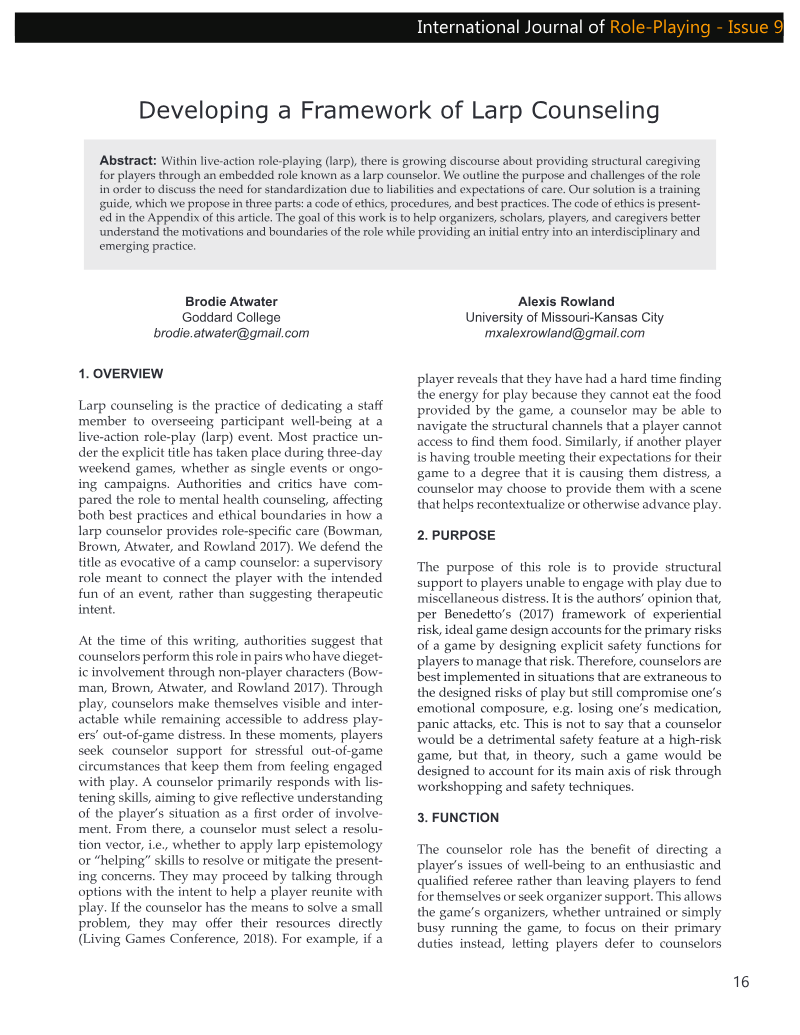
Staff are assigned to oversee participant well-being at live-action role-playing events, but the role has no shared terms, liabilities, or ethical standards.
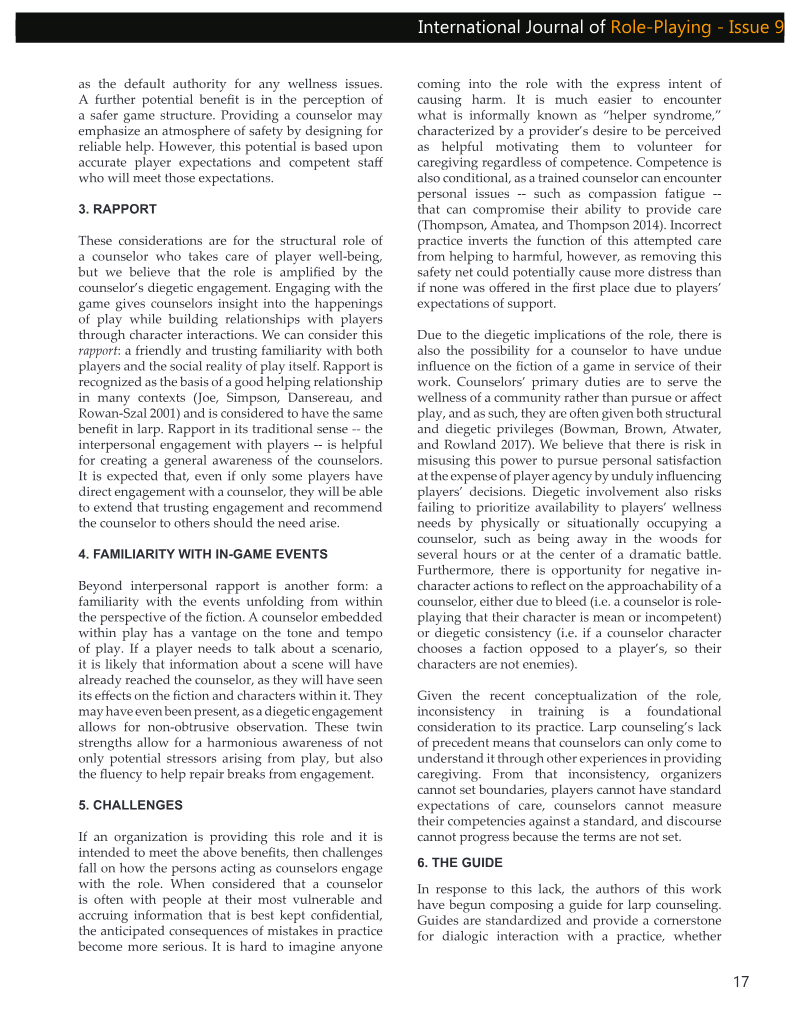
This paper proposes a standardized framework for larp counseling, the practice of assigning a staff member to oversee participant well-being at live-action role-playing events. Its central argument is that the role has grown in use without shared terms, liabilities, or ethical standards, and that a training guide is needed to give organizers, scholars, players, and caregivers a common reference. The authors position the counselor as a supervisory figure akin to a camp counselor rather than a therapist, responsible for connecting players with the intended fun of an event and addressing out-of-game distress that compromises emotional composure, such as a lost medication or a panic attack.
The paper identifies both benefits and risks of the role. Counselors embedded in play gain rapport with players and familiarity with in-game events, which lets them respond to stressors with insight and sometimes resolve problems through diegetic action. The risks include counselor burnout and compassion fatigue, "helper syndrome," misuse of diegetic power to shape a game's fiction, and incompetent care that could leave players worse off than having no support at all. The authors argue that the absence of established terminology and training standards makes these risks harder to manage and prevents the field from measuring competence or progressing in its discourse.
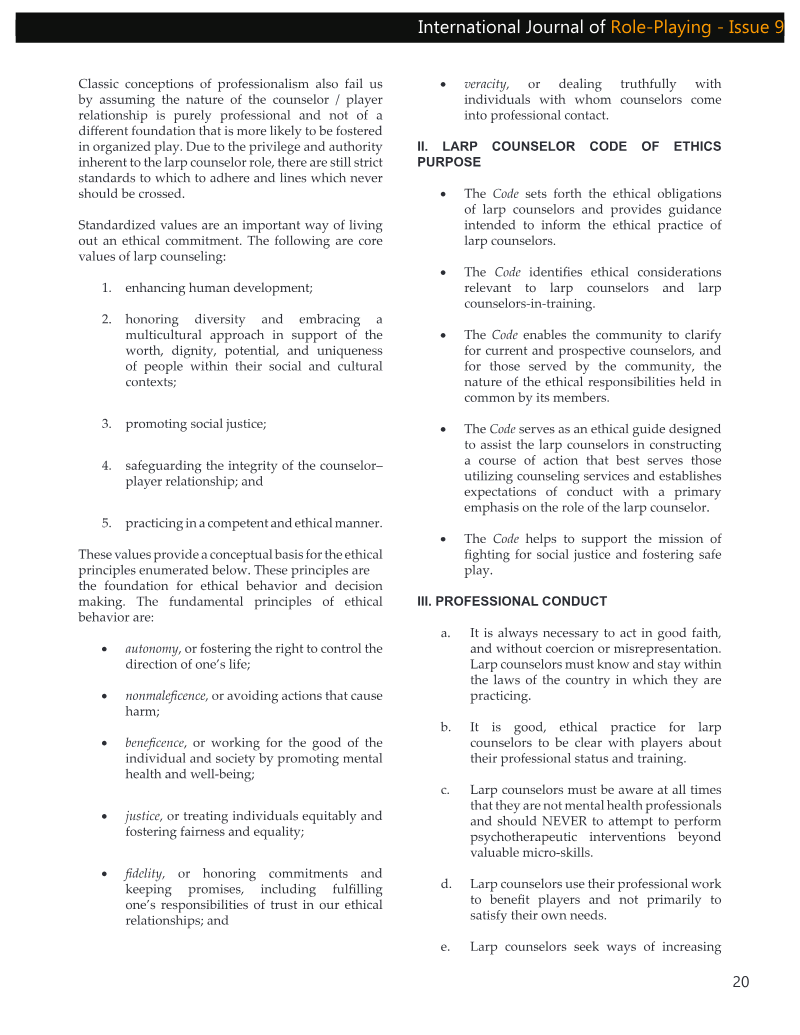
The proposed guide has three parts: a code of ethics adapted substantially from the American Counseling Association's code, recommended procedures built around the SAFER-R crisis model, and a commitment to ongoing revision. The ethics code addresses confidentiality, dual relationships, consent, professional boundaries, and the Prime Directive principle that counselors should not intentionally interfere with players' plot development. The authors acknowledge that most procedures are experiential best practices rather than evidence-based findings, and they call for future research on effectiveness and for continued community dialogue to refine the role.
European Conference on Games Based Learning (ECGBL) · 2026

























Comments