1 free read left. Create a free account for unlimited reading + AI research.
Create free accountArticle International Journal of Games and Social Impact
1 free read left. Create a free account for unlimited reading + AI research.
Create free accountArticleInternational Journal of Games and Social Impact
The paper applies Heron et al.'s (2018) Meeple Centred Design heuristics to Team3, available in green and pink versions.
Team3 is a cooperative board game available in green and pink versions, and this study evaluates its accessibility using Heron et al.'s (2018) "Meeple Centred Design" heuristics. The paper's central aim is to assess how well a collaborative tabletop game serves players across a range of disabilities and access needs, with the goal of informing both design practice and recommendations for play. The assessment covers visual, cognitive, emotional, physical, communicative, socioeconomic, and intersectional dimensions of accessibility.
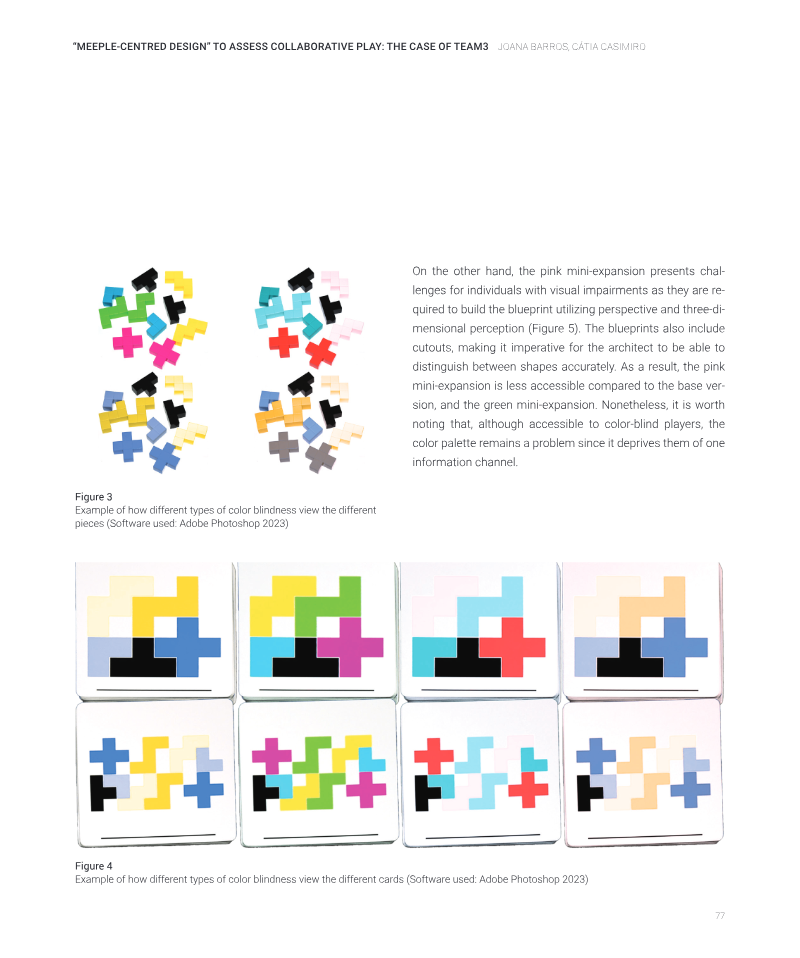
The analysis finds the game broadly accessible in most categories. Its shapes and distinct color-shape pairings support players with color blindness, although its mean contrast ratio of roughly 4.17:1 falls below the recommended 4.5:1, and the pink mini-expansion poses greater challenges due to its perspective and three-dimensional demands. Cognitive accessibility is judged favorable thanks to low reading demands, moderate game-state complexity, and a structured turn system, while emotional accessibility carries caveats around challenge, despair, and score disparity. Physical accessibility is supported by standardized cards and large, easy-to-grasp pieces, though the builder role requires the most manipulation. Communicative accessibility is rated highly for its explicit rules, though the text-based instructions have limited readability and adaptation is needed for groups with multiple deaf or hard-of-hearing players.
The study's scope is limited to a single cooperative title observed in a small number of plays within one group, and its authors are non-disabled researchers whose findings were not validated by people with disabilities. The authors therefore recommend Team3 cautiously and conservatively, with a disclaimer for neurodiverse players and those with similar sensory disabilities, inclusion of disabled people in pilot testing, and further validation across a wider range of games.
International Journal of Games and Social Impact · 2026
International Journal of Games and Social Impact · 2026
International Journal of Games and Social Impact · 2026
International Journal of Games and Social Impact · 2026
International Journal of Games and Social Impact · 2026
International Journal of Games and Social Impact · 2026
International Journal of Games and Social Impact · 2026
International Journal of Games and Social Impact · 2026
International Journal of Games and Social Impact · 2025
International Journal of Games and Social Impact · 2025
International Journal of Games and Social Impact · 2025
International Journal of Games and Social Impact · 2025
European Conference on Games Based Learning (ECGBL) · 2026