1 free read left. Create a free account for unlimited reading + AI research.
Create free accountWhitepaper International Journal of Games and Social Impact
1 free read left. Create a free account for unlimited reading + AI research.
Create free accountWhitepaperInternational Journal of Games and Social Impact
The article argues that players operate under an implicit contract that invites them to accept game rules and engage emotionally with narratives, characters, and virtual worlds.
This article argues that players function as co-creators of their own emotional experiences in video games, operating under an implicit "contract" that invites them to accept game rules and engage emotionally with narratives, characters, and virtual worlds. Drawing on foundational theories such as Salen and Zimmerman's magic circle, Juul's notion of games as "half-real," and Murray's concept of the active creation of belief, the work contends that interactivity deepens emotional connection in ways passive media cannot. It builds a conceptual framework around agency, immersion, suspension of disbelief, rational distance, involvement, and incorporation, the last of which describes how game experiences persist into players' cognitive and emotional lives beyond the moment of play.
The article's central findings rest on the claim that player agency and layered immersion models help designers create emotionally resonant experiences, and that Calleja's concept of incorporation represents an evolution of traditional immersion theory. Empirical support is drawn from research showing that players form attachments to virtual characters resembling real-life relationships. Bopp et al. (2019) identified seven distinct forms of player-character attachment, while Coulson et al. (2012) found that virtual characters can be genuinely liked or loved, with Oliver and Raney (2011) indicating that these bonds are shaped by character traits and perceived authenticity.
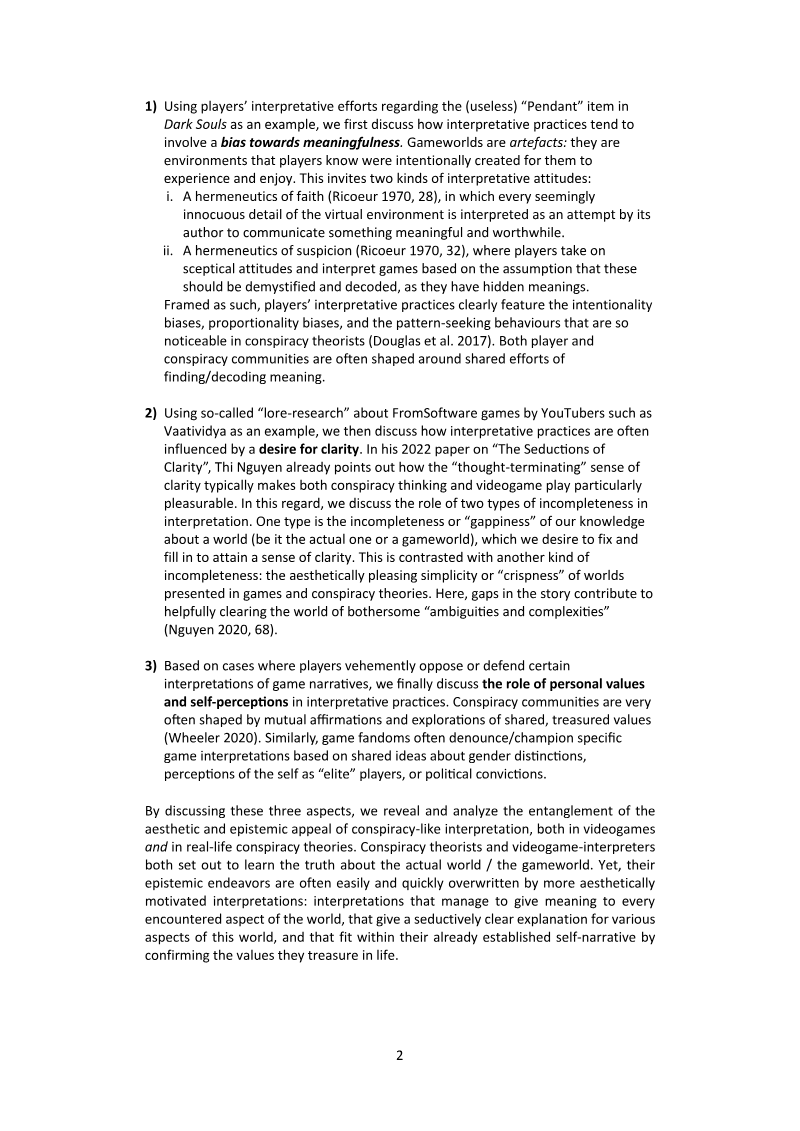
The analysis is illustrated through a consistent set of titles, including Mass Effect, The Last of Us, God of War, Life Is Strange, Tales from the Borderlands, The Witcher 3, Gone Home, and Doki Doki Literature Club!. These examples are used to show how choice, personal experience, and the dual in-game and real-world presence of players deepen emotional investment. The scope is theoretical and critical rather than based on a new large-scale dataset, situating its arguments within game studies and media psychology literature.
The article concludes that emotional connections forged in games extend beyond the screen, prompting lasting reflection on ethics, relationships, and personal values. On this account, games stand as a particularly powerful medium for meaningful emotional experience, and player agency and co-creation are central considerations for designers seeking to build emotionally resonant work.
 The WitcherGame · CD Projekt RED · 2007 · 247 documents
 The Witcher 3Game · CD Projekt RED · 2015 · 192 documents
 BorderlandsGame · Gearbox Software · 2009 · 123 documents
 Mass EffectGame · BioWare · 2007 · 67 documents
 Gone HomeGame · Fullbright · 2013 · 22 documents
Each row is a game or company this document names, each column a document, oldest first. A mark means that document names it. Select a row to see those documents.
International Journal of Games and Social Impact · 2026
International Journal of Games and Social Impact · 2026

International Journal of Games and Social Impact · 2026
DiGRA · 2026