1 free read left. Create a free account for unlimited reading + AI research.
Create free accountArticle G|A|M|E – The Italian Journal of Game Studies
1 free read left. Create a free account for unlimited reading + AI research.
Create free accountArticleG|A|M|E – The Italian Journal of Game Studies
The industry's secrecy, shaped by intellectual property protections and profit concerns, has left its realities poorly understood.
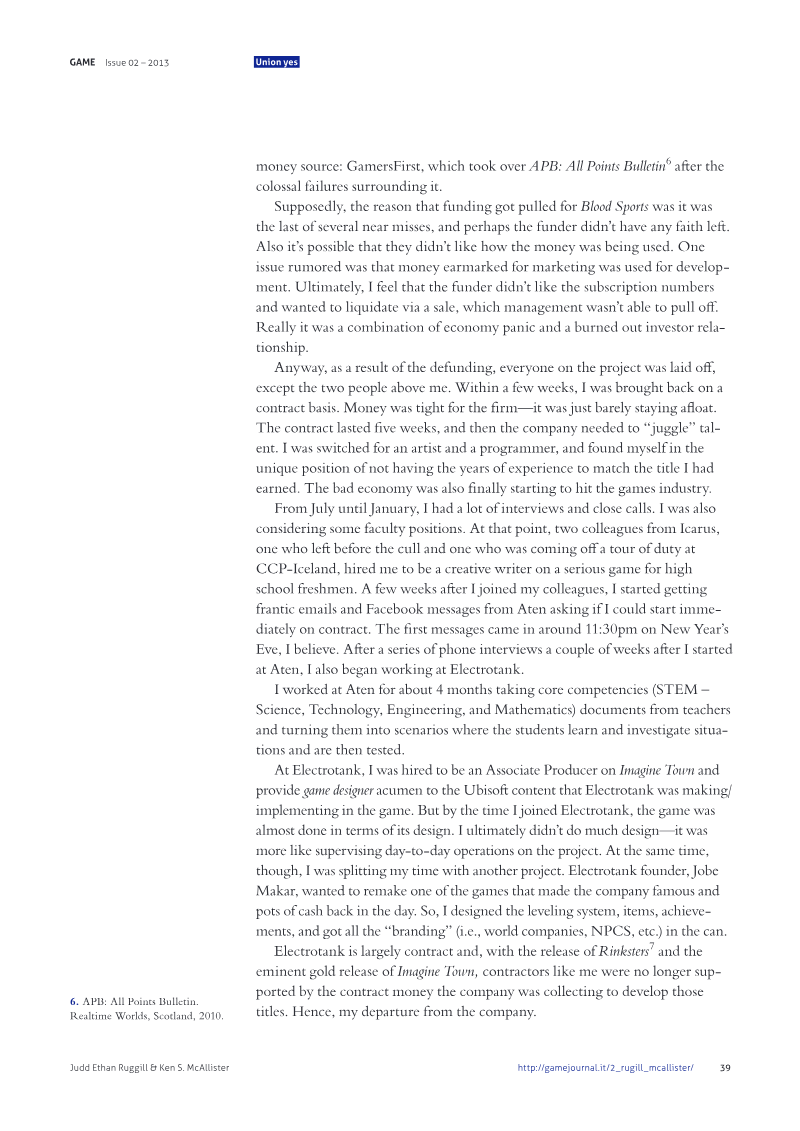
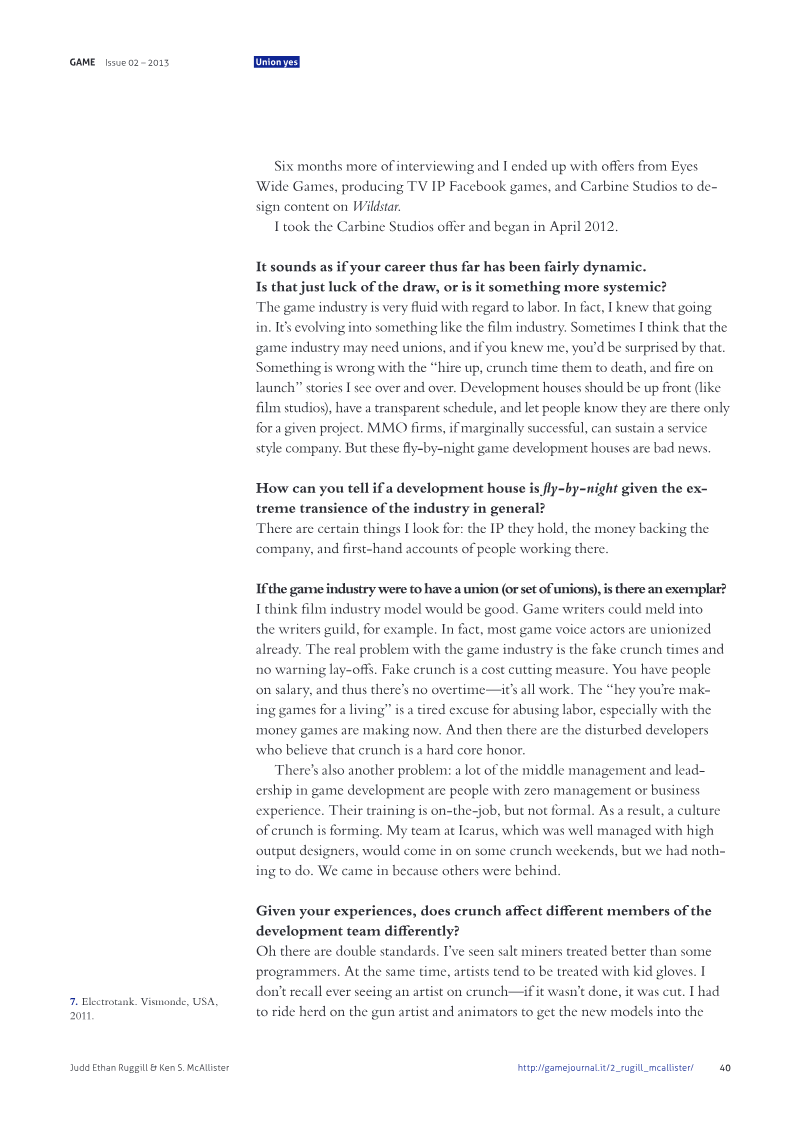
This interview with game developer and project manager Joshua Peery, conducted by Judd Ethan Ruggill and Ken S. McAllister in 2011 and 2012, forms part of a broader multi-institutional project examining the political and interpersonal economies of computer game labor. The authors argue that the game industry's secretive nature, shaped by intellectual property protections and profit concerns, has left the realities of game development poorly understood, and that the interview offers an insider perspective on these conditions at a time of widespread assaults on organized labor in Europe and the United States.
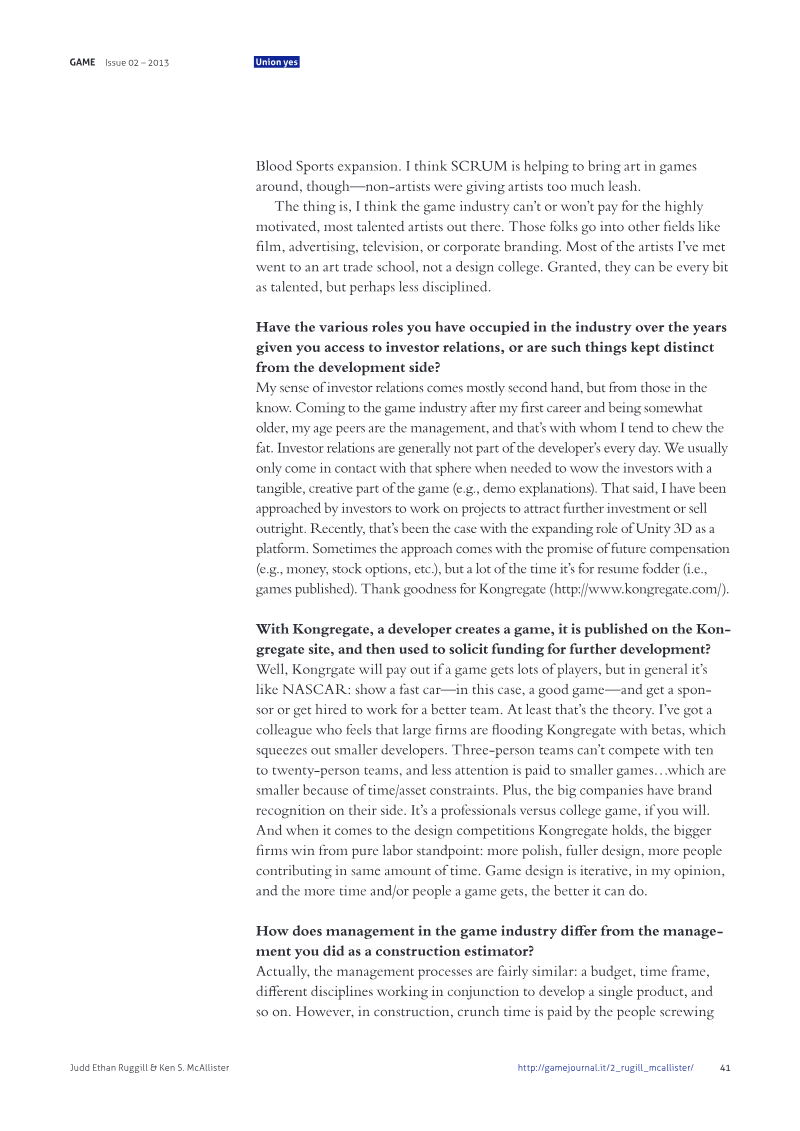
Peery recounts a highly unstable career moving through several studios, including Icarus Studios, Electrotank, and Carbine Studios, marked by layoffs, contract work, and sudden funding collapses. He characterizes the industry as fluid and increasingly resembling the film industry in its labor patterns, and he argues that practices such as unannounced "crunch" periods, salaried employees denied overtime, and the absence of advance warning before layoffs make unionization sensible for games, with the film and writers' guild models offered as possible templates. He also identifies weak management training, a culture where leaders lack formal business experience, and uneven treatment of programmers and artists under crunch as structural problems.
The interview further touches on the difficulty of assessing studio stability, the influence of investors, the competitive disadvantages small teams face on platforms such as Kongregate, and his own preference for transparent hiring practices like 90-day probationary clauses. Because it draws on one individual's experience rather than a systematic survey, its claims are illustrative rather than statistically representative, though they reflect concerns the authors position as central to understanding how play is converted into work.
G|A|M|E – The Italian Journal of Game Studies · 2026

Breda University of Applied Sciences · 2026