
European Conference on Games Based Learning (ECGBL)
Annual European conference on game-based learning and serious games; its proceedings are published open access (CC BY) by Academic Conferences International.
Documents



Translating Design Requirements into a Hybrid Prototype for Early Programming Education: The Iterative Development of IMPACT+
This paper traces the design process behind IMPACT+, a hybrid programming prototype called Orbit Cleaner, aimed at children aged eight to ten.
- The paper documents the design process for IMPACT+, a hybrid programming prototype (Orbit Cleaner) for children aged eight to ten, presenting a transparent account of design reasoning rather than claims of proven effectiveness.
- Requirements were derived from a classroom evaluation of the analogue IMPACT board game involving 161 pupils, 21 focus-group participants, and eight teachers, covering rule clarity, left-right spatial orientation, scalable classroom setup, motivating narrative, and low-preparation level progression.
- Design decisions included a space-debris narrative kept subordinate to learning goals, guided onboarding, colour- and visual-based orientation cues, rewards, ten progressive levels, and a hybrid mode where children plan programs with physical command cards and execute them digitally.
Simplifying Gamification in Practice: A Design Model for Training Transfer-Oriented Industrial Learning
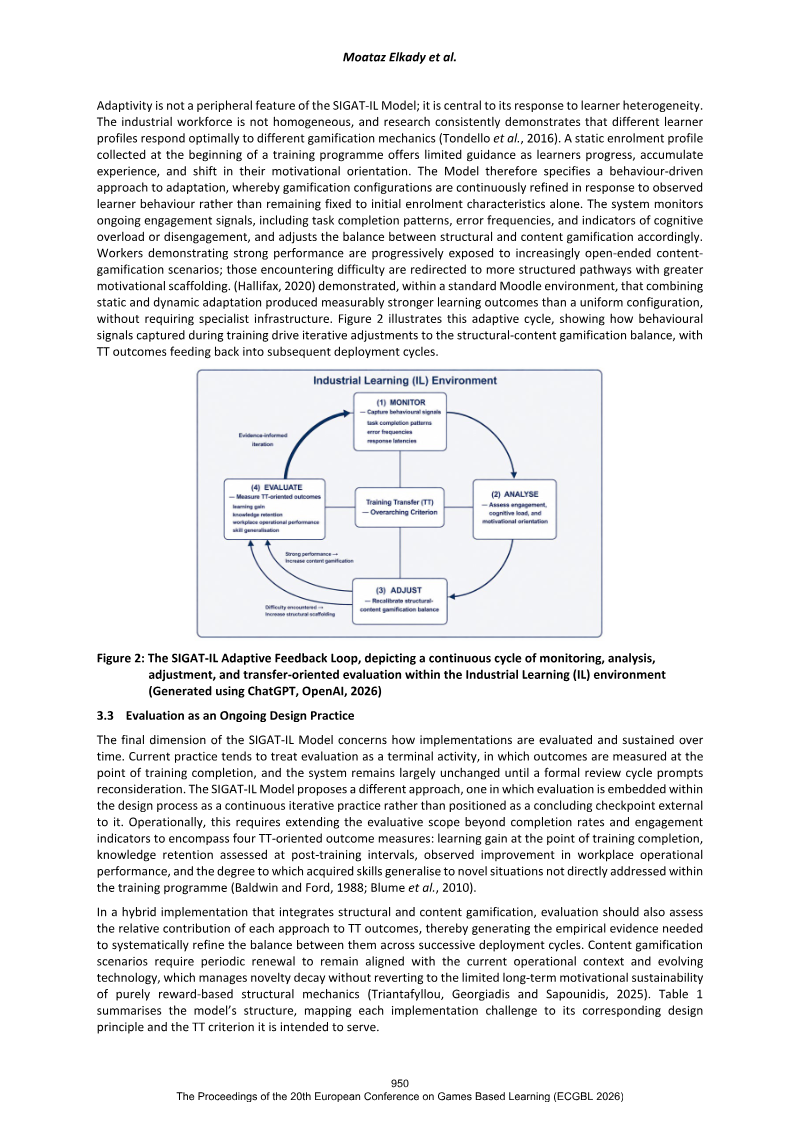
The paper presents the SIGAT-IL Model, a conceptual design framework for gamification in industrial learning management system (LMS) training.
- The SIGAT-IL Model is a conceptual design framework for gamifying industrial LMS training, arguing that gamification has too often been driven by platform availability rather than instructional design, yielding engagement rather than training transfer.
- The model identifies four implementation challenges (technological constraints, pedagogical-technical misalignment, learner heterogeneity, and scalability) and proposes a hybrid architecture where content gamification forms the instructional core and structural mechanics act as scaffolding.
- Training transfer (learning gain, retention, workplace performance, and generalisation) is proposed as the primary success criterion, with completion and engagement metrics serving a secondary role.
From Prototype to Pitch: Learning Entrepreneurial Communication Through Gameplay
This study examines an "airplane storytelling game" used in an entrepreneurship elective to teach communication skills to software students.
- Students who were technically oriented spent most of their time refining paper-airplane prototypes and typically improvised their pitches late, despite prototype and pitch being weighted equally in grading.
- More persuasive pitches frequently outscored technically superior designs, leading students to recognize that technical value must be communicated effectively to influence stakeholders.
- The authors term this pattern "experiential misalignment": the activity makes the cost of underinvesting in communication visible in a way that lectures rarely do.
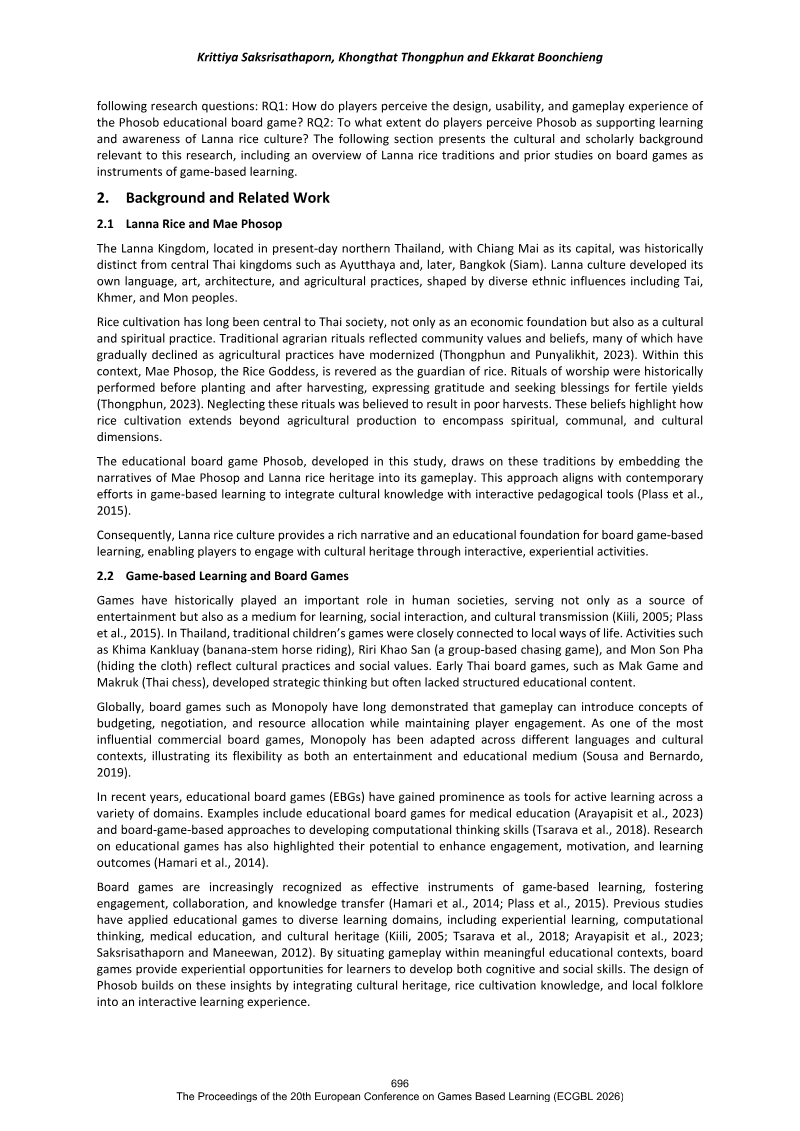
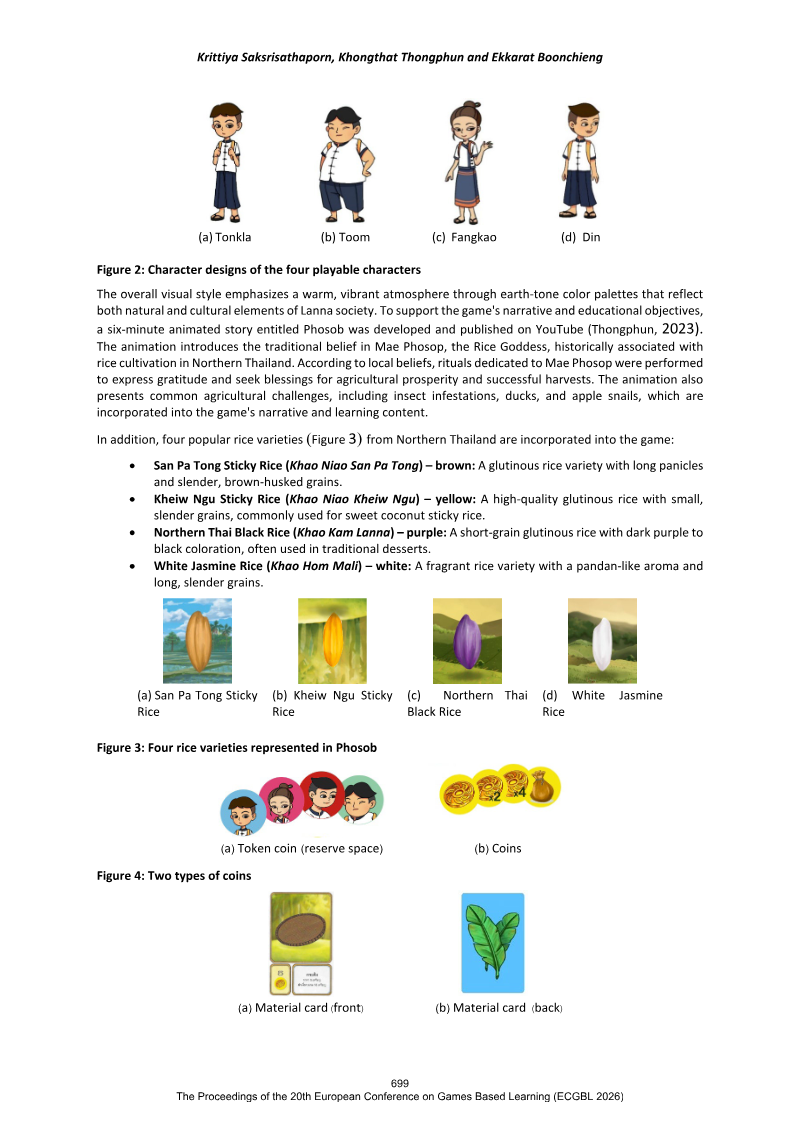
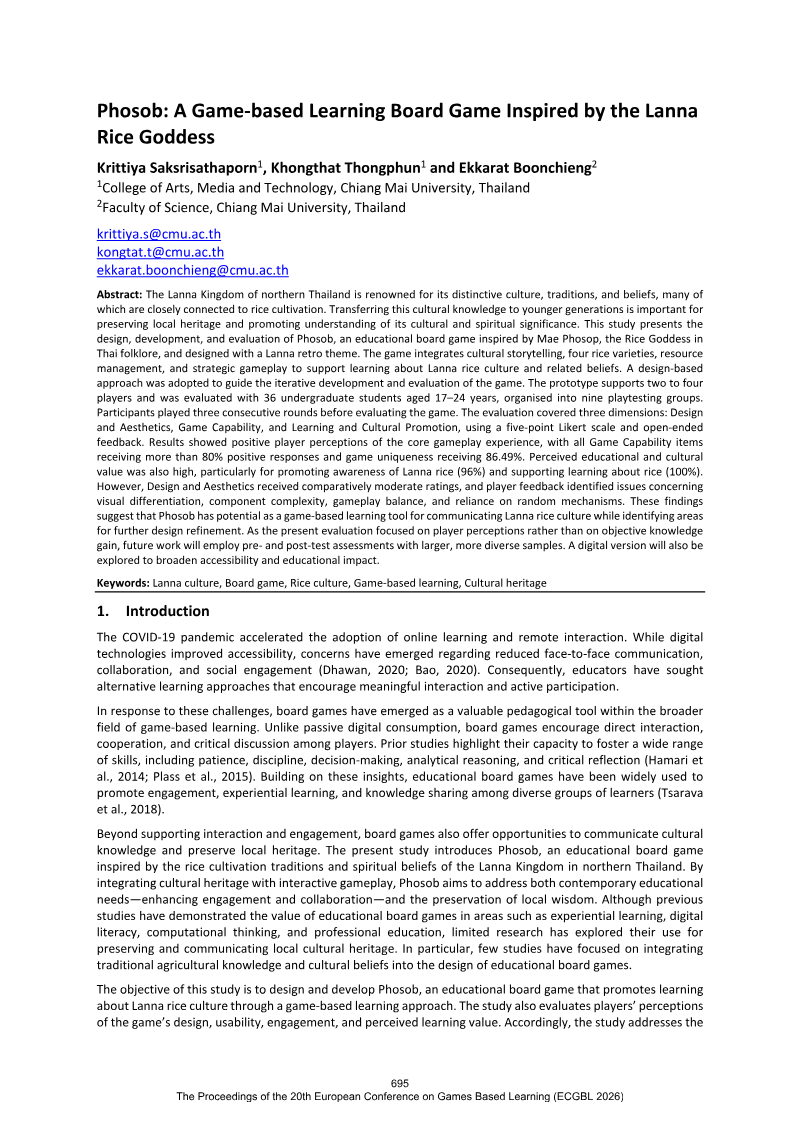
Phosob: A Game-Based Learning Board Game Inspired by the Lanna Rice Goddess
The study presents Phosob, an educational board game designed to teach players about Lanna rice culture and the Thai folklore of Mae Phosop, the Rice Goddess.
- Phosob is a Monopoly-inspired board game teaching Lanna rice culture and the Thai folklore of Mae Phosop, the Rice Goddess, with competitive mechanics converted into cooperative resource sharing.
- Thirty-six undergraduate students (ages 17–24) in nine groups tested a two-to-four-player prototype over three rounds, then rated it on a 20-item five-point Likert questionnaire plus open-ended feedback.
- Players rated the core gameplay favorably, with all Game Capability items above 80% positive and game uniqueness highest at 86.49%.
Tempus Alatum: Playing Through the Branches of the Timeline
This paper presents Tempus Alatum, a card-driven educational game designed to teach chronology in introductory university history courses by combining timeline mechanics with technology-tree structure.
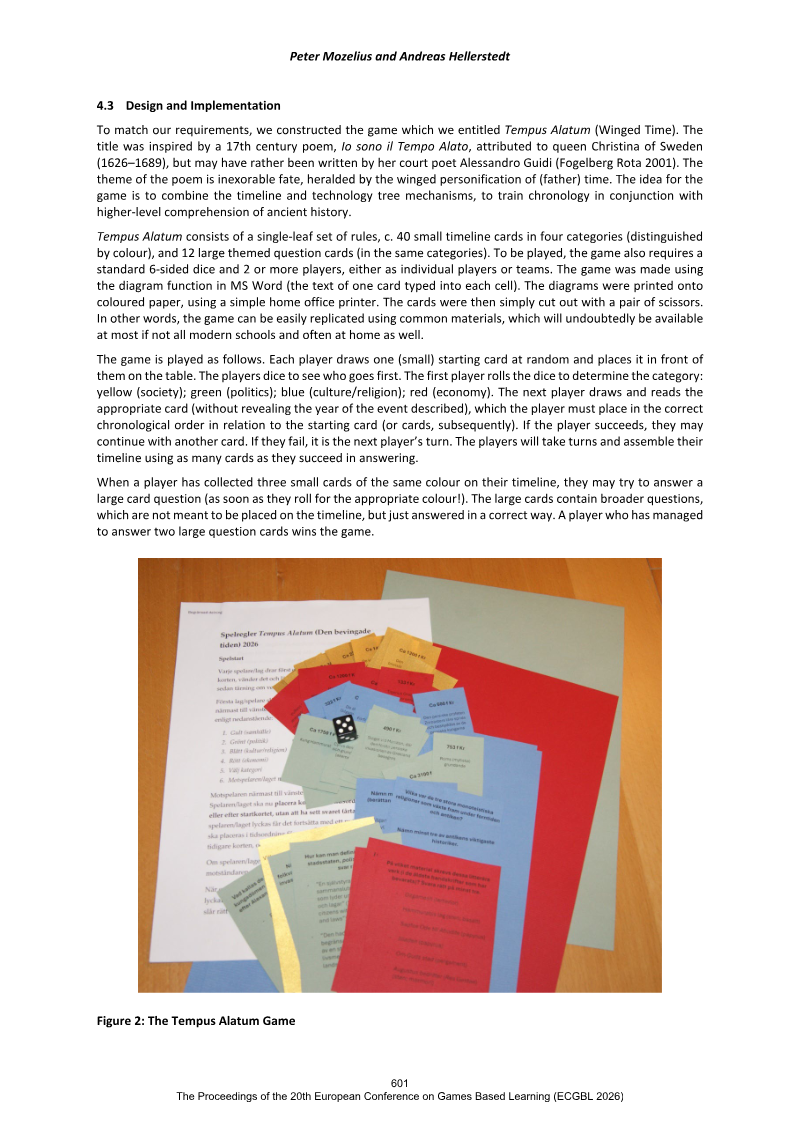
- Tempus Alatum is a card-driven educational game that teaches chronology in introductory university history courses by combining timeline mechanics with technology-tree structure, motivated by students' weak grasp of chronology needed for causal explanation.
- The game uses roughly 40 small timeline cards in four colour-coded categories (society, politics, culture and religion, economy), twelve large question cards for higher-order analysis, a six-sided die, and a rules sheet, with players advancing to larger questions after collecting enough cards of one category.
- The design is deliberately low-cost, producible with a home printer and scissors, and intended as an adaptable do-it-yourself template transferable across analogue and digital media.

Evaluating a Game-Based Workshop for Youth Urban Design Using Open-Source Tools
This evaluation examines a single-group, open-source game-based workshop in which Japanese sixth-graders, and in a related account 36 students, redesigned a Yokohama park using PLATEAU 3D city data, Blender, and Godot.
- A single-cohort, open-source game-based workshop in Yokohama, using PLATEAU 3D city data with Blender and Godot, produced significant pre/post increases in willingness to participate in civic life (d = 0.66) and interest in urban design careers (d = 0.89), both surviving Bonferroni correction.
- The study had no control group, a short timeframe, and participants clustered within 12 groups, so its results describe associations and immediate effects rather than causation or durable, generalizable outcomes.
- Conversation analysis showed a marked shift from operational talk toward design-oriented discussion, with the design-to-operation ratio rising from 0.82 to 1.96.
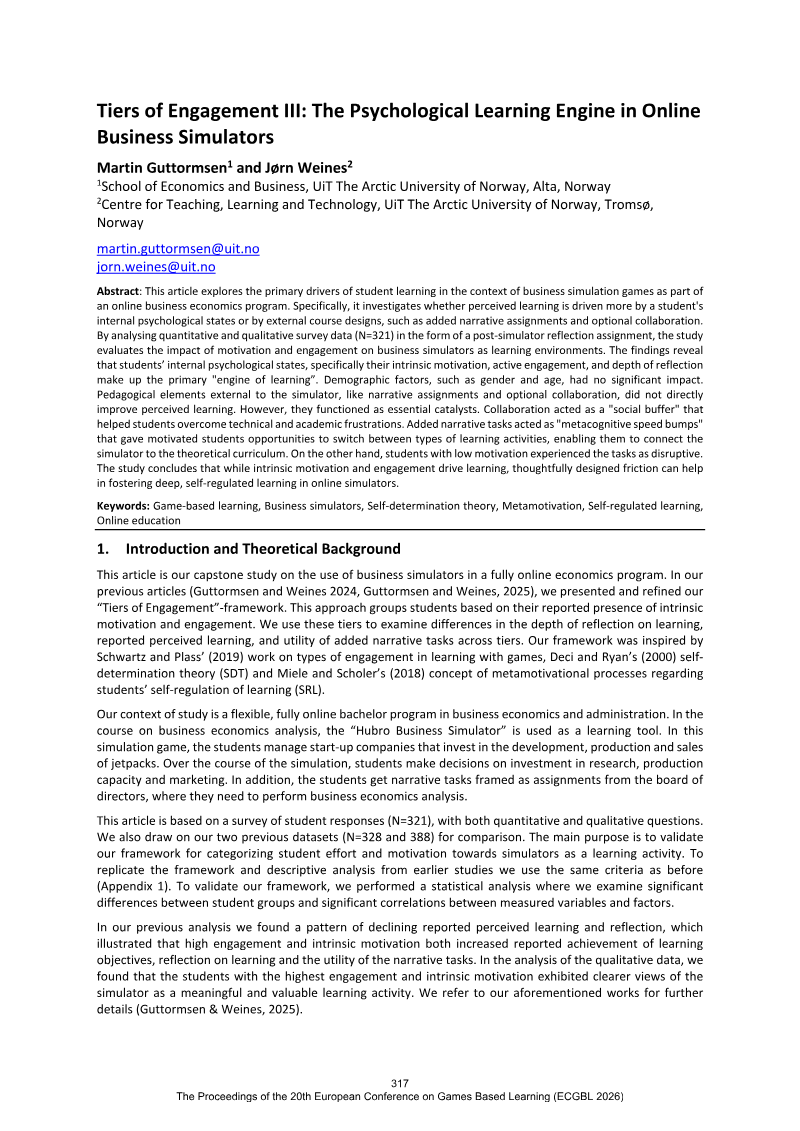
Tiers of Engagement III: The Psychological Learning Engine in Online Business Simulators
This study examines what drives students' perceived learning in an asynchronous online business simulator course, using survey data from 321 students who completed the Hubro Business Simulator in an economics education setting.
- Internal psychological states, particularly intrinsic motivation, engagement, and reflection, are the strongest direct predictors of students' perceived learning in an asynchronous online business simulator course (survey of 321 students using the Hubro Business Simulator).
- External course elements such as narrative assignments and optional collaboration did not directly predict perceived learning, but they correlated with motivation, engagement, and reflection, acting as indirect influences.
- Collaboration functioned as a social buffer, while narrative tasks helped already-motivated students connect simulated practice to theoretical content, though they could frustrate less motivated learners.



MitiGate: Risk Management Collaborative Tabletop Strategy Game
MitiGate is a collaborative tabletop strategy game designed to teach risk management through experiential play, responding to the persistent problem that risk training in project management education is often abstract and under-emphasized.
- MitiGate is a collaborative tabletop strategy game designed to teach project risk management through experiential play, addressing the abstract and under-emphasized nature of risk training in project management education.
- The game was refined through three iterative prototype cycles under a Design-Based Research approach, with evaluation drawing on 129 participants across university students, corporate trainees, and project management and serious-game experts.
- Players reported high overall satisfaction and perceived the game effectively facilitated strategic discussion of risk, while luck mechanics and victory conditions were identified as needing refinement.
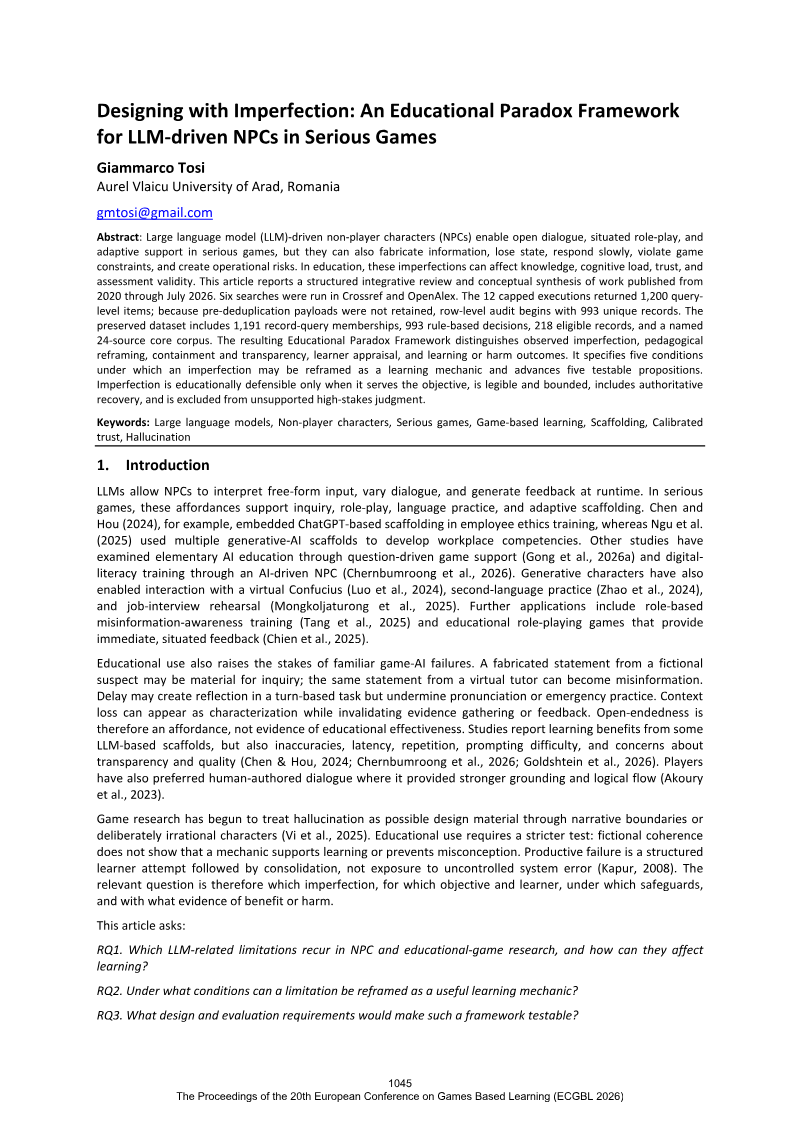
Designing with Imperfection: An Educational Paradox Framework for LLM-Driven NPCs in Serious Games
This paper proposes the Educational Paradox Framework (EPF), a conceptual model for deciding when imperfections in LLM-driven non-player characters (NPCs) can be deliberately used as learning mechanics in serious games, and when they should be eliminated or constrained.
- The core principle is that an educational NPC need not be infallible, but its fallibility must be deliberate, bounded, resolvable, and kept out of consequential judgments.
- The framework distinguishes five stages (observed imperfection, pedagogical reframing, containment and transparency, learner appraisal, and learning or harm outcomes), linking design choices to effects on knowledge acquisition, cognitive load, trust, and assessment validity.
- The evidence base is an integrative, non-systematic review of 2020–July 2026 literature drawn from Crossref and OpenAlex, yielding 993 unique records, 218 passing title and abstract screening, and a core corpus of 24 named sources, which the authors say is heterogeneous and precludes meta-analysis.



Play While You Wait: Analog Serious Games in Gastronomic Contexts
"Play While You Wait" examines whether analogue serious games can transform restaurant waiting time into a source of social and emotional engagement.
- Waiting time in restaurants is treated as a consequential, long-neglected moment in the dining experience, and analogue play can activate it more effectively than digital alternatives.
- Sabrosa Oportunidad, a tabletop game, was developed through two Design-Based Research cycles with 38 participants in five groups in Cartagena, Colombia.
- Validation was strongly positive: participants reported high joy and euphoria, none disengaged, 82% said the game would motivate a visit or recommendation, and 55% said they would otherwise have conversed less.



Flujo de Bolsillo [Pocket Flow]: A Board-Game Simulation for Financial Decision-Making
Pocket Flow, a physical board-game simulation of an annual financial cycle encompassing income, compulsory expenses, saving, consumption, and financial shocks, was developed to examine whether low-cost analogue play can support financial decision-making education.
- Pocket Flow is a low-cost physical board game simulating an annual financial cycle of income, compulsory expenses, saving, consumption, and financial shocks, refined through three Design-Based Research cycles with 62 participants, mostly university students.
- Of 18 valid post-game surveys drawn from 40 participants, 94.4% rated their perceived gains in financial knowledge and saving awareness positively, while motivation received a lower but still favourable rating of 72.2%.
- Gameplay observations documented recurring behaviours including planning, impulsive spending, and risk-taking, and participants revised their strategies after setbacks.



Masterpolis: Simulating Urban Planning Decisions Through a Boardgame Learning Environment
Masterpolis is a low-cost physical board game designed to simulate urban planning decisions, developed through a Design-Based Research approach at a Colombian university.
- Masterpolis is a low-cost physical board game for simulating urban planning decisions, developed through Design-Based Research at a Colombian university and positioned as a Global South alternative where digital simulation tools are limited or costly.
- The game was refined across eight sessions with 35 undergraduate architecture and engineering students and two urban planning experts, with sessions lasting 40 to 90 minutes.
- Observers reported active negotiation, collaborative decision-making, and improving rule comprehension as rules were simplified, while early sessions showed difficulties with rule complexity that required facilitator support and shaped later design revisions.