
European Conference on Games Based Learning (ECGBL)
Annual European conference on game-based learning and serious games; its proceedings are published open access (CC BY) by Academic Conferences International.
Documents
Knowledge Representation Schema of Educational Gameplay
The document introduces Ed-WPG, an extension of the authors' WPG gameplay schema designed to help young designers analyse educational games before full-scale evaluation.
- The report introduces Ed-WPG, a lightweight conceptual schema that maps Function-Behavior-Structure variables onto gameplay states to help young designers analyse educational games before full-scale evaluation, explicitly as an analytical tool rather than a validated measurement instrument.
- Ed-WPG is organised around three linked states: the winning state (goals and end conditions), the expected plan of action (challenge variables such as strategy, chance, skill, and knowledge, plus Bloom's cognitive levels and time control), and the game state (game world, interaction, and rewards), connected by seven processes.
- The authors argue that existing approaches are either resource-intensive or insufficient for capturing learning outcomes, and that prior frameworks such as LM-GM and CGDA either overlook gameplay dynamics or merely enumerate elements for analysis.
Puzzle, World, Trust: Interactive Fiction Heuristics for Lesson Design
This conceptual paper argues that principles from interactive fiction (IF) design can inform lesson and task design, positioning IF as a heuristic resource for teachers rather than merely a classroom medium.
- The paper maps interactive fiction design principles (puzzle fairness, world-model consistency, narrative framing, graduated hinting, player trust) onto didactic constructs such as zone of proximal development, flow, scaffolding, situated learning, and cognitively activating tasks, presenting these as design-theoretical correspondences rather than empirically validated equivalences.
- Five structural convergences link interactive fiction and lesson design: challenge calibration, inferability, scaffolded support, legible and trustworthy problem spaces, and meaningful narrative context.
- The central value of this IF-derived thinking is making the anticipated learner pathway visible before enactment, using IF-inspired playtesting to reveal where learners are likely to hesitate, misread cues, or stall so that sub-goals, hints, or prior-knowledge reactivation can be built in advance.
Designing a Non-Digital Game for Entrepreneurial Education: Case Study of Biznes na Medal
This paper presents a three-year autoethnographic case study of "Biznes na Medal," a non-digital board game for entrepreneurial education designed by Mateusz Lewandowski at the Jagiellonian University in Poland.
- The game's educational and commercial value came from iterative, bottom-up testing, and a deliberate pivot from an abstract business setting to a concrete SME context strengthened both learning outcomes and market potential.
- In pilot testing conducted in 2024 and 2025, 86% of pupils expressed a desire to play the game again.
- The development path ran from a 2022 prototype tested with students, family members, and business experts, to a 2025 final form shaped by university and technology transfer funding, incubator support, and workshop and school pilot feedback.


Countering Hindsight Bias and Memory Decay During Debriefing Through Dual-Track Simulation Game Design
This paper investigates whether Concurrent Decision Logging (CDL), a practice in which learners record their reasoning and confidence before seeing each round's outcome in a simulation game, alters how they reason and later explain their decisions during debriefing.
- Concurrent Decision Logging (CDL), where learners record their reasoning and confidence before each round's outcome is revealed, was tested in a randomized study of 41 participants (18 research, 23 control) using Lemonade Lane, a five-round browser-based business simulation.
- Players who logged rationale before outcomes showed nearly three times the intra-player pricing variance of controls, adjusting prices far more across rounds and responding differently to a mid-game competitor shock, where controls were more likely to hold prices unchanged.
- In post-game attributions, loggers wrote about 53% more text, named more distinct causes, and used more causal connectors and self-evaluative language than controls.

Quiz-Based Mechanics for Long-Term Retention in Game-Based Learning
A systematic review of 66 empirical studies examines how quiz-based mechanics in game-based learning support long-term retention.
- A systematic review of 66 empirical studies (following PRISMA guidelines) finds that retrieval practice, spacing, and corrective feedback produce the most reliable retention gains when combined, with the strongest effects arising when all three are coordinated rather than applied in isolation.
- Evidence for adaptive difficulty is inconsistent, and its benefits appear tied more to short-term engagement than to delayed recall; novelty effects remain inconclusive.
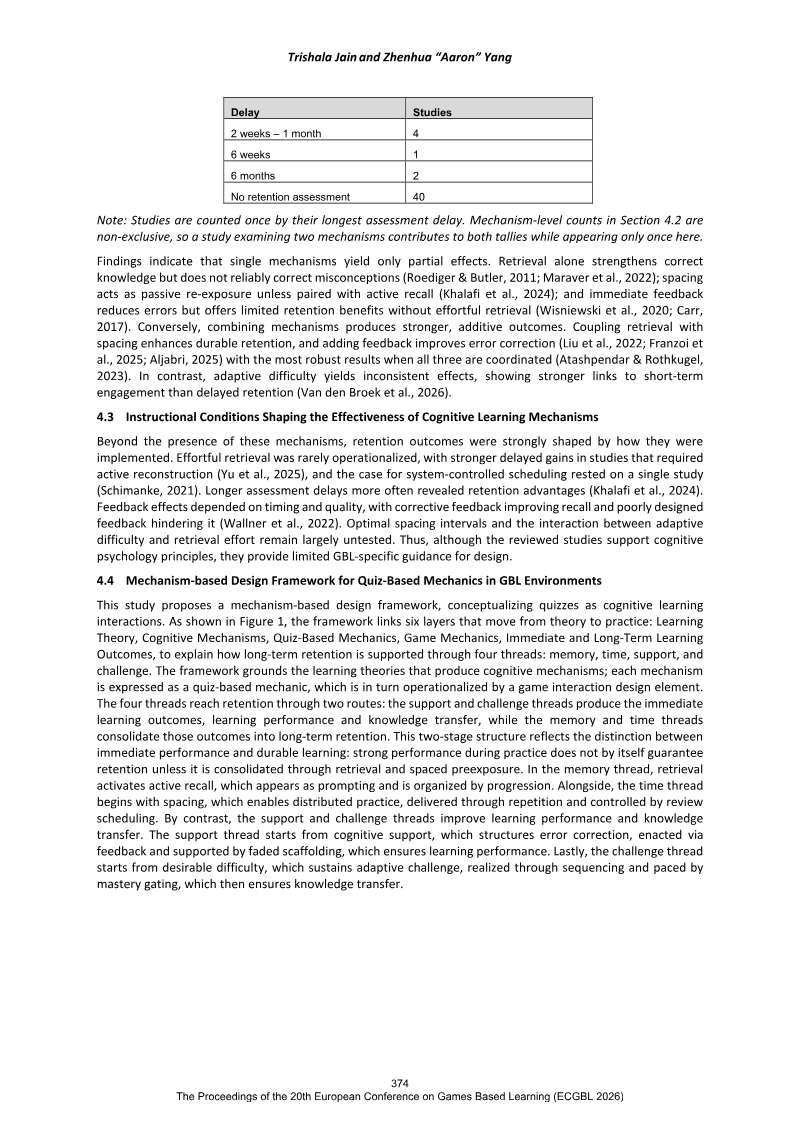
- Most studies measured outcomes immediately after instruction, only a small number extended assessment beyond one month, and 40 studies included no retention assessment at all, so claims about durable learning rest on thin evidence.



EduColorVR: A Virtual Reality Serious Game for Enhancing Color Vision Deficiency Awareness in Educational Settings
EduColorVR is a virtual reality serious game designed to raise awareness of color vision deficiency (CVD) among students and educators.
- EduColorVR is a PC-based VR serious game built in Unity that simulates protanopia, deuteranopia, and tritanopia using the Brettel-Viénot-Mollon model via a dual-matrix shader, aiming to raise awareness of color vision deficiency among students and educators.
- A preliminary interview study with four Swiss primary and secondary teachers found that color vision deficiency is rarely documented or discussed in schools and that accommodations are ad hoc because institutional guidelines are absent.
- The game's mechanics include an Ishihara demonstration, color-based memory and sorting tasks, and a color-coded maze, letting educators experience how color-dependent materials appear to affected learners.

Comparing Flow, Narrative, and Spatial Immersion in an HMD-AR Serious Game for Museum Learning
A field study of 144 museum visitors examined whether three design emphases in a head-mounted augmented reality (HMD-AR) coral-reef serious game, namely flow-enhanced, narrative-enhanced, and spatial-enhanced variants, would map onto the immersion types they were built to foster, and how those immersion types relate to…
- Narrative immersion was the only immersion type that significantly predicted perceived meaning and educational value (β = 0.221, p = .034), though it explained only about 3.9% of variance (R² = .039), a modest effect.
- The spatial-enhanced design did not produce its intended effect: spatial immersion was unexpectedly lowest in the spatial-enhanced variant, suggesting the design emphasis failed to translate into the perception it targeted.
- The flow-enhanced variant produced significantly higher flow scores than the spatial variant (p = .044), the clearest expected result of the study.

Is Less Interface More? Evaluating a Minimal Tangible Interface for Gamified Learning
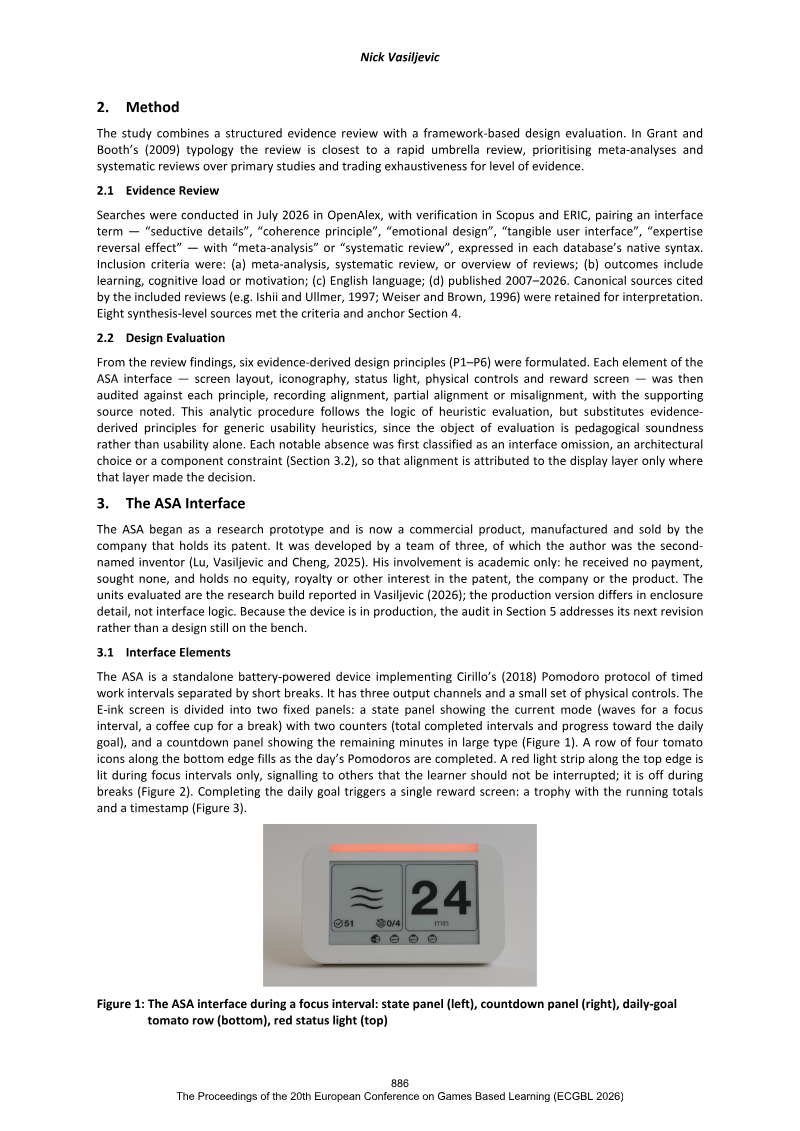
This paper examines whether a radically minimal interface can be justified as a pedagogical choice in gamified learning, using the Attention Support Apparatus (ASA), a dedicated physical Pomodoro timer with a monochrome E-ink display, a red status light, and physical controls, as its case.
- The paper argues minimal interfaces are defensible only insofar as they remove extraneous load and competing tasks; simplicity is not a blanket pedagogical virtue, and the author proposes the reframing "aligned is pedagogic" in place of "simple is pedagogic."
- The umbrella review finds robust support for removing task-irrelevant elements, but also finds that appealing design can aid motivation and that fixed structure can backfire for learners who experience it as controlling.
- The author introduces a three-way attribution scheme separating interface omissions, architectural choices, and component constraints, arguing that credit for a minimal design should go to the interface only where the interface itself made the relevant decision.
Designing for Learning Through Play: The MAPeD Framework for Conceptualizing Learning Games
The MAPeD framework, introduced by Peadar Callaghan, addresses shortcomings in existing learning game design models, which are often overly complex, confined to digital games, or structured around a false binary between learning and play.
- The MAPeD framework, introduced by Peadar Callaghan, is a deliberately simple two-axis model (practice-discourse and messaging-agency) designed to help designers conceptualize how learning and play can be designed together rather than treated as opposing forces.
- MAPeD was validated through semi-structured interviews with 14 practitioners, with participants praising its clarity (cited by 11 respondents), simplicity (8), and flexibility across game types and learning domains (8).
- Practitioners found MAPeD especially useful for team communication, stakeholder discussions, sharpening learning objectives, and ongoing reflection during development, though several cautioned it is only one component of a broader design toolkit rather than a complete methodology.
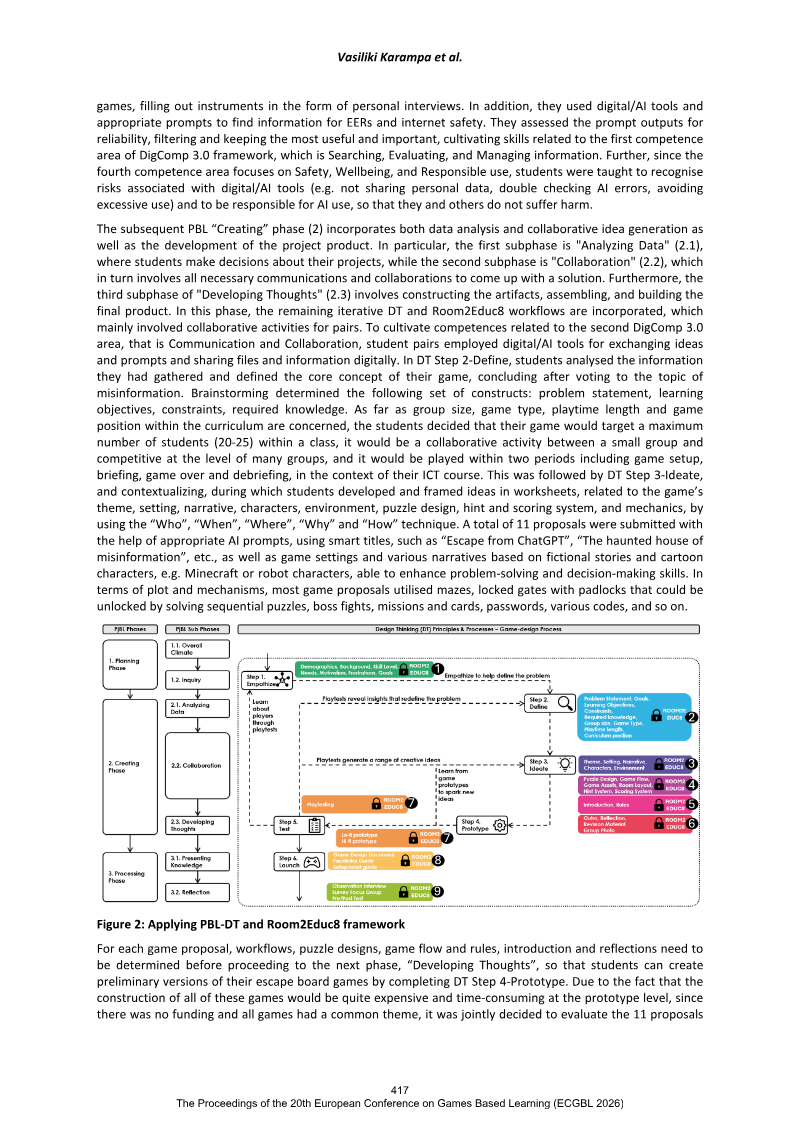
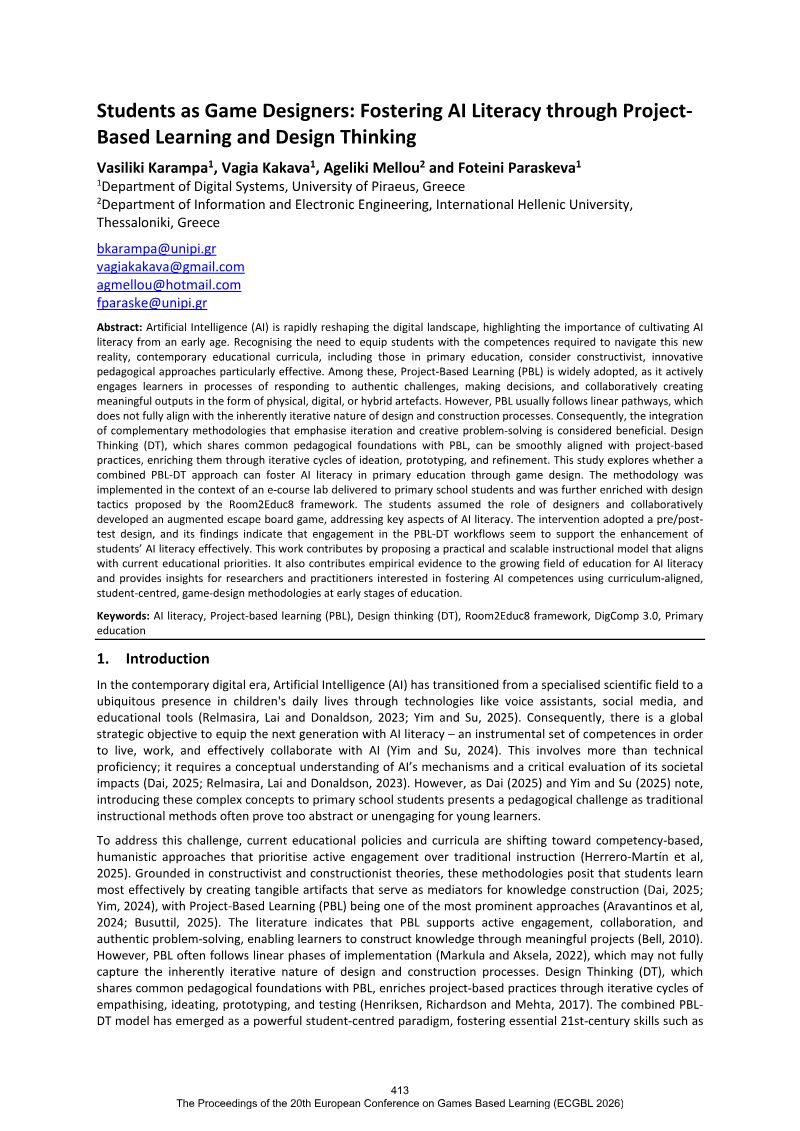
Students as Game Designers: Fostering AI Literacy through Project-Based Learning and Design Thinking
This study examines whether primary school students can develop AI literacy by designing an augmented escape board game on internet safety and artificial intelligence.
- A study of 22 primary students aged 8 to 12 found that designing an augmented escape board game on internet safety and AI, using Project-Based Learning combined with Design Thinking within the Room2Educ8 framework, improved overall AI literacy from a mean of 3.68 to 4.31 on a five-point Likert scale.
- Pre- and posttest results showed statistically significant gains (p < .001) across all five DigComp 3.0 competence areas as well as in the aggregate AI literacy measure, based on a 20-item questionnaire.
- The authors argue that PBL's linear project structure gains depth from Design Thinking's iterative cycles, and that board games and educational escape rooms are motivating ways to convey complex concepts to young learners.
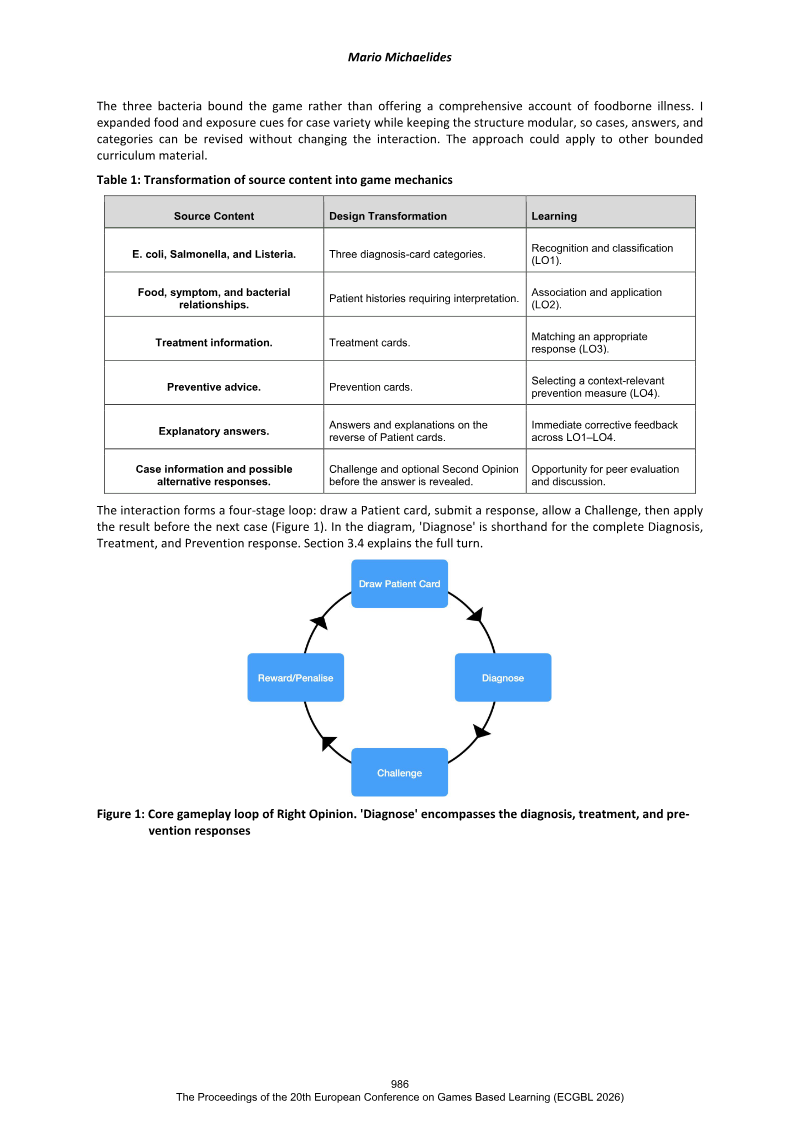
Right Opinion: Fidelity and Learning Design in a Food Poisoning Card Game
This paper describes the design of "Right Opinion," a two-player card game for Key Stage 3 learners (ages 11-14) that teaches the causes, symptoms, treatment, and prevention of food poisoning from E. coli, Salmonella, and Listeria.
- The paper describes "Right Opinion," a two-player card game for Key Stage 3 learners (ages 11-14) teaching causes, symptoms, treatment, and prevention of E. coli, Salmonella, and Listeria food poisoning, and it is the card-based baseline of a planned five-format study (card, board, 2D digital, 3D digital, and VR).
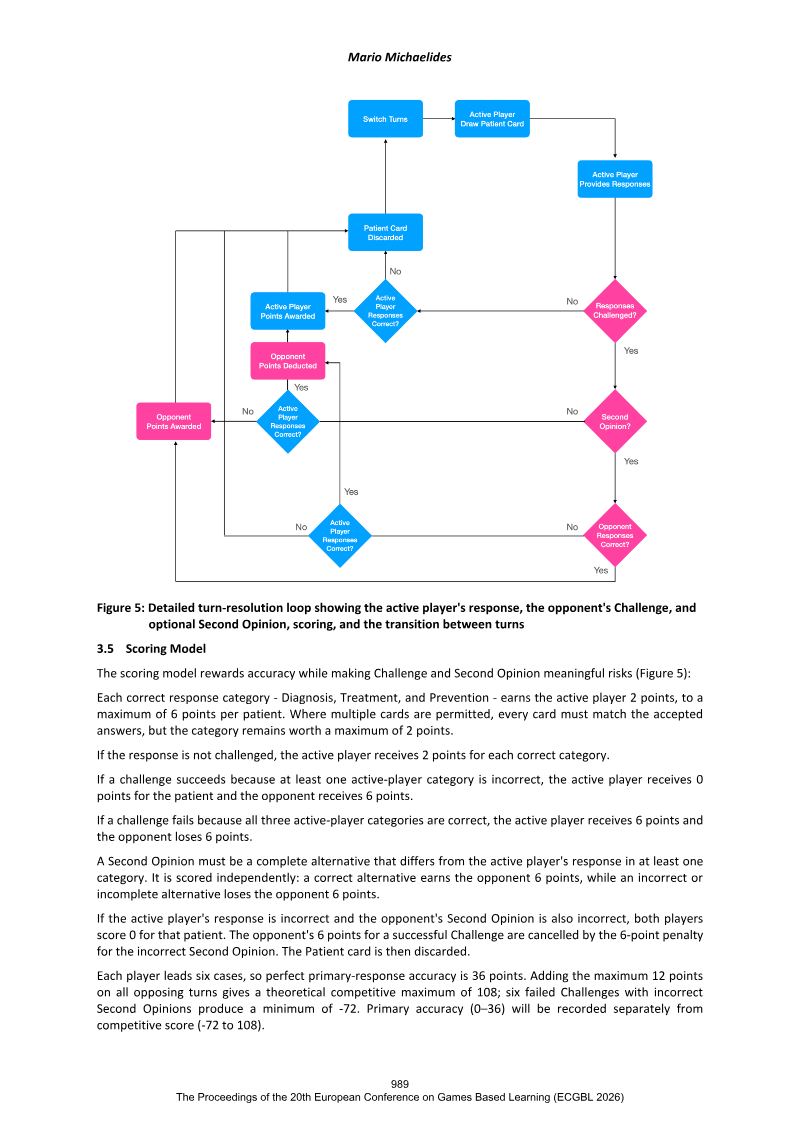
- The final game includes 12 patient cases and a 34-card set, with a scoring model that separates primary diagnostic accuracy from competitive score, and four learning outcomes drawn from Bloom's taxonomy.
- The author's design findings come from personal play-throughs, and no learner data have been collected yet; the game's effect on learning remains untested.



Translating Elementary Cellular Automata into Tangible Gameplay: Design of Shellmate
This paper presents a case study of Shellmate, a two-player tabletop strategy game designed by translating the structural principles of Elementary Cellular Automata (ECA) into tangible gameplay.
- Shellmate is a two-player tabletop game built by translating the structural principles of Elementary Cellular Automata (ECA) into gameplay, with the authors arguing that a simple computational model can underpin non-digital games that foster computational thinking.
- Strict adherence to a complete ECA simulation proved incompatible with playability; deliberately leaving some neighbourhood combinations undefined in each round introduced uncertainty and player agency, which the authors identify as the mechanism driving engagement and reasoning.
- The design went through three iterative prototype versions to fix problems including first-player advantage, overreliance on filler placement, and disproportionately powerful rule cards.