1 free read left. Create a free account for unlimited reading + AI research.
Create free accountArticle European Conference on Games Based Learning (ECGBL)
1 free read left. Create a free account for unlimited reading + AI research.
Create free accountArticleEuropean Conference on Games Based Learning (ECGBL)
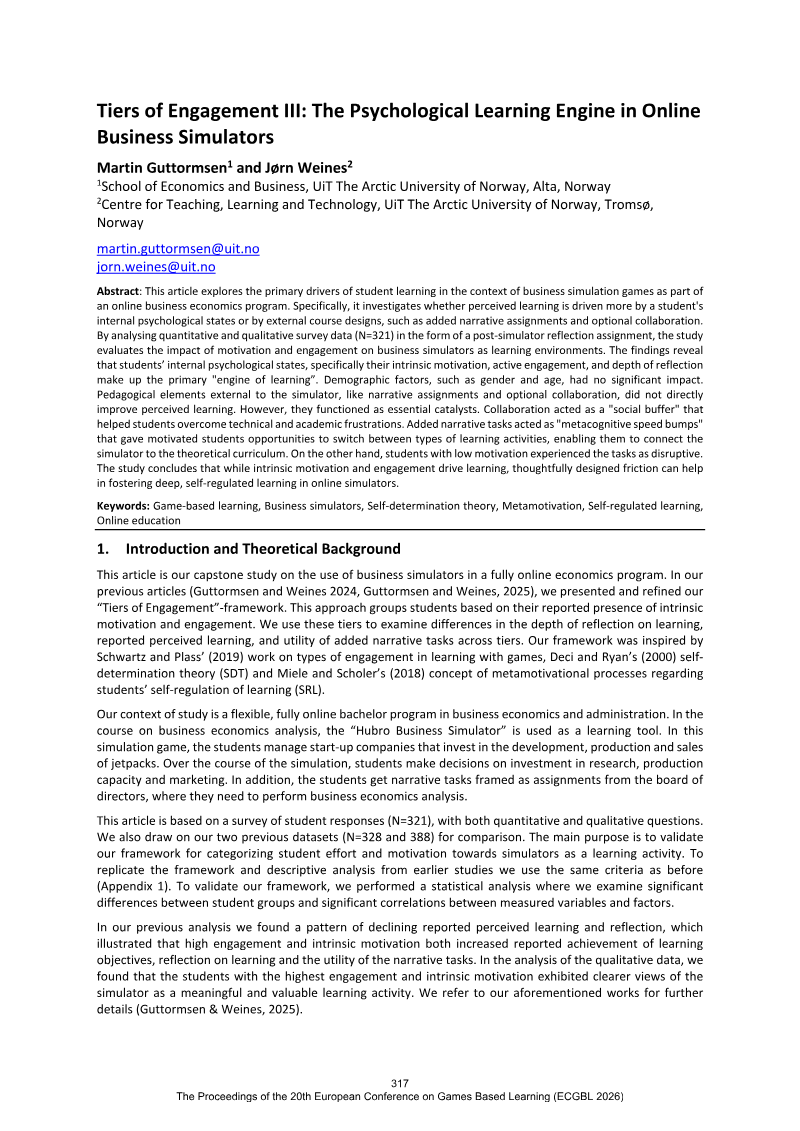
The paper starts from the observation that LLM-based non-player characters can fabricate information, lose context, respond with delay, and contradict game rules.
This paper proposes the Educational Paradox Framework (EPF), a conceptual model for deciding when imperfections in LLM-driven non-player characters (NPCs) can be deliberately used as learning mechanics in serious games, and when they should be eliminated or constrained. Its starting point is that LLM-based NPCs can fabricate information, lose context, respond with delay, contradict game rules, and create operational risks such as cost, privacy, and accessibility failures, all of which can affect knowledge acquisition, cognitive load, trust, and assessment validity. The framework distinguishes observed imperfection, pedagogical reframing, containment and transparency, learner appraisal, and learning or harm outcomes, and it sets out five conditions a reframe must meet: congruence with the learning objective, legibility of the NPC's epistemic role, containment of authoritative facts and game state, recoverability through correction or debriefing, and separation from consequential assessment.
The underlying research is an integrative review of work published from 2020 through July 2026, drawn from Crossref and OpenAlex searches using six query strings across twelve index-query executions. The pre-deduplication payloads were not retained, so the auditable trail begins with 993 unique records, of which 218 passed a rule-based title and abstract screen. The core corpus comprises 24 named sources, combining 18 screened records, one record missed by the lexical rule, and five supplementary sources, with seven additional theory sources. The authors state that the review is not systematic or exhaustive, that the evidence base is heterogeneous and prevents meta-analysis, and that the framework has not been prospectively validated.
Several cited studies illustrate the framework's concerns. One employee-ethics training study found that open ChatGPT-based dialogue did not clearly outperform document-based scaffolding and introduced prompting difficulty, while a digital-literacy study reported stronger credibility-evaluation gains than traditional instruction despite persistent occasional inaccuracies. The paper's central claim is that an educational NPC need not be infallible, but its fallibility must be deliberate, bounded, resolvable, and kept out of consequential judgments. It proposes five testable propositions and an evaluation design comparing scripted, unrestricted, grounded, and EPF-based conditions on achievement, retention, transfer, misconceptions, trust calibration, and cognitive load.
European Conference on Games Based Learning (ECGBL) · 2026



European Conference on Games Based Learning (ECGBL) · 2026



European Conference on Games Based Learning (ECGBL) · 2026



European Conference on Games Based Learning (ECGBL) · 2026



European Conference on Games Based Learning (ECGBL) · 2026



European Conference on Games Based Learning (ECGBL) · 2026



European Conference on Games Based Learning (ECGBL) · 2026



European Conference on Games Based Learning (ECGBL) · 2026



European Conference on Games Based Learning (ECGBL) · 2026



European Conference on Games Based Learning (ECGBL) · 2026



European Conference on Games Based Learning (ECGBL) · 2026

European Conference on Games Based Learning (ECGBL) · 2026



European Conference on Games Based Learning (ECGBL) · 2026



European Conference on Games Based Learning (ECGBL) · 2026



European Conference on Games Based Learning (ECGBL) · 2026