1 free read left. Create a free account for unlimited reading + AI research.
Create free accountArticle European Conference on Games Based Learning (ECGBL)
1 free read left. Create a free account for unlimited reading + AI research.
Create free accountArticleEuropean Conference on Games Based Learning (ECGBL)
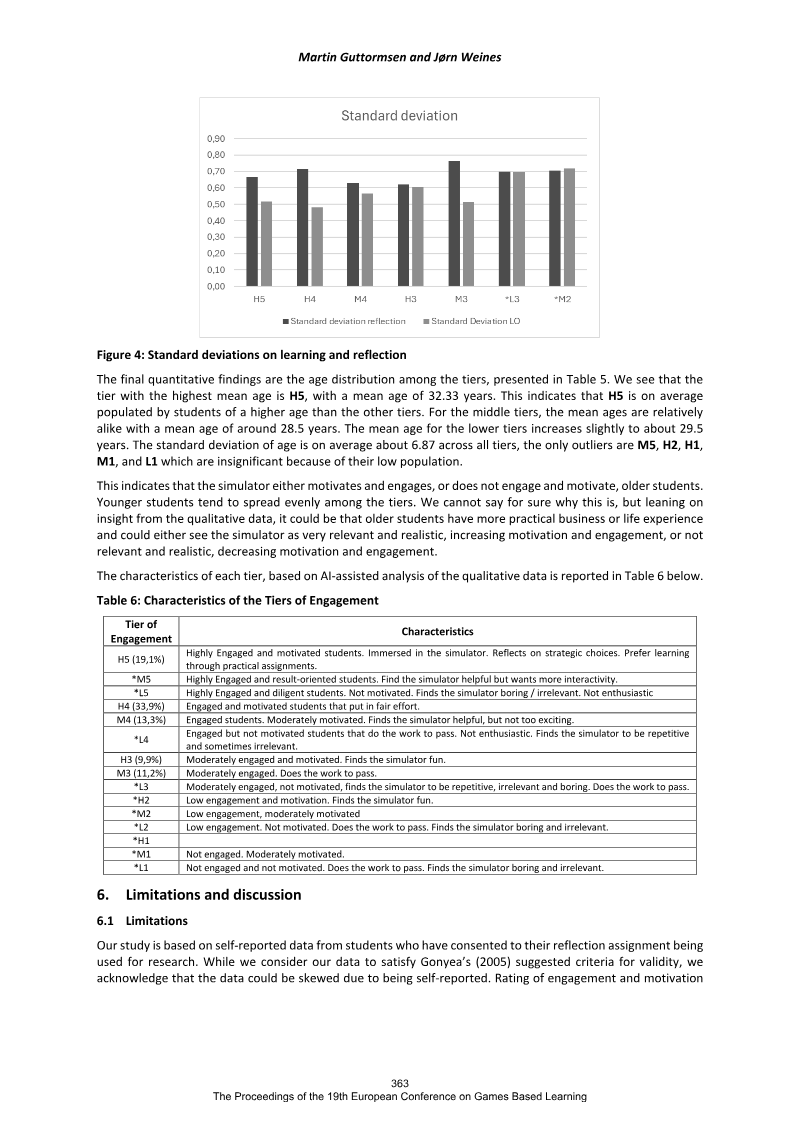
The study examines what drives students' perceived learning in an asynchronous online business simulator course.
This study examines what drives students' perceived learning in an asynchronous online business simulator course, using survey data from 321 students who completed the Hubro Business Simulator in an economics education setting. Its central thesis is that internal psychological states, particularly intrinsic motivation, engagement, and reflection, are the strongest direct predictors of how much students believe they have learned, while external course elements play a more indirect role. Demographic factors such as gender and age showed no significant effect on perceived learning, and the sample was gender-balanced.
The findings distinguish between direct and catalytic influences. Narrative assignments and optional collaboration did not directly predict perceived learning, but they correlated with motivation, engagement, and reflection. Collaboration functioned as a social buffer, while narrative tasks helped already-motivated students connect simulated practice to theoretical content, though they could frustrate less motivated learners. Exploratory factor analysis supported treating the four learning-outcome items as a single reliable construct, explaining 69.2% of variance.
A notable non-linear pattern emerged with reflection depth: students with the highest reflection levels reported slightly lower perceived learning than those with moderate reflection. The authors attribute this to heightened self-critical awareness rather than diminished learning, underscoring that self-reported measures can be distorted by psychological states. Limitations include self-report bias, language and technical barriers, and constrained generalizability beyond this context.
The study concludes that narrative assignments hold value for some students, sometimes rated above the simulator itself, and proposes extending a "metacognitive ramp" to bridge simulated practice with theoretical learning. Coding rubrics for reflection depth, motivation, narrative value, and collaboration are provided to support replication.



European Conference on Games Based Learning (ECGBL) · 2026
European Conference on Games Based Learning (ECGBL) · 2026



European Conference on Games Based Learning (ECGBL) · 2026



European Conference on Games Based Learning (ECGBL) · 2026



European Conference on Games Based Learning (ECGBL) · 2026



European Conference on Games Based Learning (ECGBL) · 2026



European Conference on Games Based Learning (ECGBL) · 2026



European Conference on Games Based Learning (ECGBL) · 2026



European Conference on Games Based Learning (ECGBL) · 2026



European Conference on Games Based Learning (ECGBL) · 2026



European Conference on Games Based Learning (ECGBL) · 2026
European Conference on Games Based Learning (ECGBL) · 2026

European Conference on Games Based Learning (ECGBL) · 2025
European Conference on Games Based Learning (ECGBL) · 2024
European Conference on Games Based Learning (ECGBL) · 2024