
European Conference on Games Based Learning (ECGBL)
Annual European conference on game-based learning and serious games; its proceedings are published open access (CC BY) by Academic Conferences International.
Documents
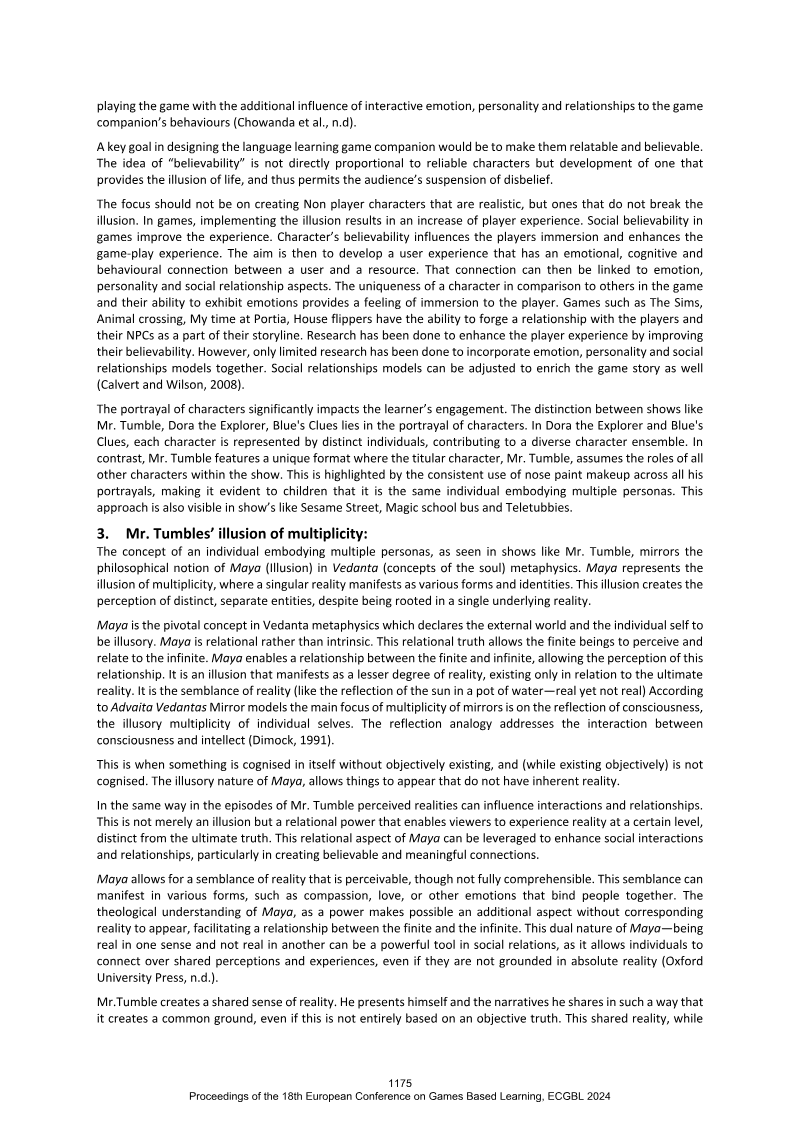
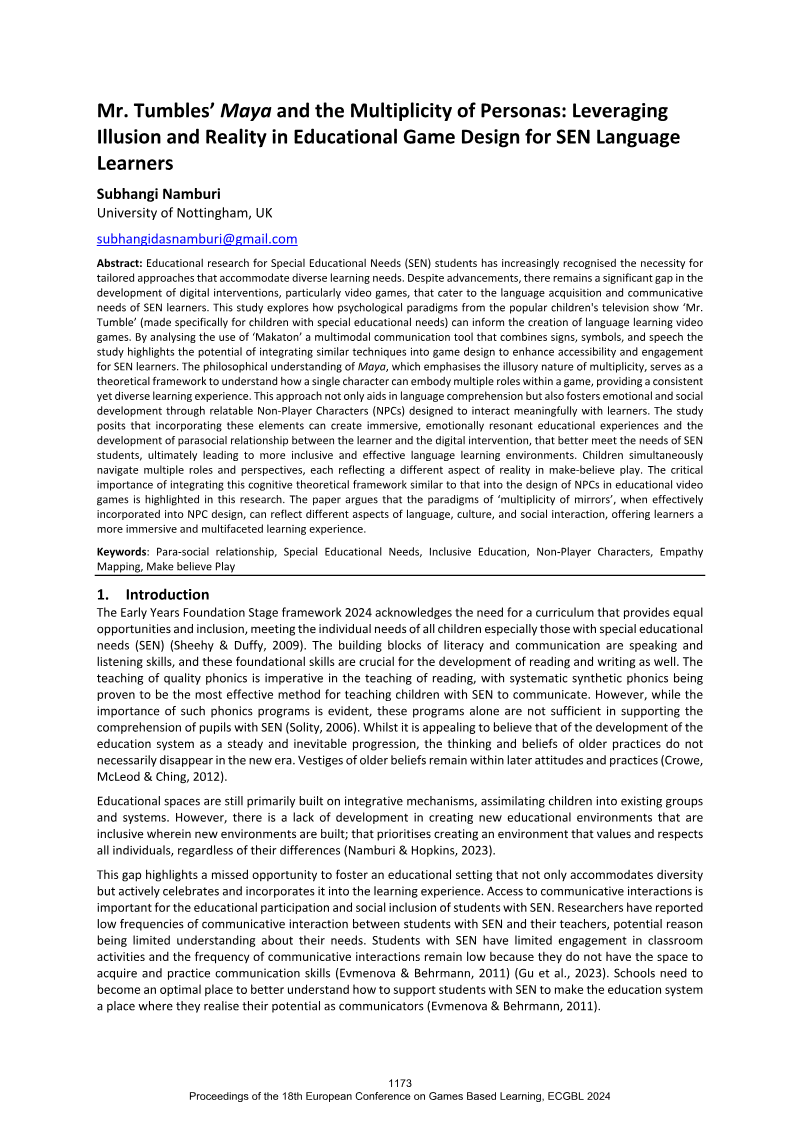
Mr. Tumbles' Maya and the Multiplicity of Personas: Leveraging Illusion and Reality in Educational Game Design for SEN Language Learners
This paper argues that the CBeebies programme Mr. Tumble offers a practical model for designing language-learning games for children with special educational needs (SEN).
- The paper proposes that a single NPC playing many roles, grounded in the Advaita Vedanta concept of Maya (the illusion of multiplicity), can generate believable, emotionally resonant interactions and parasocial relationships that lower affective barriers to language learning for SEN children.
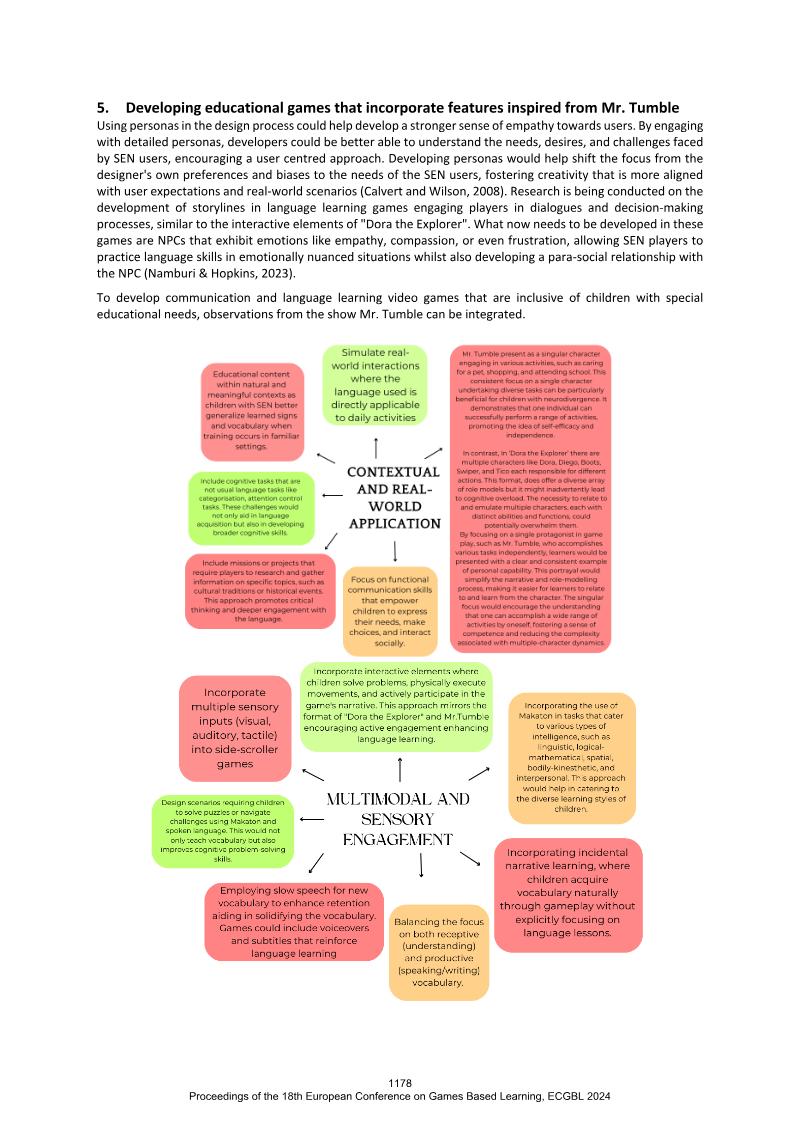
- Core design principles include one consistent protagonist, contextually grounded real-world activities, multimodal engagement such as Makaton signing, and emotionally responsive NPCs, drawing on research into personas, parasocial relationships, and self-efficacy.
- The author argues NPC design should incorporate cognitive and knowledge-related profiles rather than relying only on demographic and behavioural data, with distinct personas tailored to learners with autism, ADHD, dyslexia, and intellectual disabilities.
Enhancing Digital Game-Based Learning Through Reflective Game Design (RGD)
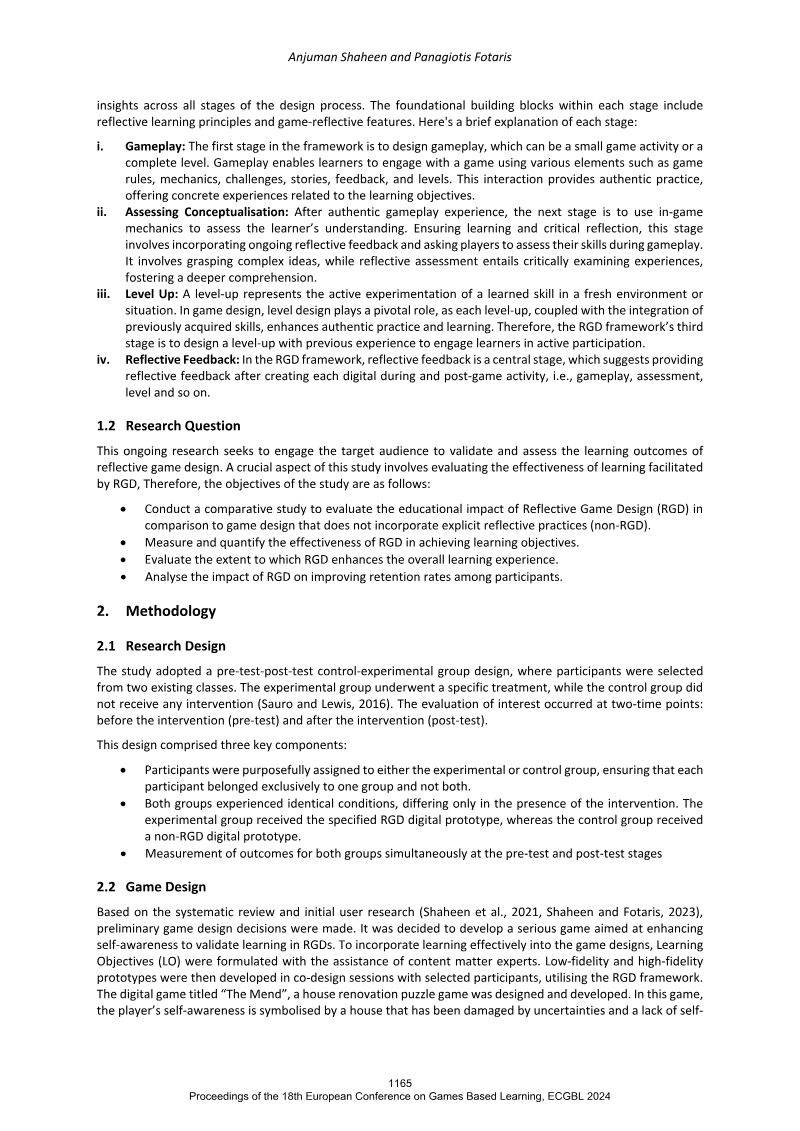
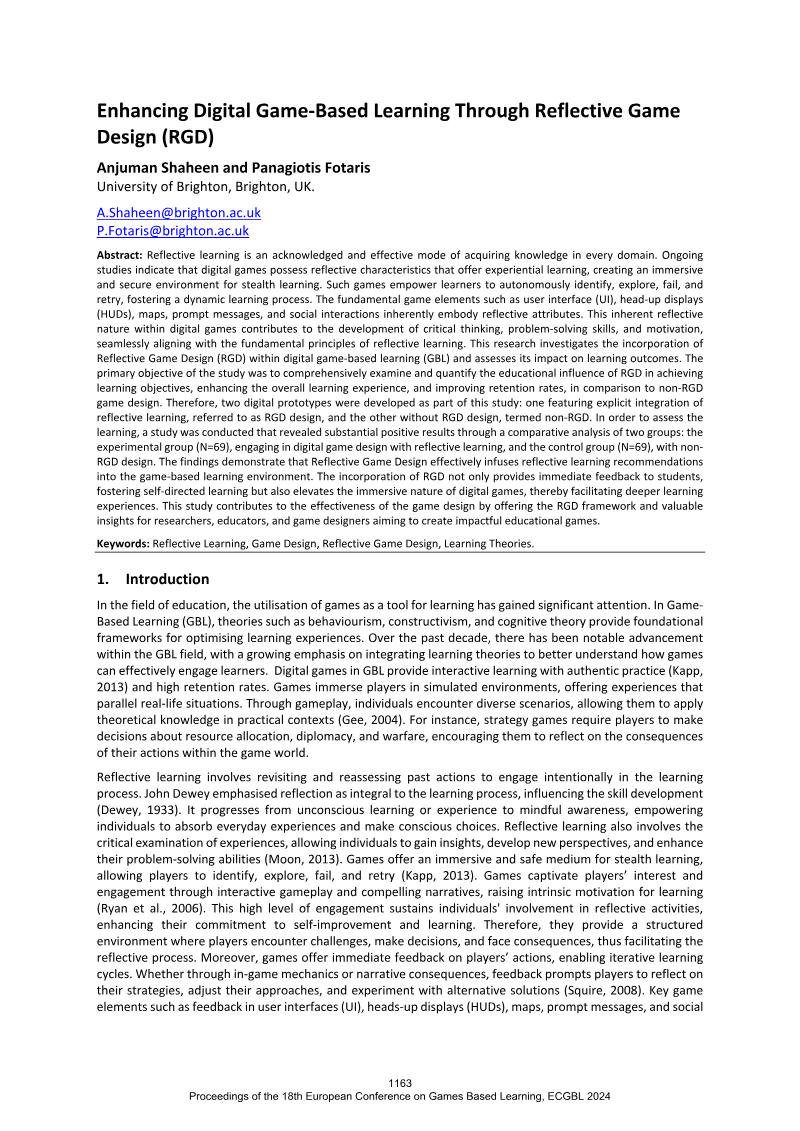
This study by Shaheen and Fotaris from the University of Brighton examines whether Reflective Game Design (RGD), a framework built on Kolb's experiential learning cycle, improves learning outcomes in digital game-based learning compared with conventional game design.
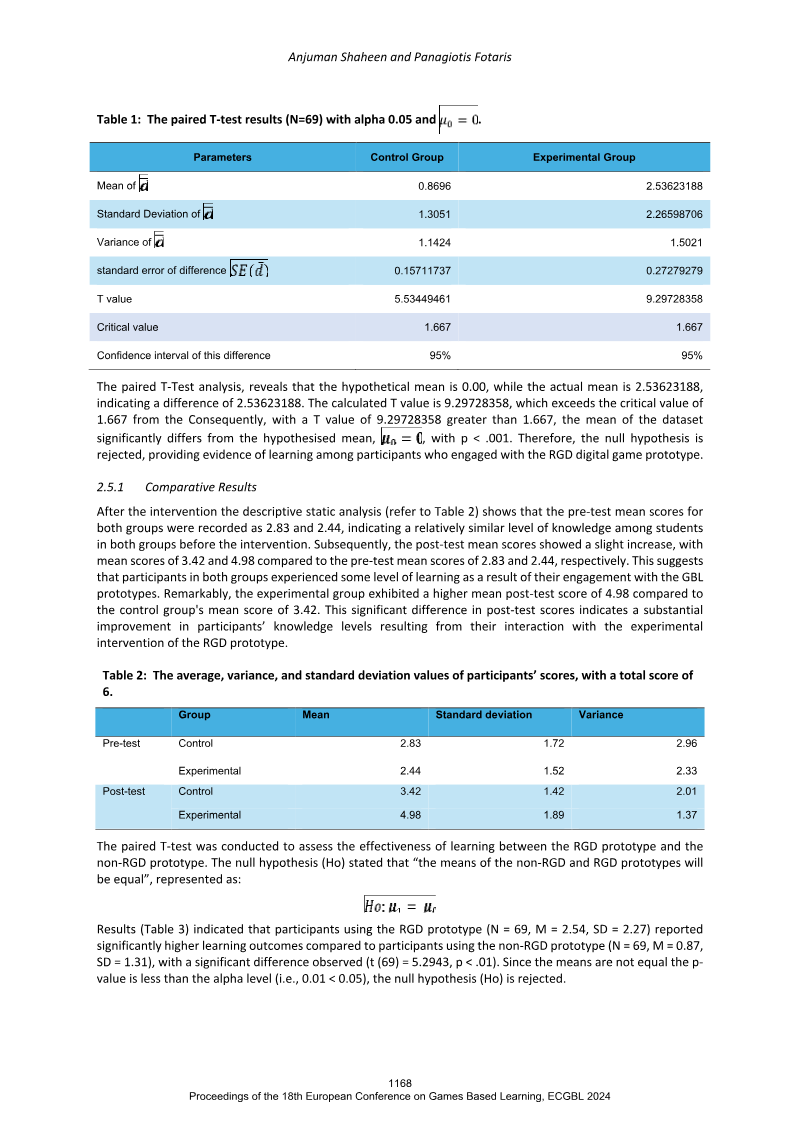
- The Reflective Game Design (RGD) prototype's mean post-test score rose from 2.44 to 4.98 on a six-item quiz, versus 2.83 to 3.42 for the non-reflective version, with both groups showing significant gains (p < .001) and a between-group comparison favouring RGD (t(136) = 5.29, p < .01).
- RGD is built on Kolb's experiential learning cycle and adds reflective features such as process displays, prompts, and diary-based reflection points to a digital serious game, the self-awareness house-renovation puzzle "The Mend."
- The study tested two prototypes of "The Mend" with 69 young adults per group, aged 18 to 24, recruited mainly from undergraduates and online gaming communities, using a pre-test/post-test control design.
Design of a Conversational Adventure App to Promote Argumentation in Science
This paper presents the design and preliminary evaluation of Energy Island, a conversational adventure mobile application for Android intended to foster argumentation and informed decision-making about energy sources in science education.
- Energy Island is a conversational adventure mobile app for Android, built in Unity and C#, designed to foster argumentation and informed decision-making about energy sources in science education.
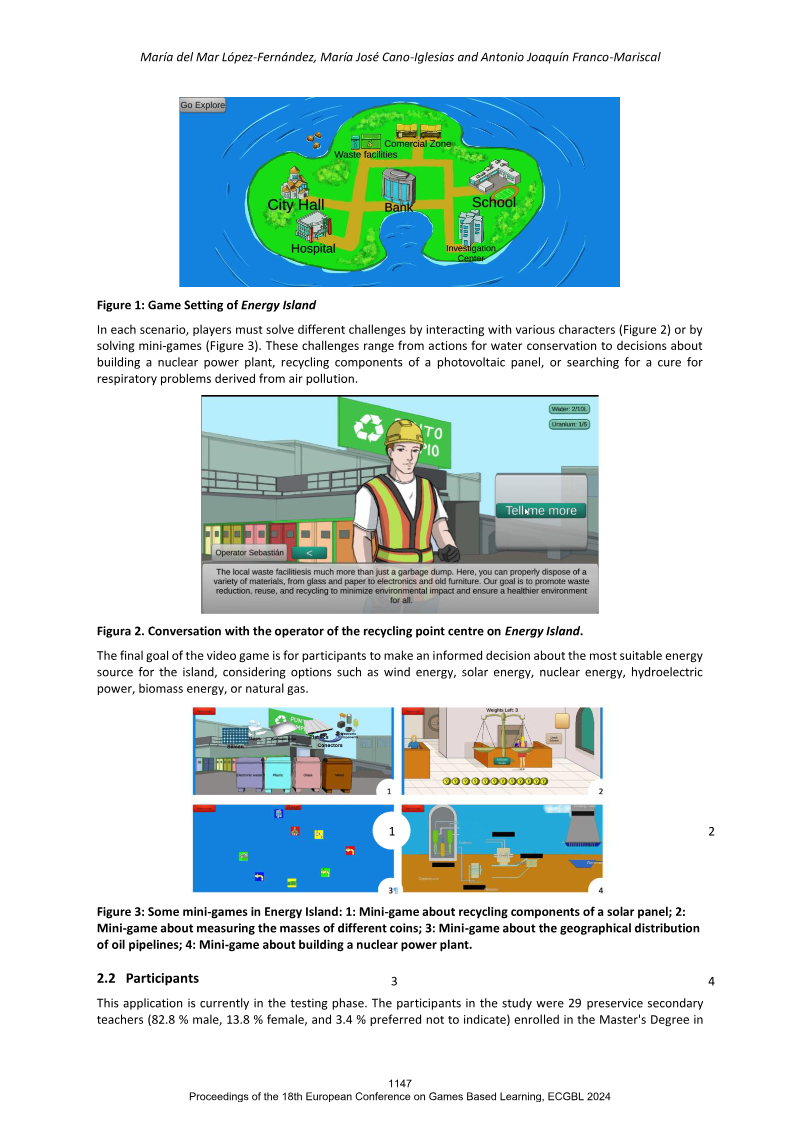
- The game places players on a fictional island where they resolve challenges through character dialogue and mini-games covering water conservation, nuclear plant decisions, photovoltaic panel recycling, and pollution-linked respiratory health, culminating in a choice among six energy sources.
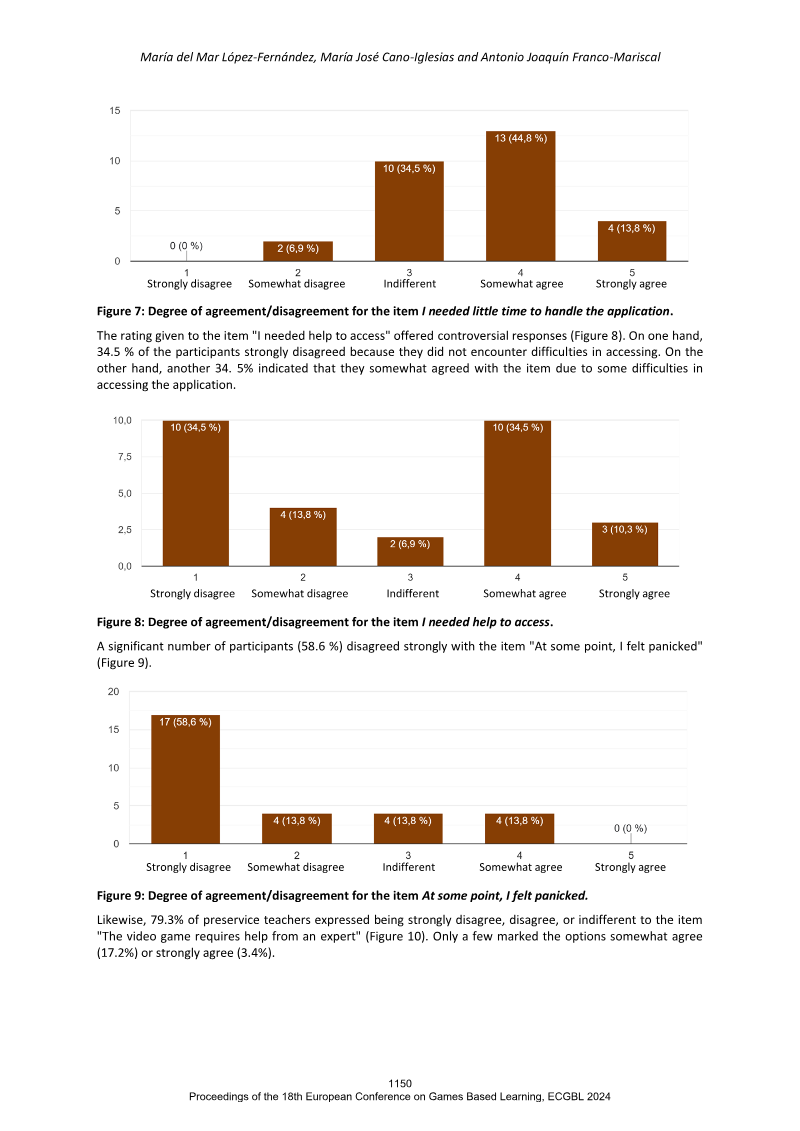
- The app was tested with 29 preservice secondary teachers at the University of Málaga, most with engineering or technical backgrounds, over roughly two weeks, followed by a 26-item usability questionnaire.
Exploring Mars: An Immersive Survival Game for Planetary Education
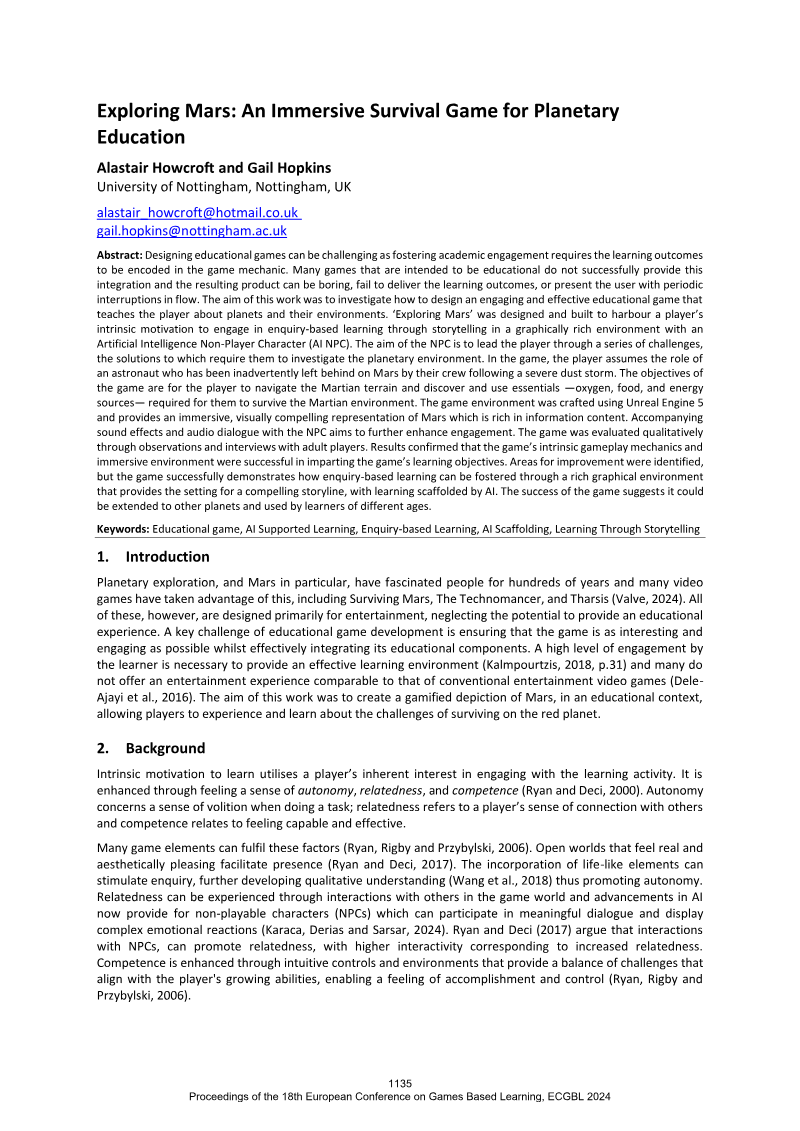
"Exploring Mars" is an educational survival game built in Unreal Engine 5 that aims to teach planetary science through enquiry-based, narrative-driven play.
- "Exploring Mars" is an educational survival game built in Unreal Engine 5 that teaches planetary science through enquiry-based, narrative-driven play, grounded in self-determination theory's autonomy, relatedness, and competence.
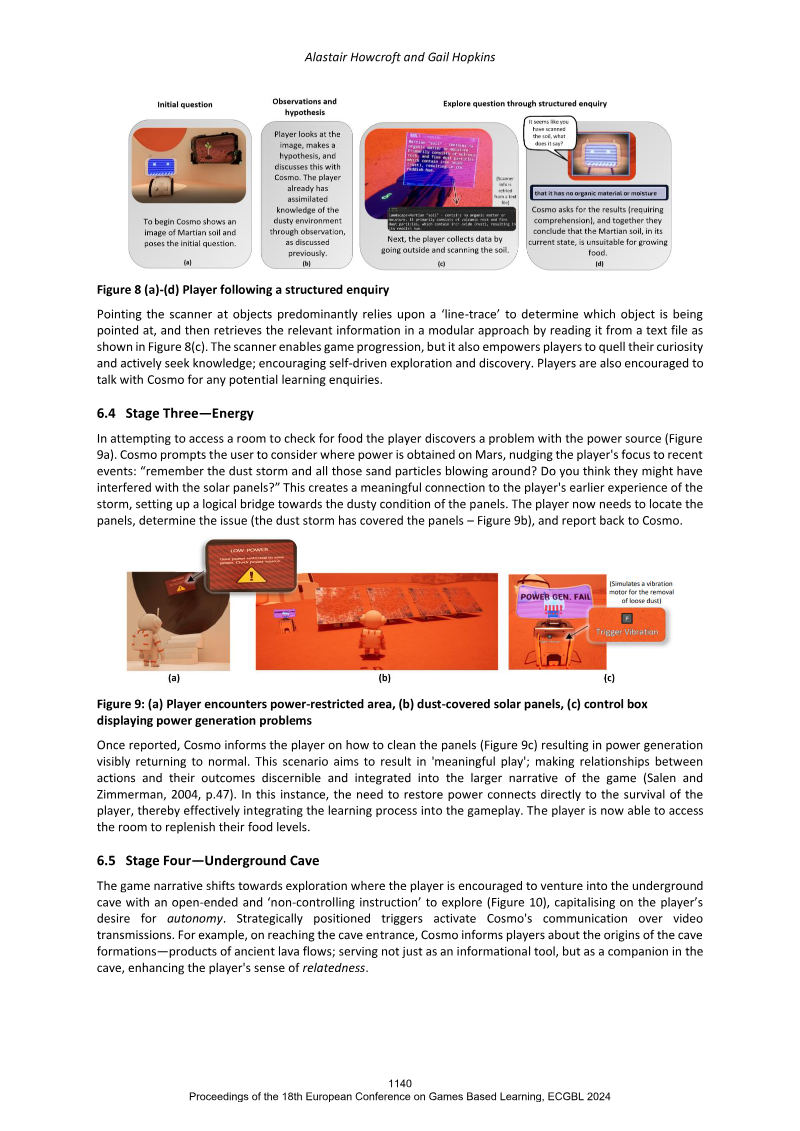
- The AI companion Cosmo, powered by GPT-3.5 Turbo, Azure Text-to-Speech, and locally run Whisper speech recognition, guides players through inquiry rather than direct instruction.
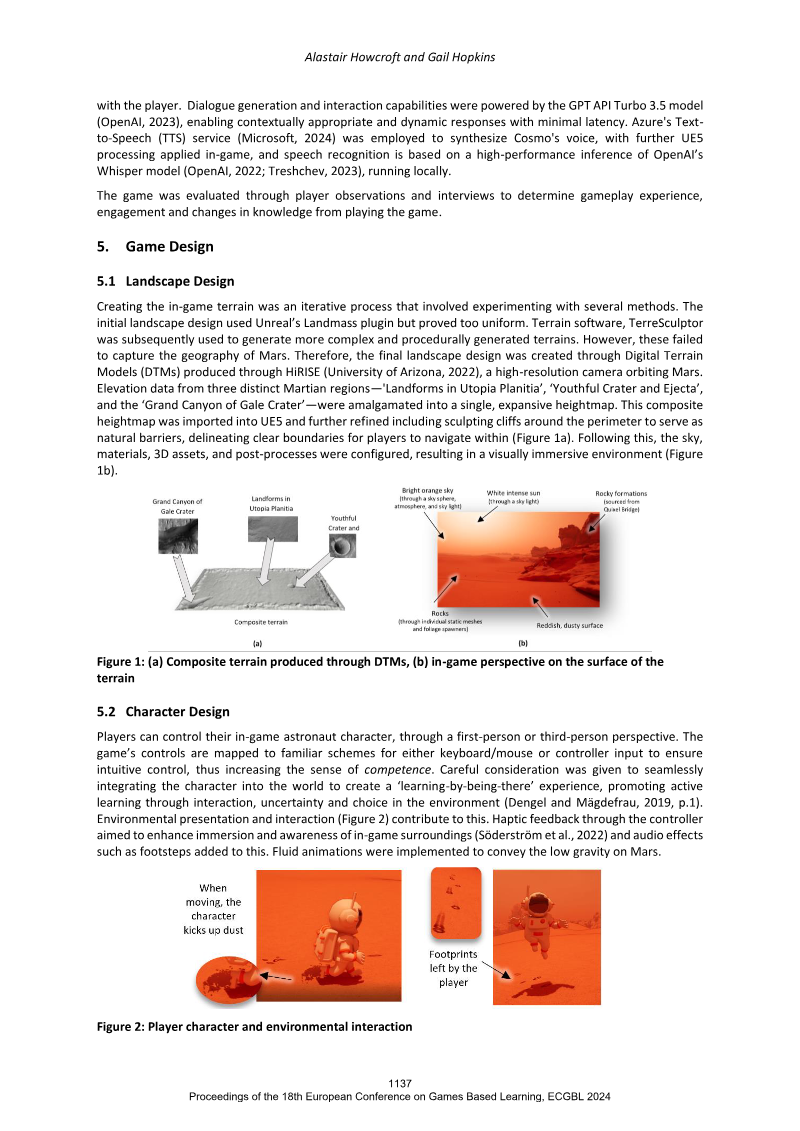
- Game environments are derived from HiRISE Digital Terrain Models of three Martian regions, giving the terrain a basis in real planetary data.
A Serious Game for the Digital Transformation of Organizations
This paper presents the design rationale, structure, and first test outcomes of DTInLine, a serious game built to help human resource management (HRM) professionals and students design HR practice configurations that both align with an organization's strategy and shape the employee behaviours needed for digital transformation…
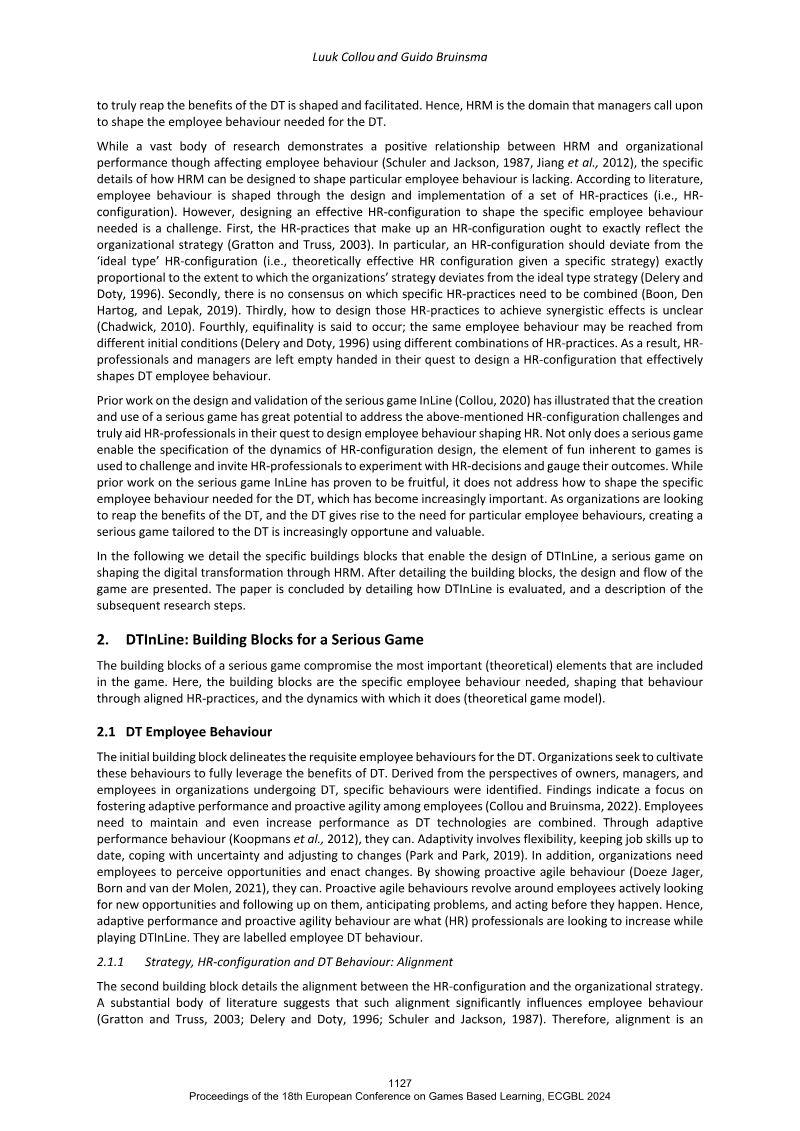
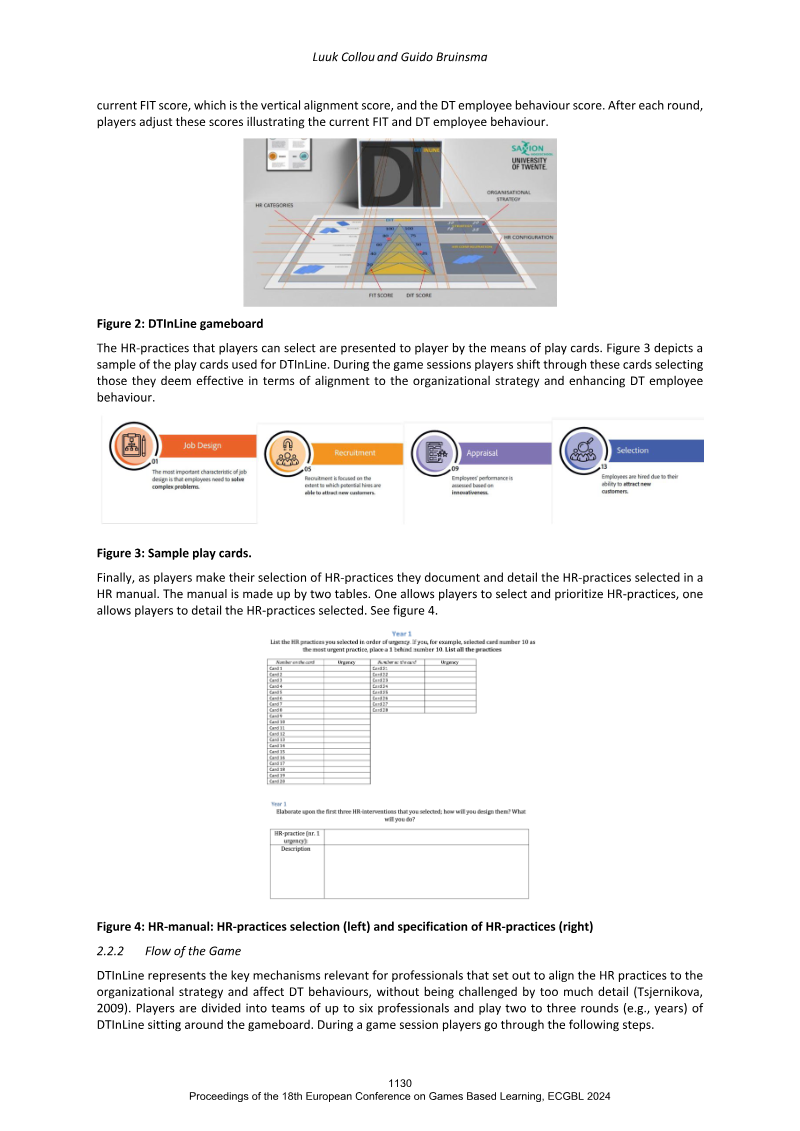
- DTInLine is a serious game that helps HR professionals and students design HR practice configurations that align with organizational strategy while cultivating employee behaviours needed for digital transformation, specifically adaptive performance and proactive agility.
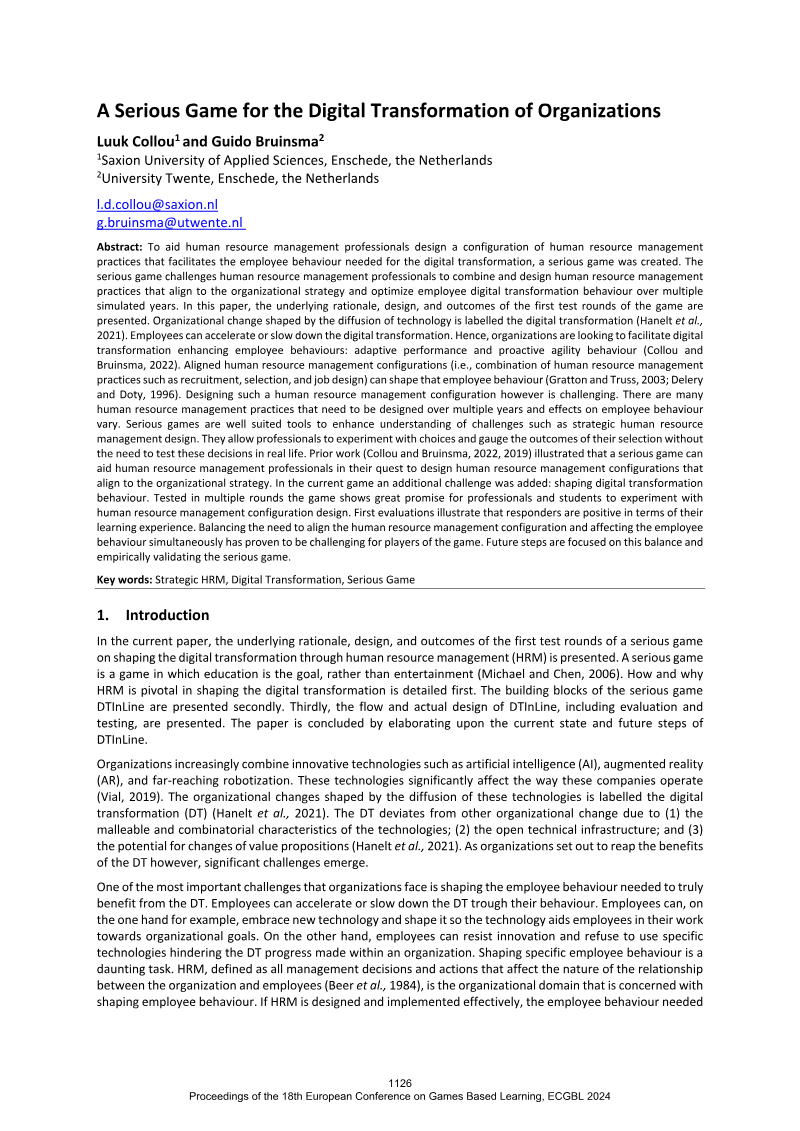
- The game builds on the competing values framework, classifying strategy and HR configurations into four quadrants (cooperative, market, mechanistic, adhocratic), with seven HR practices each offering four design options for a total of 28 options.
- The 28 options are scored for strategic alignment and for their effect on digital transformation behaviour, with the behavioural scores derived from a survey of 47 HR professionals.
Utilizing a Digital Escape Room to Improve Students' Grasp and Understanding of Qualitative Research Methods
This theoretical work-in-progress paper proposes a Digital Escape Room (DER) to help undergraduate and postgraduate students grasp qualitative research methods, a subject that many students find difficult and often underestimate in terms of the time it demands.
- The paper is a theoretical work-in-progress proposing a Digital Escape Room to help students grasp qualitative research methods, a subject many find difficult and underestimate in time demands, with motivation partly driven by serving a large online student cohort.
- The core design rationale is that the puzzle-by-puzzle structure of escape rooms may mirror the stepwise progression of qualitative methods courses, but this fit remains an open research question.
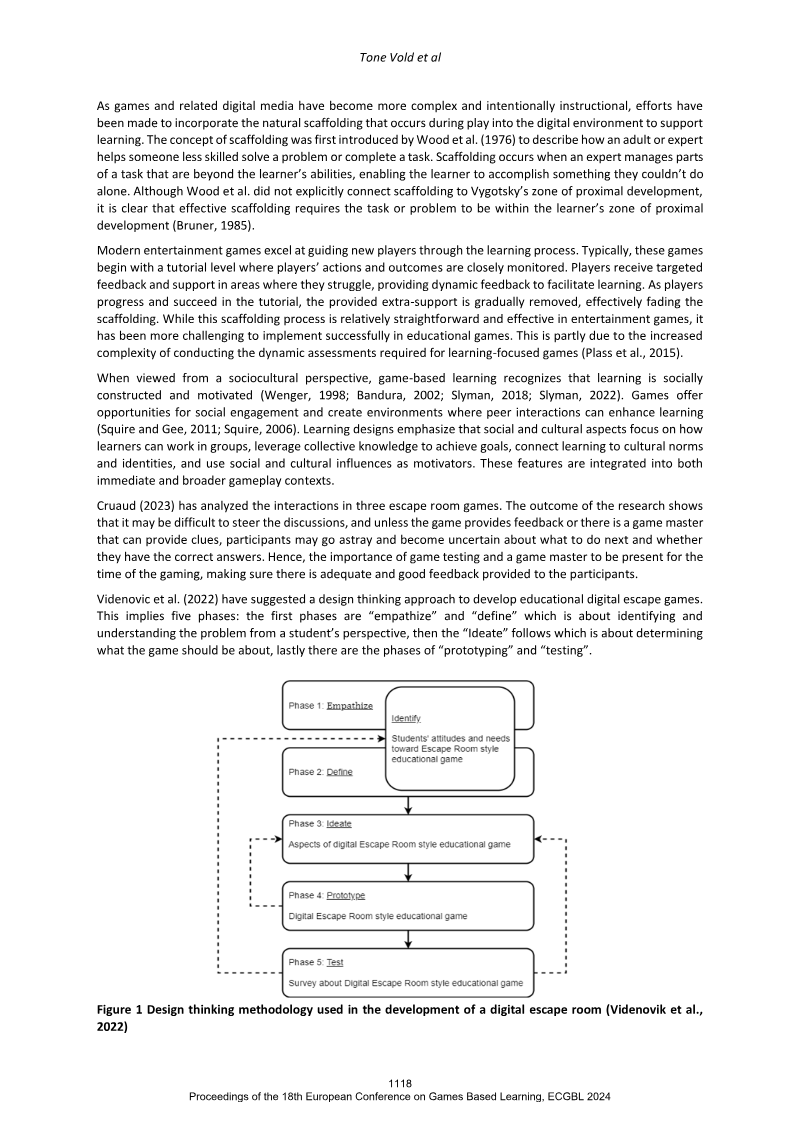
- Prior literature suggests escape rooms can boost motivation and 21st-century skills, yet learners may lose direction without adequate feedback or a game master, so the authors recommend feedback on every answer, possibly supported by AI-driven hints.
Towards AI-Assisted Board Game-Based Learning: Assessing LLMs in Game Personalisation
This study evaluates whether general-purpose large language models can generate personalisation suggestions for board game-based learning comparable to those produced by human educators.
- AI tools (ChatGPT GPT-4 and GPT-4o, Microsoft Copilot, Anthropic Claude) were tested against three expert educators on personalisation suggestions for two BoardGameGeek-based classroom activities, one primary and one secondary, using identical standardised prompts.
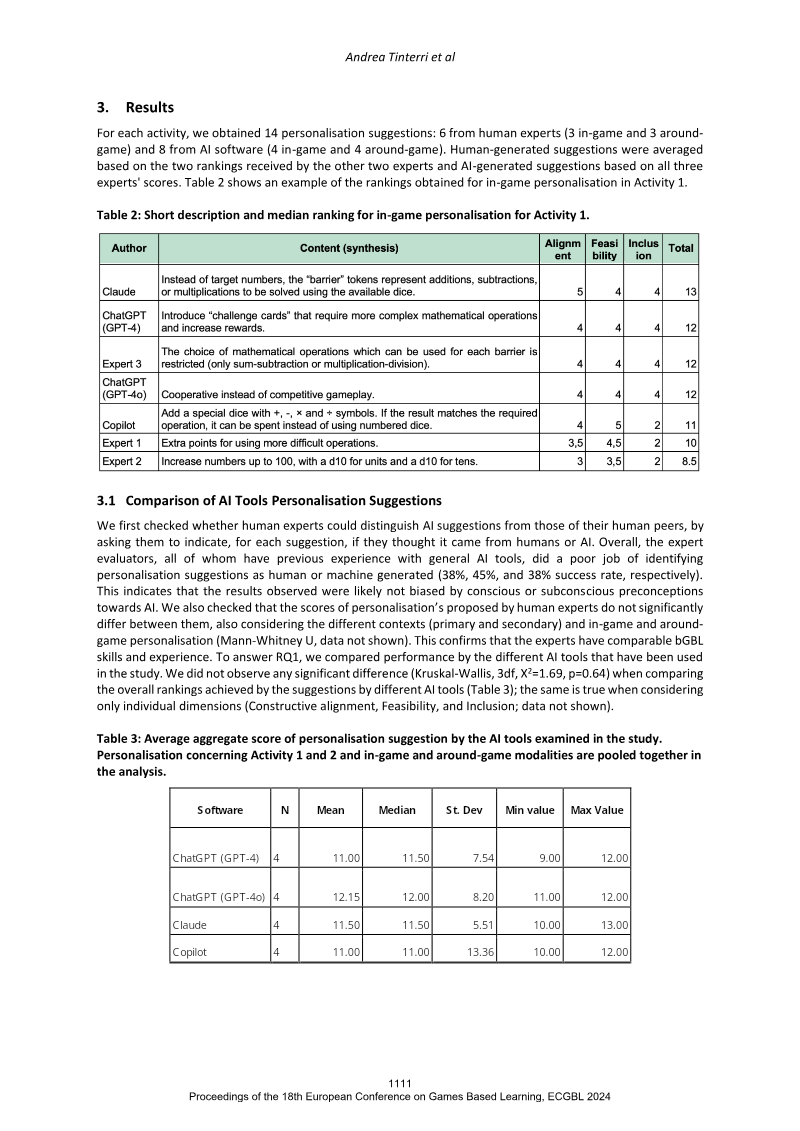
- In the pilot study, blind evaluators identified the source of suggestions at near-chance rates of 38 to 45 percent, indicating AI and human outputs were hard to tell apart.
- AI suggestions scored significantly higher than human suggestions on constructive alignment for in-game personalisation (p=0.004), while overall AI-versus-expert differences were not statistically significant.
There's More Than One Way to Skin a Game: Templating Game-Based Learning
This work-in-progress paper from Aalto University's Online Learning-Online Hybrid Lab describes the authors' shift from custom-built academic educational games toward a templating approach, in which modular, genre-conventional game frameworks could be adapted by educators across disciplines.
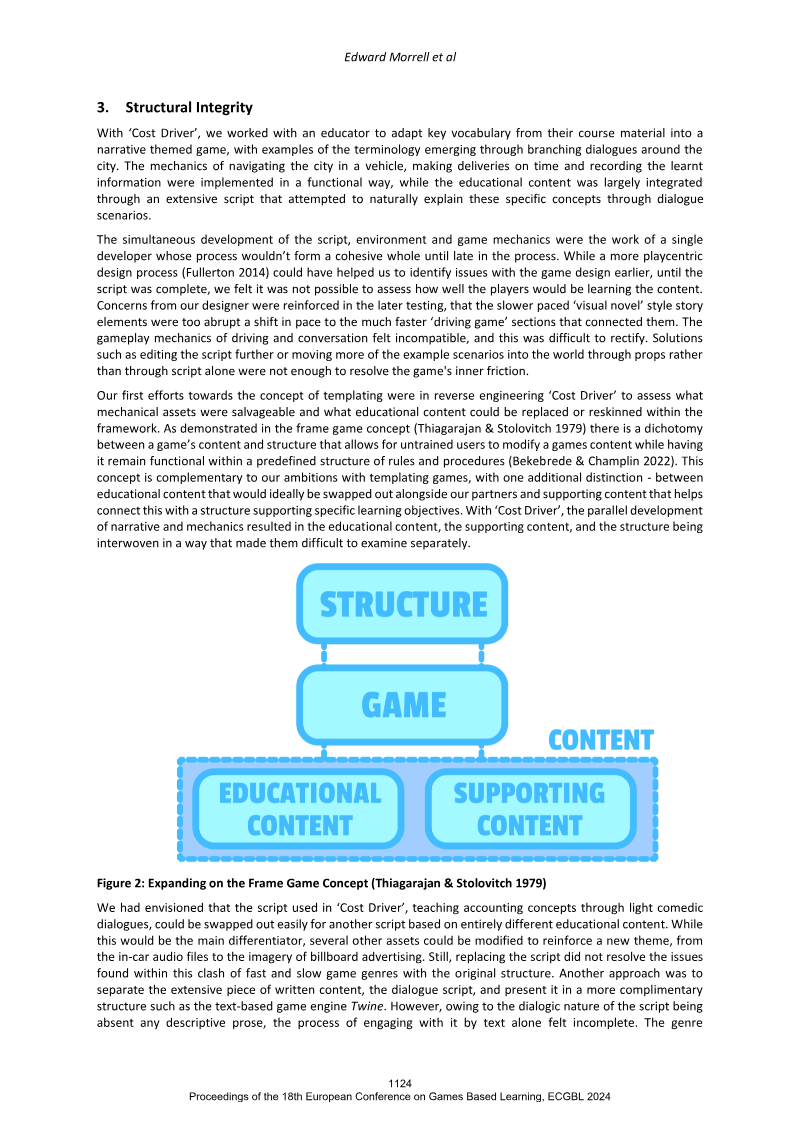
- The paper argues that resource-constrained academic developers can serve diverse educational needs more economically by separating reusable game structures from the learning content supplied by clients, a 'templating' approach.
- The authors' shift is a reflective work-in-progress drawing on prior projects rather than empirical measurements, so it offers no quantified learner outcomes.
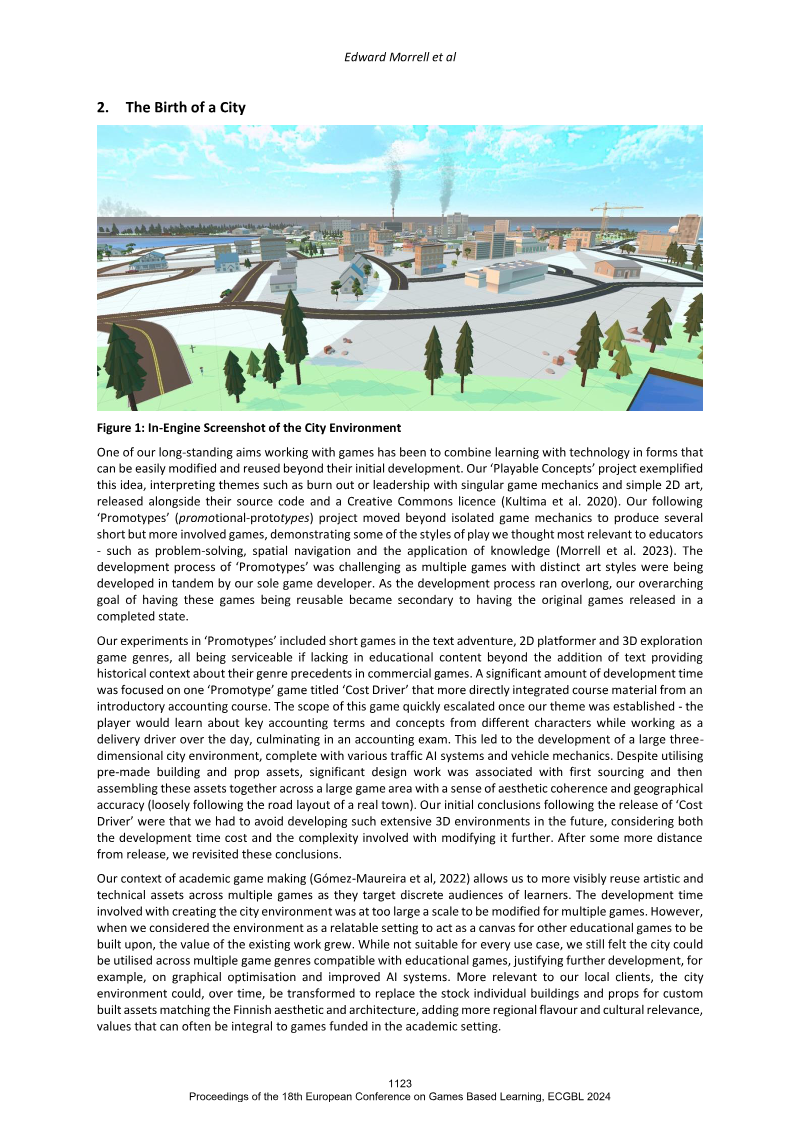
- The 'Cost Driver' delivery-driver game teaching introductory accounting proved hard to modify because its large 3D city environment and tightly interwoven script, mechanics, and content were closely coupled.
From Boring Tests to Engaging Adventures: A Game-Based Learning Approach in LMS
This paper describes a game-based approach to language placement testing within the ILIAS Learning Management System at Wismar University of Applied Sciences.
- The project 'Journey to Mars' converts the English placement tests at Wismar University of Applied Sciences into a science fiction point-and-click adventure within the ILIAS LMS, aiming to fix students being placed in mismatched courses and disengaging from assessment.
- The game has three chapters, each with four tests aligned to the language center's three competence levels, set at a spaceport, aboard a spaceship, and on Mars.
- Development relied heavily on generative AI (ChatGPT for dialogue and narrative, DALL-E for imagery, ElevenLabs for voiceovers), which the author says significantly reduced content production effort, and a functional prototype was built within a two-week timeline.
Serious Games in EDI Education: A Preliminary Discursive Literature Review
This preliminary discursive literature review, authored by Thomas Hainey and colleagues, examines serious games and games-based learning as tools for teaching sensitive Equality, Diversity, and Inclusion (EDI) content in higher education.
- Serious games are proposed as a risk-free, immersive environment for practising difficult conversations on emotionally charged Equality, Diversity, and Inclusion (EDI) topics in higher education.
- Evidence is mixed: a randomised controlled trial by Lievense and colleagues found a significant gain in autonomy-promoting strategies but no corresponding improvement in self-efficacy.
- Focus groups evaluating the Rainbow SPARX game found low acceptability, with only 38% of participants saying they would use it, largely because the game appeared dated.
Didactic and Psychological Principles of Successful Design of Serious Games
Becker and Metz's paper offers an evidence-based examination of the didactic and psychological principles that underpin effective Serious Games, with the central thesis that such games succeed only when their structure, feedback, difficulty, and reflection mechanisms are deliberately aligned with explicit learning objectives.
- Serious Games succeed only when structure, feedback, difficulty, and reflection mechanisms are deliberately aligned with explicit learning objectives.
- Serious Games enable safe, realistic learning-by-doing, where players experience the consequences of their decisions and gradually build expertise through repeated routines.
- As competence rises, motivation tends to follow, reinforcing sustained engagement with the game.
Progress Visualisation, Competition, and Collaboration in Digital Game-based Learning as Audience (DGBL-AA)
The paper proposes Digital Game-based Learning as Audience (DGBL-AA), a framework in which learners watch a subject-independent progress-visualisation game, "Frogs," that is linked to their learning scores.
- The DGBL-AA framework has learners watch a subject-independent progress-visualisation game, "Frogs," linked to their learning scores, capturing game motivation without requiring direct play and aiming to reduce distraction and implementation costs.
- In a 2023 quasi-experimental study of 54 children aged 8 to 9, the experimental groups (n=28, competition and collaboration modes) outperformed the control group (n=26) on recall tests, with means of 12.36 versus 10.77 (p=.009).
- The competition group performed better than the collaboration group in the 2023 study, but the broader analysis found no significant difference between the two game modes (p=.218).