
DiGRA
The Digital Games Research Association: the international association of academics and professionals who study digital games. Its Digital Library holds the proceedings of the DiGRA conferences since 2002.
Documents
Have Fun Working with Our Product!: Critical Perspectives on Computer Game Mod Competitions
The document argues that game mod competitions function as a strategy through which the games industry draws on unpaid modder labour, converting hobbyist creativity into commodified leisure, free promotion, and recruitment opportunities.
- Game mod competitions let the games industry draw on unpaid modder labour, with contest prizes and fame standing in for wages, converting hobbyist creativity into commodified leisure, free promotion, and recruitment.
- Contest rules such as end-user licence agreements that grant developers perpetual rights to entries legitimise the appropriation of modders' work.
- Production and consumption in mod culture are mutually dependent rather than cleanly separable, and the industry gains extended product shelf-life, customer loyalty, and market research from modding activity.
Motivational Factors in Game Play in Two User Groups
This study examines motivational factors in game play among two university populations, computer science students and MBA business students at Dalhousie University, with the goal of informing the design of educational games and activities.
- Computer science students (n=59, median age 22) ranked electronic games as their second most favorite activity and played roughly six titles, while MBA business students (n=111, median age 26) ranked gaming sixth of seven activities and played about two titles, favoring board and card games.
- The two groups diverged most sharply on engagement and social factors, which the authors attribute largely to differences in technology exposure; a validation sample of 17 high school students resembled the computer science group more closely, supporting this interpretation.
- Computer science students favored frequent, often daily, online and multiplayer play with strangers, whereas business students preferred infrequent play with acquaintances in the same room.
Evolution of Spatial Configurations in Videogames
This paper examines the basic spatial configurations found in videogames from the earliest titles to the present day, focusing on how these configurations position the player relative to the playfield and how they shape gameplay.
- The paper argues that most videogame spaces can be explained by a few features: the cardinality of gameplay (how many axes the player moves along), the cardinality of the gameworld (how the space can be navigated), and the representation (2D or 3D).
- A central observation is that gameplay cardinality is usually smaller than the cardinality of the gameworld or its representation, so a space rendered in 3D may be navigable in only two dimensions.
- The analysis distinguishes discrete segmentation, where the world is divided into screen-sized fragments, from continuous presentation, where space scrolls with the viewpoint.
Spontaneous Communities of Learning: Learning Ecosystems in Massively Multiplayer Online Gaming Environments
This doctoral research proposal examines how spontaneous communities of learning emerge within massively multiplayer online games (MMOGs), using City of Heroes as its primary case.
- Massively multiplayer online games such as City of Heroes act as informal learning ecosystems where globally dispersed players self-organise to master complex environments.
- The authors argue that because mastery typically requires collaboration, players form symbiotic learning relationships that extend beyond the game into forums, chat channels, and face-to-face meetings.
- The framework draws on legitimate peripheral participation (Lave and Wenger), connectivism (Siemens), and distributed intelligence (Levy), positing that learning is best studied in naturally occurring contexts rather than formal classrooms.
New Design Methods for Activist Gaming
This paper, authored by Mary Flanagan, Daniel C. Howe, and Helen Nissenbaum and presented at the 2005 DiGRA conference, proposes a practical methodology for embedding social and ethical values into the design of games and other technical systems.
- The paper proposes a three-phase, iterative methodology (Discovery, Translation, Verification) for embedding social and ethical values into game and technical system design, positioned as an augmentation of existing game design and HCI practices rather than a replacement.
- Discovery identifies values from four sources: definition values stated in project goals, collateral values arising from specific design choices, designer values rooted in team members' backgrounds, and user values revealed through prototyping and usability testing.
- Translation converts identified values into concrete design specifications, illustrated by a code-sharing and reward mechanism in the RAPUNSEL game that operationalized cooperation.
Realistic Agent Movement in Dynamic Game Environments
This paper addresses the challenge of realistic agent movement in computer games, particularly pathfinding in dynamic environments where the game world can change in real time.
- The paper argues that traditional pathfinding methods such as A and navigation meshes rely on static, pre-processed map representations, which become inadequate once physics middleware lets players and agents alter level geometry in real time.
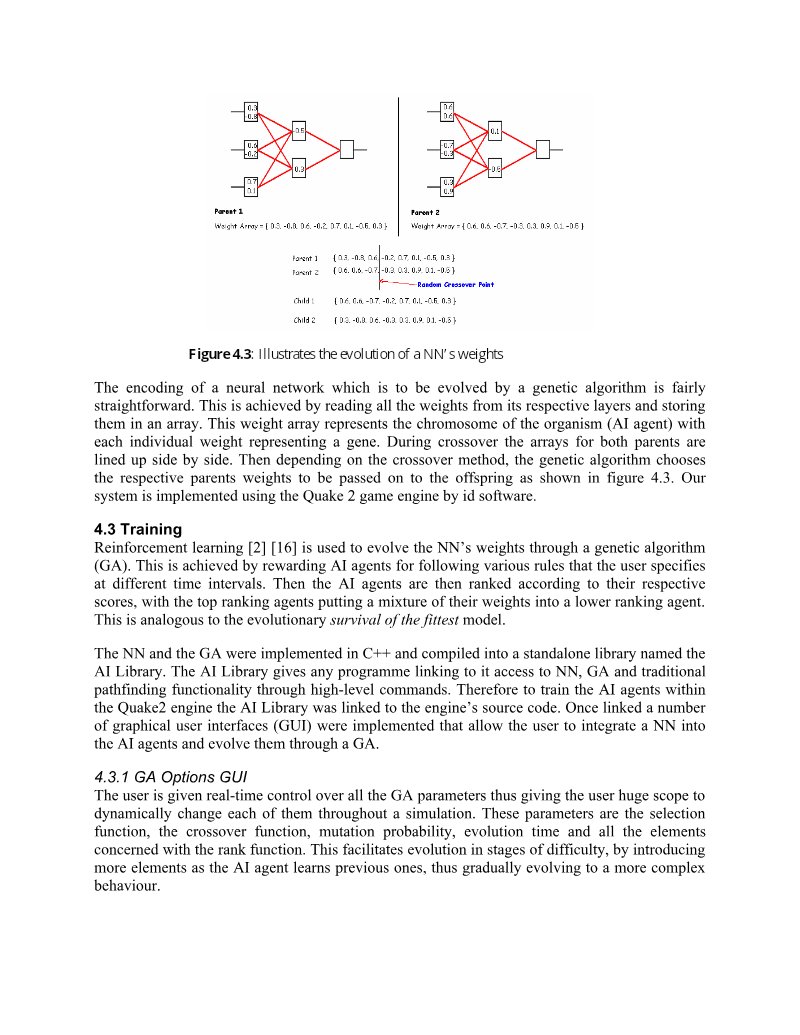
- The authors propose giving agents real-time awareness via four ray-casting sensors spanning a 90-degree field of vision, feeding an artificial neural network that controls movement, with weights evolved by a genetic algorithm guided by reinforcement-style scoring.
- The approach was implemented as a test bed on the Quake 2 engine using a custom C++ AI library, with graphical tools allowing users to adjust evolution and network parameters during training.
An Irrational Black Market? Boundary Work Perspective on the Stigma of In-Game Asset Transactions
This study examines the social stigma surrounding cash trades of in-game assets in Taiwan, a market in which players sell virtual currency and items for real money.
- The stigma around cash trades of in-game assets stems less from the virtual nature of the goods than from how the market blurs boundaries between work and play, adulthood and adolescence, and real and virtual, based on interviews with eleven participants (six sellers, five buyers) of Lineage, Lineage2, and Ragnarok Online in Taiwan.
- A Bahamut forum survey found 42.75% of respondents supported in-game asset transactions versus 22.57% opposed, suggesting Taiwanese gamers prioritize player interaction over strict adherence to game rules.
- Taiwan's roughly 1.9 million online gamers form a substantial base for a secondary market that has grown from individual trades into commercial operations employing low-wage workers in China as "currency farmers."
Designing Puzzles for Collaborative Gaming Experience: CASE eScape
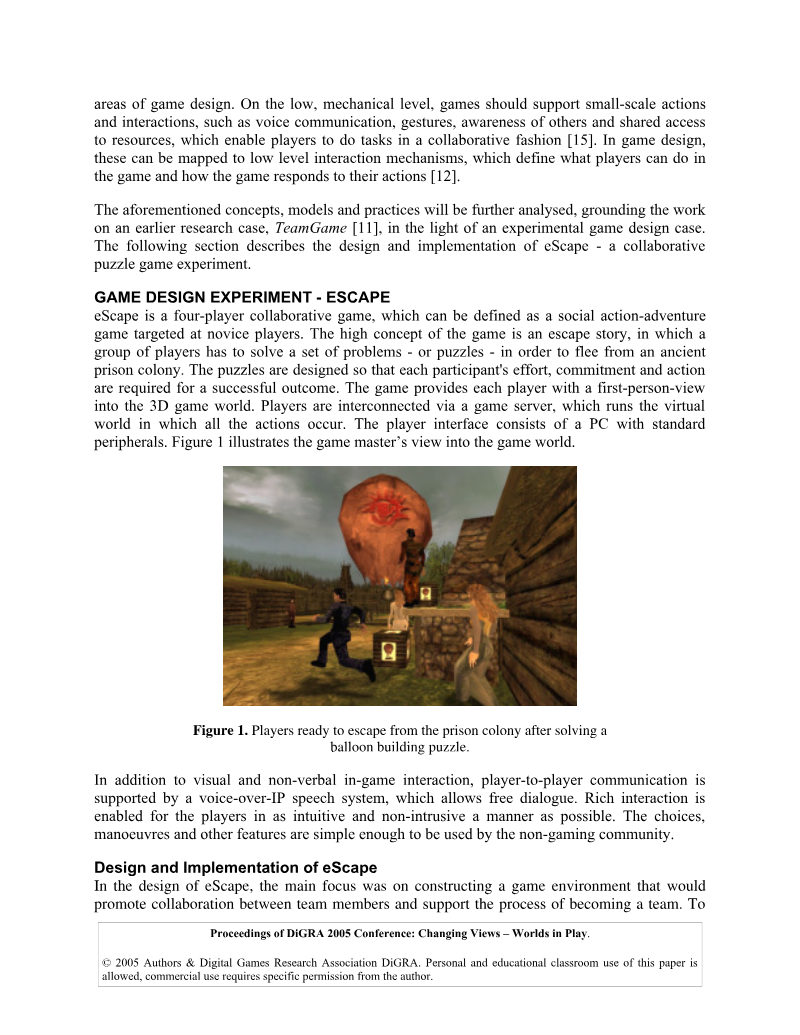
The document examines the design of collaborative puzzles for multiplayer games, using CASE eScape, a four-player social action-adventure built as a total conversion of Unreal Tournament 2003, as its test case.
- Designing multiplayer puzzles that truly require cooperation has received little systematic attention, since single-player puzzle design is well documented but collaborative puzzle guidance is scarce.
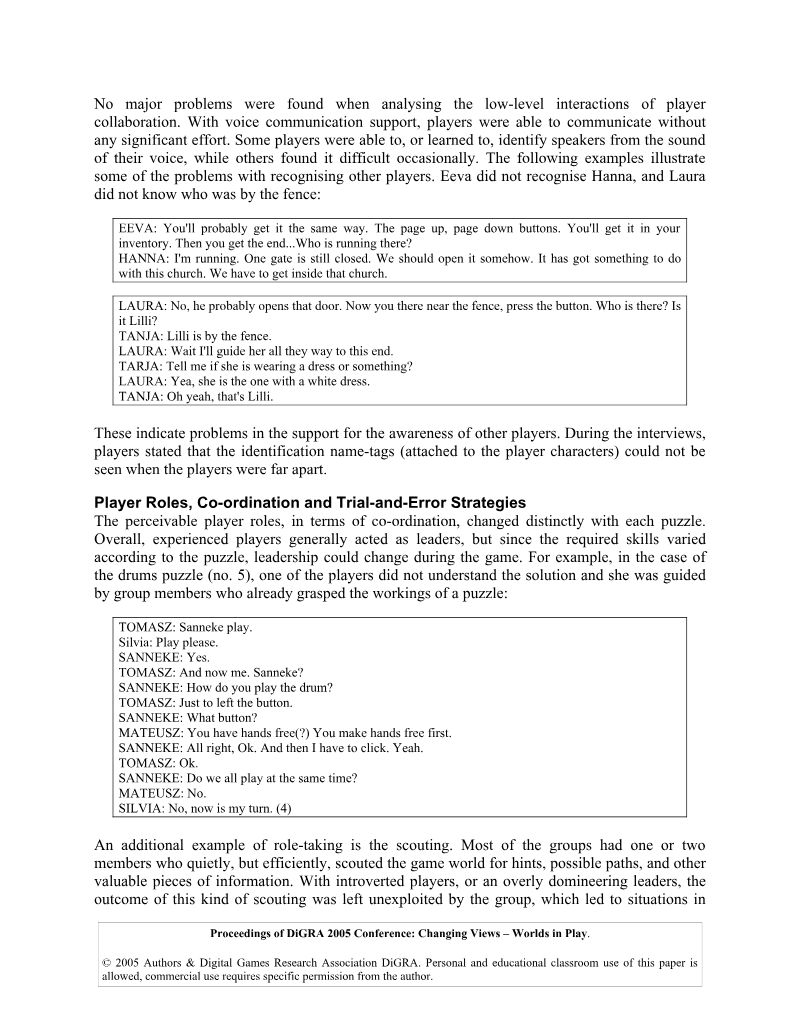
- In observations of six groups of four non-gamers playing CASE eScape, participants consistently reported stronger collaboration than the recordings showed, with puzzles such as the climbing and bee puzzles often solved by only one to three players.
- Trial-and-error approaches frequently caused coordination problems, and awareness of other players suffered partly because name tags were invisible at a distance.
When Game Design and Narratives Unite
Dominic Arsenault's paper, presented as an extended version of a 2005 DiGRA conference talk, proposes the "dynamic range" as an analytical tool for examining how game systems grant players freedom, and uses that tool to explore the relationship between game design and narrative.
- Arsenault's central thesis is that game design actively shapes narrative content, and the two work well together only when the game system's openness matches the designer's narrative intentions.
- The paper introduces 'dynamic range' as a tool measuring how far a player can manipulate a game's internal dynamics to meet a challenge, drawing on the MDA framework of mechanics, dynamics, and aesthetics, and treats openness as a matter of degree rather than a binary.
- Diablo's resource-driven system offers wide internal manipulation, whereas Splinter Cell relies on external player skill and so offers a narrow dynamic range, as shown through character charts of a level-22 Warrior and Sam Fisher.
A Brief Social History of Game Play
Dmitri Williams's paper examines the social history of video game play in the United States, the birthplace of commercial video games.
- The popular stereotype of the isolated teenage gamer diverges sharply from the statistical and historical record, which points instead to vibrant social settings and diverse playing communities.
- The early 1980s were a pivotal turning point: gaming, initially an open and free space for cultural and social mixing, was rapidly reshaped by industrial and political forces rather than by game content, producer goals, or consumer demand.
- Age, gender, and place have been framed as seemingly natural characteristics of gaming, a framing that obscures issues of power and control in ways that favor some groups over others.
Cinematic Camera as Videogame Cliché
This paper argues that the videogame camera is fundamentally a computational construct rather than an optical one, and therefore is not bound to the linear, lens-based perspective that dominates cinema and photography.
- The videogame camera is a computational construct, not an optical one, so it is not bound to the linear, lens-based perspective that dominates cinema and photography.
- The authors argue that contemporary game design has increasingly adopted cinematic camera conventions, a tendency they describe as a cliché that narrows games' expressive vocabulary and blurs the boundary between games and film.
- The paper traces linear perspective from Renaissance scientific perspective through Cubism's rejection of it, and cites Lev Manovich's account of how linear perspective became an unquestioned default in computer interfaces.
The Pervasive Interface: Tracing the Magic Circle
Eva Nieuwdorp's DiGRA 2005 paper, "The Pervasive Interface: Tracing the Magic Circle," argues that pervasive games, which embed fantasy within everyday physical and social settings, demand a rethinking of what counts as an interface.
- Eva Nieuwdorp's DiGRA 2005 paper argues that pervasive games, which embed fantasy within everyday physical and social settings, require rethinking the concept of an interface beyond hardware and screens.
- The paper proposes a "liminal interface" crossed in two stages: the paratelic interface, a playful state where players set aside lifeworld conventions through Goffman's rules of irrelevance, and the paraludic interface, a rule-bound structure where the game world's semiotic conventions dominate.
- The paper reworks the magic circle as a permeable, two-way boundary rather than a sealed space, and contends that the game world must feel omnipresent and internally consistent or the magic circle is pierced and the game collapses.