1 free read left. Create a free account for unlimited reading + AI research.
Create free accountWhitepaper DiGRA
1 free read left. Create a free account for unlimited reading + AI research.
Create free accountWhitepaperDiGRA
The paper describes geocaching as a global, socially organized mixed-reality game with more than 747,000 caches worldwide by early 2009.
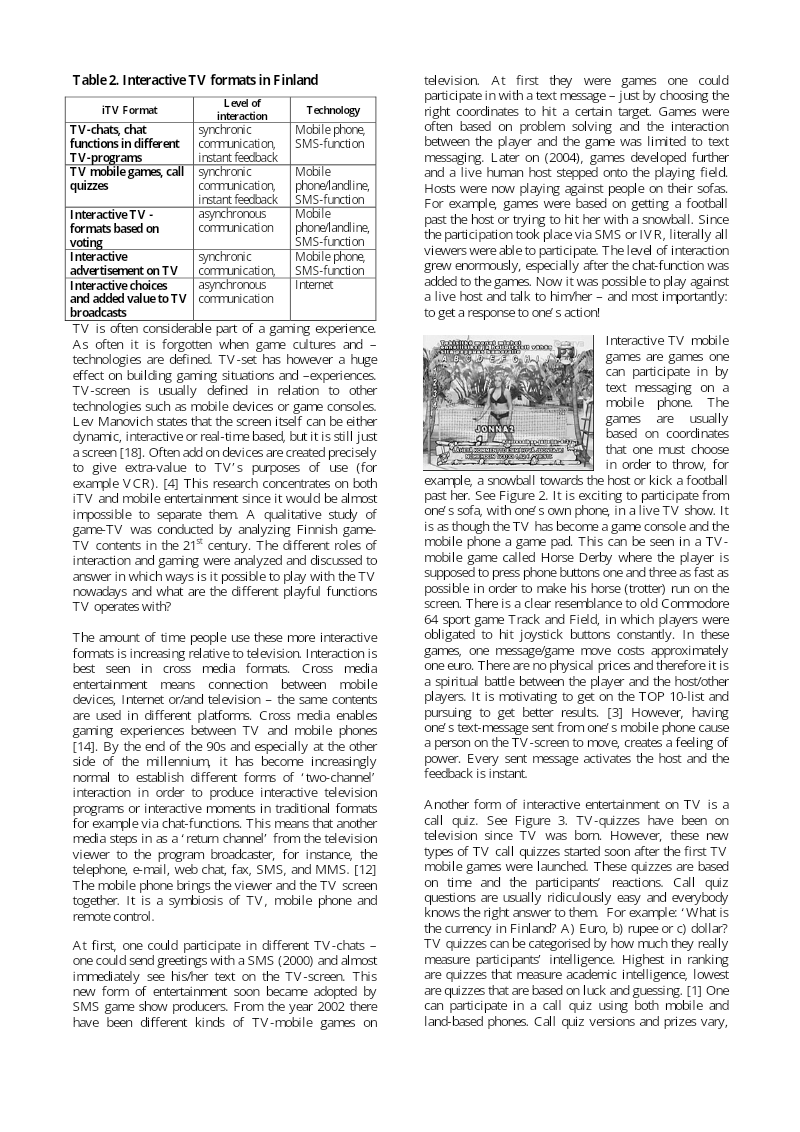
This paper examines two mobile device-based game forms from the 21st century that have achieved strong user popularity yet remain peripheral to mainstream game research: geocaching and SMS-to-TV human-hosted interactive television games. The authors position these marginal forms as deserving academic attention, arguing that their success and boundary-blurring characteristics offer new perspectives for game studies. The study addresses questions about the game cultures these forms represent, the reasons behind their success, and the dimensions they exhibit.
The research employs a qualitative methodology, combining interviews with geocachers, analysis of geocaching web pages and forums, and content analysis of roughly 35 hours of recorded interactive TV formats broadcast between 2004 and 2009. The approach follows a case study design suited to examining contemporary phenomena within their real-life contexts, with the geocaching material spanning 2001 onward. The authors draw on literature from game studies, media studies, and digital culture to interpret their observations.
Key findings include the observation that geocaching functions as a global, socially organized mixed-reality game, with over 740,000 active participants and more than 747,000 caches worldwide by early 2009, supported by a central web platform and regional forums. The interactive TV analysis traces an evolution from simple text-message participation to live human hosts who play against viewers, with interactivity and cross-media connections driving engagement. The authors contend that mobility in these games differs fundamentally: geocaching allows play anytime and anywhere, while TV-mobile games confine players to the television broadcast.
The paper concludes that these marginal forms challenge traditional game boundaries and that the rapid evolution of mobile and cross-media gaming makes their systematic study essential to the future of game research.
DiGRA · 2016
DiGRA · 2016
DiGRA · 2016
DiGRA · 2016
DiGRA · 2016
DiGRA · 2016
DiGRA · 2016
DiGRA · 2016
DiGRA · 2016
DiGRA · 2016
DiGRA · 2016
DiGRA · 2016