1 free read left. Create a free account for unlimited reading + AI research.
Create free accountWhitepaper DiGRA
1 free read left. Create a free account for unlimited reading + AI research.
Create free accountWhitepaperDiGRA
Thirty Year 6 pupils at a South London primary school designed an alternate reality game for thirty Year 5 pupils.
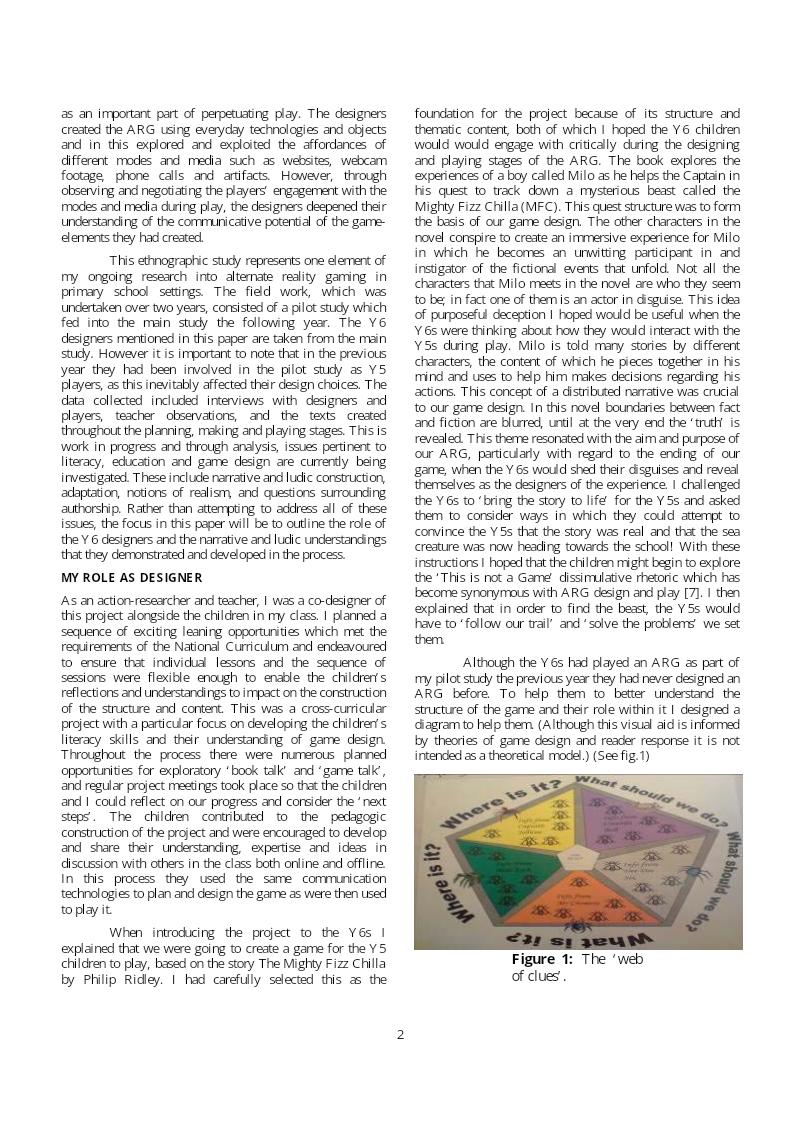
Peer Puppeteers examines an alternate reality game (ARG) designed by thirty Year 6 pupils at a South London primary school for thirty Year 5 pupils, using Philip Ridley's novel The Mighty Fizz Chilla as the narrative foundation. The study argues that children can take on the roles of game-makers, storytellers, and covert "puppeteers," distributing narrative clues through everyday communication technologies such as websites, message boards, films, phone calls, and physical artifacts. Its central proposition is that ARGs can deepen children's literacy and their understanding of narrative and media, and it offers a design framework, the "web of clues," alongside a detailed case study of one team's character creation. The work is qualitative and descriptive, grounded in two years of ethnographic fieldwork, and it is explicitly exploratory rather than conclusive.
The findings center on the dynamic between designers and players. Character websites and message boards conveyed both ludic clues and narrative context, though players did not always grasp the intended relationships between characters. Designers relied on feedback loops, including message board posts, webcam diary entries, and in-character replies, to monitor and steer player responses in real time. Players' unpredictable actions, such as appropriating everyday objects, contributed new rules and story elements, so that the game was co-created rather than fully authored. Designers anticipated many responses without being able to predict them, yet players largely interpreted the game as intended.
Taken together, the study portrays the ARG as a peer-to-peer storytelling experience in which both groups developed a richer understanding of game-making, narrative construction, and the unpredictability of audience interpretation. The authors conclude that understanding narrative and game design as world-building emerged naturally from the project, and that its liminal, playful character fostered substantial learning for designers and players alike. The research's scope is a single school and a single cohort over a limited period, so its claims are necessarily tentative. The authors acknowledge that further analysis is needed to clarify how terms such as "narrative," "story," "game," and "play" apply to ARGs.
DiGRA · 2016
DiGRA · 2016
DiGRA · 2016
DiGRA · 2016

DiGRA · 2016

DiGRA · 2016



DiGRA · 2016

DiGRA · 2016

DiGRA · 2016

DiGRA · 2016

DiGRA · 2016

DiGRA · 2016
Game Developers Conference · 2018