
DiGRA
The Digital Games Research Association: the international association of academics and professionals who study digital games. Its Digital Library holds the proceedings of the DiGRA conferences since 2002.
Documents
Girls and Gaming: Gender Research, "Progress" and the Death of Interpretation
This paper argues that research on gender and gaming has stagnated around a narrow, essentialist conception of gender that the authors describe as canonical, most visibly represented by the early Cassell and Jenkins volume and the widely cited "girl-friendly" game design work of Sheri Graner-Ray.
- The authors argue that gender-and-gaming research has stagnated around an essentialist conception of gender, exemplified by the early Cassell and Jenkins volume and Sheri Graner-Ray's 'girl-friendly' game design work, which treats socially constructed conventions as natural inner truths.
- The recurring 'findings' about what girls prefer are framed not as simple methodological errors but as products of a self-reinforcing epistemic framework, and the authors contend this orthodoxy reinstates inequality of access and opportunity.
- The supposed contrast between cooperative girls and competitive boys is challenged: the authors' observations show many girls enjoy highly competitive play, and apparent cooperation often occurs within forms socially permitted for girls.
Critical Potential on the Brink of the Magic Circle
Poremba's "Critical Potential on the Brink of the Magic Circle" examines "brink" or "forbidden" games, which deliberately blur the boundary between play and reality, such as The Stone Throwers, Intimate Controllers, and Twister.
- Poremba's paper argues that 'brink' or 'forbidden' games, such as The Stone Throwers, Intimate Controllers, and Twister, deliberately blur the boundary between play and reality, making them worth studying for the tension they create between in-game and real-world rules.
- The paper's principal theoretical contribution is challenging the classic 'magic circle' concept (Huizinga, Caillois), which treats games as set apart from reality, in favor of viewing games as entangled with social life.
- Drawing on Luhmann's functional systems theory, the author proposes a descriptive, function-focused approach for assessing the critical potential of brink games.
The Cultural Economy of Ludic Superflatness
This paper examines the "superflat" aesthetic described by artist Takashi Murakami as a defining feature of Japanese visual culture, applying it specifically to Japanese digital games as an interpretive framework it terms "ludic superflatness."
- Ludic superflatness is presented as a framework applying Takashi Murakami's superflat aesthetic to Japanese digital games, treating it as an agentive, polemical expression of culturally hybrid national identity shaped by postwar Japan's relationship with the United States and the blurring of high art and subculture.
- The author argues that games such as the Katamari series, WarioWare: Mega Microgame$, and Viewtiful Joe embody superflat aesthetics through flattened 2D visual conventions, serial reproducibility, and intertextual pastiche while reflecting contemporary commercial production logics.
- The analysis uses cultural economy theory, which treats economic and symbolic processes as mutually constitutive, reading games as assemblages of aesthetic, gameplay, and commercial practices.
Designing Games to Effect Social Change
"Designing Games to Effect Social Change" is a practitioner-oriented paper by Chris Swain of the USC Game Innovation Lab that offers a set of best practices for building games intended to raise awareness of and drive action on social issues.
- Games for social change have struggled to demonstrate measurable real-world impact, and the paper proposes a framework to close that gap, starting with defining quantifiable intended outcomes at the beginning of production.
- Core recommendations include integrating subject matter experts into the design team, partnering with credible advocacy organizations, building sustainable community features, and measuring knowledge transfer through in-game surveys or focus groups.
- The Redistricting Game set a goal of generating 5,000 letters to Congress and built a "Write Congress" feature into its game flow, with advocacy partnerships extending its reach.
The Place of Mobile Gaming: One History in Locating Mobility in the Asia-Pacific Region
This paper by Larissa Hjorth examines the relationship between mobile gaming and the concept of place within the Asia-Pacific region, arguing that the local remains a powerful force despite the global rhetoric of convergence between mobile communication and gaming.
- Hjorth argues that the local remains a powerful force in mobile gaming despite global rhetoric about convergence, and that futurist or technologically deterministic frameworks alone cannot explain how mobile play is practiced.
- The paper contrasts two models: South Korea, regarded as having the world's best broadband infrastructure, centres on massively multiplayer online games played in social PC bang venues, with Seoul alone reported to host more than 20,000 such rooms.
- Japan is portrayed as pioneering convergent mobile platforms and privatized handheld play, rooted in the keitai (mobile phone) culture.
If Power Gamers Aren't Fans, Who Are?
Wirman's paper challenges a long-standing assumption in game culture: that productivity, whether in the form of forum contributions, walkthroughs, or extensive participation in massively multiplayer games, reliably signals fandom.
- Productivity in games (forum contributions, walkthroughs, heavy MMO participation) does not reliably signal fandom: power gamers who produce heavily may not identify as fans at all, exposing conceptual ambiguity between the two categories.
- Wirman distinguishes instrumental texts that serve efficient play, such as walkthroughs, community databases like Thottbot, and cheat listings, from expressive texts like fan fiction, poetry, and machinima, which align more closely with traditional fan practice.
- Informal surveys of World of Warcraft forums found that most respondents self-identified as fans while power gamers were less likely to do so, with a gendered dimension evident in these self-identifications.
Real-Time Sweetspot: The Multiple Meanings of Game Company Playtests
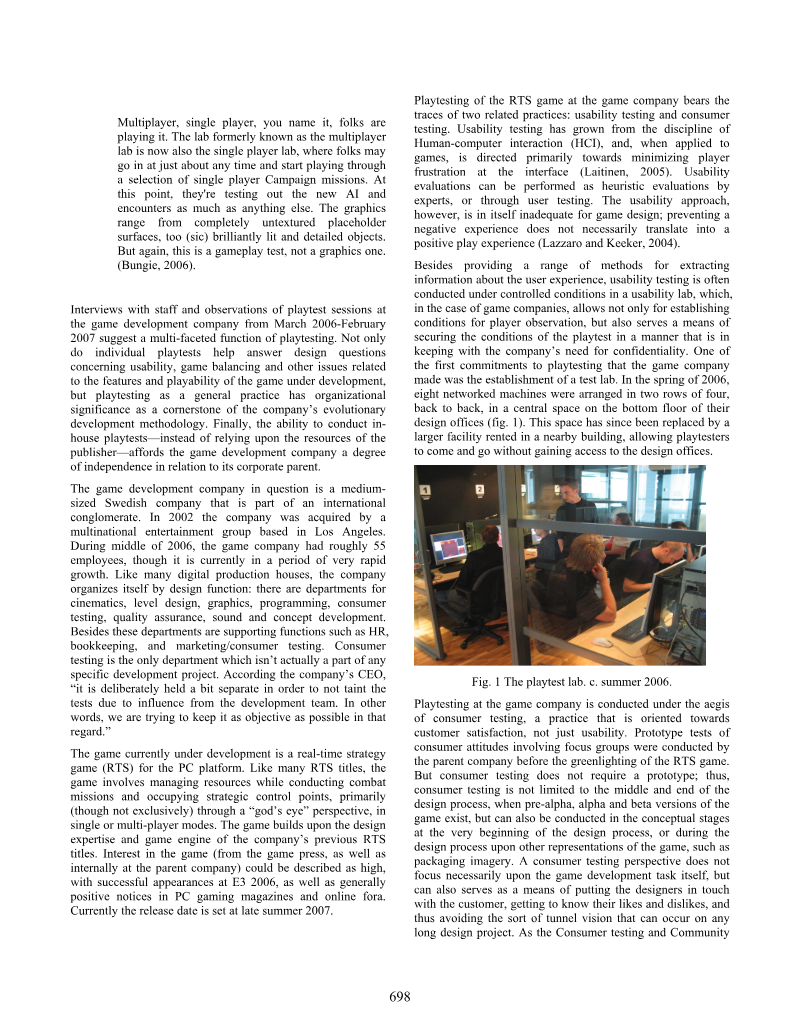
This paper examines how game companies use playtesting, focusing on a single "Sweetspot" balancing test conducted in March 2006 for a real-time strategy game at a medium-sized Swedish studio, part of an international entertainment conglomerate.
- The paper examines a single 'Sweetspot' balancing playtest conducted in March 2006 for a real-time strategy game at a medium-sized Swedish studio owned by an international entertainment conglomerate, based on interviews and observations from March 2006 to February 2007.
- Playtesting serves more than design iteration: inside the company it creates clarity in an evolutionary, biweekly build-based process, and outside it communicates project status to the publisher and parent company.
- In the Sweetspot test, eight playtesters rated four builds varying unit hit points and reinforcement tempo, and the lead designer implemented changes overnight, with the next build confirming the balancing decision.
Virtual Worlds and Fraud: Approaching Cybersecurity in Massively Multiplayer Online Games
Virtual Worlds and Fraud examines the emerging security threat posed by fraud in massively multiplayer online games (MMOGs).
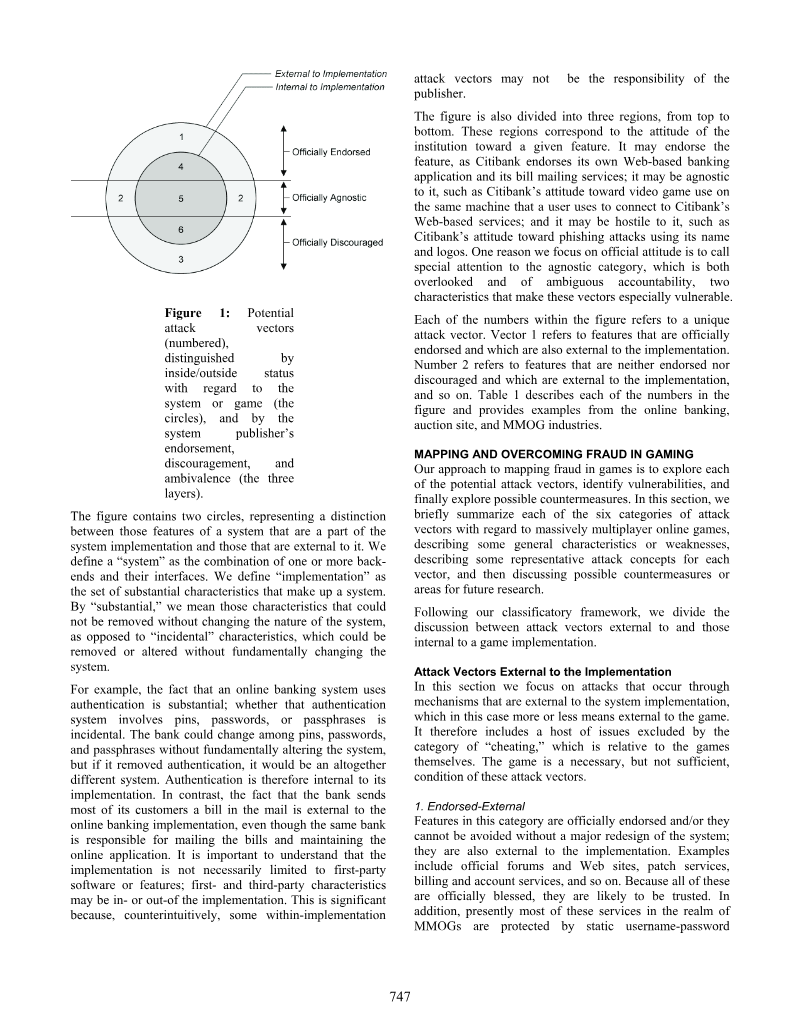
- Fraud in massively multiplayer online games is emerging as a security threat because the monetization of virtual possessions and growing product placement are pulling conventional online fraud (phishing, click-fraud, impression fraud) into game environments.
- Game scripts and modifications can serve as vehicles for malware and spam, making game content itself a potential attack channel.
- The authors argue that MMOGs are a distinct security domain, since their rule complexity and social features set them apart from earlier cheating research, which focused narrowly on cheating (taxonomies, bot detection, lag exploitation, player ranking).
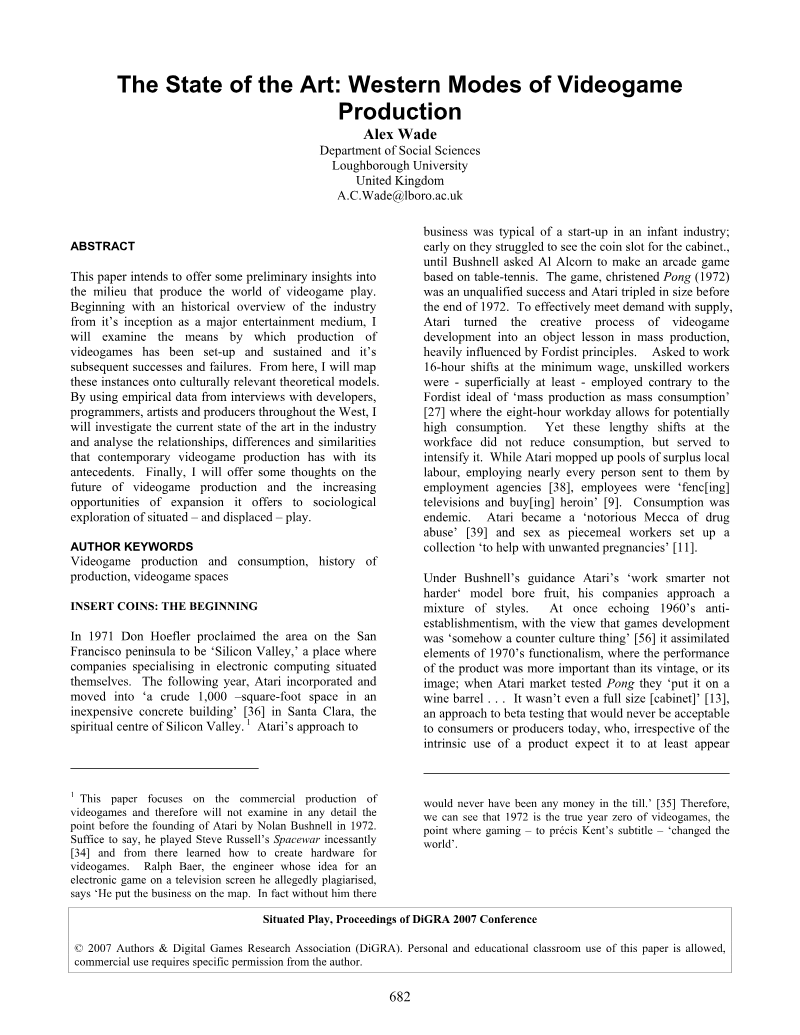
The State of the Art: Western Modes of Videogame Production
Western videogame production has long been defined by a close entanglement between the making and the playing of games, and this study argues that the boundary between producer and consumer has grown increasingly porous over the industry's history.
- The study traces the producer-consumer boundary in Western videogame production from Atari's founding in 1972 through the UK home-computer boom of the early 1980s, arguing that the line between making and playing games has grown increasingly porous.
- Atari's loosely managed, Fordist-influenced production gave way to home consoles that moved play into private space, while Spectrum-era bedroom coding and cassette copying fostered a more integrated relationship between creators and players.
- Interviews with eleven industry professionals conducted in 2006 indicate that development is increasingly governed by market research, licensing arrangements, and consumer demand rather than purely creative or technical possibility, with long working hours and globally distributed teams common.
Exporting Wars: Literature Theory and How It Explains the Video Game Industry
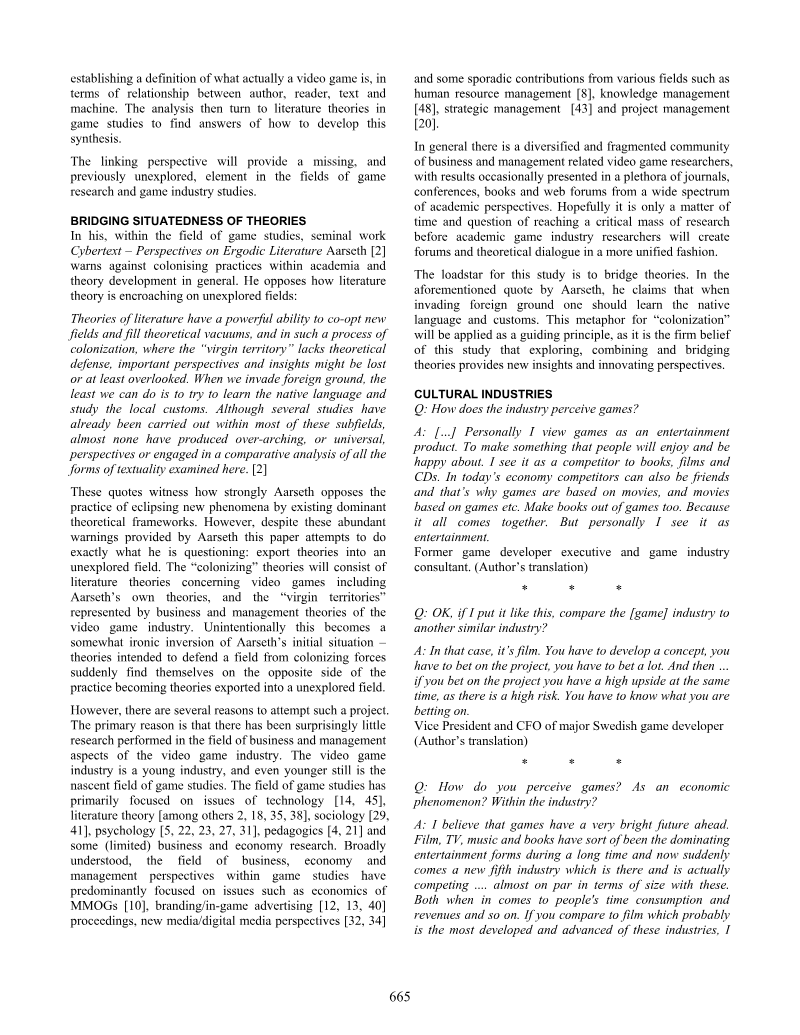
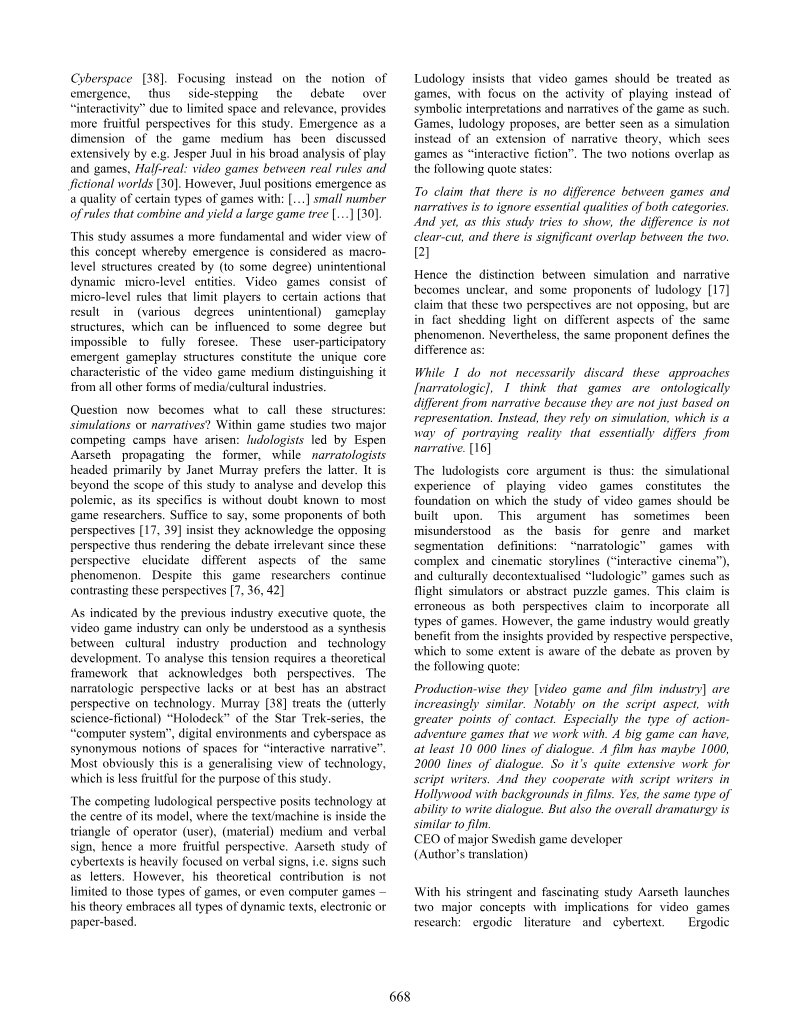
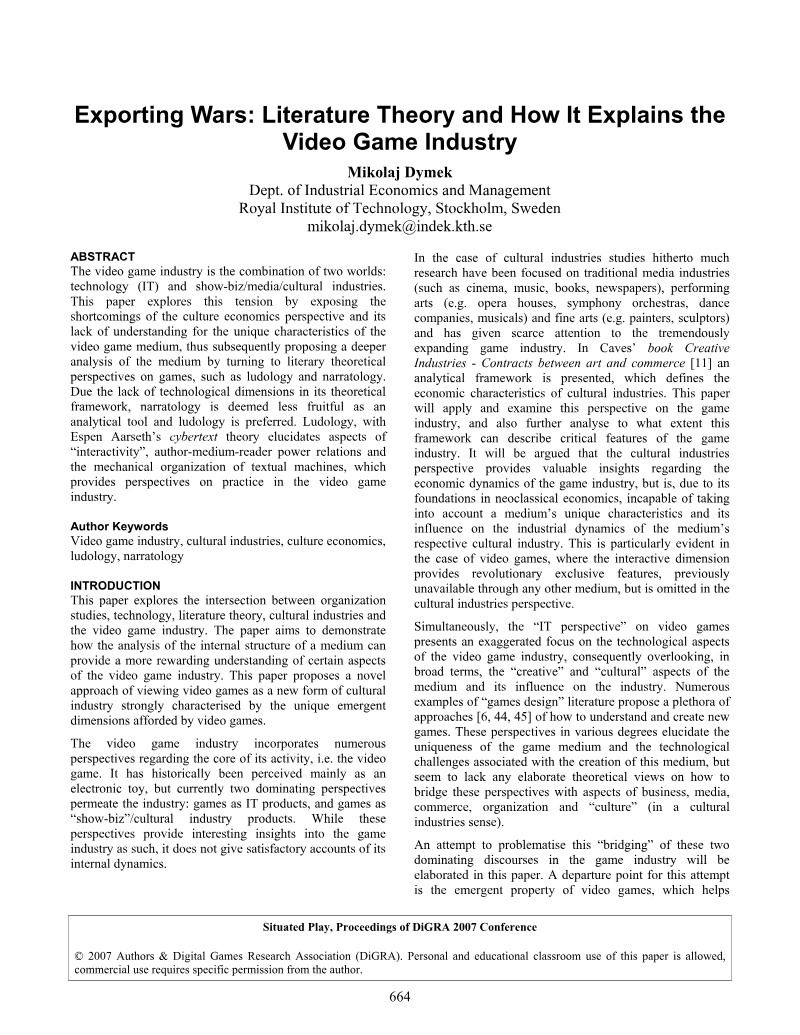
Dymek's paper argues that the video game industry occupies a hybrid position between information technology and cultural industries, and that existing cultural-industries theory, particularly Caves's framework, captures many of the sector's familiar dynamics.
- Dymek argues that the video game industry sits between information technology and cultural industries, and that Caves's cultural-industries framework captures familiar dynamics such as uncertain demand, the coordination of a 'motley crew' of creative and technical workers, hit-driven markets, and long development cycles, but is incomplete.
- The central gap identified is interactivity (emergence and simulation), which distinguishes games from other media; to fill it, the paper draws on ludology and Aarseth's cybertext theory, framing games as a cybernetic user-machine relationship rather than an authored text.
- The paper proposes a 'cybertext-cultural industry' perspective that joins cultural-industry production with technological development, arguing that bridging literary theory with economic analysis gives a fuller account of games than either alone.
Experiential Modes of Game Play
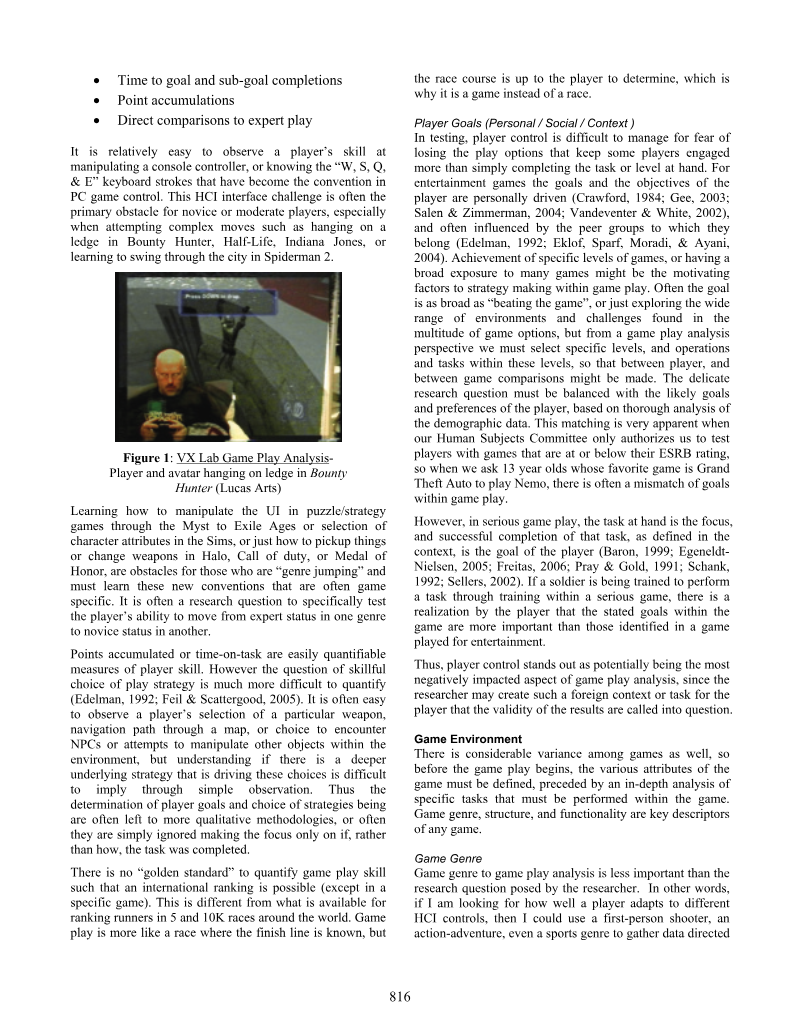
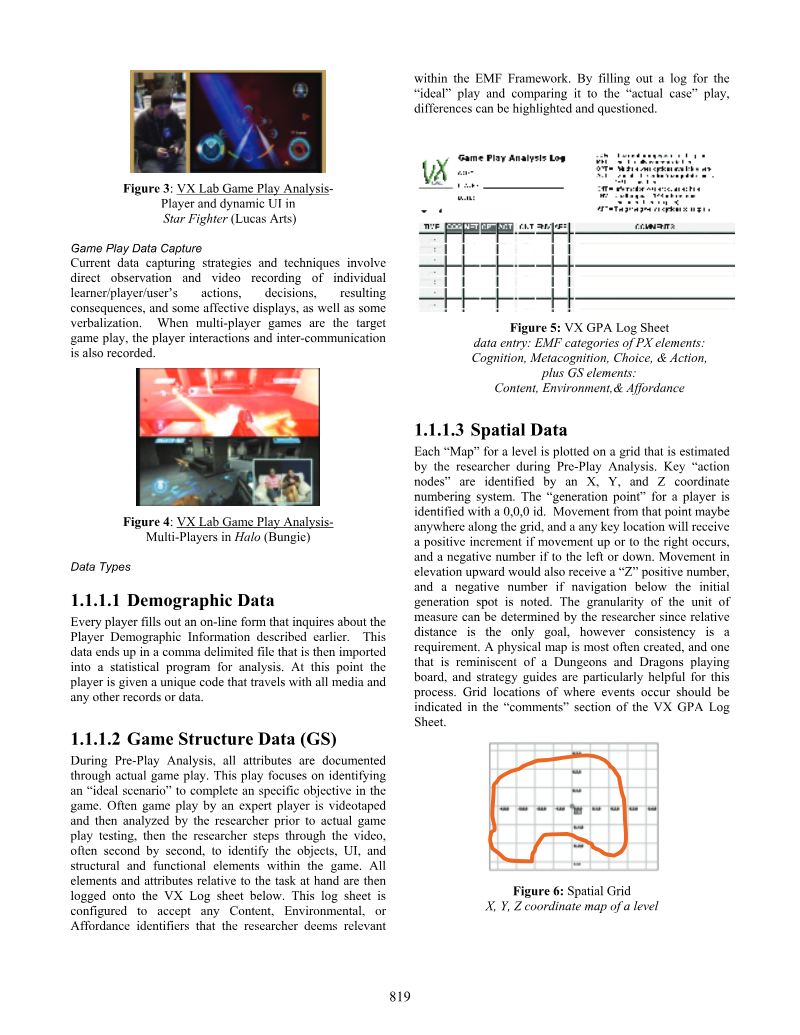
Robert Appelman's paper presents the Experiential Mode Framework (EMF), a standardized methodology developed at the Virtual Xperience Lab at Indiana University for analyzing how people play video games.
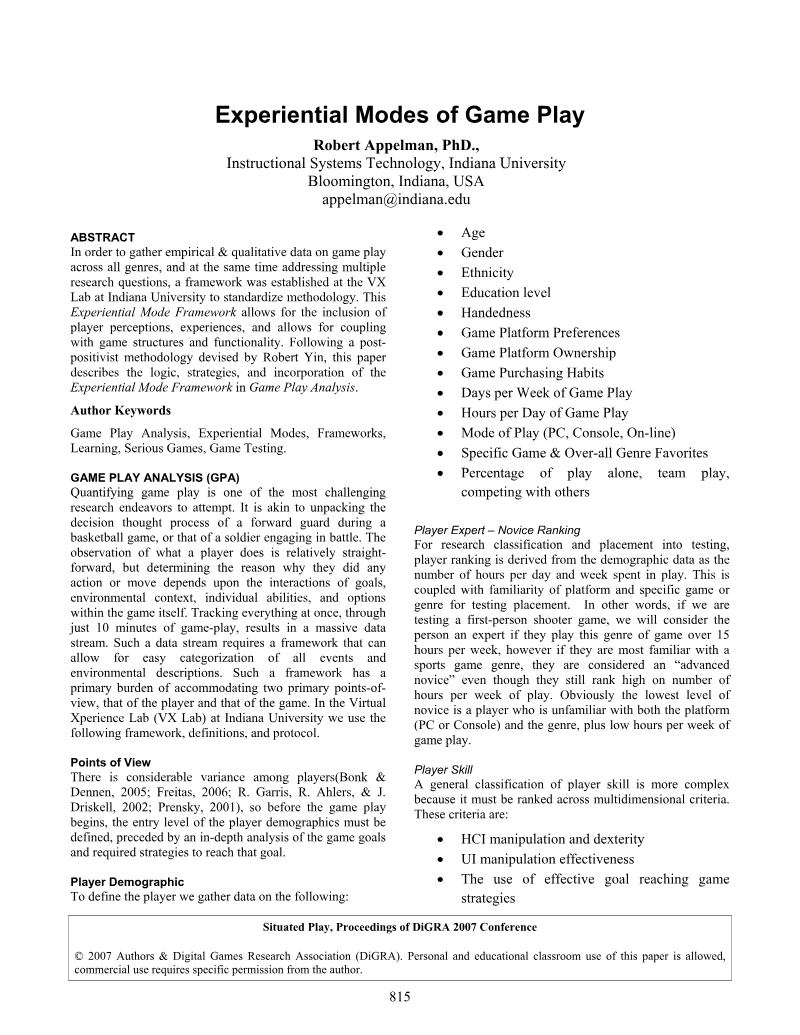
- The Experiential Mode Framework (EMF), developed at Indiana University's Virtual Xperience Lab, separates game analysis into Player Experience (cognition, metacognition, choice, action) and Game Structure (content, environment, affordances) to make game play easier to study systematically.
- The framework uses Robert Yin's multiple case study methodology, treating each play session as a distinct case and comparing patterns across sessions rather than aggregating results into statistical scores.
- The methodology has four phases: pre-play analysis of demographics and game structure, data capture via video, observation and interviews, pattern-based analysis, and summative conclusions.
Levels of Sound: On the Principles of Interactivity in Music Video Games
This paper examines the principles of interactivity in music video games, a small but distinctive genre whose roots extend to the 1970s and whose recent releases, such as Guitar Hero and Electroplankton, have achieved both mainstream success and artistic recognition.
- The paper divides music video games into two overlapping categories, rhythm games and electronic instrument games, and argues their interactive properties can be organized into a grammar of design.
- The framework identifies seven recurring qualities: active scores, rhythm action, quantisation, synaesthesia, play as performance, free-form play, and sound agents.
- Rhythm games centre on repetition and matching a tempo, with success measured as a score, whereas instrument games emphasize quantised, open-ended composition where the input-to-sound mapping is governed by convention rather than physics.