1 free read left. Create a free account for unlimited reading + AI research.
Create free accountArticle DiGRA
1 free read left. Create a free account for unlimited reading + AI research.
Create free accountArticleDiGRA
The paper argues that the Katamari series, WarioWare: Mega Microgame$, and Viewtiful Joe embody superflat aesthetics through flattened 2D conventions, serial reproducibility, and intertextual pastiche.
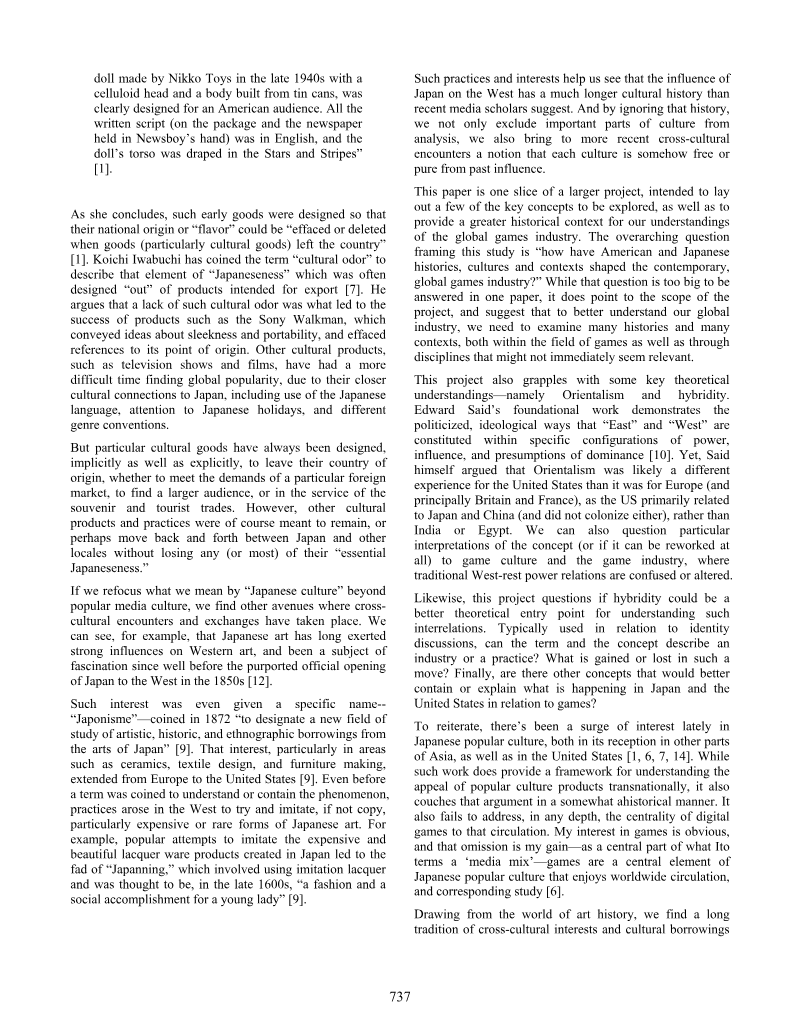
This paper examines the "superflat" aesthetic described by artist Takashi Murakami as a defining feature of Japanese visual culture, applying it specifically to Japanese digital games as an interpretive framework it terms "ludic superflatness." The author argues that superflatness is a complex, agentive and polemical expression of culturally hybrid national identity, born from the entangled histories of postwar Japan, its relationship with the United States, and the blurring of high art and subculture. Its central claim is that games such as the Katamari series, WarioWare: Mega Microgame$, and Viewtiful Joe embody superflat aesthetics through flattened 2D visual conventions, serial reproducibility, and intertextual pastiche, while also reflecting the commercial logics of contemporary cultural production.
The analysis draws on cultural economy theory, which treats economic and symbolic processes as mutually constitutive, and reads these games as assemblages of aesthetic, gameplay, and commercial practices. Key observations include the way serialisation structures both gameplay and fandom, particularly among otaku audiences, and how the WarioWare franchise openly mirrors its own corporate production ethos. Viewtiful Joe is examined as a case where Murakami's three-stage strategy for global marketing, moving from foreign recognition back to domestic adaptation, appears to converge, combining Western and Japanese pop references with a demanding, high-skill gameplay design.
The paper concludes that ludic superflatness functions as a reflexive, historically grounded practice that negotiates tensions between nationalism, local identity, and transnational capitalism. It also notes the precariousness of such commercially driven creative work, pointing to the closure of Clover Studio and the departure of key designers as evidence of the fragility of this production model.

DiGRA · 2022

DiGRA · 2022



DiGRA · 2022



DiGRA · 2022

DiGRA · 2022

DiGRA · 2022



DiGRA · 2022

DiGRA · 2022

DiGRA · 2022



DiGRA · 2022



DiGRA · 2022

DiGRA · 2022
DiGRA · 2019