
DiGRA
The Digital Games Research Association: the international association of academics and professionals who study digital games. Its Digital Library holds the proceedings of the DiGRA conferences since 2002.
Documents
"How Many Headshots You've Done": Achievement as Discursive Practice in Videogame Play
Molesworth's paper argues that achievement in videogame play functions as a discursive practice through which adults reproduce a sense of individualised progress that is otherwise lacking in their work and consumer lives.
- The paper argues that achievement in videogame play acts as a discursive practice that lets adults recreate a sense of individualised progress missing from their work and consumer lives, drawing on Bauman's account of an episodic, individualised society.
- The study is based on 24 phenomenological interviews with adult players in southern England, conducted between June and October 2006, comprising roughly 50 hours of recordings.
- Three recurring themes emerged: anticipating new hardware and releases, experiencing progress through accumulating in-game achievements or crafting something from nothing, and using play to offset work and domestic stress and boredom.
What Sort of Fish Was It?: How Players Understand Their Narrative in Online Games
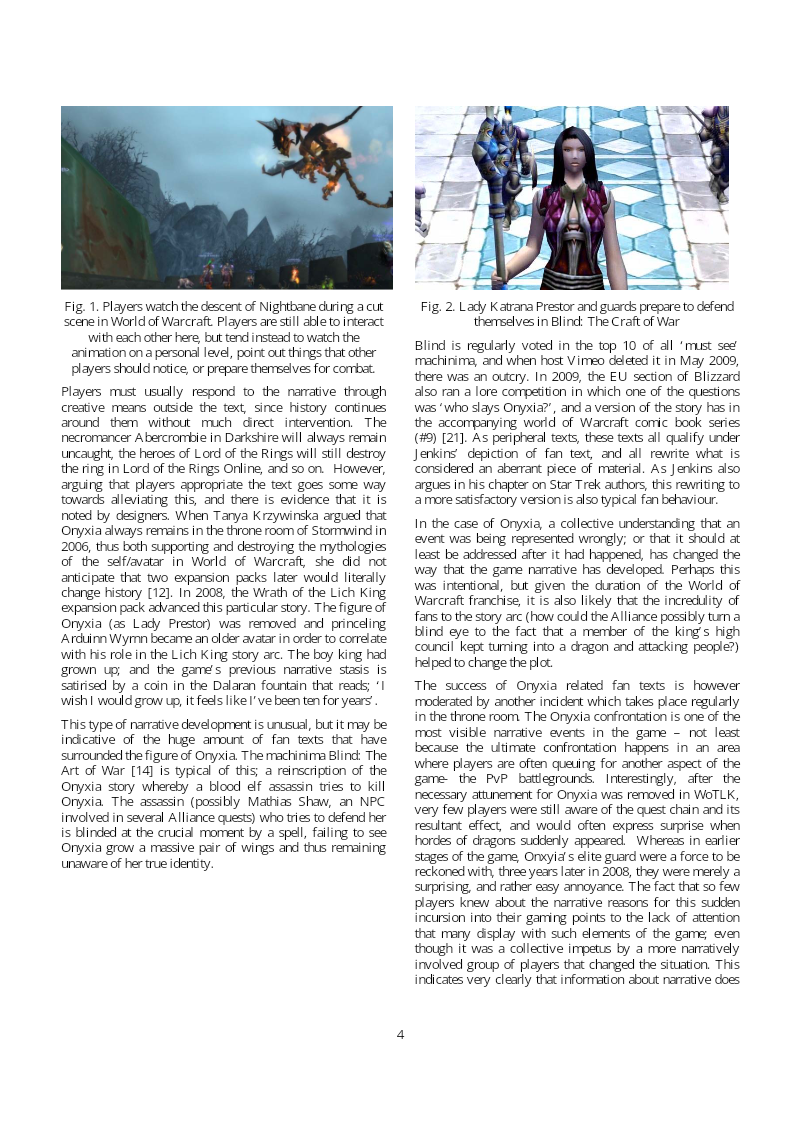
This paper examines how players of massively multiplayer online role-playing games (MMORPGs) interpret and reshape game narratives, drawing on the concept of "textual poaching" from fan studies.
- Online gaming communities are treated as legitimate, complex social entities that justify their conduct by drawing on competing rule sets: in-game norms, end-user license agreements, and informal community codes.
- Players in MMORPGs such as World of Warcraft operate within a text they simultaneously critique and rewrite, a condition the paper calls 'narrative flux', drawing on fan-studies concepts of 'textual poaching'.
- In the Onyxia case, a narratively engaged minority of players altered the game's storyline while most players remained largely unaware of the underlying quest chain and its consequences.
Effects of Peripheral Visual Information on Performance of Video Game with Hemi-Spherical Immersive Projection Screen
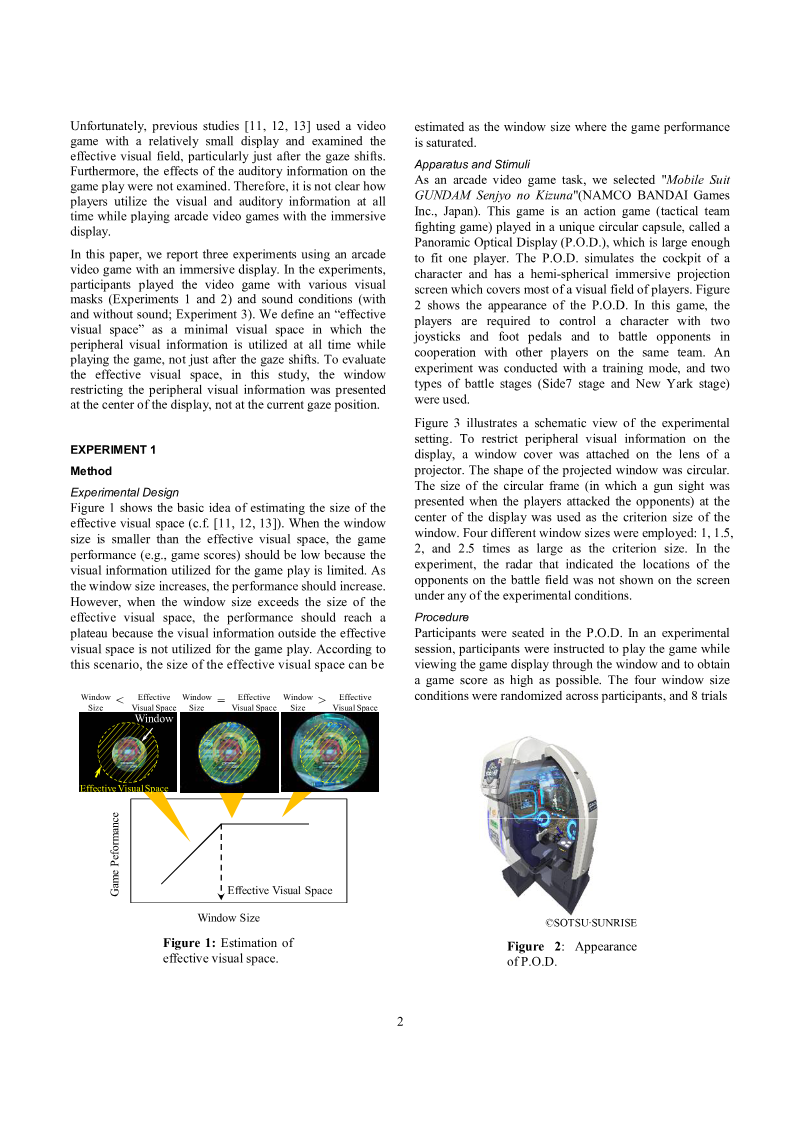
This study examines how players of an arcade action game, "Mobile Suit GUNDAM Senjyo no Kizuna," use peripheral visual and auditory information when playing on a hemi-spherical immersive projection screen inside a Panoramic Optical Display cockpit.
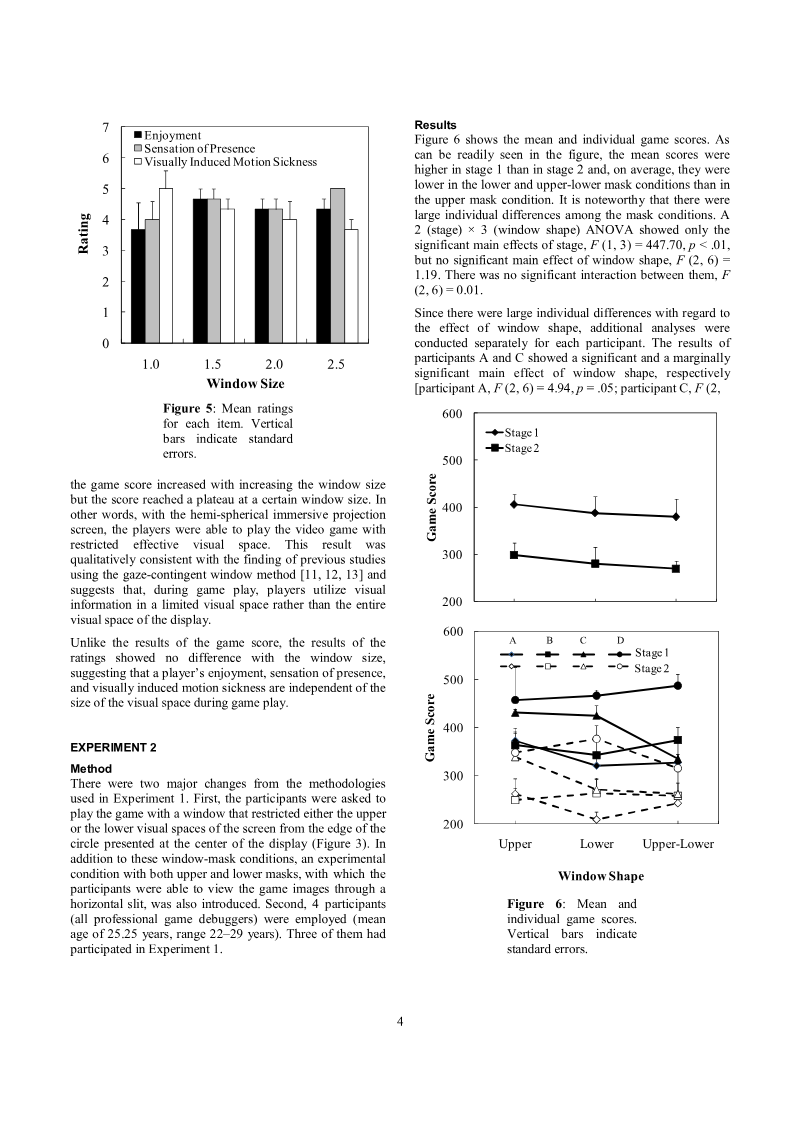
- Players of the arcade action game "Mobile Suit GUNDAM Senjyo no Kizuna" on a hemi-spherical immersive screen used a limited effective visual space: game scores rose with visual window size and plateaued at roughly 2 to 2.5 times the criterion size.
- Enjoyment, sensation of presence, and visually induced motion sickness ratings did not differ significantly across the different visual window sizes, so subjective comfort did not track the performance gains from a larger view.
- Masking the lower visual field tended to reduce scores, but effects varied considerably across individuals and may reflect game-specific strategies, such as using opponents' ground shadows as cues.
On the Edge of Reality: Reality Fiction in 'Sanningen om Marika'
"Sanningen om Marika" (2007–2008) was a Swedish alternate reality game built around a public broadcaster's television series and debate program, and this study examines how its deliberate blurring of fact and fiction shaped audience interpretation.
- The 2007–2008 Swedish alternate reality game "Sanningen om Marika," built around a public broadcaster's TV series and debate program, deliberately blurred fact and fiction, producing sharply divided audience interpretations.
- In a survey of 385 participants, about 30% judged the production to be real, 24% pretended it was real, 29% did not believe it, and 17% made no distinction between fact and fiction.
- A "Pretend that it is real" game rule combined with an "Orson Welles effect" led some viewers to accept the content as genuine despite explicit disclaimers, while experienced larpers often embraced the rule as a marker of play.
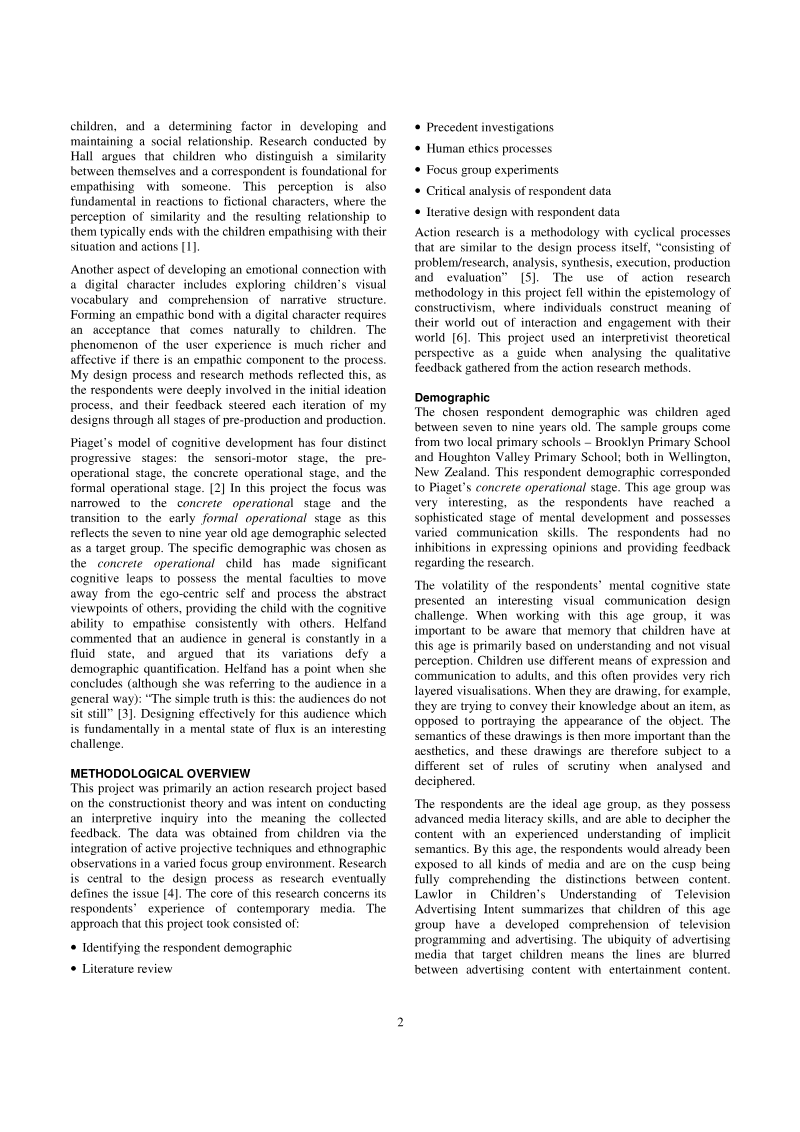
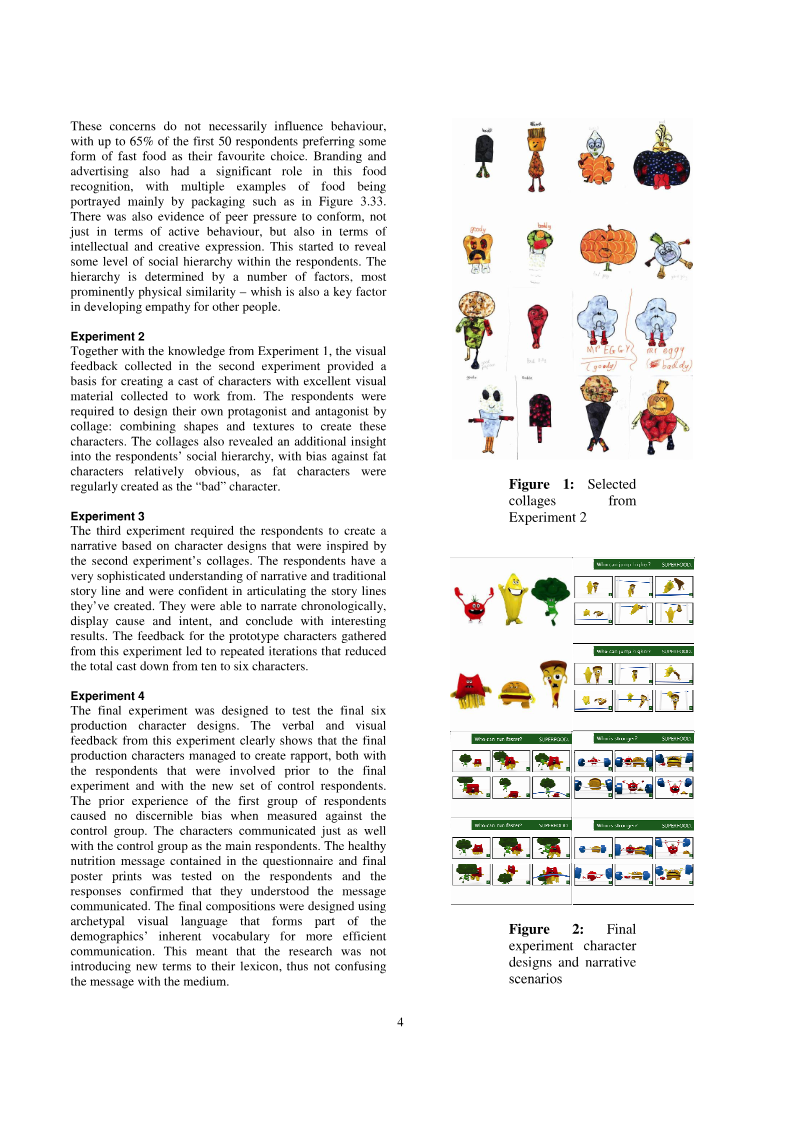
Understanding Empathy in Children through 3D Character Design
This study investigates whether an empathic bond between computer-generated 3-D characters and children can effectively communicate a healthy nutrition message.
- Empathic 3-D characters can communicate nutrition messages to children, with the research engaging about 75 children aged seven to nine from two primary schools in Wellington, New Zealand.
- Children expressed adult-like concerns about nutrition, but these stated concerns rarely translated into changes in dietary behaviour.
- Similarity in physical appearance and a social hierarchy among peers strongly shaped how much children empathised with characters.

Press Enter or Escape to Play: Deconstructing Escapism in Multiplayer Gaming
This study examines escapism in multiplayer gaming, arguing that the concept is widely used in game research yet remains loosely defined and unevenly evaluated, with its negative connotations often treated as the default.
- Escapism in multiplayer gaming is loosely defined and unevenly evaluated in research, with its negative connotations often treated as the default, though the authors argue it carries both healthy and unhealthy meanings.
- The authors propose a framework distinguishing four escapist motivations (mundane breaking, stress relief, pleasure seeking, and imagination conjuring) from activity types ranging from evasive and passive to active and extreme.
- In focus-group research with clan and guild gamers, pleasure seeking was the most important escapist motivation (4.54 on a 5-point scale), while imagination conjuring ranked lowest (2.71).
Abusing the Player, and Making Them Like it Too!
This paper, co-authored by Douglas Wilson and Miguel Sicart of the IT University of Copenhagen, argues against the prevailing assumption in game studies and design that games should be built for the player's pleasure, empowerment, and comfort.
- The paper argues that 'abusing the player' (intentionally disrespecting, antagonizing, or punishing players) is a legitimate, under-explored creative and aesthetic practice that can enrich the political and ethical dimensions of gameplay.
- Authors Douglas Wilson and Miguel Sicart of the IT University of Copenhagen challenge the dominant view that games should be built for player pleasure, empowerment, and comfort, and that design is primarily about balancing frustration and pleasure.
- The authors reframe game design as an aesthetic craft in which the designer becomes a visible implied author whose intent the player must contend with alongside the system's logic.
Some Notes on the Nature of Game Design
Kuittinen and Holopainen's paper argues that game design should be understood as a situated, reflective, and non-linear activity, rather than as rigid, goal-oriented problem solving or a sequence of fixed stages.
- Game design is best understood as a situated, reflective, non-linear activity in which designers continually reshape both the problem and its solution as their understanding evolves, rather than as rigid, stage-based problem solving.
- An analysis of six major game design books found heavy reliance on precedents, prototypes, and conceptual frameworks, but little in-depth examination of representation or the role of references.
- Reflection-on-action is implicit throughout most of the design literature and is explicitly treated only by Schell.
Fake Rules, Real Fiction: Professional Wrestling and Videogames
"Fake Rules, Real Fiction" argues that professional wrestling, having shifted from a legitimate contest to a scripted form of "sport entertainment," is best understood through a narrative framework that combines Chatman's story and discourse theory with game studies concepts such as scripted narrative and alterbiography.
- The report's central thesis is that wrestlers are active producers of meaning within pre-scripted gimmicks, so match quality depends on their skill in making the scripted narrative intelligible to audiences.
- Professional wrestling shifted from a legitimate contest to scripted 'sport entertainment', with fixing and the kayfabe illusion becoming established during the 1908 to 1911 Hackenschmidt–Gotch matches.
- The authors argue that kayfabe functions as serialized fiction operating at a 1:1 ratio between real and story time, blurring the boundary between performer and character.
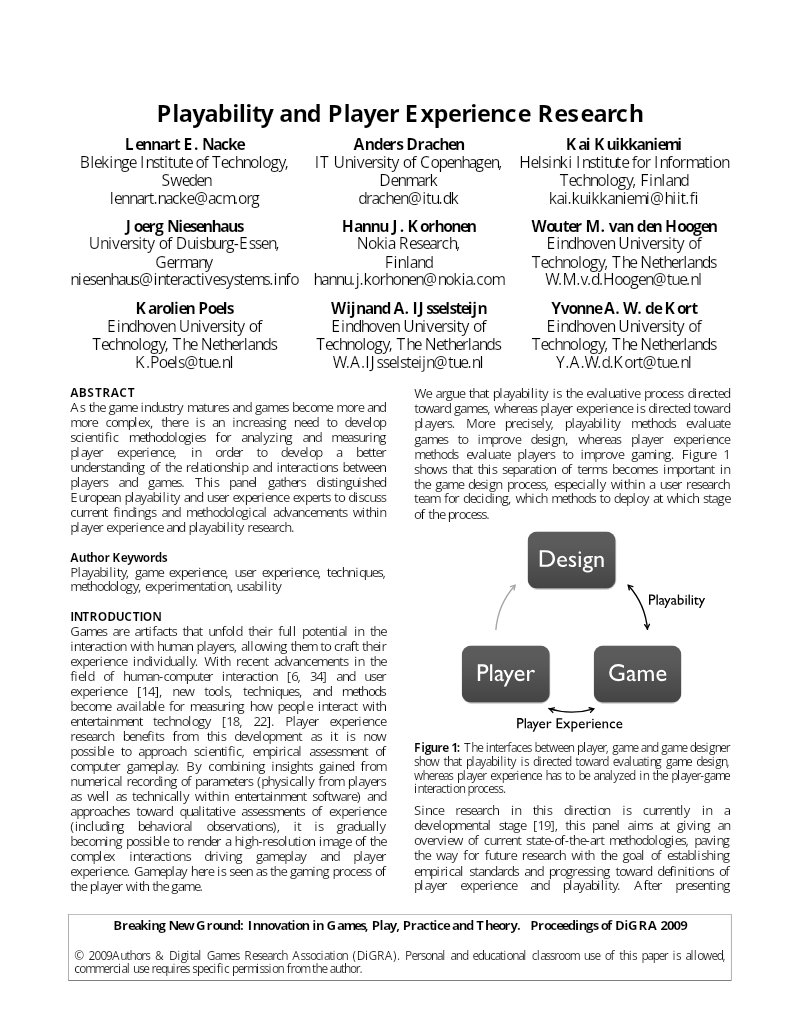
Playability and Player Experience Research
This panel paper, presented at DiGRA 2009, argues that playability and player experience are distinct but complementary research domains: playability evaluates the game itself to improve design, while player experience evaluates players to improve gaming.
- Playability and player experience are presented as distinct but complementary research domains: playability evaluates the game itself to improve design, while player experience evaluates players to improve gaming.
- The paper frames playability and player experience research as a developmental stage rather than a settled discipline, aiming to move the field toward empirical standards and clearer definitions.
- Expert review and heuristic evaluation are cost-effective, iterative methods for finding playability problems, but general usability heuristics must be adapted with game-specific sets.
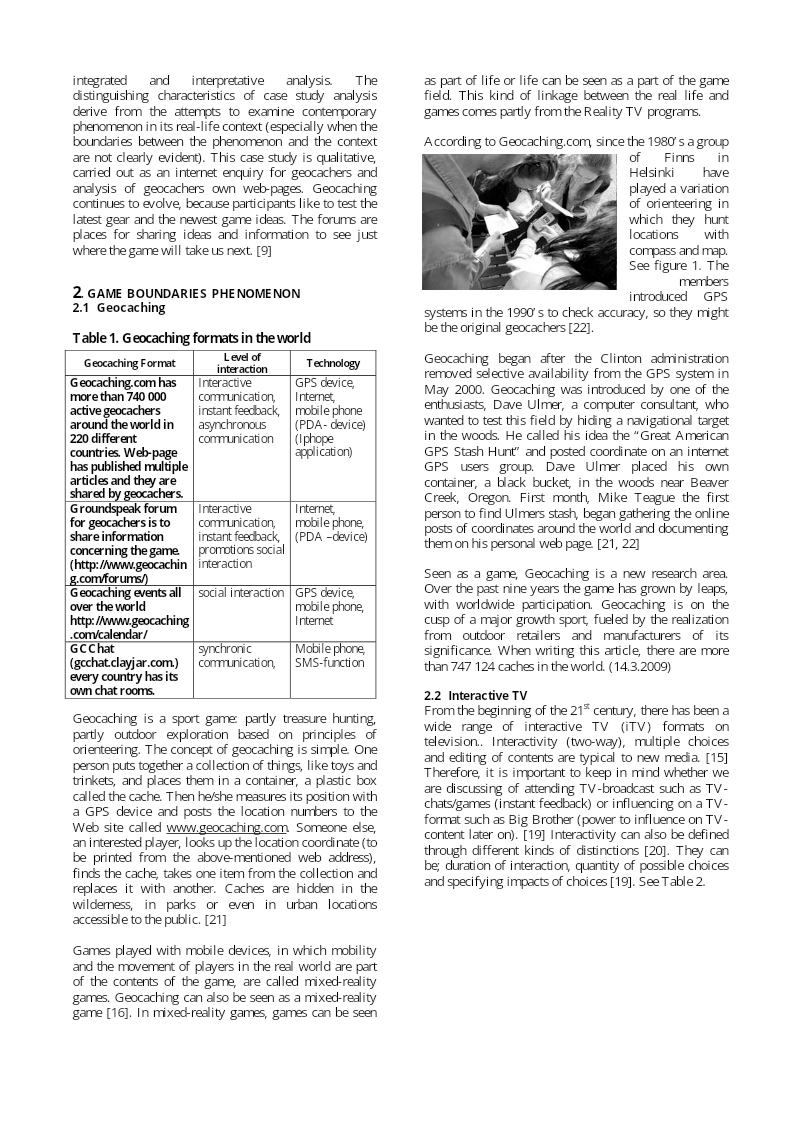
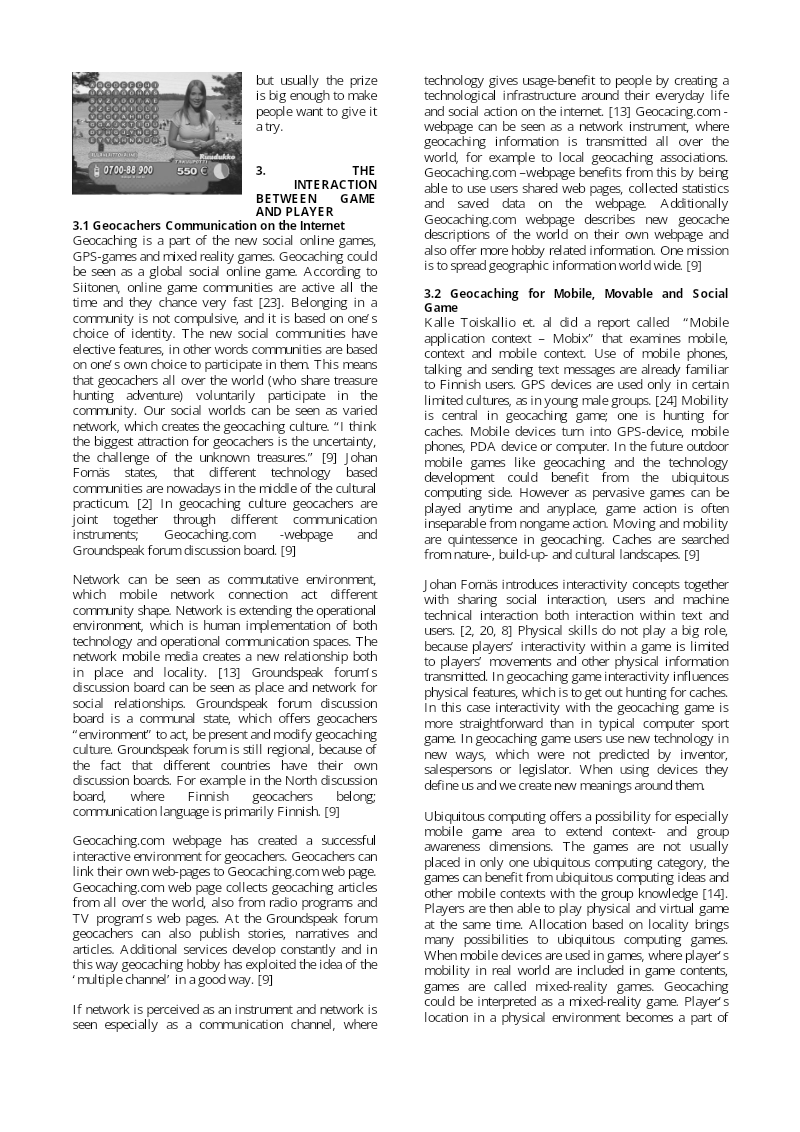
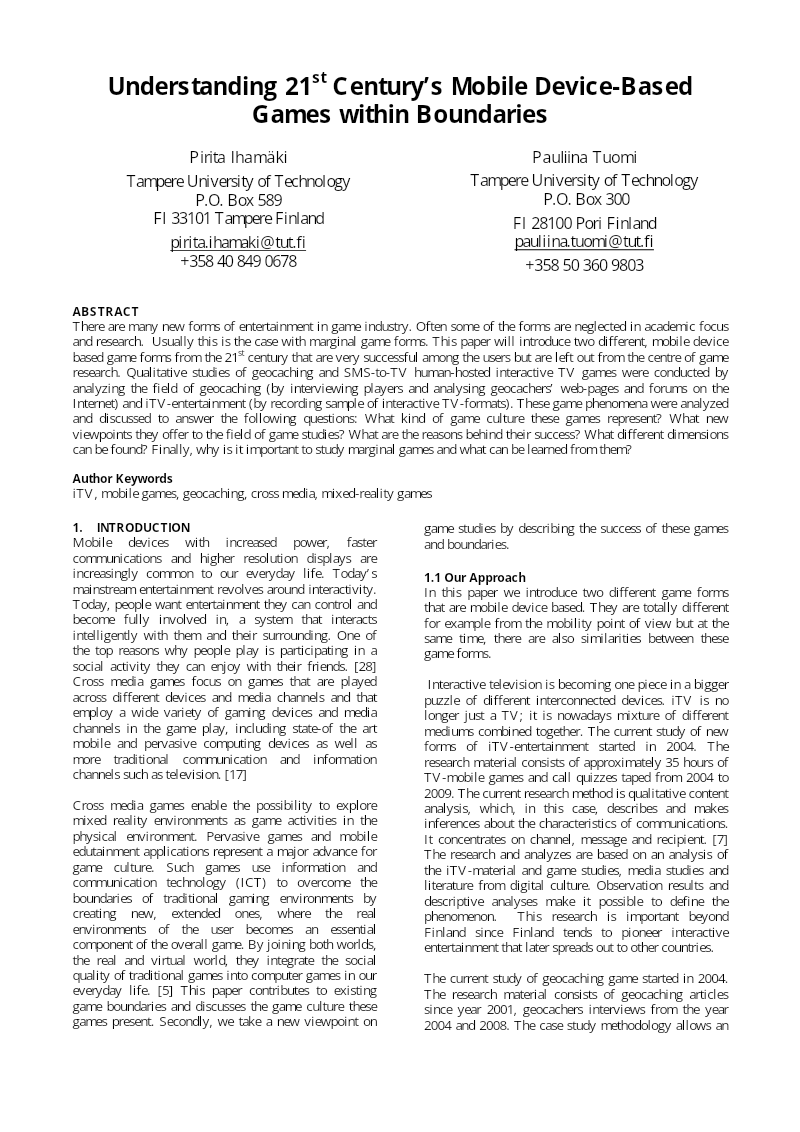
Understanding 21st Century's Mobile Device-Based Games Within Boundaries
This paper examines two mobile device-based game forms from the 21st century that have achieved strong user popularity yet remain peripheral to mainstream game research: geocaching and SMS-to-TV human-hosted interactive television games.
- Geocaching is treated as a global, socially organized mixed-reality game, with over 740,000 active participants and more than 747,000 caches worldwide by early 2009, supported by a central web platform and regional forums.
- The paper argues that marginal mobile game forms such as geocaching and SMS-to-TV interactive games deserve academic attention because their popularity and boundary-blurring characteristics challenge traditional game studies.
- The study uses a qualitative case-study design combining interviews with geocachers, analysis of geocaching websites and forums, and content analysis of roughly 35 hours of interactive TV broadcasts from 2004 to 2009.
Playing Your Network: Gaming in Social Network Sites
Luca Rossi's paper examines gaming within social network sites, focusing on Facebook as the dominant platform in most Western countries, and uses the UK-based company Playfish as its central case.
- Games on Facebook are built around existing social relationships, shifting gaming from a standalone or shared-passion activity toward one grounded in friendships, a distinct branch of online gaming the paper calls SNS gaming.
- The paper uses UK-based Playfish as its central case, observing a catalogue of about eight titles with over eleven million monthly players, and draws on qualitative, exploratory methods plus preliminary player interviews.
- Skill and knowledge games such as Who Has the Biggest Brain? and Geo Challenge rank players on friend, country, and global ladders, and players use these rankings to assert status within their social circles.