1 free read left. Create a free account for unlimited reading + AI research.
Create free accountArticle DiGRA
1 free read left. Create a free account for unlimited reading + AI research.
Create free accountArticleDiGRA
"The Emancipated Player" argues that a distinct mode of player involvement, which the author terms "emancipated involvement," extends video game engagement beyond entertainment and immersion into critical reflection and the pursuit of significance. Building on Gordon Calleja's model of player involvement and on the theories of Jacques Rancière, Wolfgang Iser, and Kendall Walton, the work proposes that the "emancipated player" combines participatory play, marked by immersion and affect, with emancipatory play, marked by critical reflection on the gameworld. The paper's central claim is that a game's aesthetic complexity, understood through the concept of the "implied player," determines whether it can elicit this deeper form of engagement. Thatgamecompany's Journey serves as the principal case study, with supporting references to Gone Home, Flower, BioShock, and Civilization.
The analysis of Journey rests on close textual interpretation rather than empirical data. The author contends that the game's labyrinthine structure, its adaptation of the Hero's Journey framework, and its shifting ascents and descents metaphorically portray life as largely predetermined, with the player's principal agency residing in finding and relating to companions. Drawing on Aarseth, Iser, Nitsche, and Nussbaum, the work frames these meanings as products of imaginative interpretation combined with ergodic action, forming what Iser would call a "system of perspectives" within the gameworld.
The study's final argument is that meaning in Journey is not fixed but co-created through play. Different player styles, such as achievers or explorers in Bartle's typology, produce different interpretations, and cooperative play in particular fosters something akin to Aristotelian friendship, grounded in the concept of eudaimonia. The author concludes that the emancipated player functions both as an empirical player type and as an analytic method, freeing game narrative analysis from linear interpretation and treating meaning as an experiential outcome of the player's ideational work in dialogue with the game's implied player.
Each row is a game or company this document names, each column a document, oldest first. A mark means that document names it. Select a row to see those documents.
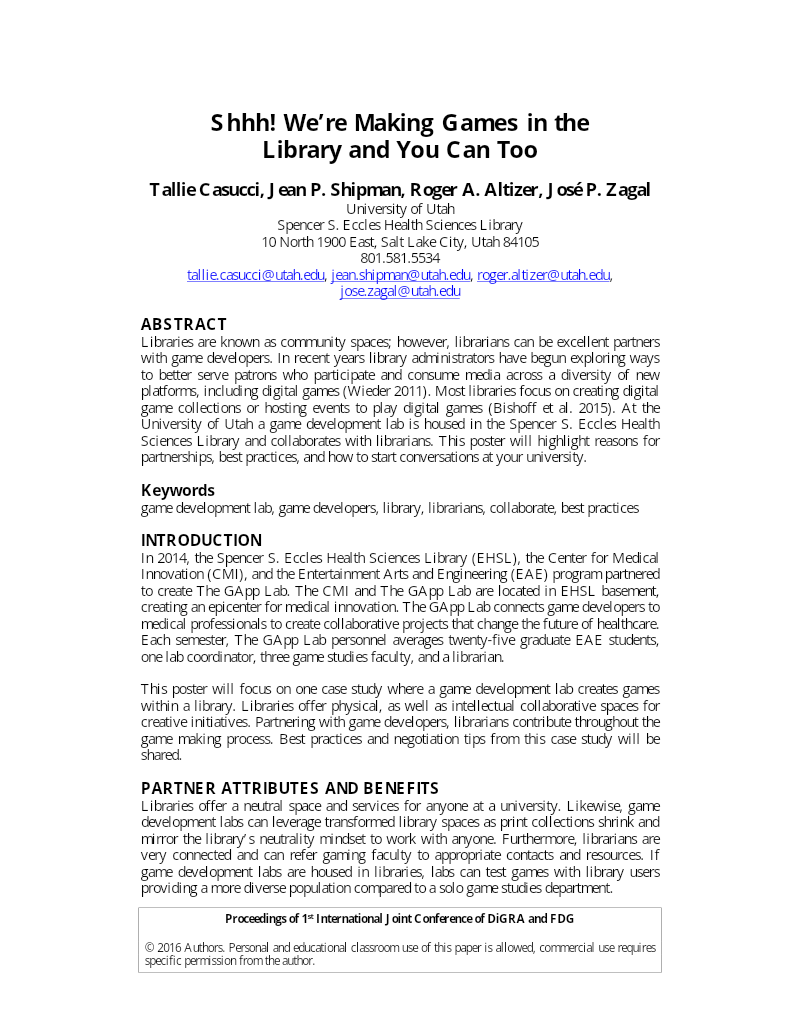
DiGRA · 2016
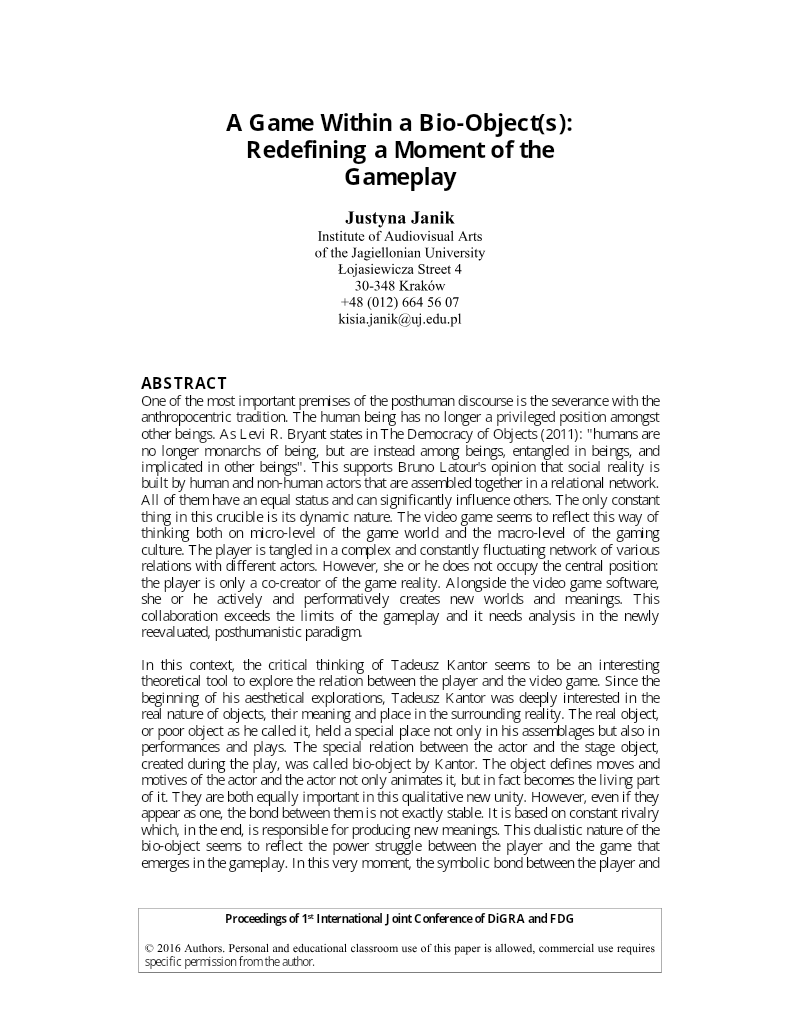
DiGRA · 2016
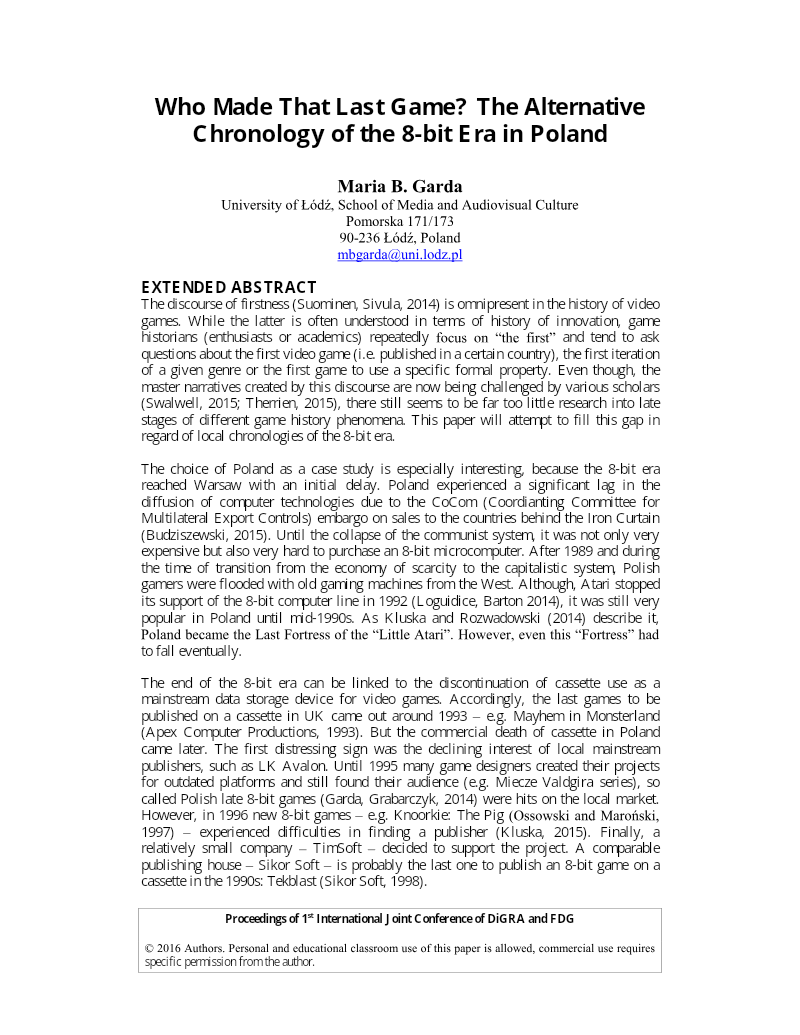
DiGRA · 2016
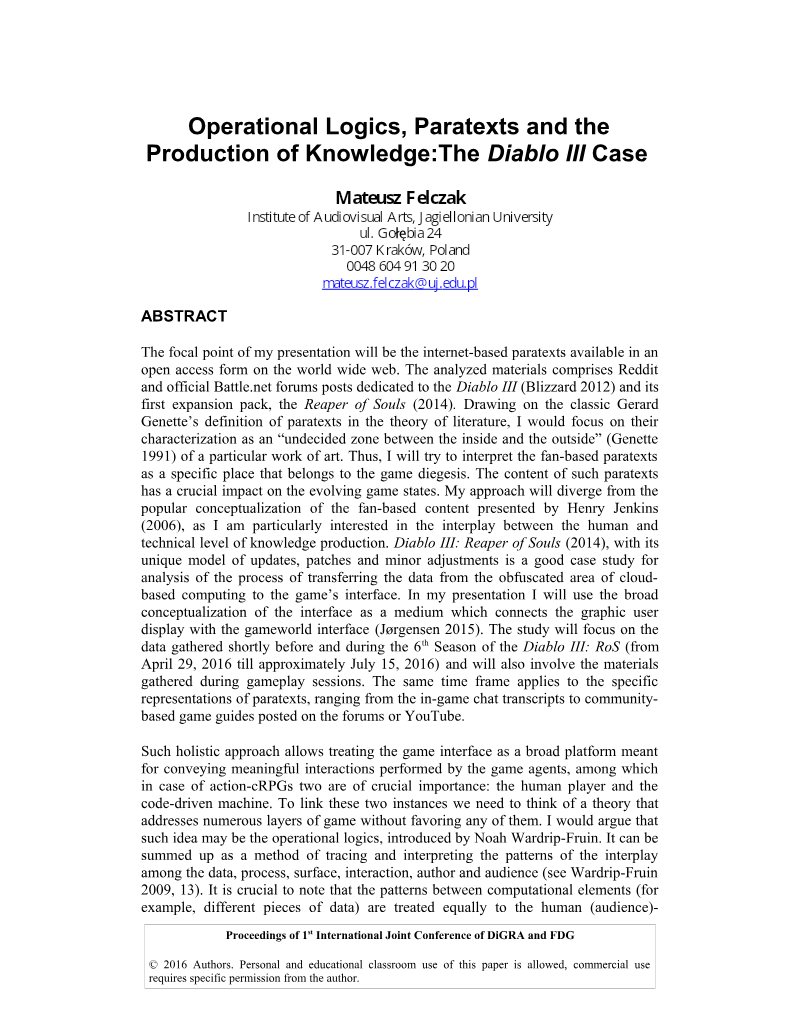
DiGRA · 2016

DiGRA · 2016

DiGRA · 2016



DiGRA · 2016

DiGRA · 2016

DiGRA · 2016

DiGRA · 2016

DiGRA · 2016

DiGRA · 2016
The Game Business · 2026