1 free read left. Create a free account for unlimited reading + AI research.
Create free accountWhitepaper DiGRA
1 free read left. Create a free account for unlimited reading + AI research.
Create free accountWhitepaperDiGRA
The analysis argues that a video game's code can support interpretation without depending on what its creator says about it. Its case study is Jason Rohrer's 2007 game Passage.
This analysis argues that the source code of video games can yield interpretive insight into their meaning without depending on the creator's stated intentions. Using Jason Rohrer's 2007 game Passage as its case study, the work contends that existing hermeneutic readings by scholars such as Parker, Harrer, and Robinson and colleagues rely too heavily on Rohrer's public statements, and that the game's underlying code offers an independent route to interpretation. The central proposal is that naming conventions for variables and methods, along with the structure of the game's logic, can be read as carriers of symbolism and metaphor in their own right.
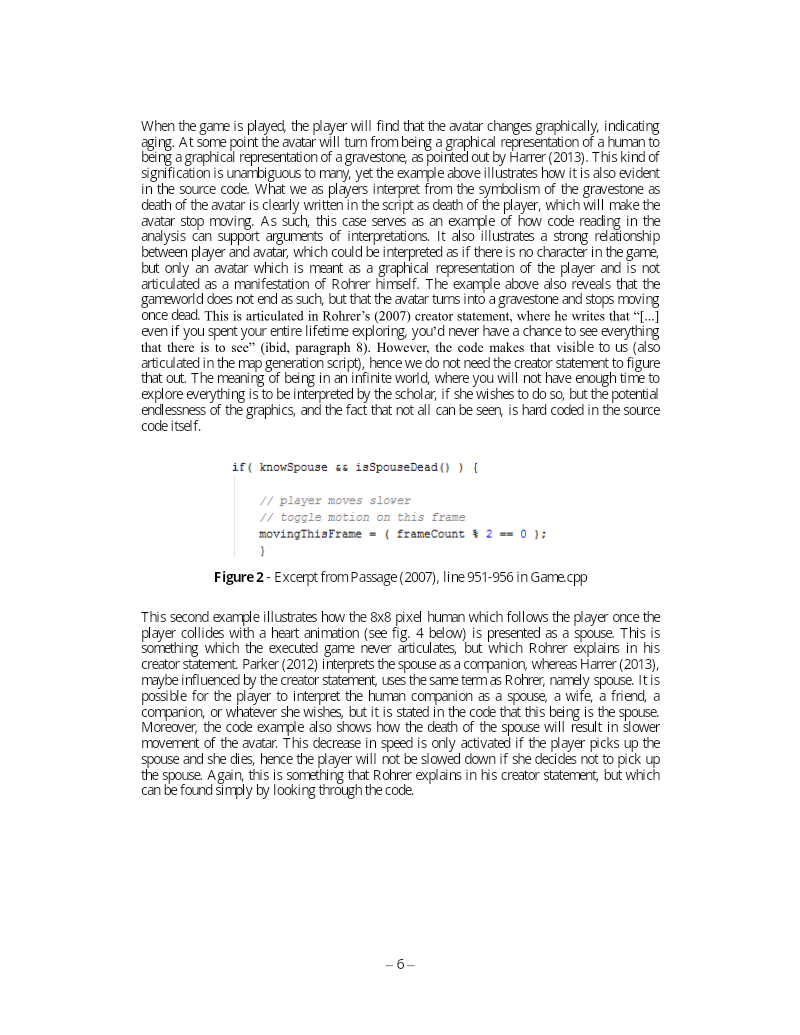
The close reading centers on the file Game.cpp and identifies two kinds of findings. The first is hardcoded symbolism, including the mapping of the avatar's death onto the player's death and the treatment of the spouse, whose presence is governed by a rule permitting only one spouse per playthrough, a constraint the analysis reads as monogamous and heteronormative. The second is hidden system rules that shape gameplay but are invisible to the player, most notably a multiplier of 2 applied to explorer points when the spouse is present, a mechanic discoverable only through the code. These observations are presented as evidence that white-box analysis can illuminate ideological and experiential dimensions of the game that formal analysis of play alone may miss.
The study's scope is focused on a single title and a single line of interpretive method rather than on the broader industry, and it does not offer quantitative or comparative data across games or markets. Its conclusions are framed as a productive supplement to formal game analysis rather than a replacement for it. The work also leaves open significant questions: whether source code, developer comments, and the executed game constitute distinct texts or paratexts, and how the authorship of code complicates the claim to set aside authorial intent. These unresolved theoretical issues, drawing on authorship theory from Barthes and Foucault, point toward an ongoing reconsideration of what it means for a game to be a "work."
DiGRA · 2019
DiGRA · 2019
DiGRA · 2019
DiGRA · 2019



DiGRA · 2019
DiGRA · 2019
DiGRA · 2019
DiGRA · 2019
DiGRA · 2019
DiGRA · 2019
DiGRA · 2019
DiGRA · 2019

Jason Schreier · 2026










Comments