1 free read left. Create a free account for unlimited reading + AI research.
Create free accountWhitepaper DiGRA
1 free read left. Create a free account for unlimited reading + AI research.
Create free accountWhitepaperDiGRA
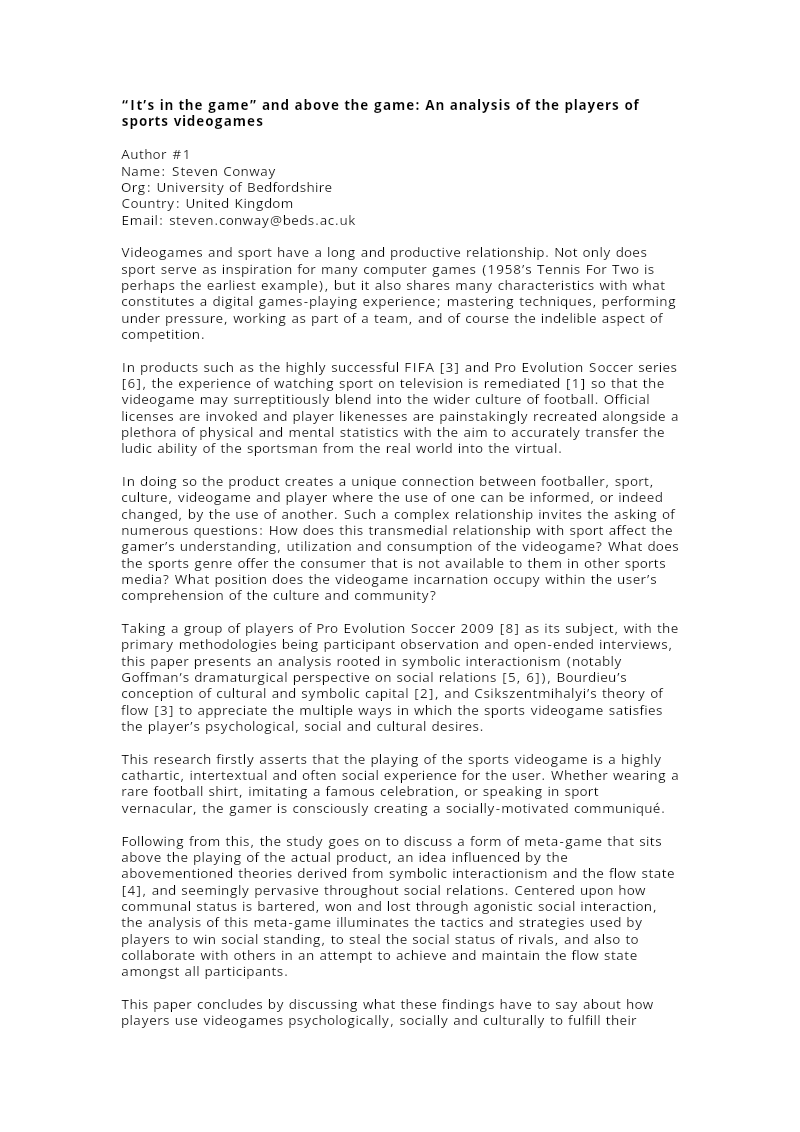
The paper frames playing a sports videogame as a cathartic, intertextual, and often social activity. The experience reaches well beyond the act of play itself.
Distilling the key insights…
This paper examines how players of sports videogames relate to the games they play, arguing that the experience extends well beyond the act of play itself into social and cultural domains. Its central claim is that playing a sports videogame is a cathartic, intertextual, and often social activity, and that players operate within a "meta-game" in which social standing is won, lost, and bartered through interaction with peers. The analysis focuses on football, using titles such as the FIFA and Pro Evolution Soccer series as examples of how sports videogames blur into the wider culture of the sport through official licenses, recreated player likenesses, and detailed statistical modeling.
The study's methodology centers on participant observation and open-ended interviews with a group of players of Pro Evolution Soccer 2009. The findings are interpreted through three theoretical lenses: Goffman's dramaturgical perspective on social relations, Bourdieu's concepts of cultural and symbolic capital, and Csikszentmihalyi's theory of flow. The sample is small and drawn from a single title and community, so the scope of the findings is qualitative and focused rather than broadly representative of the wider gaming population.
Among the key conclusions, the research finds that players express social meaning through behaviors such as wearing rare football shirts, imitating famous goal celebrations, and adopting sport vernacular, which together constitute a socially motivated form of communication. The meta-game identified in the analysis involves tactics for gaining social standing, displacing rivals' status, and collaborating to sustain a shared flow state among participants. The paper concludes that players use sports videogames psychologically, socially, and culturally to satisfy needs, enhance social position, and achieve the self-enrichment that Stebbins describes as serious leisure.
DiGRA · 2016
DiGRA · 2016
DiGRA · 2016



DiGRA · 2016



DiGRA · 2016



DiGRA · 2016



DiGRA · 2016



DiGRA · 2016



DiGRA · 2016

DiGRA · 2015



DiGRA · 2015



DiGRA · 2015
DiGRA · 2005