1 free read left. Create a free account for unlimited reading + AI research.
Create free accountWhitepaper DiGRA
1 free read left. Create a free account for unlimited reading + AI research.
Create free accountWhitepaperDiGRA
It draws on doctoral ethnographic research on a community of Halo 3 players. The research followed them to a local LAN tournament, the 2008 MLG Toronto Open, and the 2008 World Cyber Games in Cologne, Germany.
This paper examines how gender is enacted and policed within North American competitive gaming, using doctoral ethnographic research on a community of Halo 3 players followed to a local LAN tournament, the 2008 Major League Gaming (MLG) Toronto Open, and the 2008 World Cyber Games in Cologne, Germany. Its central argument is that MLG's promotional strategy borrows the legitimating symbols and organizational models of mainstream North American sports media, and that by linking gaming to sport, a domain where women remain marginal, it makes female participation and its rewards precarious.
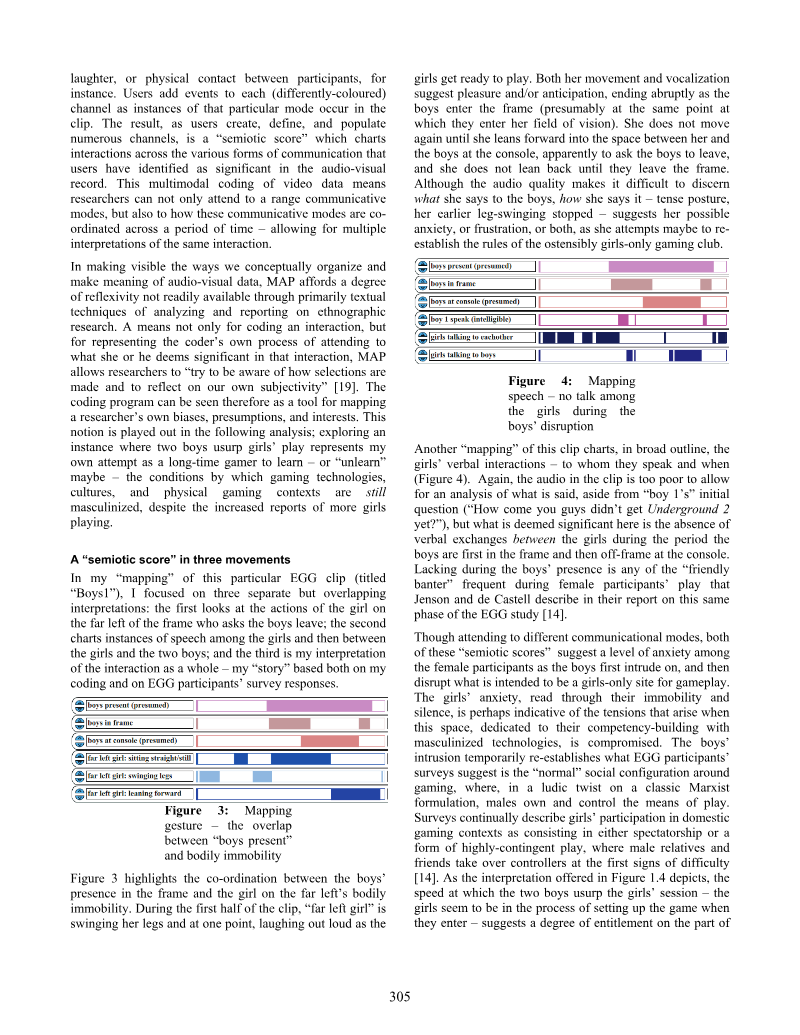
The analysis rests on four audiovisual clips analyzed with the Multimodal Application Program, which examines embodied interaction and the technological infrastructure of the events. Drawing on theories of gender performativity and the masculinization of technology, the author explores how interactions either challenge or reproduce the gendered order of digital play. Two clips follow a single female player whose competence is undercut by a misogynistic discourse among male players that has little to do with the game itself. The other two depict the more common and socially "safe" roles available to women: a mother presenting herself as a "cheerleader" despite functioning as a team's general manager, and "booth babes" promoting a racing-game exhibit before an audience of male spectators.
The findings suggest that while women can compete at a high level, the gendered landscapes of these events position them mainly as spectators or promotional figures, leaving few incentives for women to pursue professional careers. The study's scope is limited to three sites and a single game community, so its conclusions speak to the specific culture of Halo 3 competition in Canada and its tournament circuit rather than to competitive gaming as a whole.
Each row is a game or company this document names, each column a document, oldest first. A mark means that document names it. Select a row to see those documents.

DiGRA · 2016

DiGRA · 2016

DiGRA · 2016



DiGRA · 2016



DiGRA · 2016



DiGRA · 2016



DiGRA · 2016



DiGRA · 2016



DiGRA · 2016

DiGRA · 2015



DiGRA · 2015



DiGRA · 2015
DiGRA · 2007