
DiGRA
The Digital Games Research Association: the international association of academics and professionals who study digital games. Its Digital Library holds the proceedings of the DiGRA conferences since 2002.
Documents
What Happens If You Catch Whypox? Children's Learning Experiences of Infectious Disease in a Multi-User Virtual Environment
This study investigated how children's experiences with a virtual infectious disease in a multi-user virtual environment (MUVE) influenced their understanding of natural infectious diseases.
- Students' explanations of natural disease shifted significantly toward biological causal mechanisms after a ten-week, teacher-led infectious disease unit that embedded a virtual outbreak, with more comprehensive answers about causes and factors that increase spread.
- The study followed 46 sixth-grade students aged 10 to 12 from two science classes taught by the same teacher at a Los Angeles laboratory school, using pre- and post-unit surveys, a Whypox-specific survey, and coded analysis of videotaped class discussions (80% inter-rater agreement).
- The virtual disease Whypox spread through Whyville.net, a multi-user virtual environment with more than 400,000 registered users at the time, and students frequently described themselves as having Whypox, indicating strong immersion.
Fundamental Components of the Gameplay Experience: Analysing Immersion
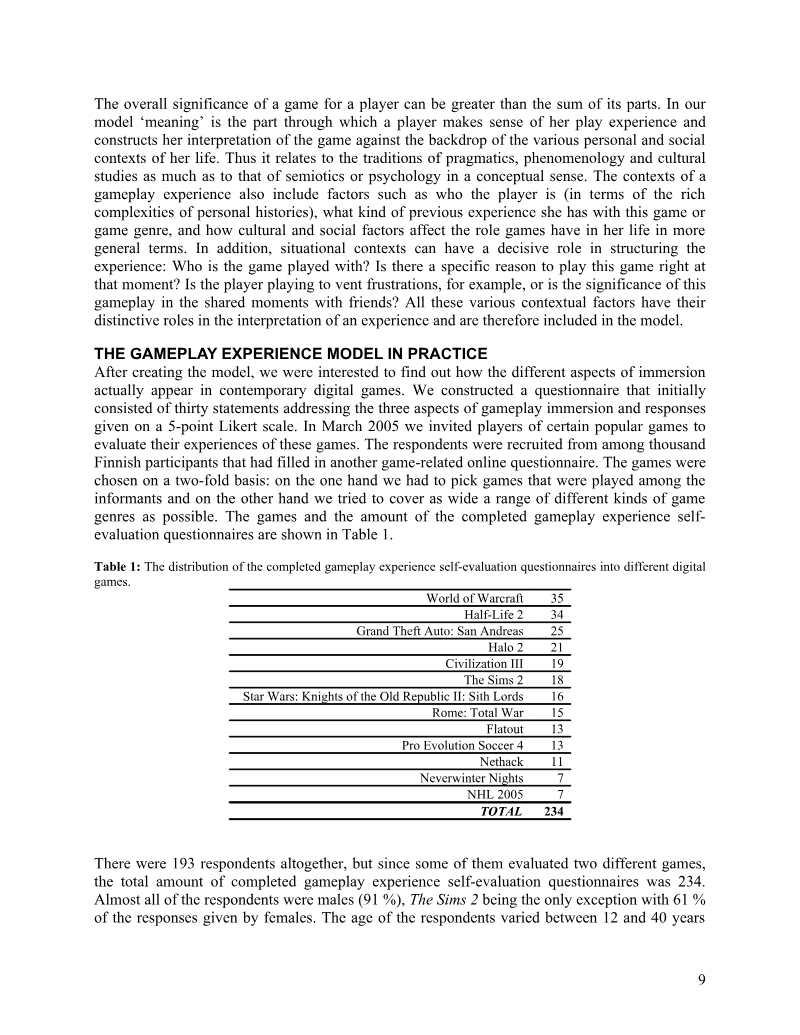
This study examines immersion as a central component of the gameplay experience, proposing the Sensory, Challenge-based, and Imaginative (SCI) model as a way to distinguish qualitatively different forms of immersion.
- The report proposes the Sensory, Challenge-based, and Imaginative (SCI) model to distinguish qualitatively different forms of game immersion, arguing that existing research lacked the qualitative distinctions needed to explain why different games absorb players in different ways.
- A survey of 234 self-reported gameplay experiences across 13 popular titles found overall immersion levels were high across the sample, which was predominantly male and aged 12 to 40.
- Half-Life 2 recorded the highest combined immersion score in the study, while The Sims 2 recorded the lowest.
Game Fiction: Playing the Interface in Prince of Persia: The Sands of Time and Asheron's Call
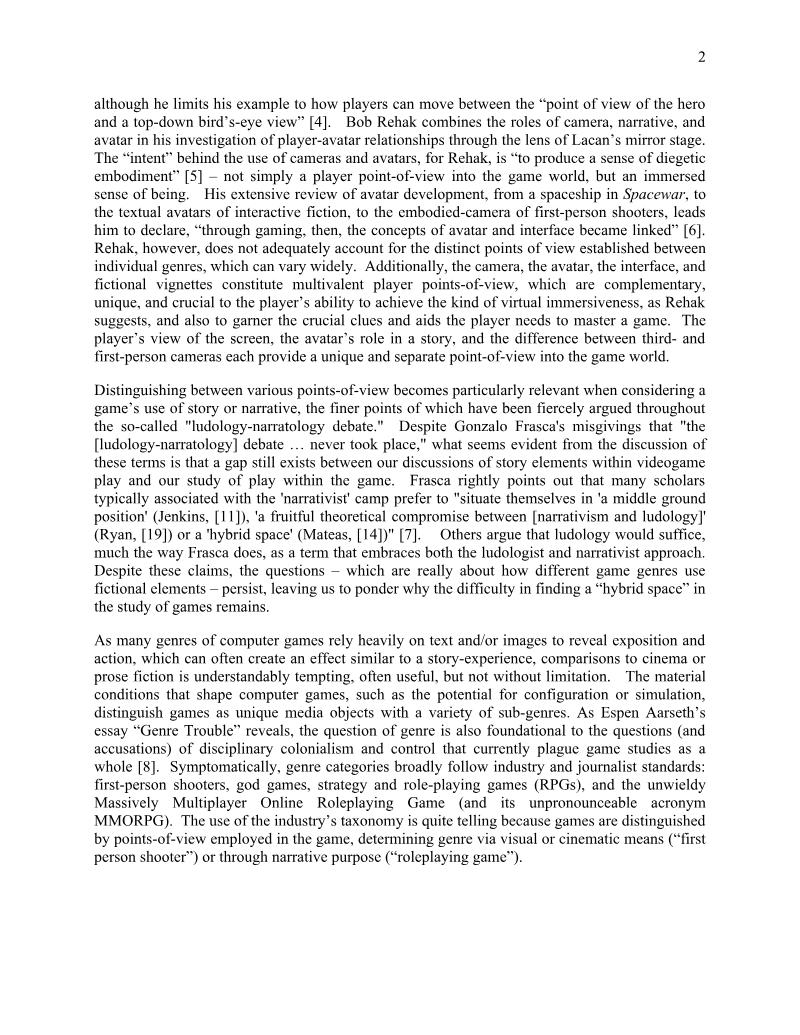
This paper explores the concept of "game fiction" to analyze how various mechanisms establish and control player point-of-view in videogames, moving beyond traditional narrative-centric discussions.
- Videogame play requires negotiating several simultaneous points of view (cameras, avatars, interfaces, and cut-scenes), and mastering these perspectives is central to completing a game's goals.
- The paper proposes "game fiction" as the imaginative devices games use as native rule elements, a framing that sidesteps the ludology-narratology debate and lets non-narrative games like Tetris or chess be analyzed for their fictional construction.
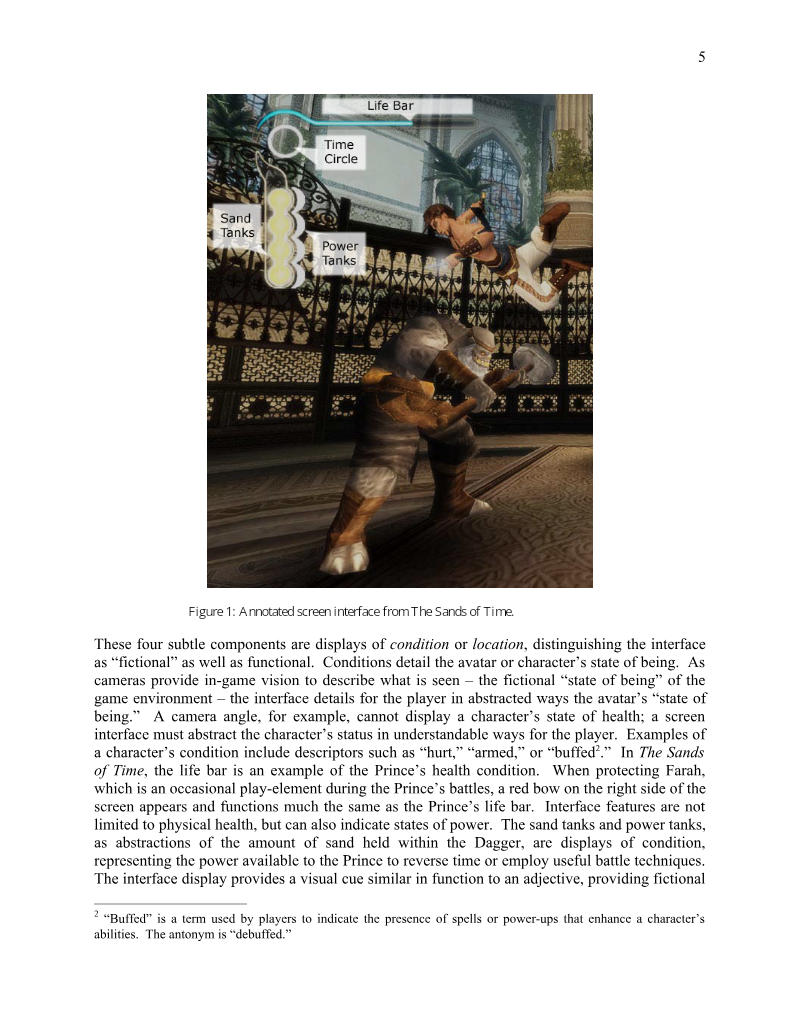
- In Prince of Persia: The Sands of Time, the minimal on-screen interface (life bar, time circle, sand tanks, power tanks) functions like adjectives describing the Prince's state and location, with the time circle marking chronological position in the reversed-time narrative.
Designing Goals for Online Role-Players
This document examines the fundamental differences in goal structures between traditional gamers and role-players within persistent online worlds, emphasizing the growing need for game design to cater to the latter audience.
- Role-players construct subjective fictional worlds (diegeses) and pursue goals chosen by their characters rather than goals encoded in game rules, and they often treat winning or losing as meaningless.
- The paper distinguishes exogenous goals (the player's own reasons), endogenous goals (built into game rules), and diegetic goals (belonging to the character's imagined world), arguing role-players largely disregard endogenous goals.
- It proposes six criteria for effective online role-playing goals: diegetic desirability, plausibility, sensibility, consequentiality, relative optionality, and sociality.
Baldur's Gate and History: Race and Alignment in Digital Role Playing Games
Christopher Warnes's paper argues that digital role-playing games, using Baldur's Gate I and II as its central case, cannot be fully understood through the formalist approaches that dominate game studies, particularly the ludology/narratology debate.
- Christopher Warnes argues that digital role-playing games such as Baldur's Gate I and II cannot be fully understood through the formalist ludology/narratology approaches that dominate game studies, which he attributes to disciplinary insecurity and anxiety about the games industry's commercial pull.
- Warnes advocates historicised, cultural materialist and postcolonial critique as alternatives, applying them to commercially produced computer games in a sustained way for the first time.
- The paper is a theoretical and interpretive essay, not an empirical study; it draws on literary, historical, and media-studies sources rather than survey data or original player research.
End of Story? Quest, Narrative and Enactment in Computer Games
The document challenges Espen Aarseth's hypothesis that all "narrative games" are better understood as "quest games," proposing Max Payne as a counter-example.
- Løvlie argues against Espen Aarseth's view that 'narrative games' are better understood as 'quest games,' using Remedy Entertainment's 2001 third-person shooter Max Payne as a counter-example whose linear, heavily narrated structure cannot be separated from its gameplay.
- The author proposes 'enactment' as a more fitting concept than acting or authorship, describing the player as reacting to a script of narrative and rules rather than performing a fixed script or freely authoring the experience.
- Max Payne's dream sequences deliberately break genre conventions, and the game's forced repetition of an unavoidable event with identical outcomes is read as an attempt to express metaphysical themes through new media, drawing on Manovich's database-interface model and Jakobson's paradigm-syntagm account of poetry.
Feel It, Don't Think: The Significance of Affect in the Study of Digital Games
The document, "Feel It, Don't Think: The Significance of Affect in the Study of Digital Games," argues that traditional game studies methodologies, which prioritize visual, narrative, and semiotic elements, fail to adequately account for the embodied, multisensory, and physiological dimensions of gameplay.
- Shinkle argues that game studies focused on visual, narrative, and semiotic content overlook the embodied, physiological 'feel' of gameplay, which she calls affect: a multisensory, temporally delocalized experience that operates partly outside linear time and conscious choice.
- The paper distinguishes affect from emotion and presents itself as a preliminary theoretical examination rather than an empirical study, drawing on Massumi, Grodal, Aarseth, and Poole.
- Sega's rave-inspired Rez is cited as an example whose appeal lies in a trance-like synchronicity between player and environment rather than in level completion.
A Cognitive Psychological Approach to Gameplay Emotions
Bernard Perron argues that emotions in story-driven video games extend well beyond the fictional world and the game as artefact, and that the core of the experience lies in gameplay emotions: those arising from the player's actions and the game's reactions to them.
- Gameplay emotions are treated as a distinct category from fiction emotions and artefact emotions, and the paper argues they deserve focused study in their own right.
- Drawing on Nico Frijda's appraisal and action-tendency theory and Ed Tan's work on film emotion, the author maps how players evaluate their coping potential in game situations and how emotions drive action.
- The paper's central contribution is a set of appraisal dimensions (motive consistency, expectedness, causal attribution, certainty, appetitive versus aversive orientation, and control potential), each illustrated with examples from titles such as Max Payne, Metal Gear Solid 3, Splinter Cell, Resident Evil 4, ICO, and XIII.
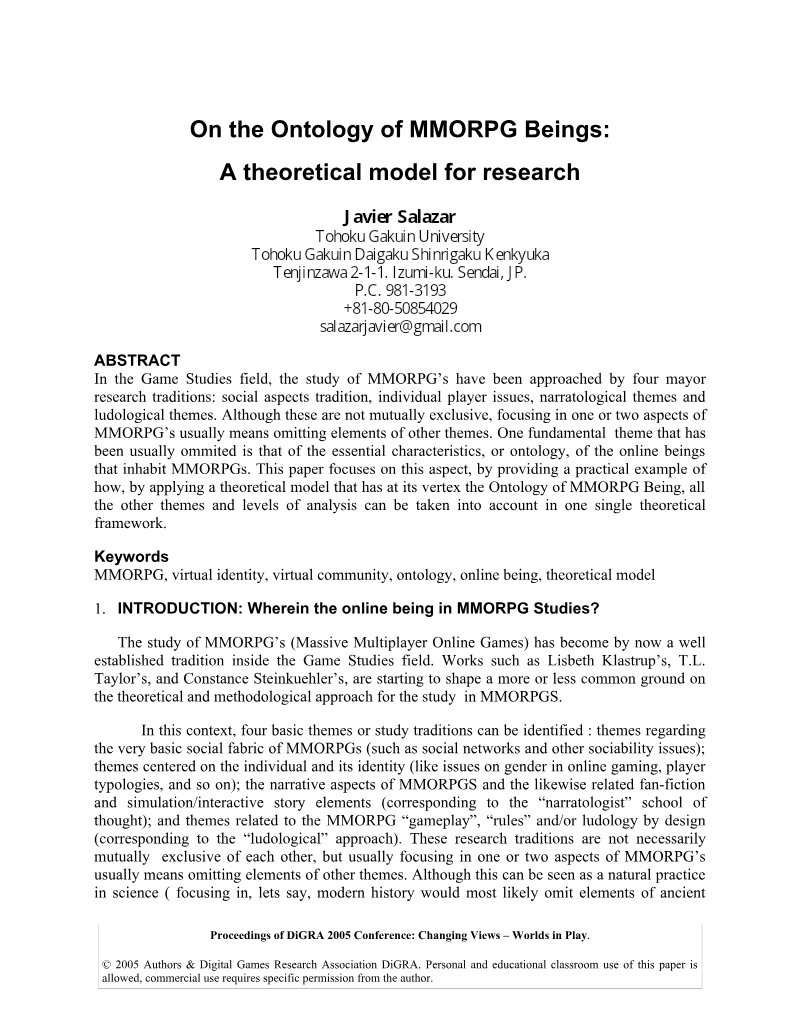
On the Ontology of MMORPG Beings: A Theoretical Model for Research
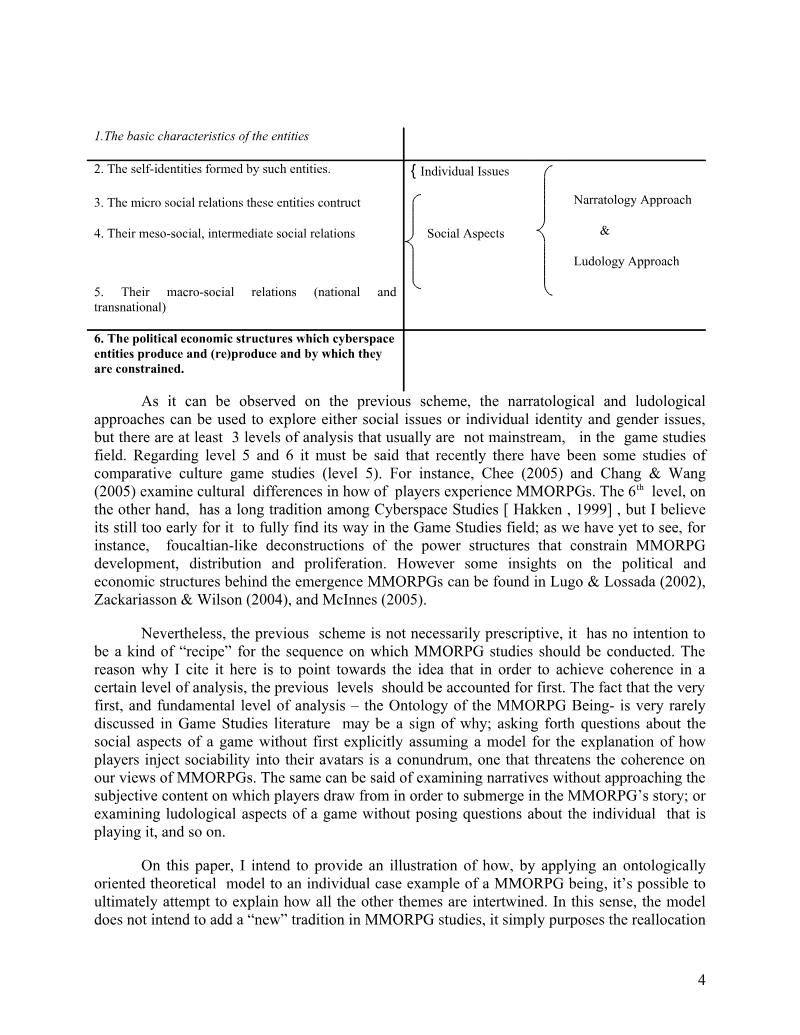
The document proposes a theoretical model for MMORPG research, centered on the "Ontology of MMORPG Beings," to unify the disparate research traditions within Game Studies, specifically social, individual player, narratological, and ludological approaches.
- The paper argues that the ontology of MMORPG beings (the essential characteristics of online avatars) is a neglected fifth research theme in Game Studies, alongside the social, individual, narratological, and ludological traditions.
- Its core claim is that established Game Studies traditions implicitly rely on an ontological foundation that has never been made explicit, so ontological clarification is presented as a prerequisite for coherent MMORPG research.
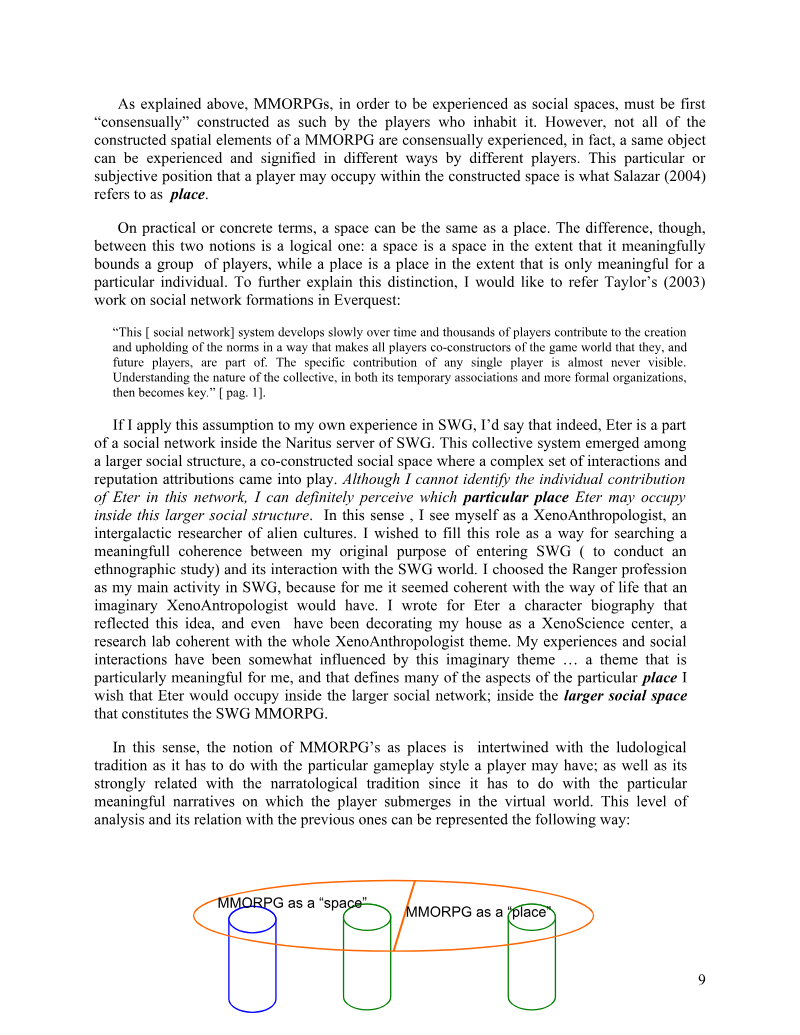
- The proposed model is layered, starting from the player's pre-existing subjective content and developers' software, hardware, and design elements, then analyzing MMORPGs as game spaces, social spaces, and individual places, and culminating in player identity expressed through cyborg-like avatars.
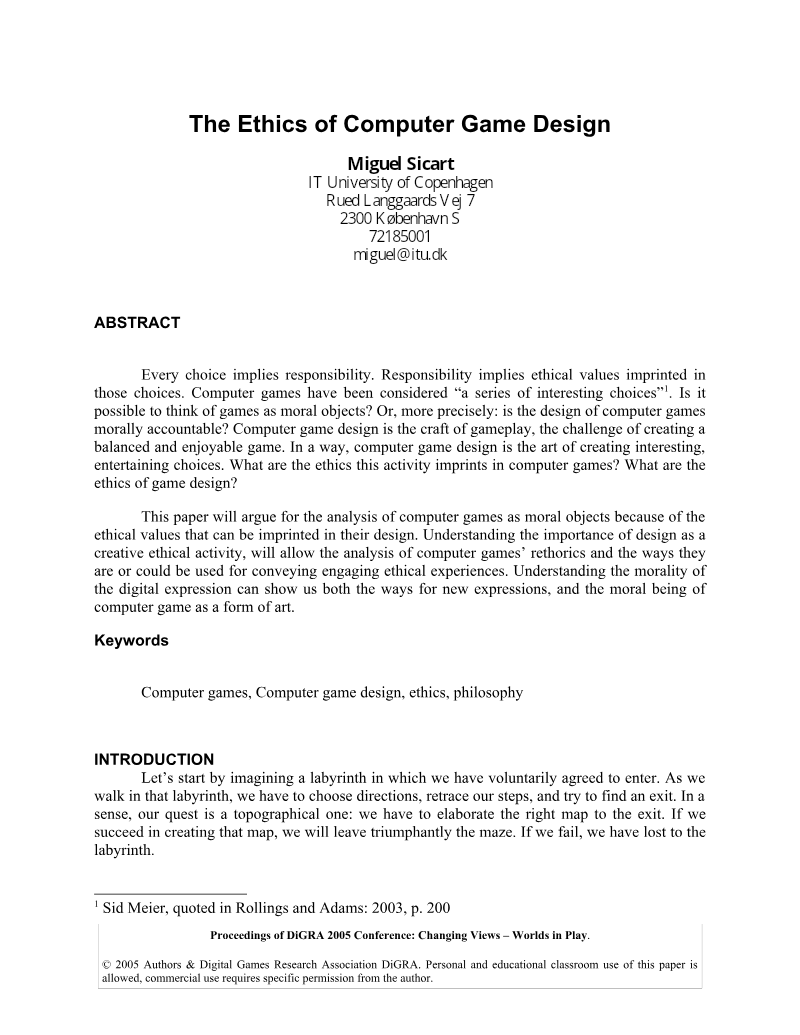
The Ethics of Computer Game Design
Miguel Sicart argues that computer games are moral objects because ethical values are built into their design, and that designing a game is therefore inherently a moral activity.
- Miguel Sicart argues that computer games are moral objects whose code (rules) and architecture (experienced play space) embed ethical values and act as power structures that shape how players behave.
- Sicart treats games as agents with a degree of artificial agency, which grounds the claim that they can be genuine ethical objects rather than neutral entertainment.
- Because designers inevitably shape the choices available to players and the values those choices express, Sicart concludes that designing games is itself a moral act.
Beyond P-1: Who Plays Online?
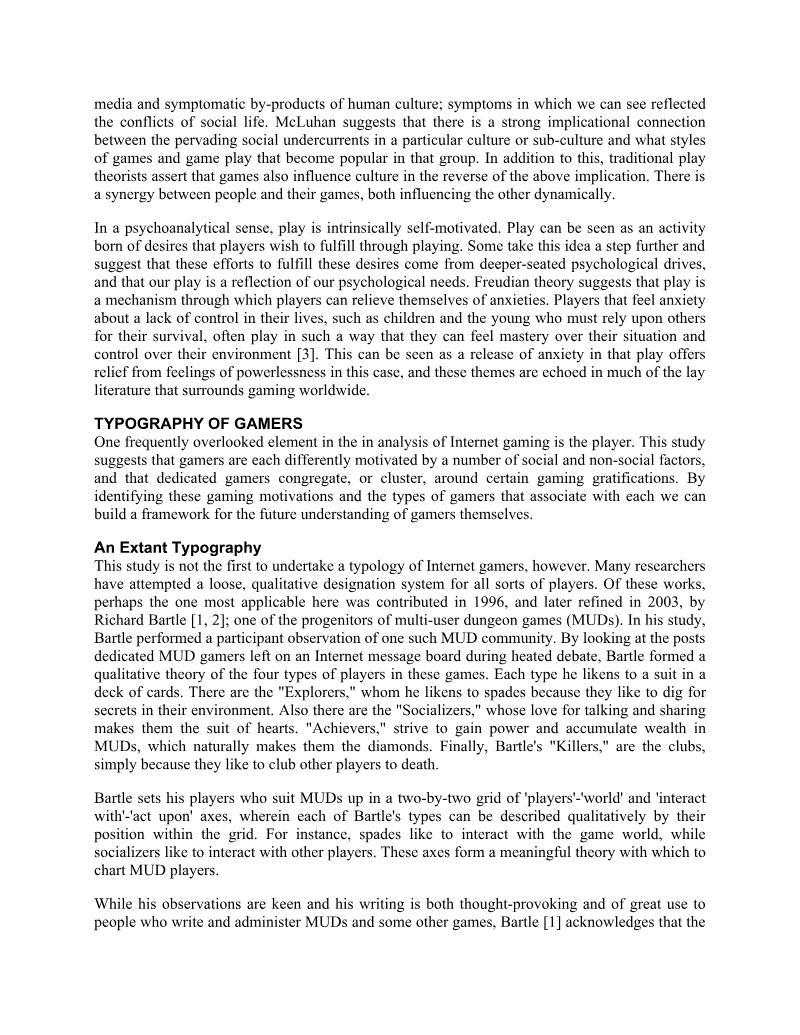
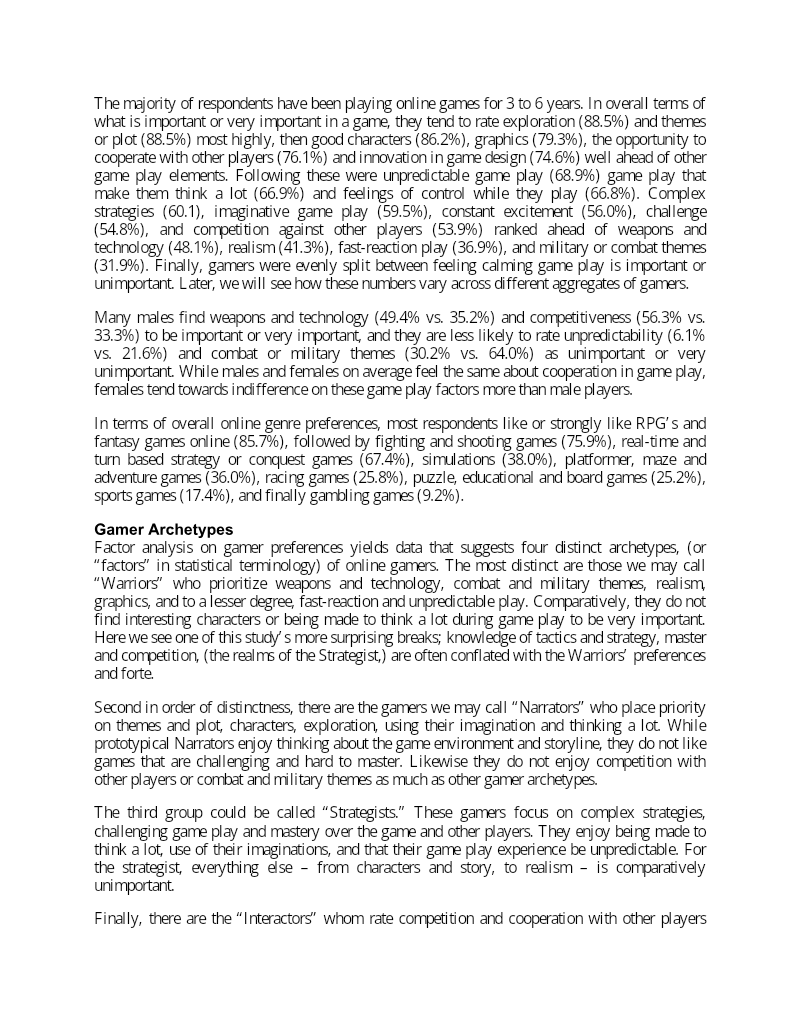
This study quantitatively identifies four distinct archetypes of online gamers, moving beyond qualitative typologies to provide empirically sound classifications.
- Exploration and themes/plot (88.5% each), good characters (86.2%), and graphics (79.3%) were the most important game features to surveyed online gamers, while military themes (31.9%) and realism (41.3%) ranked lowest.
- Based on a survey of 1,178 online gamers recruited via websites and bulletin boards, the sample is self-selected, heavily engaged, and skewed toward dedicated and Western players, limiting generalizability.
- Gender preferences diverged: males rated weapons, technology, and competition more highly, while females were more often indifferent to these features.

Canadian Content in Video Games
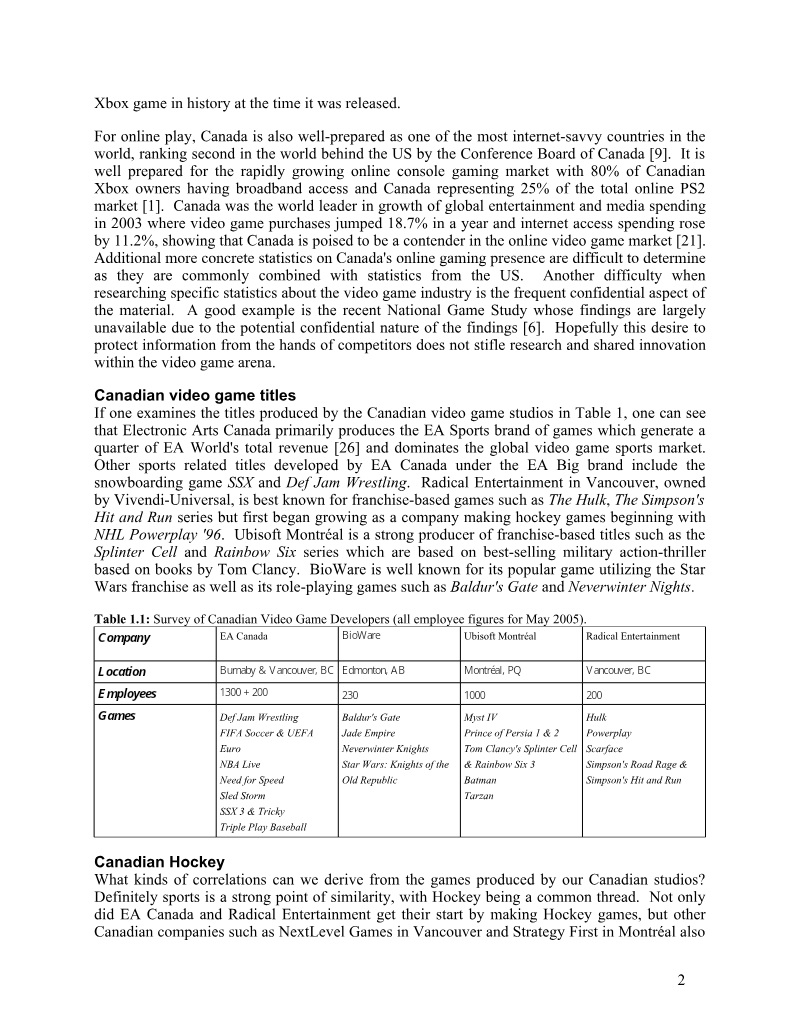
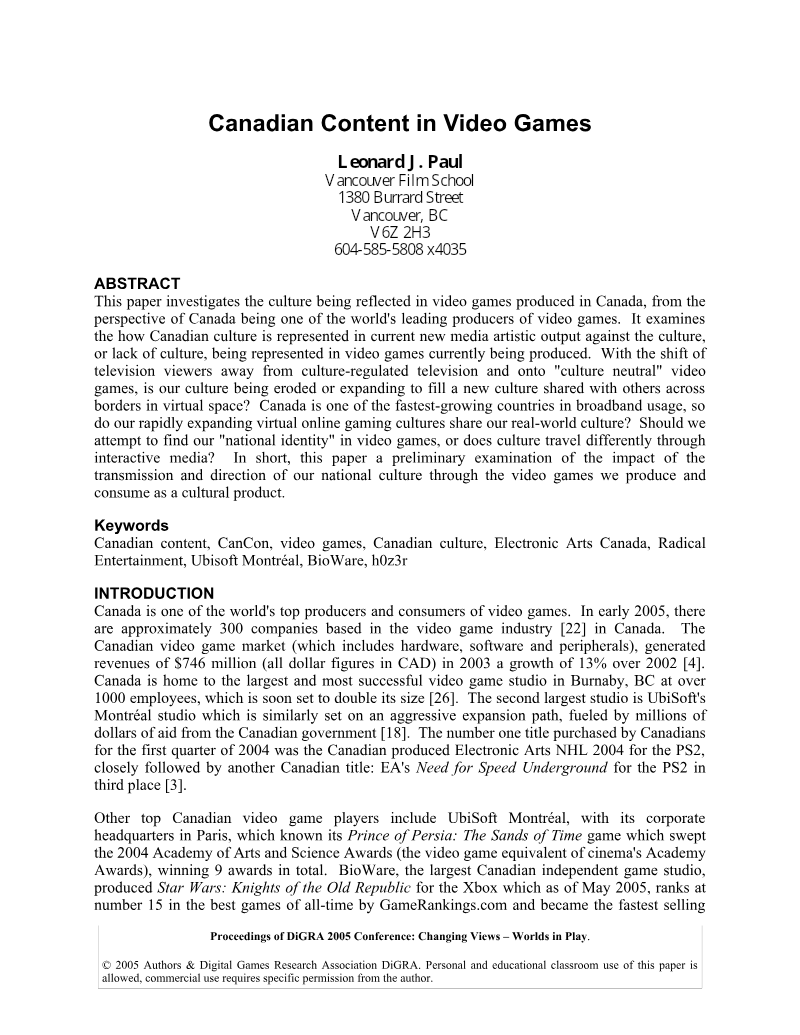
Leonard J. Paul's paper, "Canadian Content in Video Games," examines whether video games produced in Canada reflect a distinct national culture, despite Canada being one of the world's leading producers and consumers of the medium.
- The paper's central finding is that Canadian-made video games show little distinct cultural identity, with Canadian content surfacing mainly in isolated touches like hockey-themed details or Quebec French-language requirements.
- Studios often replace Canadian place names and spellings with American or generic equivalents to reach the largest market, indicating that publisher market calculations, not national cultural policy, drive how Canadian content appears.
- The author concludes that the sector's economic growth has not yet been matched by culturally distinctive output, though academic game programs and new funding may eventually change this.