
DiGRA
The Digital Games Research Association: the international association of academics and professionals who study digital games. Its Digital Library holds the proceedings of the DiGRA conferences since 2002.
Documents
A Model for Exploring the Usefulness of Games for Classrooms
The Game Uses Model for Classrooms (GUMC) provides a structured framework for Australian educators to integrate digital games into their curriculum, moving beyond mere content delivery to foster deeper student engagement and learning.
- The Game Uses Model for Classrooms (GUMC) is a planning framework built from interviews with 13 Queensland educators, designed to move teachers beyond short-form drill use of digital games toward curriculum-integrated learning.
- The authors argue that most classroom game use is limited to simple edutainment titles, attributed partly to difficulty aligning games with curriculum requirements and to limited teacher time.
- The GUMC organises planning around four student-centred components (Practising, Influencing, Discovering Affinity, and Inspiring), each supported by focus questions, with Inspiring being the most developed.
Whose Mind Is the Signal? Focalization in Video Game Narratives
The document, "Whose Mind Is the Signal?
- Focalization, adapted from Gérard Genette's literary framework, asks whose perspective a game conveys, and this question is central to how players relate to their avatars.
- Because ergodic games allow player choice, the classic framework must be modified: player agency can blur whether a character's thinking is revealed or merely implied.
- Internal focalization in games can be signaled through audiovisual presentation, selective knowledge, and ludic affordances, such as Mirror's Edge's color-coded "Runner Vision" that aligns the player with the protagonist's mindset.
Costume Agency in German Larp
The study "Costume Agency in German Larp" investigates the significant role of costumes as active collaborators in German live-action role-playing (LARP), moving beyond human-centric views of agency.
- The study argues that costumes are active, agentic participants in German larp rather than passive props, shaping material arrangements and prompting adjustments from other actors, with agency shifting from human players and organizers toward material actors.
- A 1991/92 DragonSys rulebook marked a pivotal turning point by counting real metal armor as game armor points, directly tying game mechanics to costume choices and commercial demand for armor.
- Fantasy dominates German larp, accounting for roughly 80% of announced larps, and costume investment is said to steer narratives toward this genre and discourage character death.
The Well-Played MOBA: How DotA 2 and League of Legends Use Dramatic Dynamics
The analysis, "The Well-Played MOBA: How DotA 2 and League of Legends Use Dramatic Dynamics," investigates how these popular Multiplayer Online Battle Arenas (MOBAs) are designed to generate dramatic tension for their online spectators.
- Drama in DotA 2 and League of Legends arises from conflict between uncertainty and inevitability, analysed through Marc LeBlanc's dramatic dynamics and Freytag's dramatic arc.
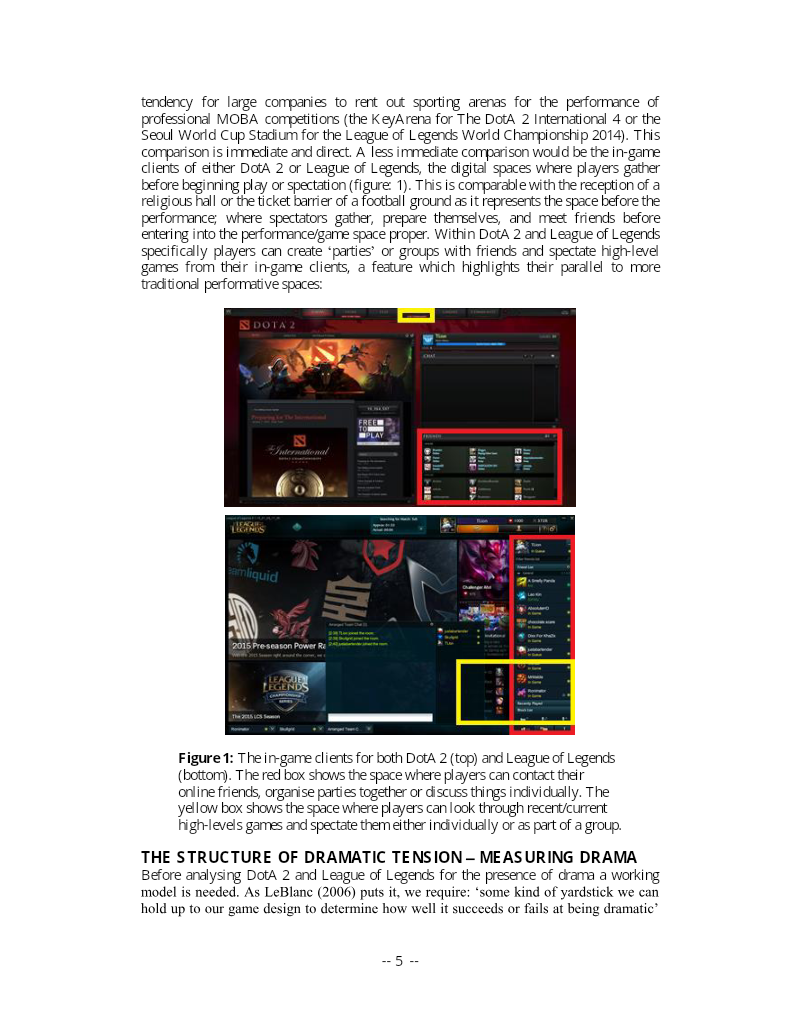
- Schechner's five qualities of performance (time, objects, non-productivity, rules, and performance spaces) are present in both games, with event time as the dominant structure and esports stadiums and in-game spectator clients acting as performance venues.
- Early-game tools such as ticking clocks, hidden information, nonrenewable tower health, passive gold accumulation, and the tower "defender's advantage" sustain suspense or drive matches toward resolution during the draft and laning phases.
The Concept and Research of Gendered Game Culture
The document establishes a foundational framework for understanding gendered game culture, addressing a notable gap in theoretical approaches within academic game studies.
- The field of gender and game culture has progressed through three waves: 1990s work on gender difference and "girls' games," 2000s research on social and cultural conditions shaping access and participation, and 2010s work on intersectionality and masculinity, yet it still lacks a coherent theoretical framework because each wave conceptualizes gender differently.
- A study of 1,074 research articles and conference papers published in leading game studies venues from 2001 to 2014 found that gender was a primary or secondary subject in only 2.6 to 7.8 percent of them.
- Most gender-focused game research in that period took a woman-centric approach, and roughly 60 percent of it was authored by women.
Ideological Narratives of Play in Tropico 4 and Crusader Kings II
Commercial games without overt ideological aims still produce distinct ideological narratives through play, and this analysis of Tropico 4 and Crusader Kings II shows how.
- Games without explicit ideological agendas still embed ideology through their procedural mechanics, and this meaning emerges through play rather than explicit messaging, drawing on Althusserian theory and Bogost and Frasca's concept of procedural rhetoric.
- Procedural mechanics give games a dual capacity: they can reinforce dominant ideologies or open space for critique, depending on which choices the systems reward.
- In Tropico 4 (Haemimont Games, 2011), rewarding popular satisfaction, supported by a dehumanized satirical population, steers players toward a satisfied, socialist-leaning society that makes utopian alternatives appear achievable.
The Tragedy of Betrayal: How the Design of Ico and Shadow of the Colossus Elicits Emotion
Tom Cole argues that Ico and Shadow of the Colossus produce unusual emotions such as guilt, grief, and loneliness through ludic and mechanical design as much as through narrative.
- Ico and Shadow of the Colossus evoke uncommon emotions such as guilt, grief, loneliness, and ambivalence, rather than the triumphant feelings typical of mainstream games built around cycles of challenge and victory.
- The emotional effects of both games are attributed to the interplay of ludic design, representation, narrative, and sound, analysed through cognitive theories of emotion rather than psychoanalysis, immersion, or classical tragedy.
- Shadow of the Colossus undercuts the sense of victory after each defeated colossus through minor-key music and requiem-style cutscenes, leaving players feeling more like perpetrators than heroes.
Digitising Boardgames: Issues and Tensions
The document examines the digitization of Eurogames, specifically focusing on titles such as Puerto Rico, Agricola, and Ascension.
- The report's central argument is that the boardgame metaphor anchors most digital ports, which are generally praised for fidelity, yet digital tools inevitably reshape the play experience.
- Digitisation automates "articulation work" (turn management, resource restocking, and scoring), lowering barriers for casual players but removing some rule-learning and social interaction that physical play requires.
- Digital versions enable "informating," where published statistics and optimisation tools let players theorycraft optimal strategies, shifting play from subjective decision-making toward something closer to solving the game.
Roleplaying and Rituals for Cultural Heritage-Orientated Games
The document, "Roleplaying and Rituals for Cultural Heritage-Orientated Games," posits that contemporary Computer Role-Playing Games (CRPGs) and virtual worlds frequently fall short in authentically representing the profound cultural significance embedded within their virtual environments, roles, and rituals.
- Champion argues that computer RPGs such as The Elder Scrolls IV: Oblivion and Skyrim simulate cultural worlds but do not genuinely support cultural learning, because their roles are largely cosmetic or interchangeable and their rituals lack depth.
- The paper distinguishes environmental, social, and cultural presence, contending that cultural presence can persist in weakened form without social interaction because culture is carried through artefacts reflecting past creators' agency.
- Champion proposes "hermeneutic richness," the interpretive depth with which an environment conveys cultural perspectives and creators' intentions, as a measure of a space's potential for cultural learning.
Game Elements-Attributes Model: A First Step Towards a Structured Comparison of Educational Games
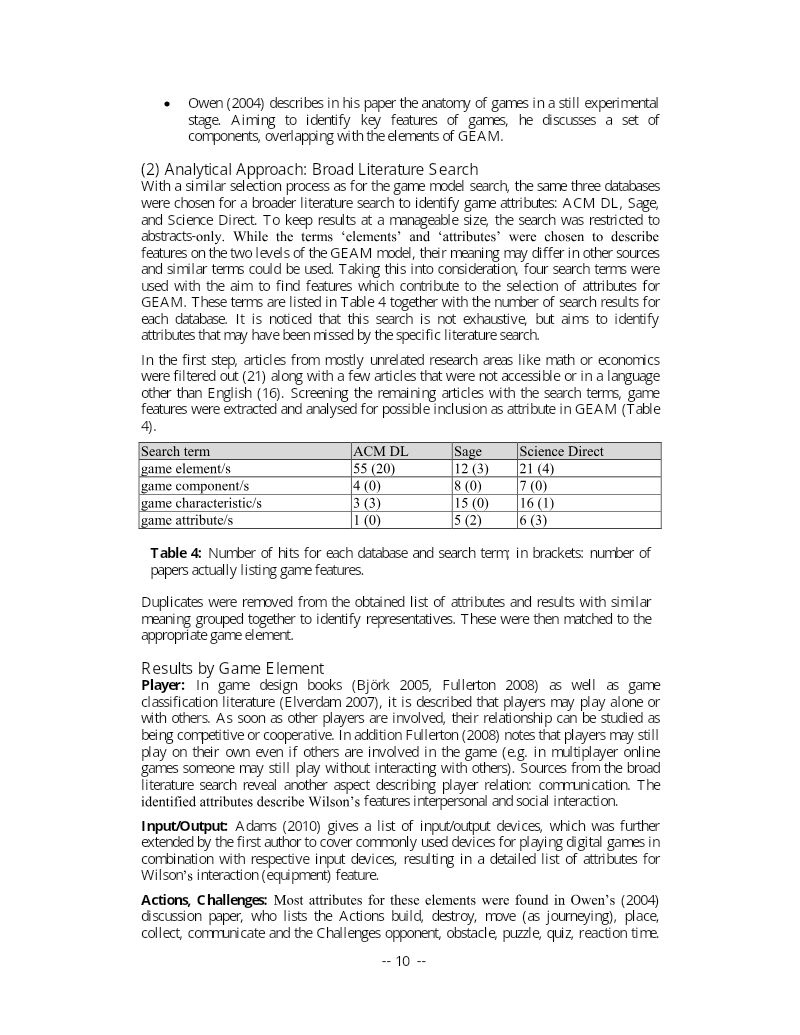
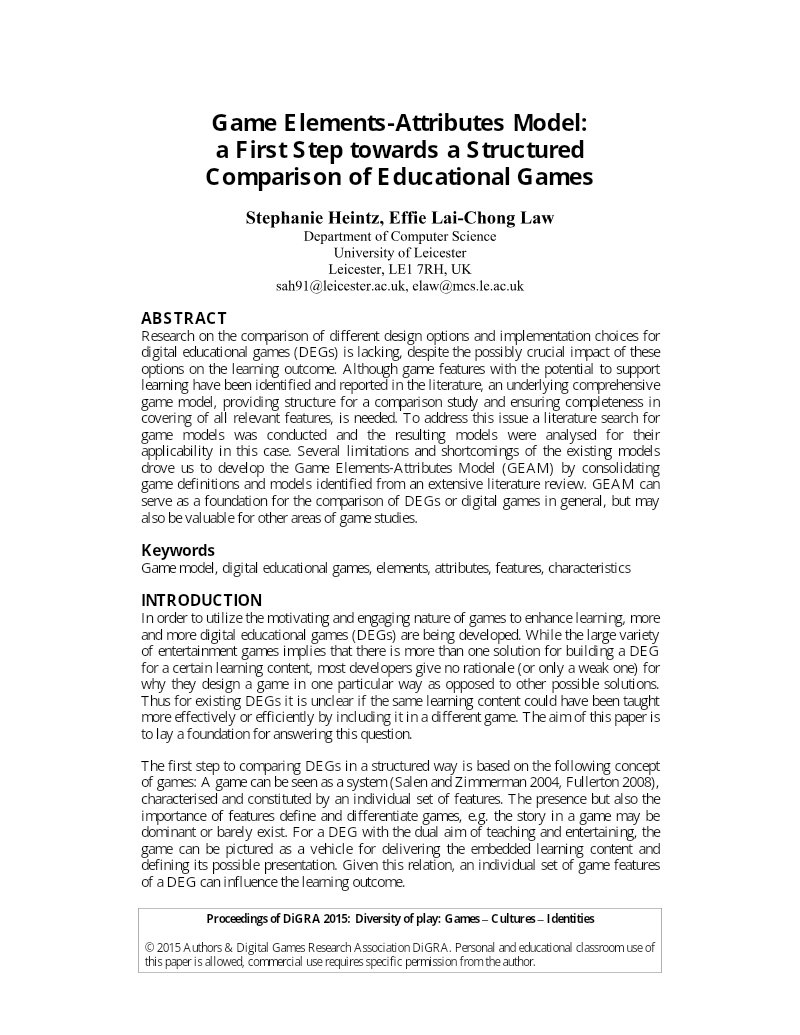
The Game Elements-Attributes Model (GEAM) is introduced as a novel framework designed to facilitate the structured comparison of Digital Educational Games (DEGs).
- The Game Elements-Attributes Model (GEAM) proposes a structured framework for comparing digital educational games, addressing the lack of systematic structure in Wilson et al.'s (2009) feature list, which had no underlying organization or completeness guarantee.
- GEAM is organized around seven core elements (Player, Actions, Challenges, Goals, Rewards, Setting/World, and Structure), with attributes grouped beneath each and mapped to the nine categories proposed by Bedwell et al. (2012).
- The model was built from a literature review of 211 screened articles that identified ten existing game models, of which seven were evaluated against two requirements: inclusion of Wilson's features and a categorical structure comparable to Bedwell et al.'s.
Taking a Look at the Player's Gaze: The Effects of Gaze Visualizations on the Perceived Presence in Games
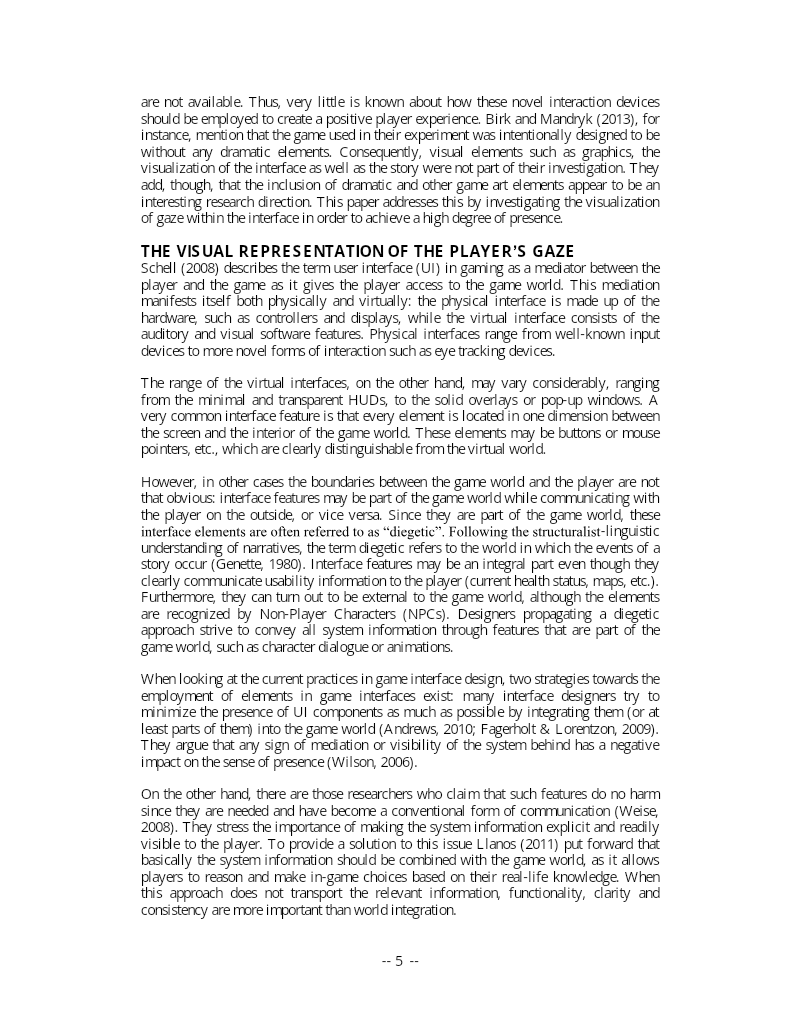
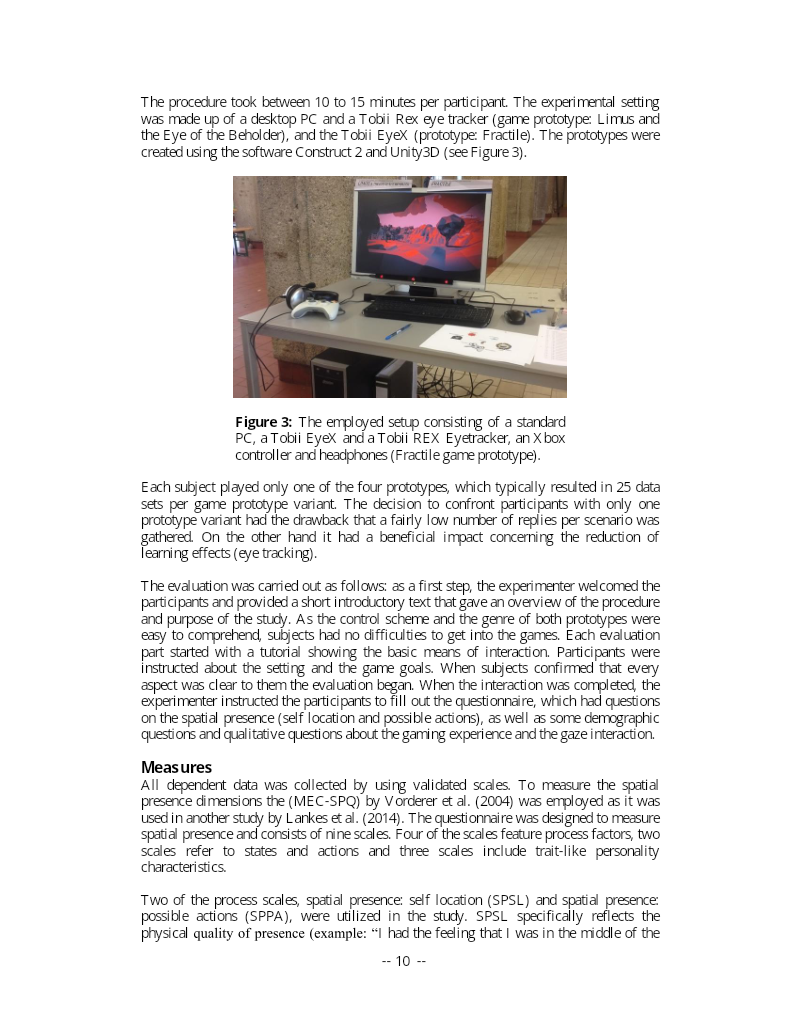
This study investigates the effects of gaze visualizations within game interfaces on players' perceived presence, aiming to inform game designers and researchers about factors influencing immersion in gaze-based interactions.
- Genre had a more consequential effect on presence than the visualization choice: the 2D platformer produced markedly higher perceived possible actions than the 3D exploration variants.
- Scenario significantly affected the self-location dimension of spatial presence, with the first-person variant lacking a gaze rectangle scoring highest, though pairwise differences were limited.
- A visible white gaze-position rectangle initially reduced spatial presence, but players adapted to it over time, suggesting a learning effect.
Analysing Cultural Heritage and Its Representation in Video Games
This research establishes a framework for analyzing the representation of cultural heritage in video games, using "Assassin's Creed I" and "Unearthed: Trail of Ibn Battuta" as primary case studies.
- The paper's central premise is that greater cultural awareness among developers leads to greater consideration of cultural authenticity in game design, and its analysis is interpretive rather than quantitative.
- Close-reading analysis of Assassin's Creed I (set in twelfth-century Middle East) finds strong architectural and historical fidelity alongside misrepresentations such as mismatched minaret styles and calligraphy, misplaced artefacts, a westernised protagonist, and offensive Western-influenced dialogue.
- Unearthed, a Saudi-developed game tracing a fourteenth-century journey, is grounded in real architectural sites, but commercial conventions and artistic licence ("Hollywoodisation") take priority over realism, with cultural sites clustered for gameplay convenience.
Do you work at DiGRA? Get a free report of how these documents are read and cited here.