
DiGRA
The Digital Games Research Association: the international association of academics and professionals who study digital games. Its Digital Library holds the proceedings of the DiGRA conferences since 2002.
Documents
Conceptualising Inspiration Networks in Game Design
Inspiration networks serve as a robust analytical framework for mapping the iterative and combinatorial nature of game design.
- Inspiration networks visualize the 'six degrees of separation' effect in game design, allowing developers to map how ideas connect and evolve during rapid development cycles like the 48-hour Global Game Jam.
- The research identified four primary methods of idea connection: adaptation (moving an idea to a new domain), reuse (refurbishing for a similar purpose), transmediation (transforming an idea into a new medium), and combination (merging multiple concepts).
- Visualizing these networks reveals 'islands' of related concepts, which helps designers identify emerging, informally recognized game genres such as 'player interpretation,' 'changing perspective,' and 'reactive games.'
Remembering and Exhibiting Games Past: The Popular Memory Archive
The Popular Memory Archive serves as a collaborative research portal dedicated to documenting the production and reception history of micro-computer games in Australia and New Zealand during the 1980s.
- The Popular Memory Archive documents the production and reception history of 1980s micro-computer games in Australia and New Zealand.
- Traditional object-focused museum displays are insufficient for capturing the cultural significance of early gaming, necessitating a hybrid archival model.
- The project integrates scholarly classification with user-generated content, including personal photographs, oral histories, and community-led software reconstructions.

The Limits of the Evolution of Female Characters in the BioShock Franchise
Female characters across the BioShock trilogy have evolved in presentation but remain constrained to supporting roles defined by a male player character's perspective.
- The report argues that female characters across the BioShock franchise (BioShock, BioShock 2, BioShock Infinite) have become more independent on the surface yet remain largely confined to patriarchal roles as supporting figures, gameplay rewards, or damsels in distress.
- The analysis uses a multimodal framework combining appraisal analysis, Kress and van Leeuwen's visual grammar, and Lim's gesture system, and is offered both to diagnose stereotypical representation and as a practical aid for designers seeking more diverse characters.
- In BioShock Infinite, Elizabeth is coded heavily for "reaction: impact" (572 tokens) and "insecurity" (31 tokens), positioning her as a guide who depends on the male protagonist.



Early Computer Game Genre Preferences (1980-1984)
This analysis of early computer game genre preferences from 1980 to 1984 reveals a significant divergence in player interests between general computer owners and a more dedicated "hardcore" gaming community.
- Arcade games dominated commercial sales in 1980–1984, accounting for roughly 61 percent of Softalk's monthly Apple II "Top Thirty" best-seller chart entries, while strategy games made up about 52 percent of Computer Gaming World reader preferences from 1982 to 1984.
- The gap between sales charts and reader preferences points to a hardcore hobbyist audience whose tastes diverged sharply from the broader consumer market.
- Wizardry and Choplifter! were the strongest performers across both the Softalk sales data and the Computer Gaming World reader ratings.

Hackers and Cyborgs: Binary Domain and Two Formative Videogame Technicities
Brendan Keogh's paper "Hackers and Cyborgs: Binary Domain and Two Formative Videogame Technicities" uses Sega's Binary Domain as a lens for arguing that two competing modes of identifying with videogames have shaped the medium.
- Using Sega's Binary Domain as its lens, the paper treats the cyborg as a resistant and complementary perspective rather than a strictly opposed one, arguing the two identities are entangled and interdependent.
- The author contends the hacker ideal is masculinist and that this "technicity" influences which games get made, which are celebrated as exemplary, and how scholarly and popular discourse values the medium.
- Mainstream journalism and design privilege skill-based mastery, leading critics to dismiss exploration-focused and queer or women-created titles such as Dear Esther and Gone Home as "not real games," a rhetorical policing that also hits casual and avant-garde games reaching broader, more diverse audiences.



Defining the Global Ludo Polychotomy
The document, "Defining the Global Ludo Polychotomy," investigates the applicability of the established East-West Dichotomy to the global video game industry.
- The paper proposes replacing the East-West dichotomy (Meštrovic, 1994) with a "Global Ludo Polychotomy," arguing that regional differences in game design are real but too simplistic to explain market patterns.
- Using the "Three Corners of Reward" model (James et al., 2013), the authors find Western design tends toward fast-paced extrinsic, material rewards displayed through competitive online play, while Eastern design favours personal goals and intrinsic progression with less emphasis on showing achievements to others.
- The analysis covers only six titles released 2007–2013: Call of Duty: Ghosts, Assassin's Creed IV: Black Flag, Pokémon X and Y, Super Mario 3D World, Grand Theft Auto V, Battlefield 4 and Lego Marvel Super Heroes, selected for popularity and seminal status.
Editors of Play: The Scripts and Practices of Co-creativity in Minecraft and LittleBigPlanet
"Editors of Play: The Scripts and Practices of Co-creativity in Minecraft and LittleBigPlanet" examines the emergent genre of "editor games," which empower players to construct game worlds rather than merely interact with pre-defined ones.
- The study's central thesis is that design decisions act as inscribed 'scripts' (drawing on Akrich) that actively structure how players create and cooperate, so understanding participation requires observing play as it unfolds rather than analysing design or text alone.
- A praxeological, media-ethnographic method is proposed as essential for studying 'co-creative' editor games like Minecraft and LittleBigPlanet, because it attends to both designed affordances and how users actually implement them.
- In a workshop of nine participants reconstructing a digital replica of Castle Wahn, LittleBigPlanet's jump'n'run scripts, freely adjustable elements, and rewind-based editing encouraged spontaneous, playful building but often caused frustration.
Understanding Player Experience Through the Use of Similarity Matrix
The document proposes a novel methodology for analyzing player experience in video games through the application of similarity matrices derived from game audio and visual output.
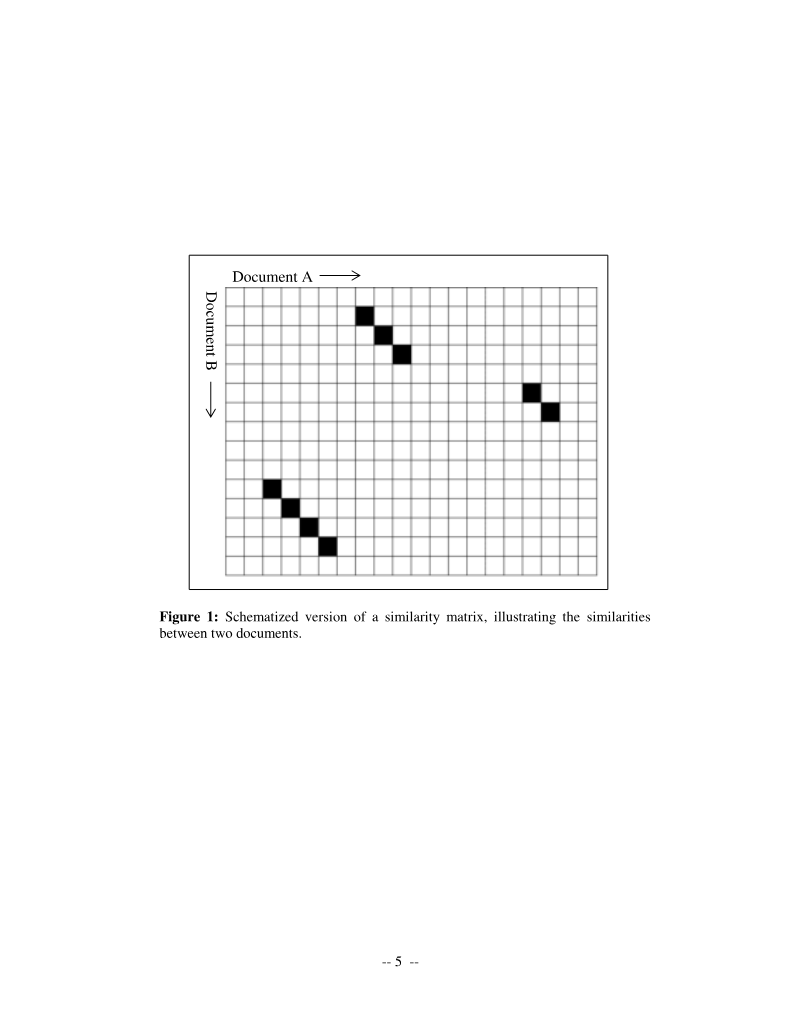
- The paper proposes a similarity matrix method that converts gameplay audio into chroma representations, discards the video channel, and computes pairwise similarity between sound segments to reveal the structure of a play session through diagonal patterns.
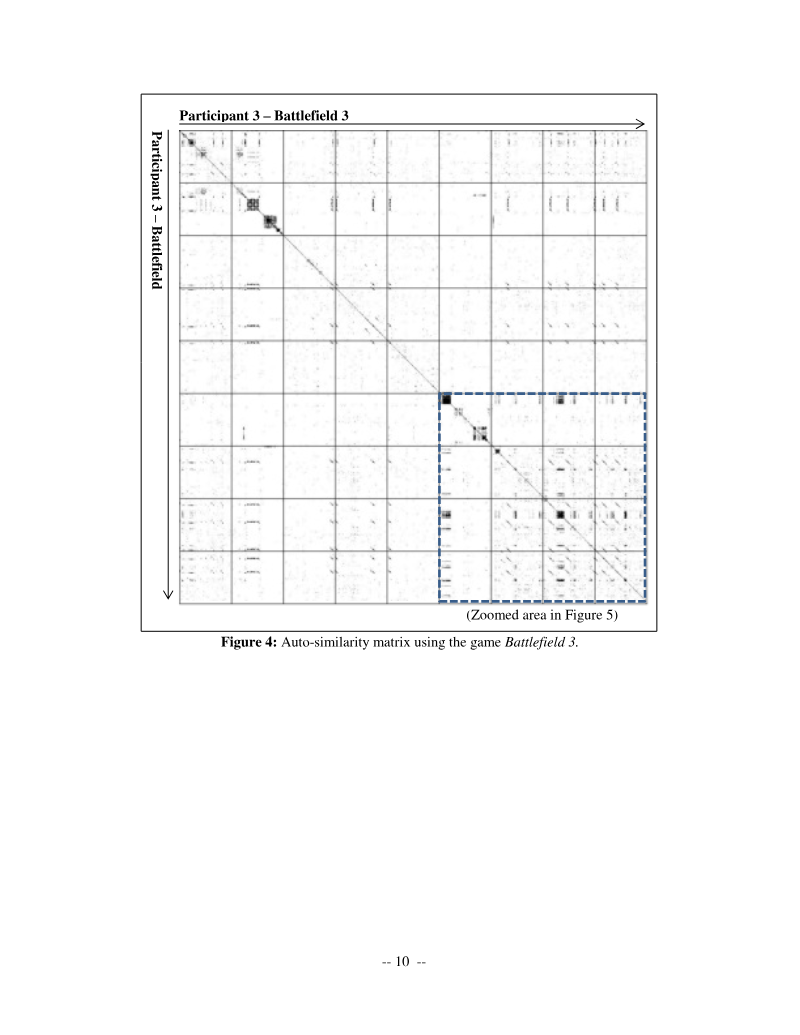
- Applied to recordings of Max Payne 3, Battlefield 3, and Super Hexagon, the similarity matrices distinguish player strategies, such as players who customize settings before playing versus those who immediately begin acting in the game.
- Repeated diagonal patterns in the matrices identify replayed sequences, including those that follow player deaths.
The Role of Gaming Platforms in Young Males' Trajectories of Technical Expertise
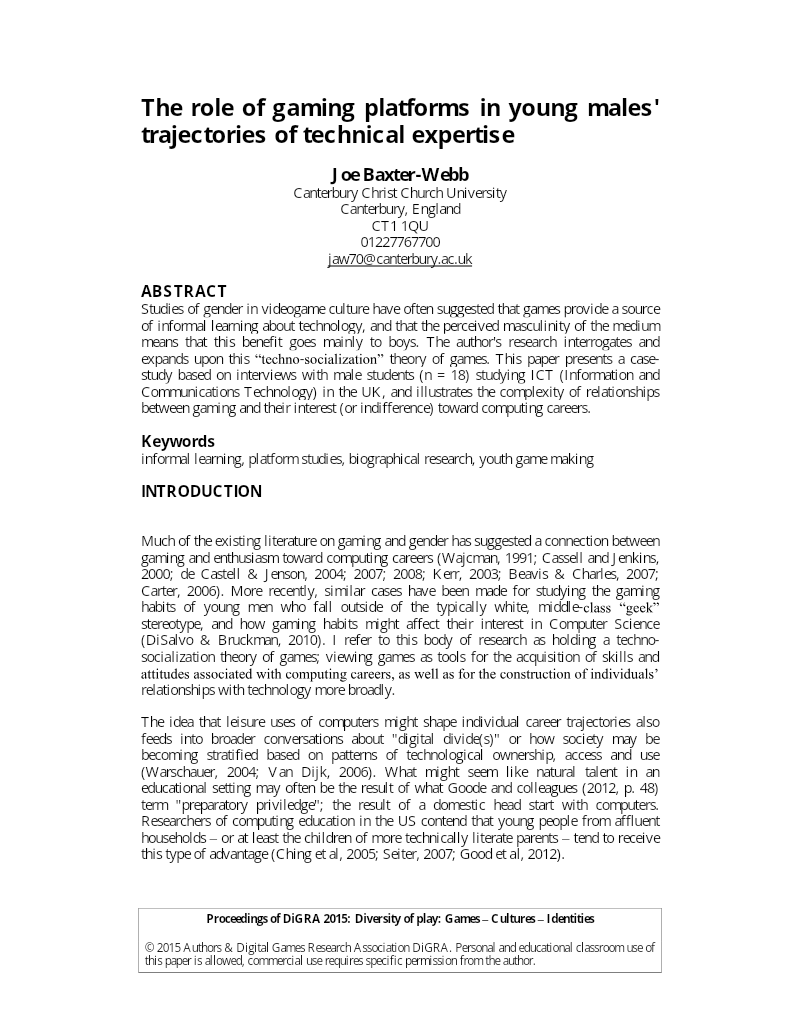
The research explores the "techno-socialization" theory, examining how gaming platforms contribute to the development of technical expertise and career interest among young males, particularly in the context of Information and Communication Technology (ICT) fields.
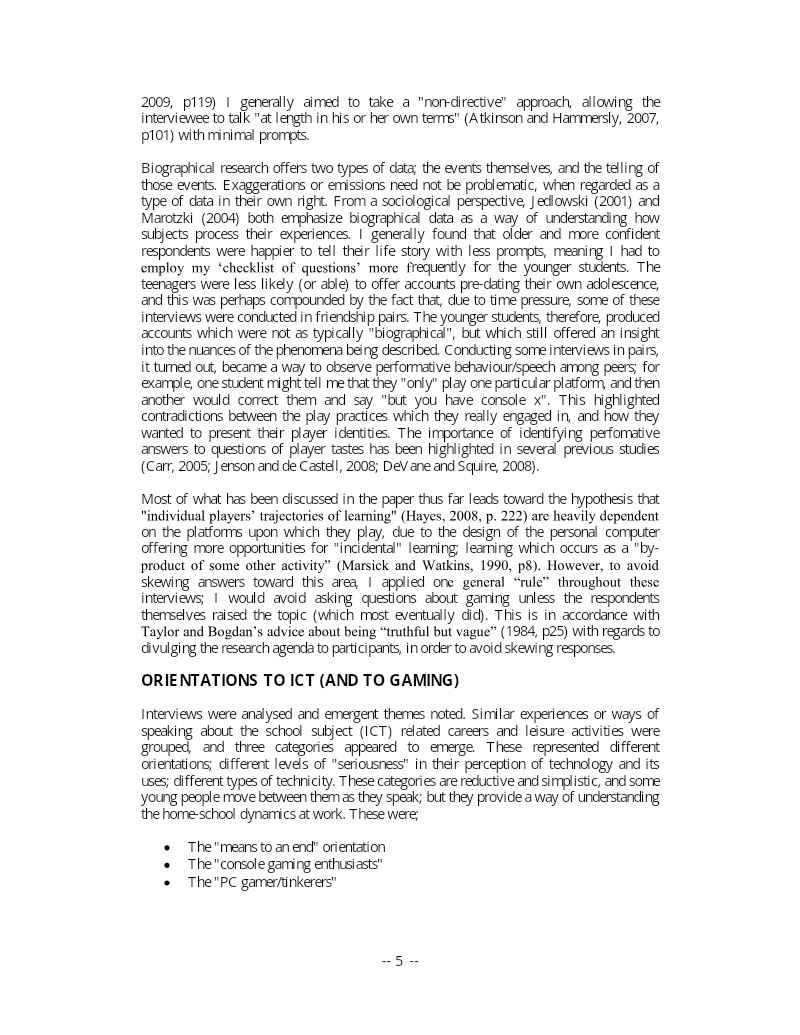
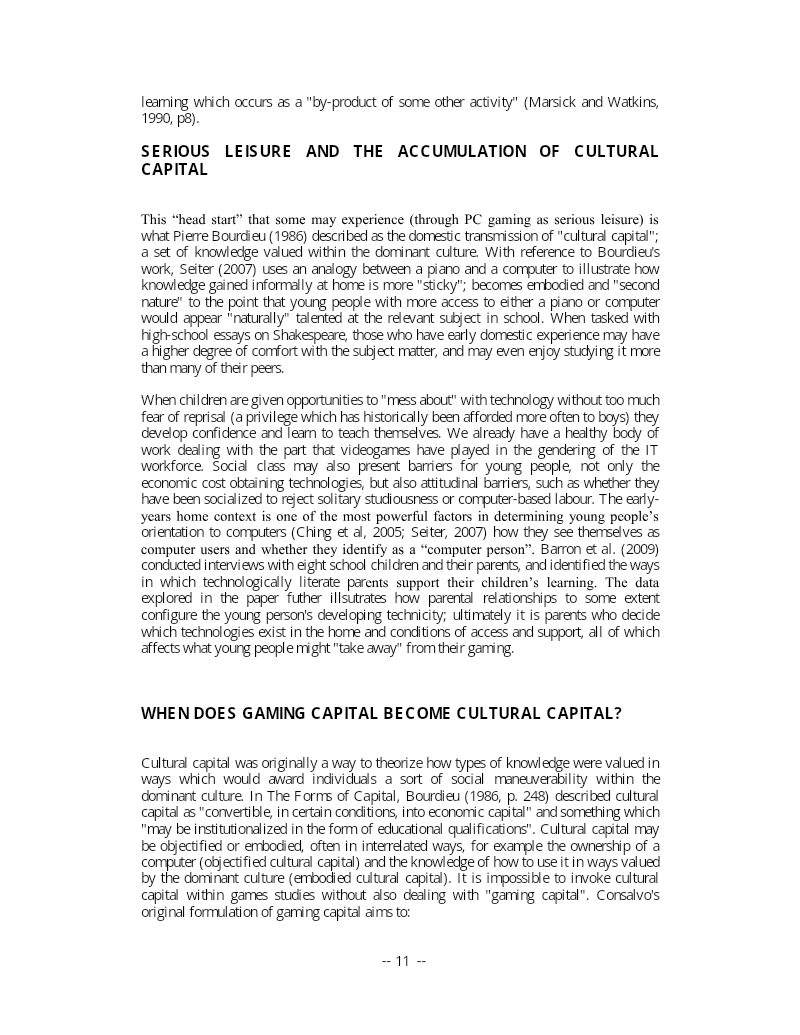
- The study, based on semi-structured interviews with 18 male post-16 ICT students in two socioeconomically deprived UK schools, finds that gaming's link to computing skills depends heavily on the platform used, parental involvement, and home technology access rather than gaming in general.
- PC gaming, with its greater openness and opportunities for modification, is identified as the platform most likely to support technical learning.
- Console gamers tend to aspire to game development but have little hands-on making experience, whereas PC gamer-tinkerers who build machines or program small games follow informal learning routes similar to those of adult IT workers.

Failed Games: Lessons Learned from Promising but Problematic Game Prototypes in Designing for Diversity
The "Failed Games: Lessons Learned from Promising but Problematic Game Prototypes in Designing for Diversity" document presents findings from the BIAS project, which sought to develop game-based interventions to mitigate biases and enhance women's engagement in STEM fields.
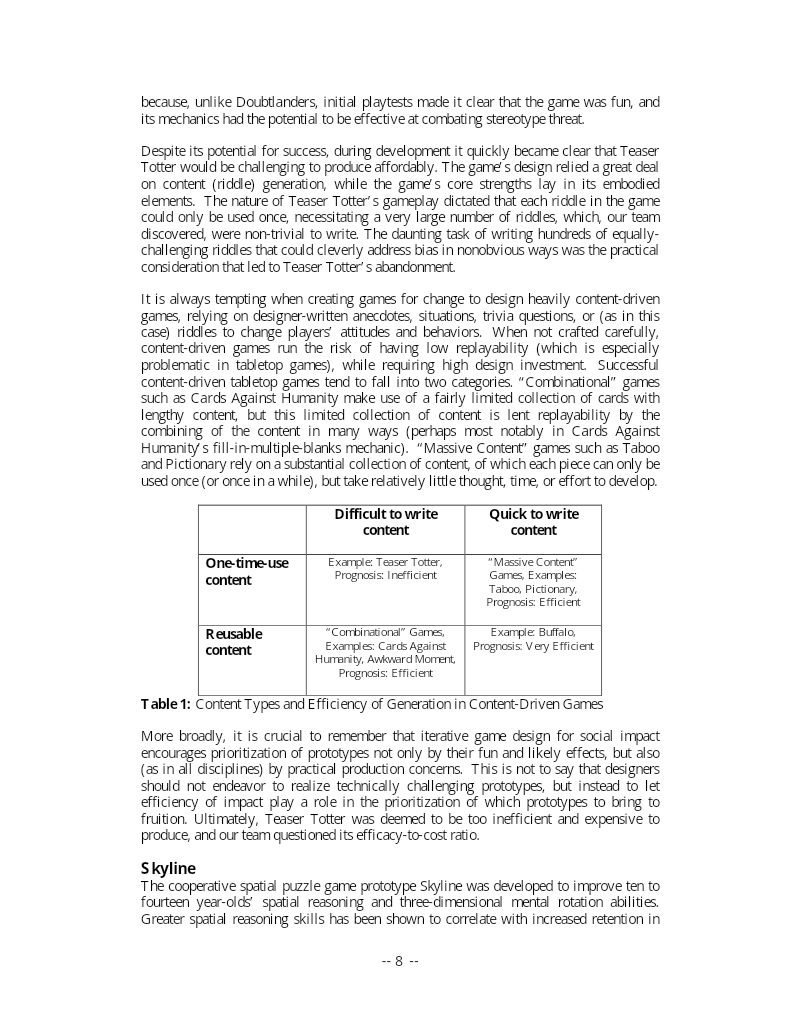
- Games designed for social impact must meet a "dual bottom line": they need to be genuinely enjoyable to play while also producing measurable change in players.
- Overt, explicit treatments of bias undermine engagement; the abandoned board game Doubtlanders, which literally used the word "stereotype," felt dour and heavy to players and was shelved despite being on-topic.
- Indirect persuasion is favored over explicit messaging, since heavy-handed content pushes players away from the very material meant to persuade them.
EVE Is Real
The phrase "EVE is real," popularized by CCP Games in 2011, functions as an epitext: a paratext that shapes the informal rules, culture, and identity of EVE Online.
- The phrase "EVE is real" functions as a discursive device that legitimizes scamming, espionage, and sabotage by framing them as authentic social competition rather than cheating, and CCP popularized it in 2011.
- CCP intervenes against technical exploits, staff impersonation, and harassment, but generally leaves social exploits and scams to player-enforced norms.
- The phrase carries several reinforcing meanings at once: emotional investment, a claim to historical authenticity drawn from CCP's "True Stories" project (whose truth claims the authors treat as contested), and the substantial real-world labor players devote to the game.
Postdigital Play and the Aesthetics of Recruitment
"Postdigital Play and the Aesthetics of Recruitment" examines the evolving nature of videogames, arguing that "hybrid play"—the integration of material and digital elements—is not a novel development but a re-emergence of gaming's foundational hybridity.
- Hybrid play is framed as a return to videogames' long-standing hybrid nature, now intensified by distributed computing rather than a wholly novel development.
- The authors argue that device-focused models classifying hybrid play by synchrony and dependency cannot account for contexts where devices, spaces, and bodies cannot be specified in advance.
- The proposed analytical framework centres on interface effects and an "aesthetic of recruitment," in which spatial, social, and material domains are enrolled into play.
Do you work at DiGRA? Get a free report of how these documents are read and cited here.