
DiGRA
The Digital Games Research Association: the international association of academics and professionals who study digital games. Its Digital Library holds the proceedings of the DiGRA conferences since 2002.
Documents
DeFragging Regulation: From Putative Effects to 'Researched' Accounts of Player Experience
This paper, by Schott, Marczak, Mäyrä, and van Vught, argues that regulatory and media-effects debates about violent video games have treated violence as a homogeneous category and have overlooked how game systems, interactivity, and mechanics shape what players actually experience.
- The paper argues that violent video game regulation has treated violence as a homogeneous category, ignoring how game systems, interactivity, and mechanics shape what players actually experience, and proposes grounding classification decisions in observed player experience instead of assumptions about violent content.
- Its case study of Max Payne 3 used a mixed-methods design with 14- to 16-year-old players observed over five to six weeks, collecting biometric, observational, metric, and commentary data, with New Zealand's game classification regulation as the policy context.
- Players mostly treated bullet time as a tactical resource for performance and resource management rather than as spectacle, with the authors arguing that the game subordinates spectacle to player agency, unlike stylized screen violence in films such as Bonnie and Clyde and Natural Born Killers.
Spec Ops: The Line's Conventional Subversion of the Military Shooter
Brendan Keogh's paper argues that Spec Ops: The Line critiques the military shooter genre by subverting its conventions from within, exposing the violence and moral ambiguity that the genre's romantic, technologically superior depictions of modern warfare tend to obscure.
Untangling Twine: A Platform Study
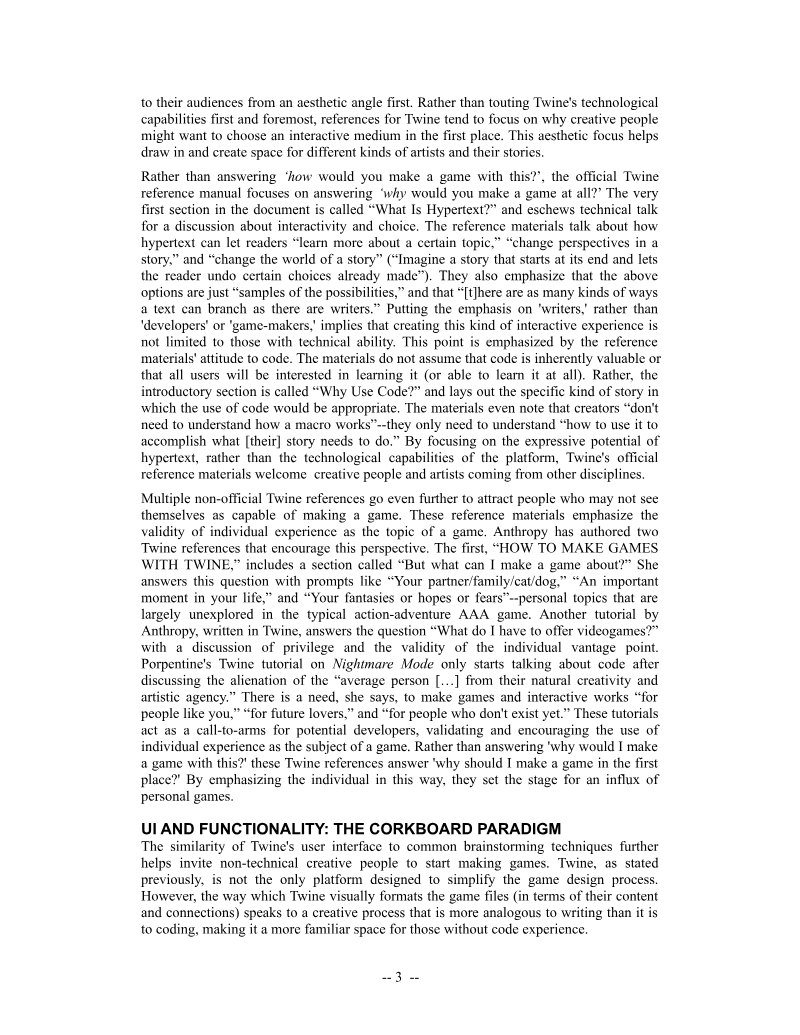
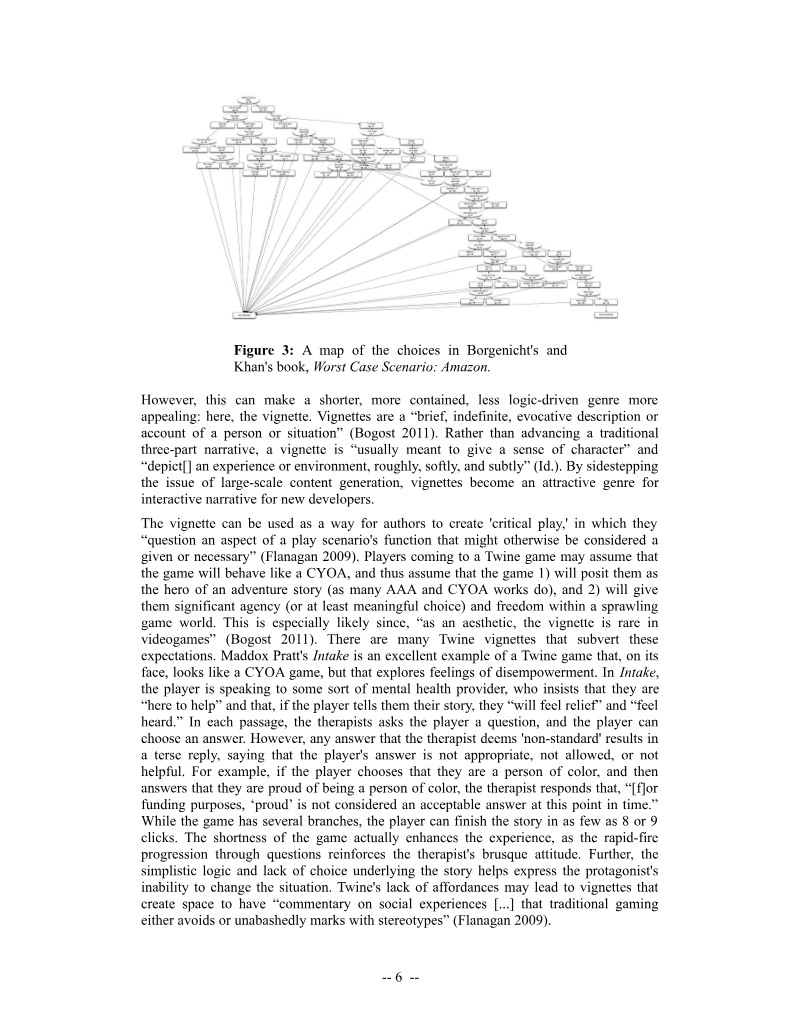
Jane Friedhoff's platform study examines why Twine, a free tool for creating branching interactive stories, has become the primary venue for personal and non-mainstream games dealing with marginalization, queerness, mental health, and discrimination.


Analyzing the Believability of Game Character Behavior Using the Game Agent Matrix
This paper examines how convincingly non-player characters (NPCs) in modern single-player games behave as human-like agents, a property the authors call believable behavior.

The Pretence Awareness Contexts and Oscillating Nature of Coaching Frames
Coaching in multiplayer games, the authors argue, forms a temporary and recurring play frame in which players move back and forth between instructing newcomers and playing normally.
Incongruous Avatars and Hilarious Sidekicks: Design Patterns for Comical Game Characters
This paper proposes a structured approach to humour in game character design, grounding its analysis in classical theories of humour, namely superiority, relief, and incongruity.
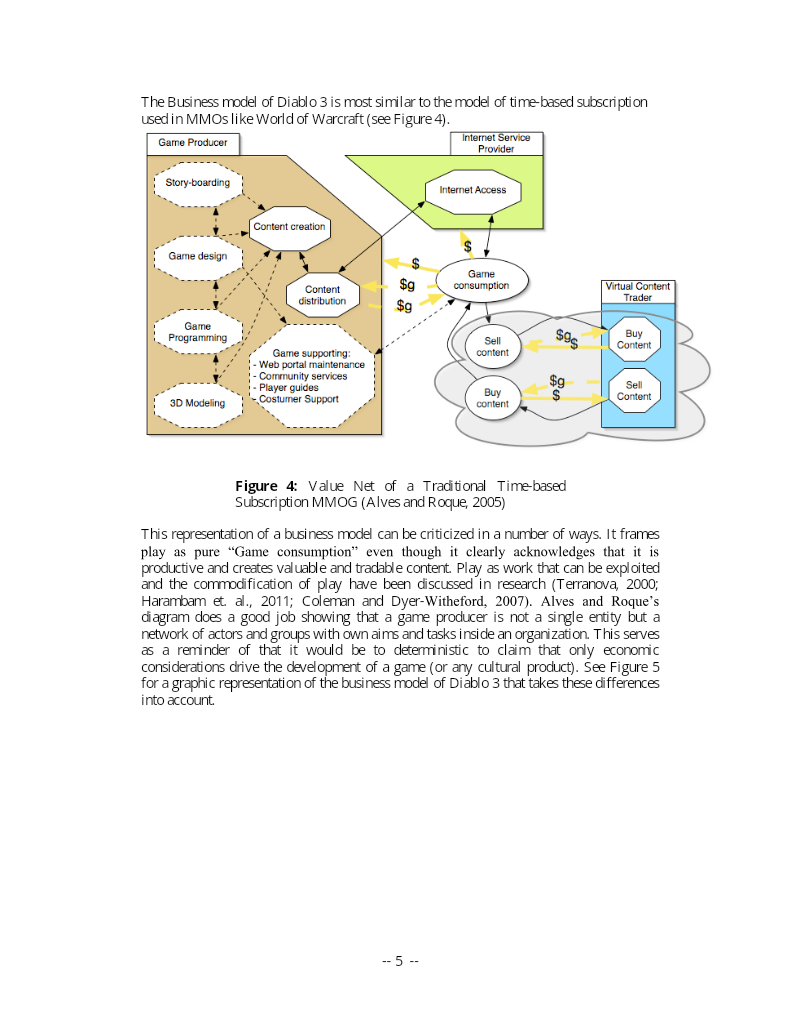

Game Design and Business Model: An Analysis of Diablo 3
Diablo 3 is examined here as a case study in how business models shape game design, with particular attention to the Real-Money Auction House (RMAH) that Blizzard operated for the game.

A Cognitivist Theory of Affordances for Games
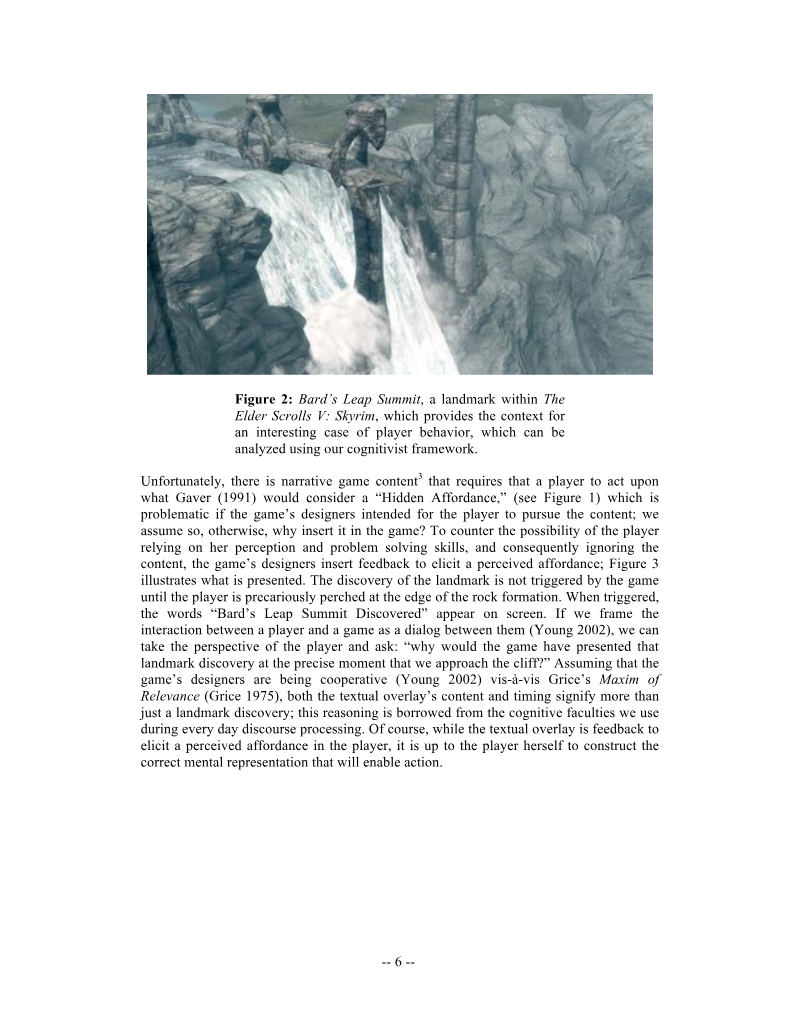
This paper presents a cognitivist theory of affordances for games, arguing that a useful framework for analyzing games must account for cognition rather than treating affordances as purely environmental properties in the manner of ecological psychology.

The Strenuous Task of Maintaining and Making Friends: Tensions Between Play and Friendship in MMOs
Massively multiplayer online games are often praised for fostering social bonds, but a study of 52 World of Warcraft players drawn from two Nordic research projects argues that maintaining friendships within these games can be a strenuous undertaking.
- The central finding is that the performance-measured structure of competitive play, especially raiding, often conflicts with the low-demand, voluntary character that friendship requires, making friendships within MMOs a strenuous undertaking.
- Based on a study of 52 World of Warcraft players drawn from two Nordic research projects, the analysis uses three ideal-type player portraits to illustrate how these tensions manifest.
- Players commonly face a dilemma between staying with friends in a casual, non-competitive guild and advancing through challenging raid content with more skilled groups.

Suit The System To The Player: A Methodology for Physical Creativity
Friedhoff's paper argues that motion-controlled exertion games such as those built for Kinect, PlayStation Move, and Wii tend to constrain players to narrow, tightly tracked movements, when they could instead nurture physical creativity and shared, norm-breaking play.
- Friedhoff argues that motion-controlled exertion games such as those for Kinect, PlayStation Move, and Wii tend to confine players to narrow, tightly tracked movements, when they could instead foster physical creativity and norm-breaking play.
- The paper proposes a five-part design methodology: inattentive systems that track loosely, festive social contexts, responsive systems that generate outcomes from player input, multiple simultaneous physical inputs balanced for skill, and playful transgression of social norms.
- Its evidence is primarily theoretical reasoning and qualitative examples (including B.U.T.T.O.N., WarioWare: Smooth Moves, Happy Action Theater, Messa di Voce, and PewPewPewPewPewPewPewPewPew) rather than large-scale empirical study.
Understanding Japanese Games Education
Zagal's study examines how game design and development are taught in Japan, drawing on in-person interviews with ten instructors conducted with interpreter support and analyzed through iterative open coding.
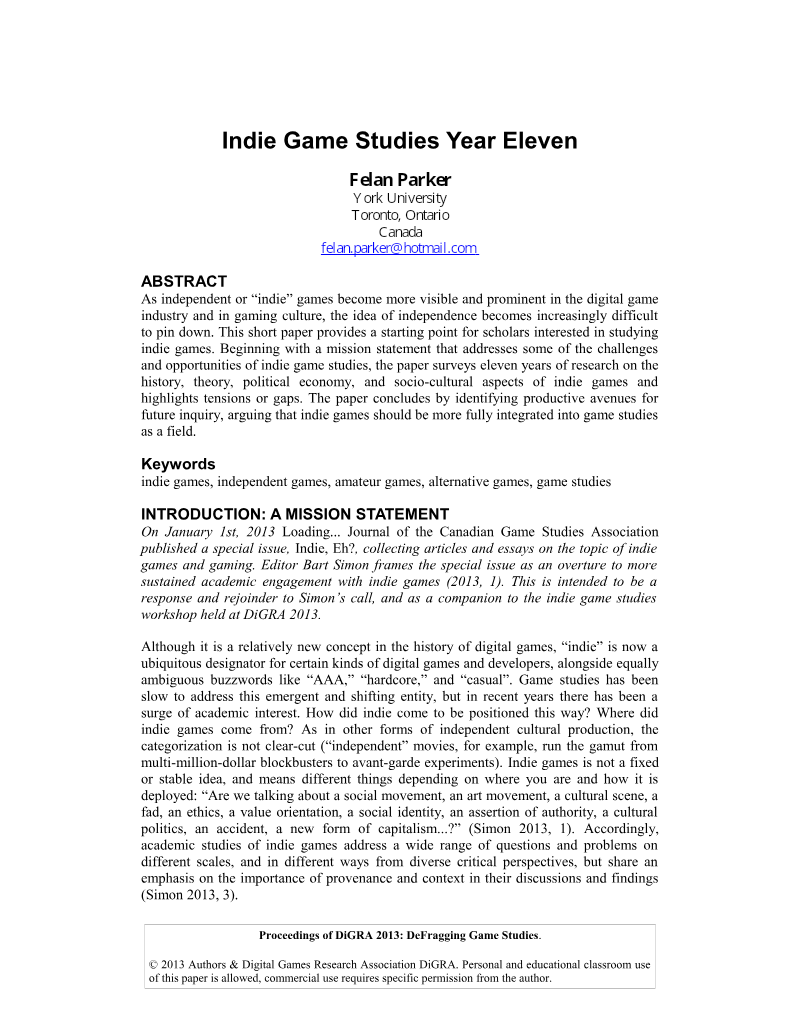
Indie Game Studies Year Eleven
Indie Game Studies Year Eleven, authored by Felan Parker, argues that "indie" functions as a slippery, context-dependent category that resists fixed definition.