Loading the document
1 free read left. Create a free account for unlimited reading + AI research.
Create free accountWhitepaper DiGRA
1 free read left. Create a free account for unlimited reading + AI research.
Create free accountWhitepaperDiGRA
The central thesis is that game designers should prioritize perceived possibilities within an interactive virtual environment. The framework is presented as a lens for both game design and analysis.
This theoretical paper proposes a cognitivist theory of affordances specifically for games, aiming to unify disparate approaches from ecological psychology, interaction design, and human-computer interaction. The central thesis is that game designers should prioritize what players perceive they can do within an interactive virtual environment, rather than solely focusing on what is actually possible. This framework is presented as a useful lens for both game design and analysis.
The theory defines three independent, manipulable entities relevant to games: real affordances, perceived affordances, and feedback. Real affordances are the actions genuinely possible and supported by the game's underlying computational model. Perceived affordances are the actions players believe are possible, influenced by in-game experience, memory, analogical thinking from similar games, and genre conventions. Feedback constitutes the perceptual information designers introduce to advertise real affordances, aiming to elicit accurate perceived affordances. The framework acknowledges that poor feedback can lead to real affordances remaining unperceived.
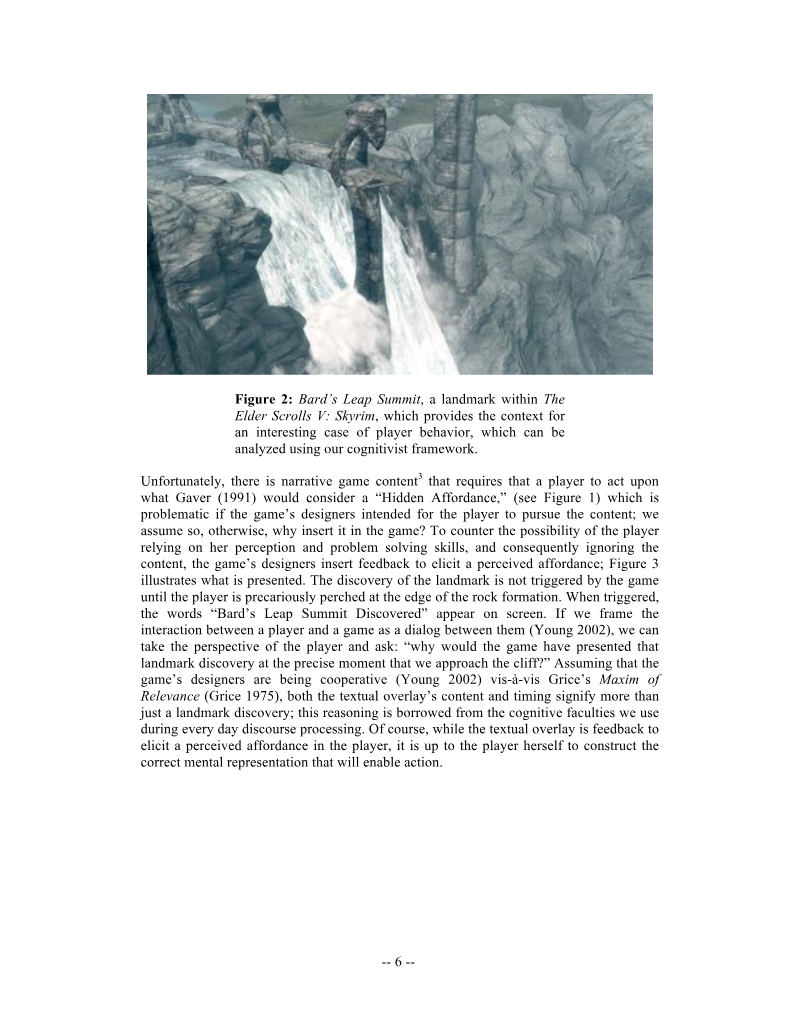
The authors argue for the necessity of a cognitivist approach, contending that an anti-cognitivist stance cannot adequately explain how players perceive, understand, and learn within virtual environments. They illustrate the theory's application through a case study of "The Elder Scrolls V: Skyrim," analyzing a specific sequence at Bard's Leap Summit. This example demonstrates how the game uses feedback (a textual overlay upon landmark discovery) to guide players toward a "hidden affordance" (jumping into a lake to survive a fall), thereby influencing perceived affordances and player action to access narrative content and a skill boost. The paper concludes by emphasizing the theory's utility for practitioners in monitoring perceived affordances and for scholars in understanding player-game dynamics and cognitive processes.
Each row is a game or company this document names, each column a document, oldest first. A mark means that document names it. Select a row to see those documents.

DiGRA · 2026

DiGRA · 2026



DiGRA · 2026



DiGRA · 2026



DiGRA · 2026



DiGRA · 2026



DiGRA · 2026



DiGRA · 2026



DiGRA · 2026

DiGRA · 2026



DiGRA · 2026



DiGRA · 2026
Thomas Brush · 2025