
DiGRA
The Digital Games Research Association: the international association of academics and professionals who study digital games. Its Digital Library holds the proceedings of the DiGRA conferences since 2002.
Documents
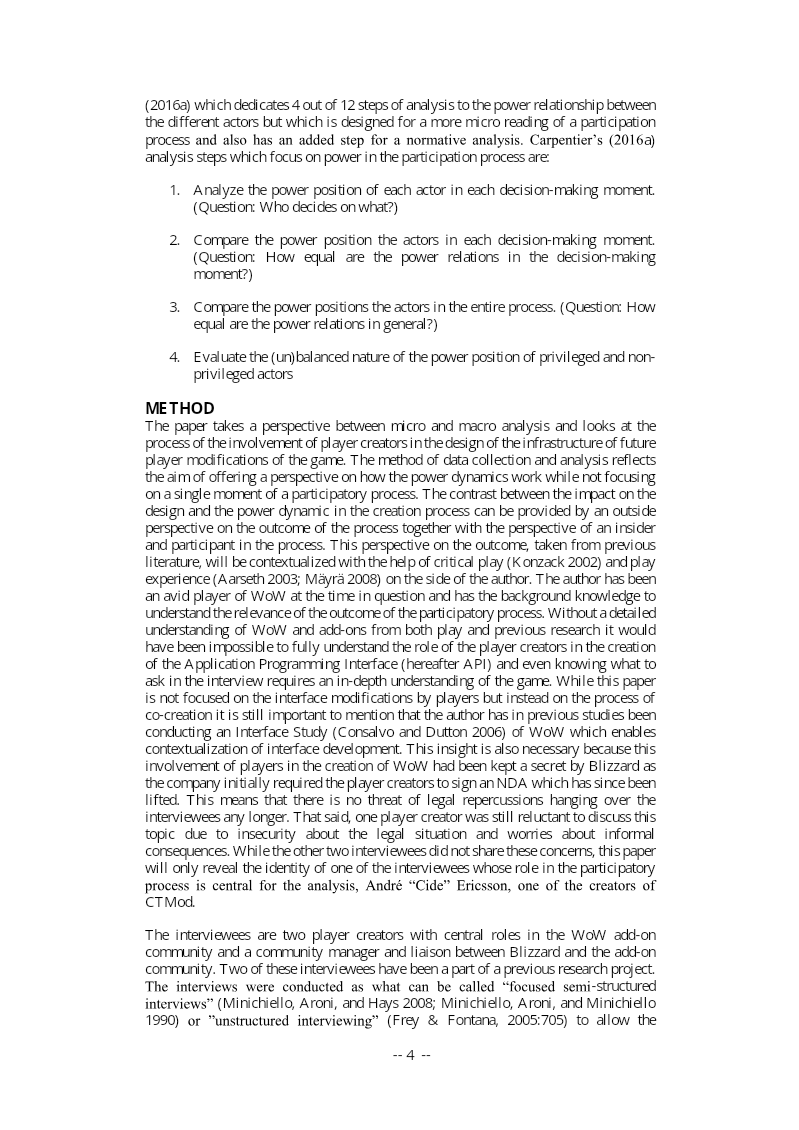
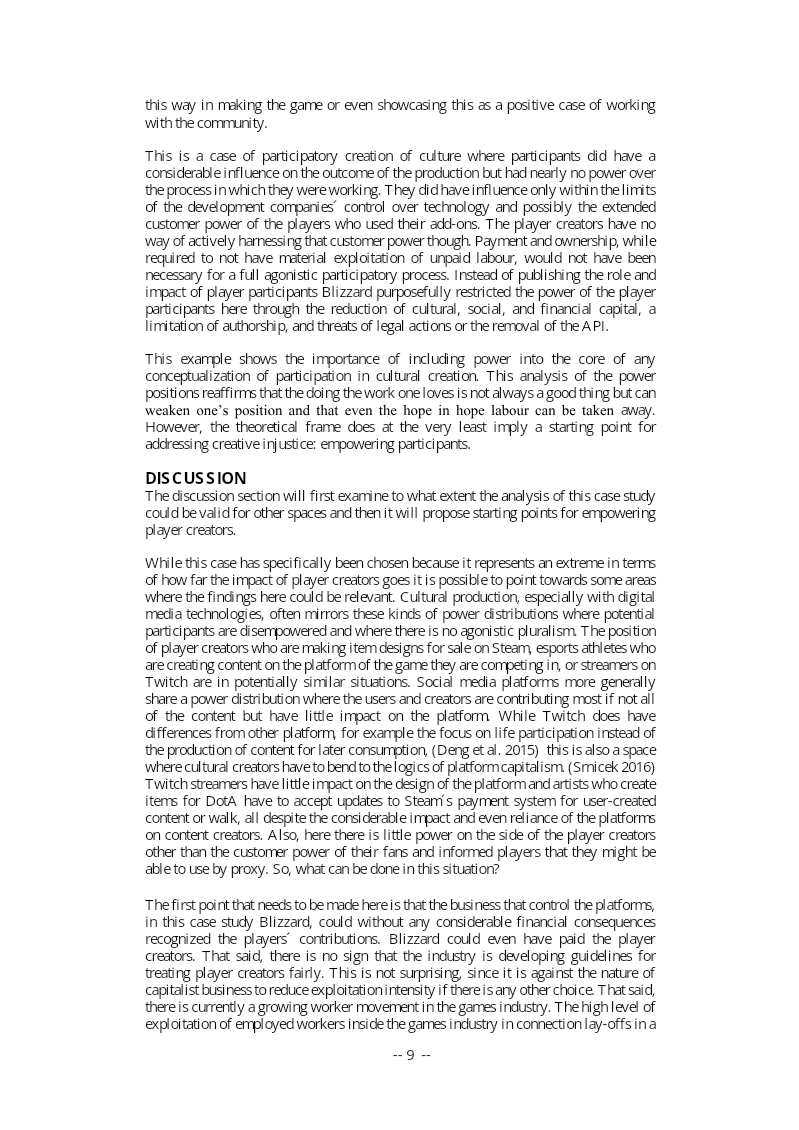
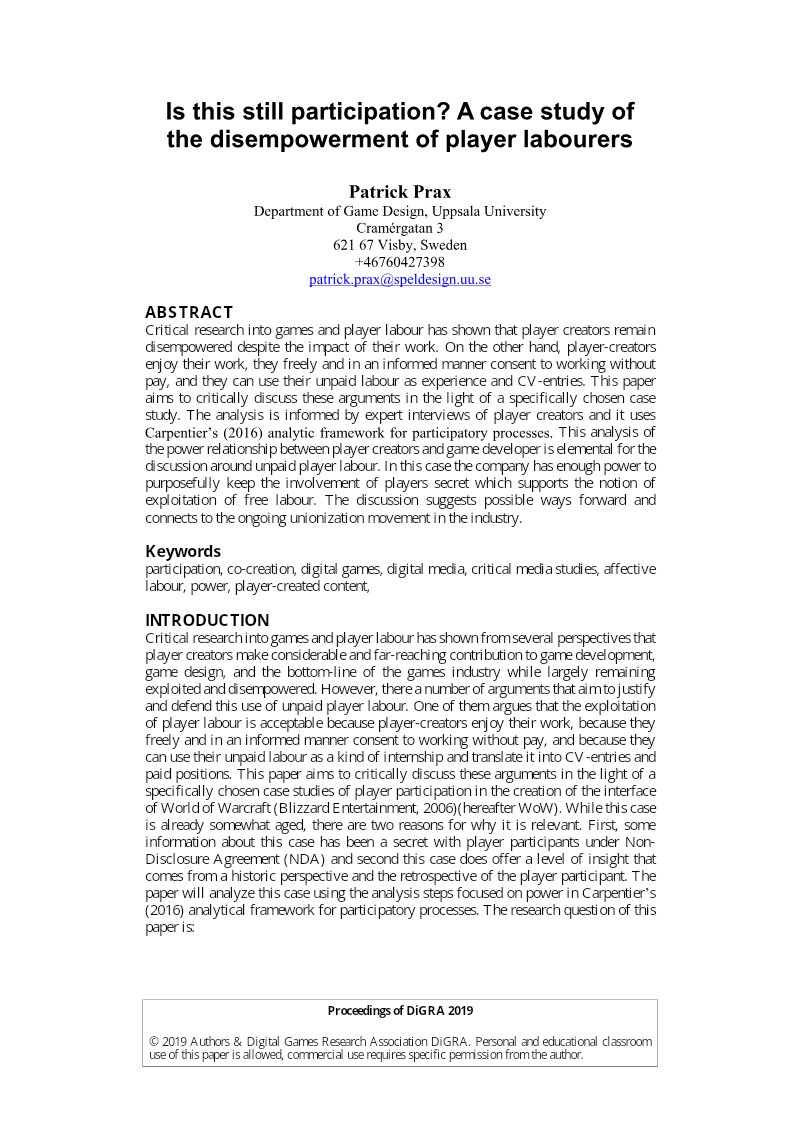
Is This Still Participation? A Case Study of the Disempowerment of Player Labourers
This analysis critically examines the disempowerment of player laborers within the game industry, challenging common justifications for unpaid co-creation.
- The study argues that claims of consent, enjoyment, and mutual benefit do not justify unpaid player labour, because these framings can conceal a substantial power imbalance between developers and players.
- Drawing on Carpentier's power-analysis framework and three expert interviews plus the author's insider experience, the analysis contends that aspirational and hope labour frameworks can mask exploitation when players lack meaningful control over the systems they help build.
- In the core case, add-on creators such as the developers of CTMod contributed to Blizzard's design of an API that removed certain automation features while still letting add-ons display game information.
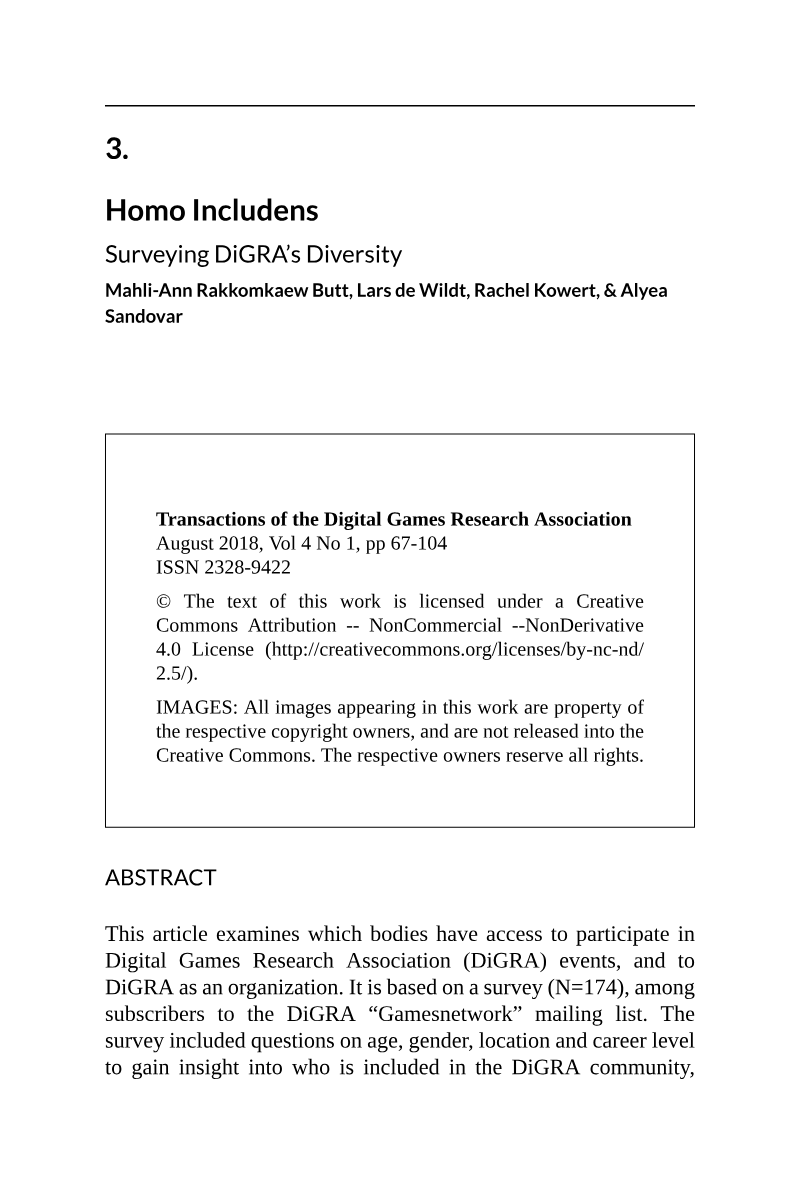
Homo Includens: Surveying DiGRA's Diversity
The Digital Games Research Association (DiGRA) faces a critical need to dismantle systemic barriers that perpetuate Eurocentric and masculine hierarchies within its academic community.
- Nearly 64 percent of DiGRA members report feeling unsafe at association events, highlighting an urgent need for formal safety and recourse mechanisms.
- The organization’s membership is demographically skewed, consisting primarily of young, male researchers concentrated in North America and Northwestern Europe.
- Current diversity initiatives are perceived as largely symbolic, failing to address the material barriers that exclude women, genderqueer individuals, and early-career scholars.
Traumatic, Spectacular Prologues: AAA Players as Ethical Witnesses
AAA games frequently employ traumatic and spectacular prologues as strategic narrative devices to cultivate player engagement and provide moral justification for subsequent in-game violence.
- AAA games utilize traumatic prologues as a strategic narrative device to frame subsequent in-game violence as a righteous, defensive response to initial suffering.
- By forcing players to experience helplessness and spectacle, developers cultivate a sense of moral disengagement that justifies the player's later transition into an active agent of retribution.
- The structural integrity of modern blockbuster titles relies on these prologues to align the player’s desire for agency with the protagonist’s violent trajectory.
Transactions of the Digital Games Research Association: Game Design Lineages
Game design lineages offer a robust analytical framework for understanding the evolution of interactive media by moving beyond traditional genre classifications.
- Game design evolution is best analyzed through the lineage of specific mechanics—such as grid-based inventories and crafting systems—rather than traditional genre classifications.
- Modern digital gaming mechanics are heavily derived from analog predecessors, specifically tabletop role-playing games like Dungeons & Dragons.
- Early titles like Dungeon Master and Diablo functioned as critical bridges that adapted established tabletop habits to the hardware constraints and automation capabilities of their time.
When to Use a First-Person Shooter as a Historical Tool: Ludic Site Preservation in Hong Kong
This paper argues that the playable space of the first-person shooter should be treated as an active medium of historical representation rather than a neutral container for 3D reconstructions, particularly when game engines are used in virtual archaeology.
- The paper argues that the first-person shooter's playable space should be treated as an active medium of historical representation, not a neutral container for 3D reconstructions in virtual archaeology.
- Its central case is Autosave: Redoubt, a CS:GO mod built on the Valve Source Engine that recreates the WWII-era British Shing Mun Redoubt in Hong Kong's Kowloon mountains.
- The author frames the FPS's 'camera-gun' perspective and 'tunnel vision' spatiality as shaping what a historical site can communicate, and warns these affordances risk the 'institutional amnesia' flagged by Gareth Beale and Paul Reilly.
A Universe Divided: Texts vs. Games in The Elder Scrolls
Dennis Jansen examines how fan communities construct and contest the narrative universe of The Elder Scrolls, focusing on the Imperial Library, a Drupal-based fan archive in which only designated "Librarians" hold editing rights.
- The paper argues that fan-built archives, most prominently The Imperial Library, strengthen a "universe-as-texts" model that privileges written lore over the games themselves, making in-game lore accessible to readers who never play.
- The fandom is deeply divided over canonicity: some accept developer-written texts such as the 2004 forum roleplay "The Trial at Hogithum Hall" as authoritative, some recognize only in-game or official Bethesda material, and others treat all out-of-game lore with suspicion.
- Because players can fully experience the games without engaging the written lore, a persistent tension between the "universe-as-games" and "universe-as-texts" models creates ongoing ambiguity in the fictional world.
The Asylum Seekers Larp: The Positive Discomfort of Transgressive Realism
Bjørkelo and Jørgensen present Asylsøkjarane (The Asylum Seekers), a 3-5 hour larp for 7-10 players designed to produce "positive-negative experiences" and "transgressive realism": discomfort that feels real and meaningful without pushing participants to quit.
- The study centres on Asylsøkjarane, a live-action role-playing game by Bjørkelo and Jørgensen at the University of Bergen that simulates the stress of asylum processing through cold waiting rooms, language barriers, and unequal access to information.
- The design is grounded in the concepts of positive-negative experience and "transgressive realism," which hold that players will tolerate and even value discomfort when it feels emotionally authentic and connected to their characters.
- Ethical safeguards, including informed consent, explicit priming for discomfort, and the option to opt out, are central to the game's design.
21st Century Soul Guides: Leveraging Myth and Ritual for Game Design
The document, "21st Century Soul Guides: Leveraging Myth and Ritual for Game Design," posits that video games can function as contemporary "Soul Guides," facilitating player engagement with profound existential concerns such as death, isolation, freedom, and the search for meaning.
- Doris Rusch's paper argues that myth and ritual, historically used to help people confront existential givens like death, freedom, isolation, and meaninglessness, can be revived through video games as modern vehicles for meaning-making.
- The paper contends that prior game research has focused on myth's social and aesthetic dimensions while neglecting its psychological and spiritual function, and it is framed as a call to action rather than an empirical study with no measured claims about player outcomes.
- The concept of the 'soul guiding' game distinguishes titles such as Journey, Shadow of the Colossus, and Never Alone from action-focused mythic games, favoring contemplation and reduced rigid structure over using myth as mere backdrop.
NieR (De)Automata: Defamiliarization and the Poetic Revolution of NieR: Automata
NieR (De)Automata: Defamiliarization and the Poetic Revolution of NieR: Automata examines NieR: Automata as a prime example of how video games can achieve artistic evolution through "defamiliarization," a concept rooted in Russian Formalist poetics.
- Grace Gerrish applies Russian Formalist theory, particularly Shklovsky's and Eichenbaum's concept of defamiliarization (ostranenie), to argue that video games can renew players' perception by subverting their technical devices such as interfaces, controls, music, and language.
- The essay positions NieR: Automata as a deliberate balance between familiar gaming conventions and disruptive innovation, using shifting gameplay styles, perspective changes, and interface-narrative blending to destabilize player expectations about genre.
- Specific examples cited include a treasure-hunt side quest that tricks players into committing violence and the "chaos language" songs that feel both familiar and alien.
"There Are No Women and They All Play Mercy": Understanding and Explaining (the Lack of) Women's Presence in Esports and Competitive Gaming
The document investigates the significant underrepresentation of women in esports and competitive gaming, positing that structural barriers rooted in a "toxic meritocracy" and "hegemonic (geek) masculinity" are primary deterrents.
- The authors argue that women's scarcity in esports stems from cultural structures, namely toxic meritocracy and hegemonic geek masculinity, rather than any deficit in gaming skill, and that women's room for participation is extremely narrow in both extent and legitimate forms.
- In a questionnaire of 737 Finnish women gamers, 13.5 percent had considered competing, and the most common reasons for not doing so were disliking competitiveness, lacking interest in esports titles, and feeling insufficiently skilled, with gender-related concerns and community toxicity recurring as significant themes.
- Analysis of former Overwatch official forum discussions from 2016 to 2018 found that users largely attributed women's absence from the Overwatch League to cultural and environmental factors rather than biology, often citing research showing negligible gender differences in gaming skill.
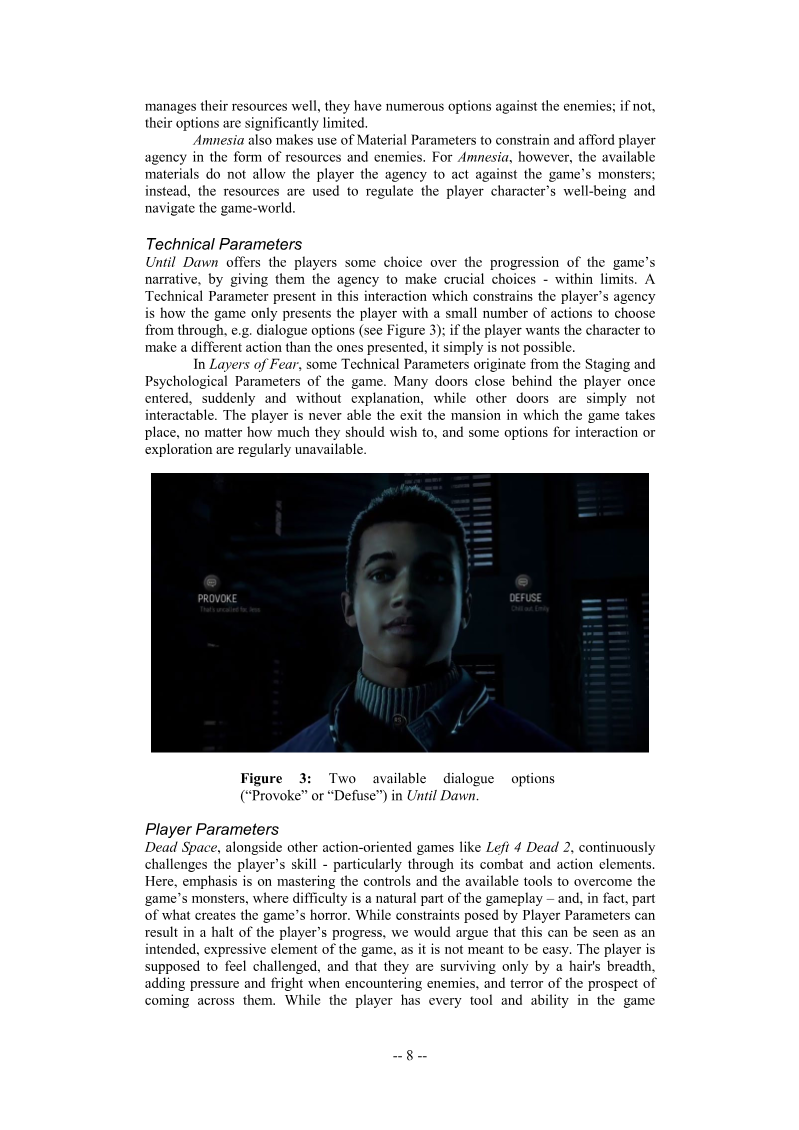
Paralysing Fear: Player Agency Parameters in Horror Games
"Paralysing Fear: Player Agency Parameters in Horror Games" proposes an "Agency Parameter Model" to explain how player agency is manipulated in horror games to evoke fear, terror, and suspense.
- Horror in games is produced less by content than by calibrated constraints and affordances that restrict or open up what the player can do, and the report proposes an Agency Parameter Model to analyse this.
- The model organises agency into three hierarchically arranged categories: Player Character Parameters (physical and psychological), System Parameters (technical and material), and Player Parameters, all encapsulated by Staging.
- The framework was built from hands-on play, fieldnotes, and recordings of six horror titles, including Amnesia: The Dark Descent, Dead Space, and Until Dawn, and is grounded in qualitative humanistic analysis.
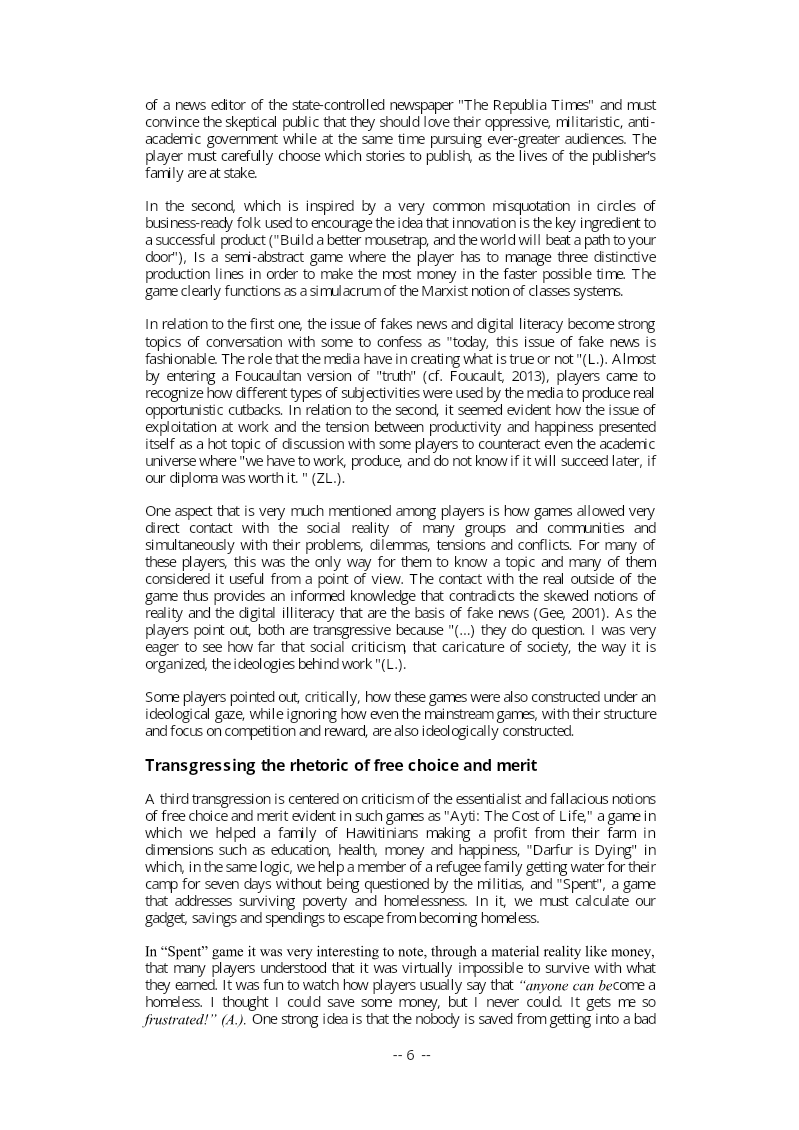
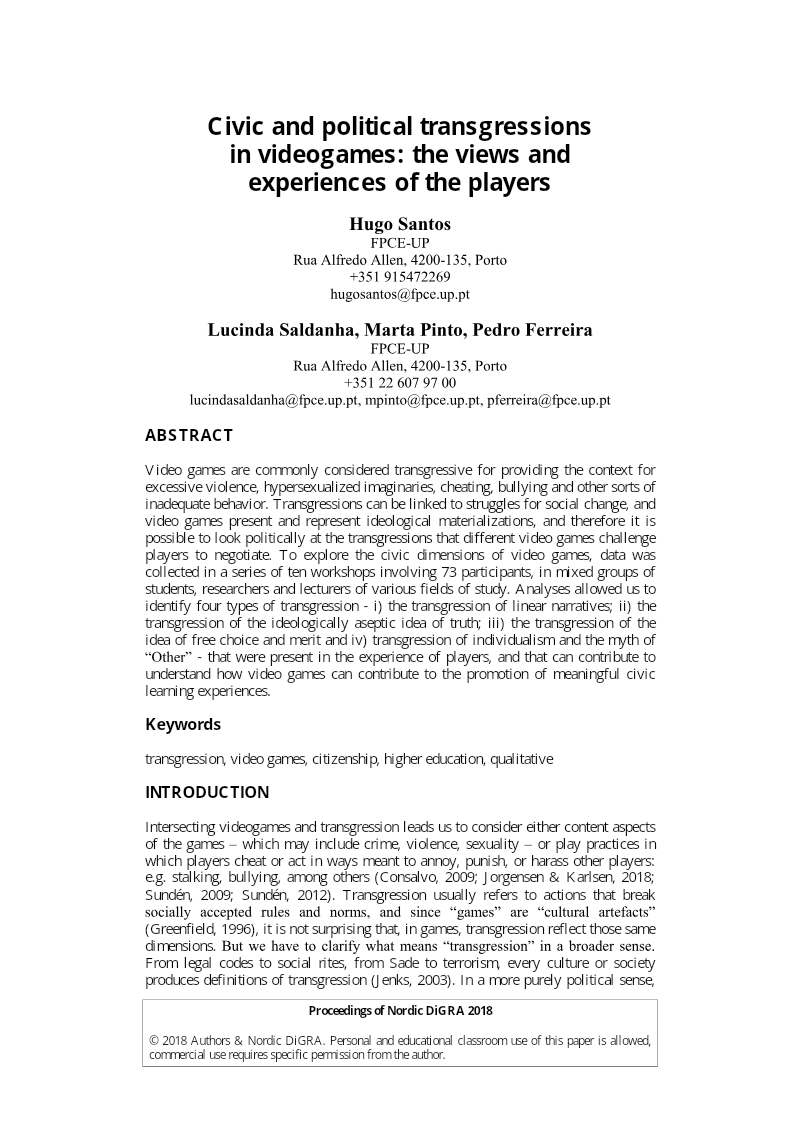
Civic and Political Transgressions in Videogames: The Views and Experiences of the Players
This study investigates the civic and political dimensions of transgression in video games, focusing on player experiences to understand how games can foster meaningful civic learning.
- Players in ten participatory workshops (May–December 2017) with 73 members of the academic community in Porto, Portugal, analysed short, freely available games on social issues, and the transgressive framework emerged inductively from their accounts rather than being imposed in advance.
- Four forms of transgression were identified: the transgression of linear narratives (e.g., Unmanned), of ideologically neutral truth (e.g., Republia Times, To Build a Better Mousetrap), of the rhetoric of free choice and merit (e.g., Spent, Darfur is Dying, Ayiti), and of individualism and the myth of the "Other" (e.g., The Migrant Trail, Against All Odds, Quandary).
- Players recognised that structural conditions, rather than individual decisions alone, shape poverty and mobility, challenging meritocratic assumptions.
Do you work at DiGRA? Get a free report of how these documents are read and cited here.