1 free read left. Create a free account for unlimited reading + AI research.
Create free accountWhitepaper DiGRA
1 free read left. Create a free account for unlimited reading + AI research.
Create free accountWhitepaperDiGRA
The paper argues that cultural structures, namely toxic meritocracy and hegemonic geek masculinity, explain why women are scarce. It also argues that women's room for participation is extremely narrow.
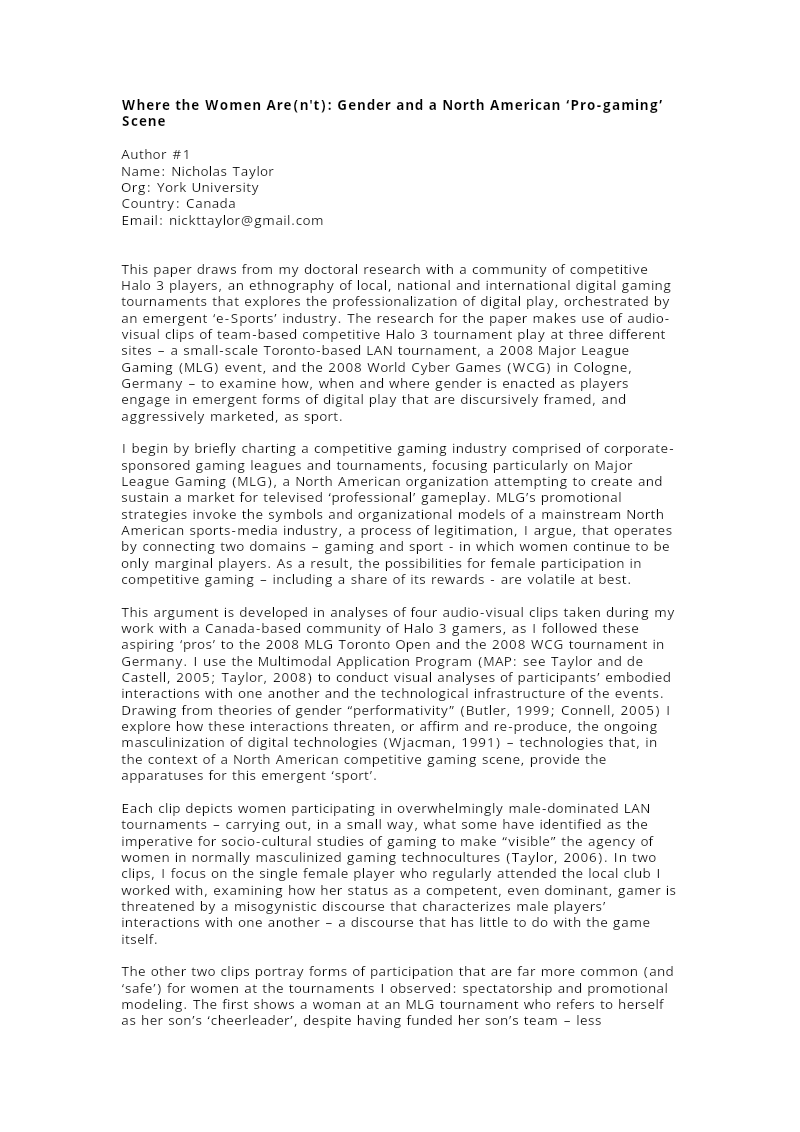
This Nordic DiGRA 2018 paper by Ruotsalainen and Friman investigates why women remain scarce in esports and competitive gaming, arguing that the explanation lies in cultural structures rather than any deficit in skill. Drawing on a questionnaire completed by 737 Finnish women gamers and on discussion threads from the former Overwatch official forums during 2016 to 2018, the authors contend that the field is shaped by toxic meritocracy and hegemonic geek masculinity, which constrain both women's access to competitive play and their recognition within it. The work positions women's room for participation as extremely narrow, both in terms of how many women take part and in the forms their participation can legitimately take.
The survey evidence shows that 13.5 percent of the women respondents had considered competing. Among those who had not, the most common reasons were a dislike of competitiveness, a lack of interest in esports titles, and a sense of insufficient skill, with gender-related concerns and community toxicity recurring as significant themes. Forum discussions largely attributed the absence of women in the Overwatch League to cultural and environmental factors rather than biology, often citing research finding negligible gender differences in gaming skill. The signing of the player Geguri was widely framed as merit-based, although her gender nonetheless became a focal point of debate.
A further finding concerns the association of women with the character Mercy. Women players frequently justified playing her by pointing to team needs, the character's background and design, and their enjoyment of supportive roles. Yet many respondents, including male players mistaken for women or identified as queer, reported disliking her or never playing her, and noted pressure to play Mercy despite competence with other heroes. The authors conclude that Mercy functions as a narrow, tolerated but subordinate position for women, reflecting gender-essentialist assumptions and a masculinized competitive culture that leaves women's participation in esports precarious.
Each row is a game or company this document names, each column a document, oldest first. A mark means that document names it. Select a row to see those documents.
DiGRA · 2022
DiGRA · 2022
DiGRA · 2022
DiGRA · 2022
DiGRA · 2022
DiGRA · 2022
DiGRA · 2022
DiGRA · 2022
DiGRA · 2022

DiGRA · 2022
DiGRA · 2022
DiGRA · 2022
DiGRA · 2009