User Acquisition reports and market data
Documents

GOAT: Matej Lancaric on Mobile Gaming, UA, and Fun | Full Interview
This interview features mobile marketing consultant and podcast host Matej Lancaric, who provides an analytical perspective on the mobile gaming industry, user acquisition (UA) strategies, and the professional evolution of a solopreneur.
- Effective user acquisition requires deep product knowledge, as managers who do not actively play the games they market cannot develop accurate targeting or high-performing creative assets.
- The mobile gaming industry suffers from a systemic reliance on deceptive or misleading creative assets, which remain prevalent because platforms fail to regulate their short-term conversion efficacy.
- Long-term industry health depends on radical transparency and the sharing of real data, rather than the industry-standard practice of withholding actionable insights to protect competitive secrets.

Cracking the 4X Code: Billion Dollar Strategy (2.5gamers x @GameMakersDev crossover)
The 4X strategy genre has undergone a significant transformation, evolving from traditional, complex simulations into a highly efficient, data-driven ecosystem dominated by a new generation of titles.
- Modern 4X game success is driven by 'genre mashing,' where developers layer hyper-casual mechanics (like those in Frozen City or Legend of Mushroom) onto traditional 4X engines to lower high user acquisition (UA) costs.
- The 4X genre has shifted from simple reskins to complex multi-core gameplay, with titles like 'High Seas Hero' integrating three distinct gameplay layers to maximize engagement and retention.
- Aggressive UA strategies are now defined by massive creative volume, with top-performing studios like the developers of 'Dark War' managing up to 600 pages of ad creatives to optimize performance.
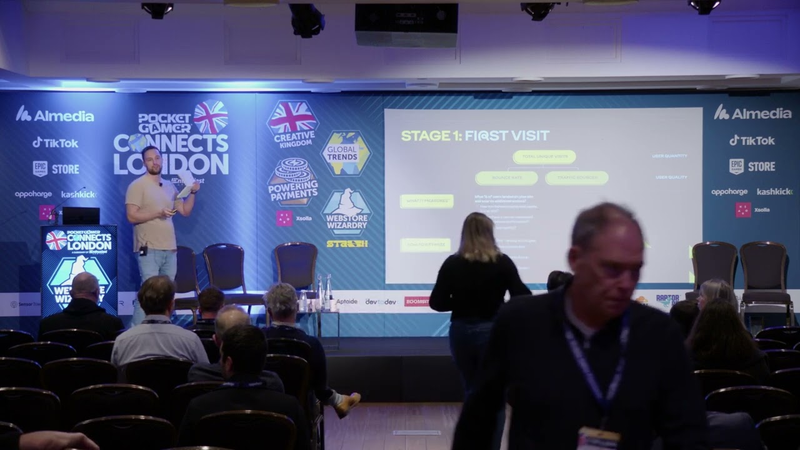
Session: From Data To Dollars – How To Crush Your Web Shop’s KPIs - Archie Stonehill, Stash.gg
Web stores for mobile games function best when treated as dedicated e-commerce products rather than simple extensions of in-game monetization.
- The primary KPI for web shops is channel share, which measures the percentage of total player spending occurring through first-party web channels rather than in-app stores.
- Increasing channel share by as little as 2.5% yields higher financial returns than equivalent percentage reductions in payment processing fees.
- Web stores should be treated as dedicated e-commerce products rather than simple extensions of in-game monetization to maximize revenue impact.
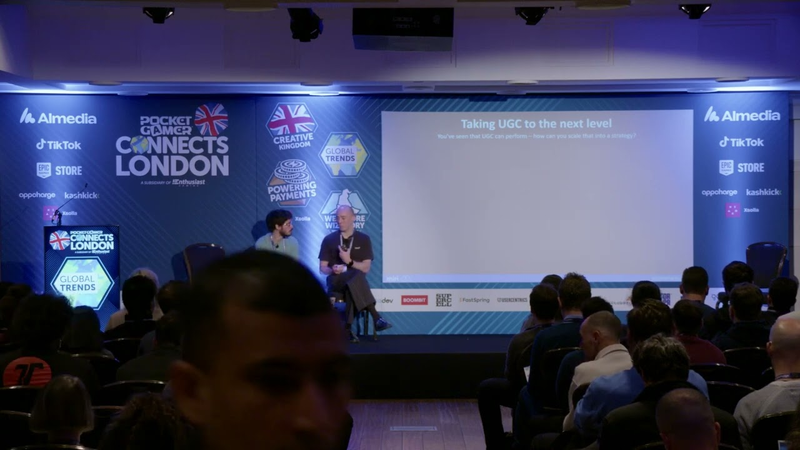
Fireside chat: How To Maximise Your Creative Win Rate - Zach van Driel & David Westerman.
Maximizing creative win rates in mobile game user acquisition requires a strategic balance between maintaining high-performing hero creatives and exploring new concepts to combat inevitable creative fatigue.
- Hero creatives typically experience performance degradation within four to eight weeks, necessitating a structured lifecycle management strategy to combat creative fatigue.
- When performance is strong, marketing teams should maintain a 40/60 ratio between exploring new creative concepts and iteratively testing existing winning assets.
- Underperforming creative sets should be addressed by pivoting toward competitor analysis or re-imagining past winners through different execution styles, such as shifting from gameplay to user-generated content (UGC).
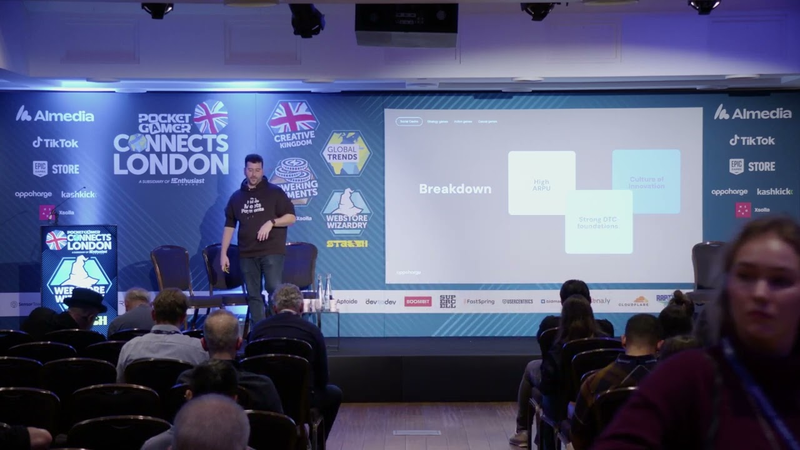
Session: Web Store Popularity & Adoption – What Does the Data Say? - Gil Tov Ly, Appcharge
The mobile gaming industry has reached a critical inflection point regarding monetization, as web stores have transitioned from an emerging trend to a standard, ubiquitous revenue channel.
- Web stores have become a standard monetization channel, with 72% of the top 20 grossing mobile games in the United States now operating a direct-to-consumer platform.
- Adoption rates are highly correlated with genre-specific player behavior: social casino games show 100% adoption, followed by strategy (80%) and action (75%) titles.
- Casual games currently exhibit the lowest adoption rate at 30%, as their reliance on impulsive, high-volume in-app purchases is harder to translate to a web-based environment.

The State of Mobile Gaming in Brazil 2025: Data, Trends, and Market Analysis
Brazil has established itself as the largest gaming market in Latin America, characterized by a robust development ecosystem and high consumer engagement.
- Brazil is the largest gaming market in Latin America with 103 million players and approximately 1,000 game studios, ranking fifth globally in total online players.
- Android dominates the mobile landscape with an 83% market share, compared to 17% for iOS.
- Brazil ranks third globally in Android ad spend, fourth in Android ad revenue, and fifth in Android in-app purchase revenue.
Casual Games Report 2024: Following the 5 Routes to Success
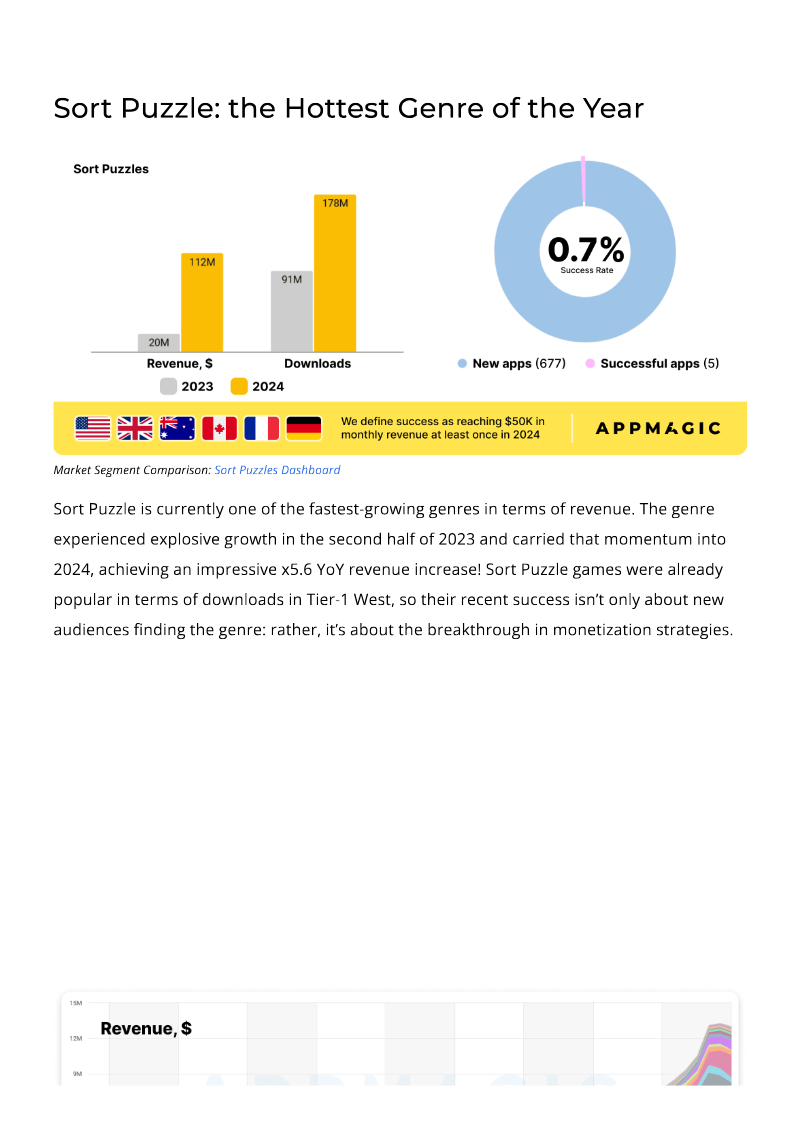
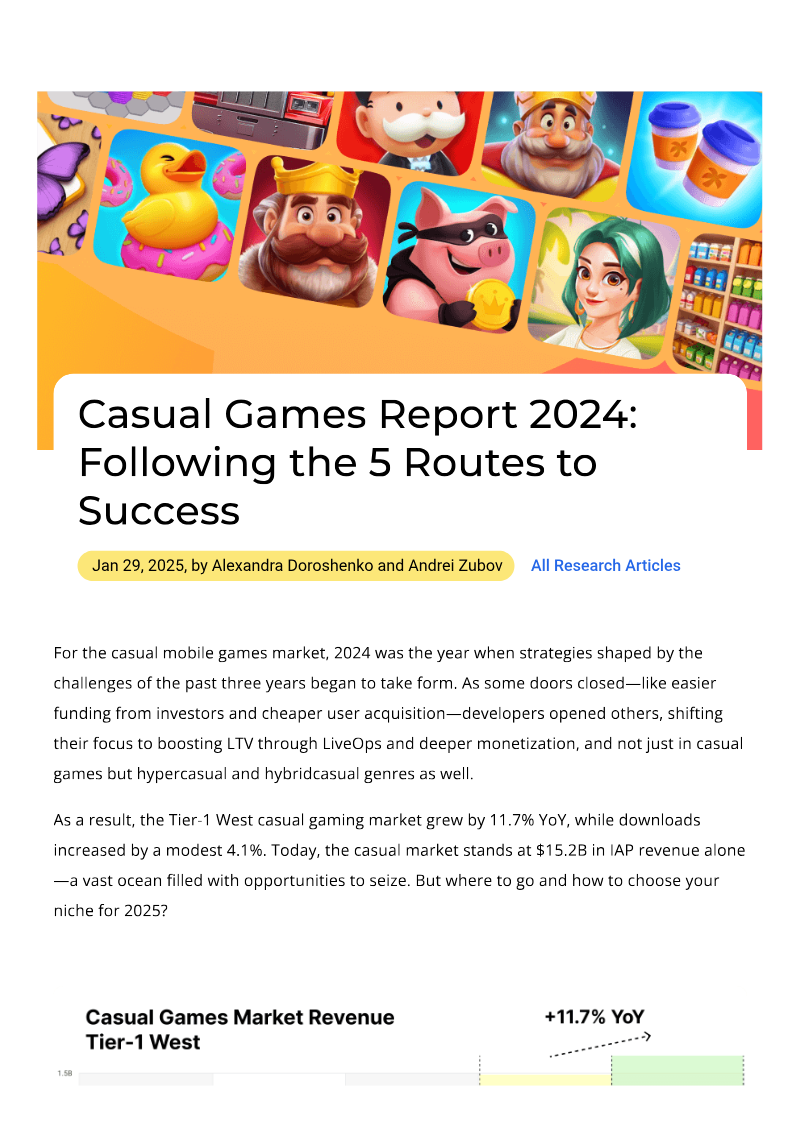
The 2024 casual mobile gaming market across Tier-1 Western nations is defined by a transition toward maturity, characterized by an 11.7% revenue increase despite escalating user acquisition costs.
- The casual mobile gaming market in Tier-1 Western nations grew revenue by 11.7% in 2024, despite rising user acquisition costs necessitating a shift toward complex meta-layers and data-driven LiveOps.
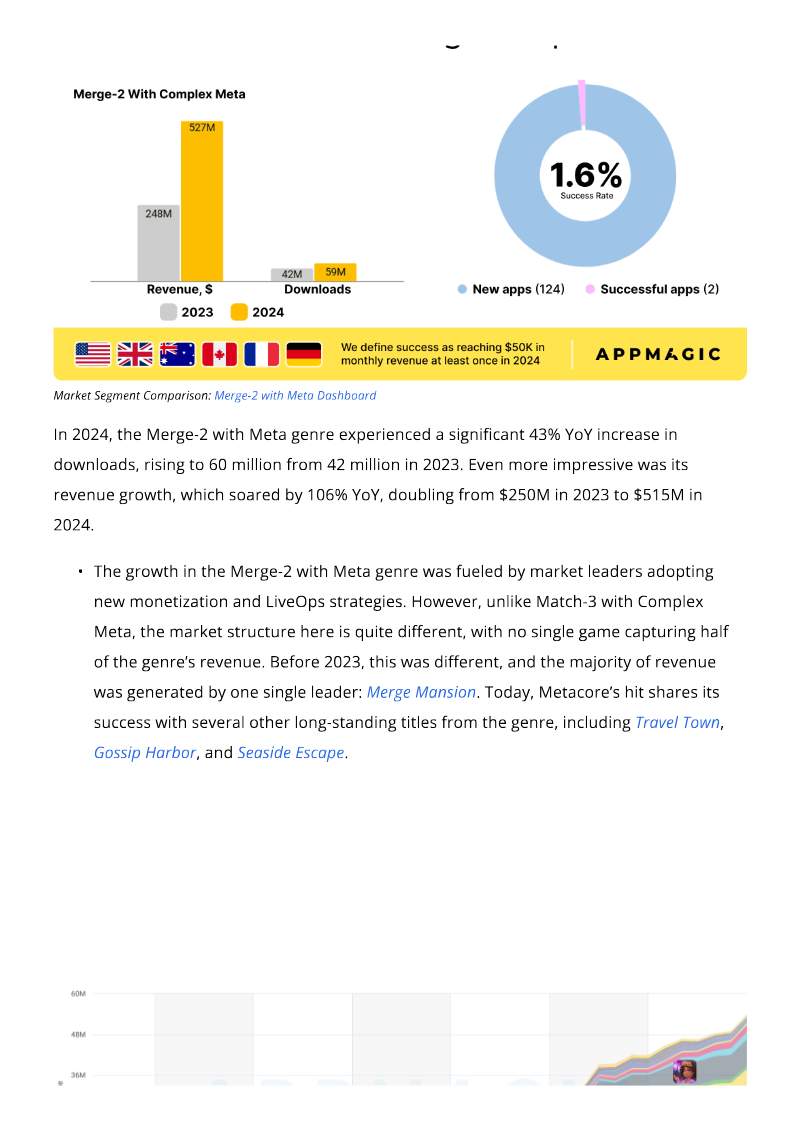
- The Merge-2 with Meta segment is the fastest-growing category, recording a 106% surge in growth as competition among top-tier titles intensifies.
- The Casual Casino sector is highly consolidated, with three dominant titles capturing approximately 80% of total revenue and high barriers to entry limiting new releases.

MMPs and Attribution: Grow Your Mobile Game Now!
Mobile Measurement Partners (MMPs) function as the foundational infrastructure for the mobile gaming industry, serving as centralized hubs that normalize data across fragmented ad networks.
- MMPs serve as the essential infrastructure for mobile gaming by normalizing fragmented data across ad networks and providing unified SDKs for cross-platform attribution and ROAS calculation.
- To counter the deprecation of the Identifier for Advertisers (IDFA), MMPs have transitioned to a privacy-first framework utilizing Apple’s SKAdNetwork, probabilistic modeling, and server-side conversion APIs.
- Modern studios use MMPs as data backends by piping raw, real-time data into internal business intelligence systems for custom lifetime value modeling and fraud detection.

Why Every Game Needs A Creator Program
Modern live-service games increasingly rely on creator programs as foundational pillars for long-term growth, shifting the focus from traditional influencer marketing toward sustainable, performance-based ecosystems.
- Creator programs are shifting from ad-hoc influencer marketing to performance-based ecosystems that drive player retention, reactivation, and conversion of free users into high-value customers.
- Revenue-sharing models using integrated creator codes allow even creators with modest audiences to generate significant revenue, serving as a vital link between community engagement and direct-to-consumer web shops.
- Scaling these programs requires moving away from manual processes toward automated infrastructures to handle the administrative complexities of global payouts, tax compliance, and performance tracking.

Mobile App Retention: The Critical Difference Developers Miss
Mobile app retention analysis relies on two distinct cohort methodologies—absolute and relative—which significantly impact how publishers interpret user behavior and evaluate campaign performance.
- Absolute retention tracks users by calendar day, while relative retention measures activity based on a strict 24-hour window following the exact moment of installation.
- Absolute retention typically yields higher figures than relative retention because it counts any return visit on a subsequent calendar day, whereas relative retention requires a full 24-hour cycle.
- Relative retention is the preferred metric for user acquisition analysis as it eliminates time-zone-based noise to provide a more accurate signal of engagement.

Project R.I.S.E Alpha Test First Look: Gameplay & impressions! What's next for @supercell?
Project R.I.S.E. represents a strategic shift for Supercell as it explores the cooperative PVE roguelite genre.
- Supercell is diversifying its portfolio by developing Project R.I.S.E., a cooperative PVE roguelite built on Unreal Engine that marks a strategic departure from the company's traditional PVP-focused titles.
- The game features a complex meta-progression system centered on the 'Tower Forge,' which utilizes a currency-based economy and gacha-style mechanics for skill upgrades.
- Technical performance is a critical barrier, with alpha testers reporting severe hardware issues including rapid battery depletion and device overheating.
*Emergency Episode* TikTok is Banned in the US! Now what?
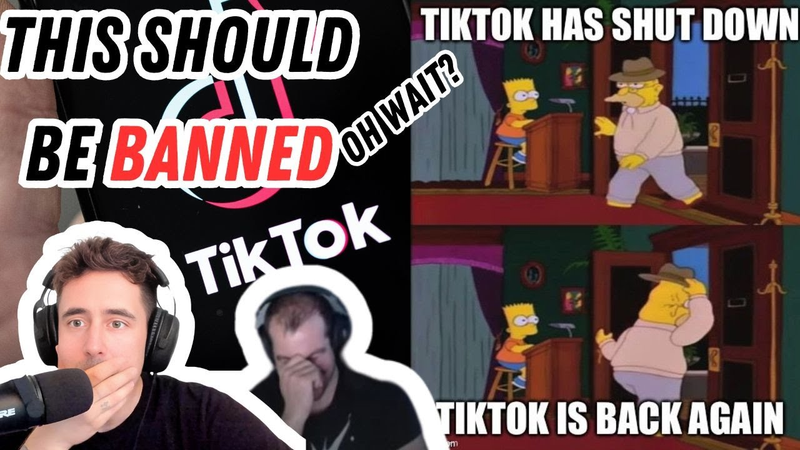
The recent legislative and judicial developments surrounding the potential ban of TikTok in the United States highlight the extreme volatility of the current digital advertising and user acquisition landscape.
- The U.S. government’s mandate for TikTok to divest to an American entity or face a total ban creates extreme volatility for mobile game user acquisition strategies.
- A temporary service suspension forced major gaming titles to immediately pause all marketing campaigns, demonstrating the high risk of relying on a single advertising channel.
- TikTok resumed U.S. operations within 13 hours of the initial ban after securing a 90-day extension to negotiate a potential sale.