PC reports and market data
Documents

How I Made My FPS Weapons - Devlog
The primary objective of this development overview is to define and demonstrate the concept of game feel in first-person shooters.
- Game feel is defined by the immediate, responsive relationship between player input and audio-visual output, serving as the primary differentiator between mediocre and successful FPS titles.
- Weapon systems should utilize a centralized state machine paired with animator override controllers to manage weapon-specific animations, particle effects, and kickback intensities within a streamlined codebase.
- Dynamic screen shake can be achieved by integrating Cinemachine’s Perlin noise, with amplitude and frequency scaled to match the perceived power of individual firearms.

Before you make your DREAM INDIE GAME… WATCH THIS
Aspiring indie game developers should avoid making their dream project their first commercial release.
- Avoid making your dream project your first commercial release to prevent burnout and ensure you have the necessary skills for long-term success.
- Apply the 80/20 principle to your development process, focusing on the 20% of your efforts that generate 80% of your success to identify your unique value proposition.
- Release small, low-stakes projects on platforms like itch.io to build technical proficiency and practice the essential cycle of finishing and publishing content.

AI for Testing: The Development of Bots that Play Battlefield V
The development of autonomous bots, known as AutoPlayers, serves as a critical solution to the scalability challenges inherent in testing large-scale multiplayer games like Battlefield V. As game sessions grow in size and complexity, relying solely on human testers becomes logistically impossible and prohibitively expensive.
- EA utilized autonomous 'AutoPlayers' to conduct over 500,000 hours of automated testing for Battlefield V, equivalent to approximately 300 work years of manual labor.
- The AutoPlayer system is designed to be input-driven and decoupled from game code, allowing bots to interact with the game via abstract inputs like yaw, pitch, and fire rather than hardware-level button emulation.
- Automated testing proved critical for stability, with AutoPlayers identifying 49% of the crashes found during a two-month analysis period, while another 15% were deemed likely to be found with additional runtime.
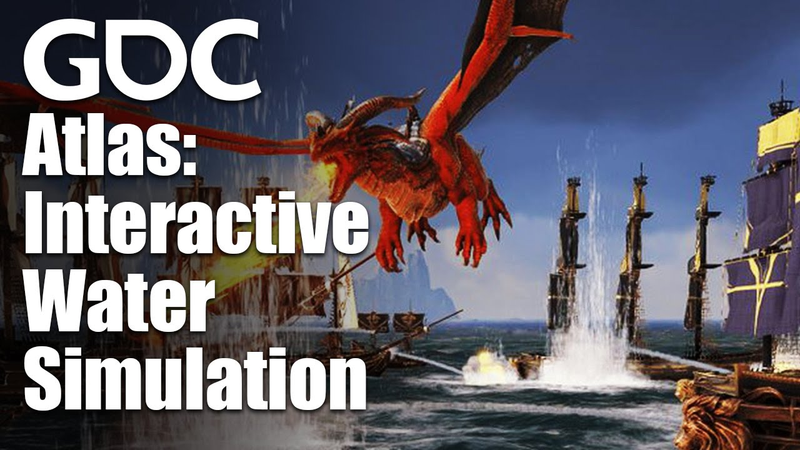
Wakes, Explosions and Lighting: Interactive Water Simulation in Atlas
The development of the ocean simulation for the massively multiplayer online game Atlas centers on balancing high-fidelity visual realism with the rigorous performance constraints required for a seamless, multi-server environment.
- To simulate vast ocean surfaces for Atlas, Grapeshot Games replaced the standard Phillips spectrum with JONSWAP and JONSWAP-variant spectra to avoid unrealistic wave heights in non-oceanic environments.
- The team optimized FFT-based ocean simulation by using larger waves to distort smaller frequency bands, effectively masking tiling repeats without sacrificing performance.
- Buoyancy for rigid bodies is calculated by taking discrete displacement samples along a boat's hull and using an iterative Newton's approximation method to determine height at specific world locations.
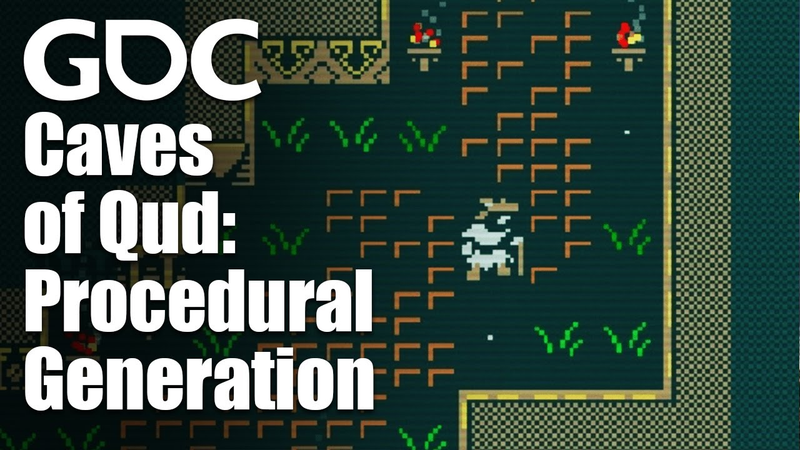
End-to-End Procedural Generation in Caves of Qud
The procedural generation architecture of Caves of Qud functions as a multi-tiered pipeline designed to bridge the gap between abstract historical simulation and concrete environmental manifestation.
- Caves of Qud utilizes a multi-tiered procedural pipeline that translates abstract historical data—such as factional history and religious practices—into concrete game objects like NPCs and architecture.
- The generation process follows a five-step pipeline that converts abstract key-value pairs into specific game states only upon player entry into a map, ensuring memory efficiency and narrative coherence.
- The system integrates advanced algorithms, including Dijkstra maps for pathfinding and Wave Function Collapse for context-aware layout generation, to bridge the gap between cultural blueprints and physical environments.

Data Informed Decisions with the Champions of League of Legends
Riot Games employs a sophisticated, data-informed strategy to manage the character roster of League of Legends, balancing quantitative engagement metrics with qualitative sentiment research.
- Riot Games utilizes a 'breadth versus depth' framework to measure champion engagement, where breadth tracks the number of unique players and depth tracks the frequency of play per user.
- Champion updates, such as the rework of Akali, create significant spikes in play rate driven by both existing players and new users attracted by updated visuals and gameplay kits.
- Mass champion surveys are used to collect sentiment data on non-gameplay attributes like personality, voice, and visuals, allowing developers to understand player affinity beyond raw telemetry.

The Game Jam Experience
The game jam experience is characterized by a recurring cycle of ambitious ideation, technical friction, and eventual time-pressured development.
- Game jams function as high-intensity, 72-hour development environments that test rapid prototyping, project management, and team communication skills.
- Teams frequently struggle with 'scope creep,' where initial goals for simple, polished projects are undermined by the addition of complex features like narrative cutscenes and boss fights.
- Technical friction, specifically regarding version control and synchronization errors, is a primary cause of development delays that consume significant portions of the limited 72-hour window.

Min-Spec vs AAA - The Secret Accessibility of the PC - Extra Credits
Technical accessibility regarding minimum hardware requirements is a critical, often overlooked component of game design.
- Prioritizing low minimum hardware requirements is a strategic necessity for global market penetration, as many players in regions like Brazil and India rely on PCs because consoles are prohibitively expensive or unsupported.
- Steam hardware survey data confirms that a significant portion of the global PC gaming audience utilizes entry-level GPUs, dual-core processors, and monitors with resolutions of 1080p or lower.
- Games like Valorant and Fortnite demonstrate that maintaining low minimum hardware requirements is a proven strategy for sustaining large, active, and inclusive player bases.

PR Success.gif: How to Get Your Game Across in 5 Seconds
Animated GIFs serve as a critical, low-cost marketing instrument for independent game developers, functioning as essential tools to capture the attention of players, press, and publishers in an era defined by fleeting digital engagement.
- Animated GIFs significantly outperform static images, with one developer reporting that GIFs were shared 10 times more often than screenshots.
- A 'main GIF' should act as a mini-trailer that highlights the game's core hook within the first one to two seconds to capture the attention of scrolling users.
- Recycle existing trailer footage by cutting it into smaller 10-second clips and teasers to generate multiple marketing assets without additional production work.

The Art of Afterparty: The Devil's in the Details
Afterparty represents a significant evolution in narrative-driven game design, transitioning from two-dimensional aesthetics to a fully realized 3D environment while preserving the signature branching dialogue mechanics of Night School Studio.
- To bridge the gap between concept art and in-game assets, Night School Studio developed a 'rotoscoping' pipeline where 3D geometry is modeled precisely around perspective-corrected concept art, which is then disassembled and textured for Unity.
- The game's visual identity was built on three pillars: 'comedic' dialogue and animation, an 'alive' world inspired by the nightlife of Shibuya, and 'heart' derived from character-driven storytelling.
- The 'liquid courage' mechanic allows players to influence dialogue branches by choosing specific drinks, which trigger a third, unique dialogue option during conversations.

Vehicle Physics and Tire Dynamics in Just Cause 4
The vehicle physics system in Just Cause 4 was designed to support over 100 diverse vehicle types within a large-scale open-world environment while maintaining a 30Hz simulation rate.
- To maintain stability in a 30Hz simulation, Avalanche Studios implemented friction clamps that prevent the physics model from diverging when applying high levels of grip.
- The team utilized a 'useful mass' heuristic to calculate friction clamping, which determines the ratio of vehicle mass represented by a single tire based on its relative wheel load.
- By decoupling the tire model from strict realism, developers can use steepness in friction curves to simulate 'feel'—where the slope represents grip levels and the leveling off of the curve simulates the sensation of sliding.
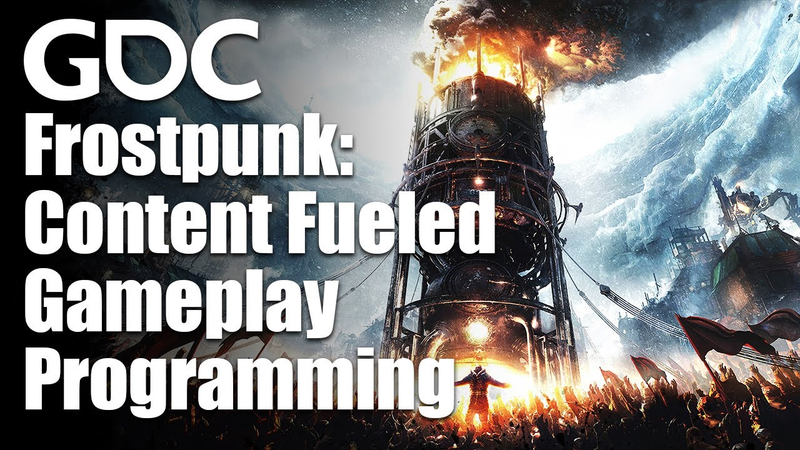
Content Fueled Gameplay Programming in Frostpunk
The development of Frostpunk centers on a data-driven architecture built upon a proprietary Liquid Engine, utilizing an Entity Component System (ECS) to manage the game’s intricate society-survival mechanics.
- 11 bit studios utilized a custom data-driven architecture based on Entity Component Systems (ECS) to manage the high entity count and complex gameplay logic required for Frostpunk.
- The architecture enforced a strict 'one system per component type' rule, which improved code clarity and maintainability for a growing development team by adhering to the single responsibility principle.
- Designers were empowered to control game flow, narrative events, and building visuals through a template-based system that allowed them to configure game state conditions and effects without direct programming.