Monetization reports and market data
Documents

🎯 Mobile Ad Monetization Checklist: From Soft Launch to Scale by Felix Braberg
This guide provides a strategic framework for mobile game developers to implement and scale ad monetization, covering the transition from soft launch to full-scale operations.
- Prioritize user retention by enforcing strict ad creative standards, as networks often default to intrusive, long-form end cards that degrade the user experience.
- During soft launch, target a 45% viewer rate for rewarded video ads and a 70% viewer rate for interstitials to balance monetization with retention.
- Maintain an updated app-ads.txt file to ensure full access to reseller demand and maximize potential ad revenue.
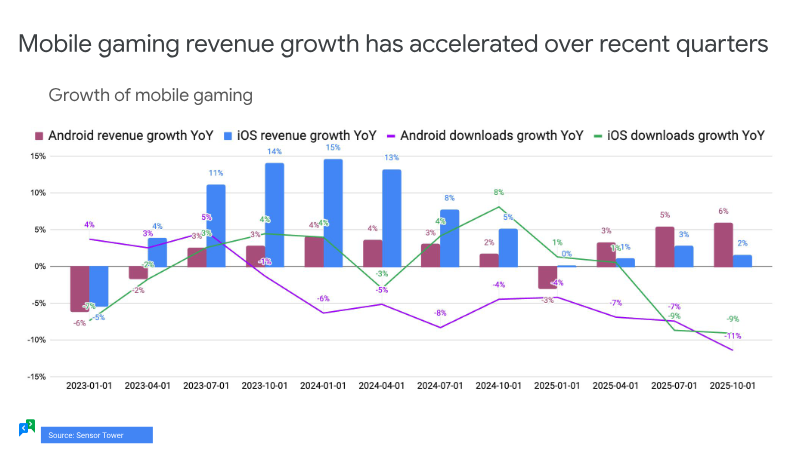
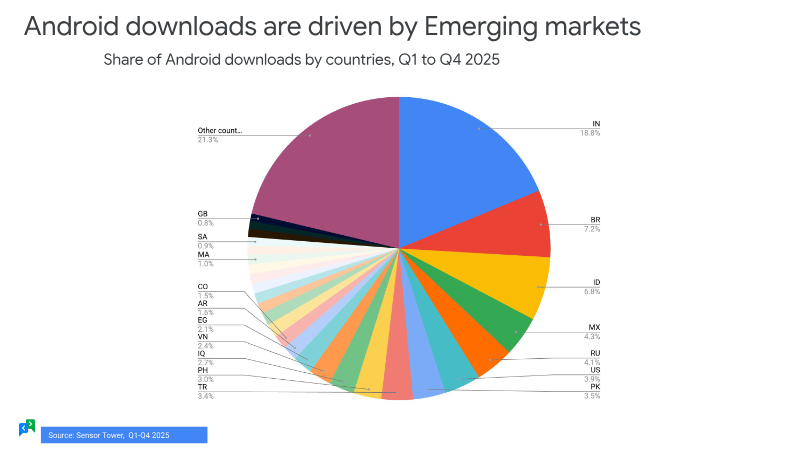
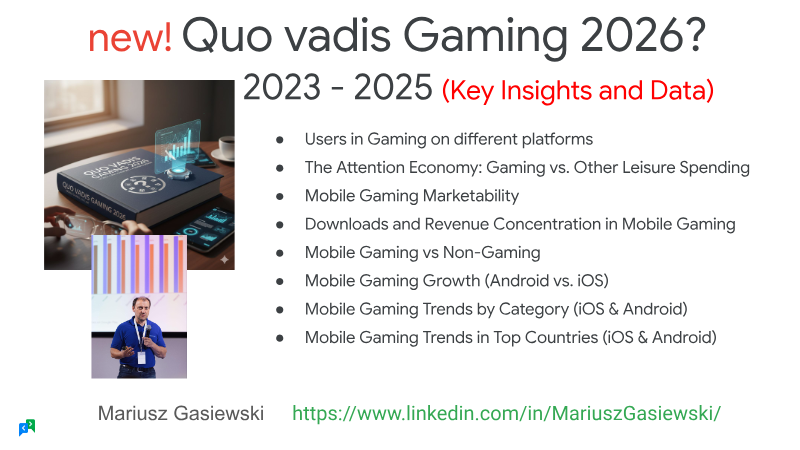
Key Insights and Data: 2023–2025
Mobile gaming drives the global industry’s growth through 2025, accounting for more than half of worldwide revenue and over eighty percent of players.
- Global gaming revenue is projected to reach $197 billion in 2025, representing a 7.5% year-over-year increase driven primarily by mobile and PC segments.
- Mobile gaming remains the dominant force in the industry, accounting for over 50% of global revenue and more than 80% of the total player base.
- The mobile market is increasingly a winner-take-all environment, with the top 10 to 50 titles on Google Play and the Apple App Store capturing a growing share of total revenue.

🚨📢 BREAKING NEWS: Ubisoft Restructures, IAP Hits $167B, Turkey Keeps Raising, Pokémon Goes IRL
The gaming industry is currently undergoing a structural shift characterized by a transition toward a monetization-first era.
- Global mobile in-app purchase revenue reached $167 billion in 2025, confirming a strategic industry shift toward maximizing lifetime value over user acquisition scale despite declining download volumes.
- Ubisoft is reorganizing into five specialized creative houses to achieve $200 million in cost savings, a process that includes canceling projects like the Prince of Persia Sands of Time remake and mandating a full-time return to the office.
- Major publishers are prioritizing stability by leveraging legacy intellectual property and diversifying platforms, such as Outfit7 expanding into PC development and Rovio relaunching the Angry Birds franchise in China.

TWiG #367: A Certain IPO, 2026's 1st Cozy Launch & When CEOs Get Sued
Corporate governance and strategic pivots define the current landscape of the interactive entertainment industry.
- Shareholders have initiated legal action against former Activision Blizzard CEO Bobby Kotick, alleging that the $69 billion acquisition process prioritized personal financial gain and legal protection over fiduciary duties.
- Adtech firm Liftoff has reached a $4 billion valuation via IPO, signaling a growing industry reliance on AI-driven user acquisition financing to maintain growth despite significant debt burdens.
- Major publishers like Krafton are shifting strategies toward operational efficiency by leveraging AI-integrated development and user-generated content to scale established intellectual property like PUBG.

Sandloop review: It looks simple. That’s the point.
Sandloop, a physics-based sorting game published by Voodoo, exemplifies the effectiveness of a minimalist design philosophy in the hyper-casual mobile market.
- Sandloop generates $60,000 to $120,000 in daily ad revenue from approximately 50,000 daily downloads.
- The game utilizes a high-spend acquisition model with $200,000 in daily marketing costs, targeting a three-month payback period.
- To minimize initial user churn, the game delays all monetization and menu access until level 20.

Google’s Thomas Zybulski & Saejoon Oh on APAC’s New Wave: Data, Fintech & Vietnam’s Rising Talent
The Asia-Pacific (APAC) mobile app and gaming ecosystem is currently defined by a transition toward data-driven decision-making and the diversification of business models.
- APAC developers are increasingly adopting data-driven decision-making and scientific measurement to differentiate their apps in an oversaturated market.
- Non-gaming sectors, particularly fintech and finance companies, are aggressively entering the ad monetization space to better understand user behavior and maximize Lifetime Value (LTV).
- Rising user acquisition costs post-COVID are forcing developers to move beyond traditional models and innovate with new business models, genres, and service offerings.

Google’s Zachary Kuney on Monetisation, AI & Why Vietnam is a Global Growth Engine
Vietnam has emerged as a critical growth engine within the global mobile application ecosystem, characterized by a unique combination of young, highly skilled talent, strong government support, and a collaborative, innovation-focused developer community.
- Vietnam is currently a primary growth engine within the APAC mobile app ecosystem, driven by a young, tech-focused talent pool and strong government support for the digital economy.
- AI is being leveraged by developers to transform massive datasets into actionable insights, effectively providing small studios with the capabilities of an in-house data science team.
- Google is shifting its support strategy for developers by integrating cross-functional teams—covering cloud, infrastructure, ad buying, and monetization—to provide a more cohesive and simplified scaling experience.

New genre leader in cozy games by Jakub Remiar
Heartopia has emerged as a significant leader in the cozy, avatar-life simulation genre, demonstrating strong market performance shortly after its January launch.
- Heartopia, a mobile avatar-life simulation game launched in January, currently generates over $200,000 in daily revenue with hundreds of thousands of daily downloads.
- The game’s monetization is driven entirely by cosmetic-only gacha systems for clothing and furniture, avoiding gameplay-affecting mechanics or competitive stats.
- Market success is heavily concentrated in Asia, led by Japan, followed by the United States, Taiwan, South Korea, and Thailand.


State of Mobile 2026
The 2026 State of Mobile report demonstrates that the global mobile ecosystem remains mature yet increasingly monetized, with 2025 in-app purchase (IAP) revenue reaching $85.6 billion—a 21% year-over-year rise that now places non-game apps ahead of games for the first time.
- Non-game apps surpassed games in in-app purchase (IAP) revenue for the first time in 2025, contributing to a total global IAP market of $85.6 billion, a 21% year-over-year increase.
- Generative AI and short-form drama are the fastest-growing subgenres, with AI assistants like ChatGPT generating $3.4 billion in 2025 and short-drama apps capturing over 10% of global video-entertainment time.
- Roblox solidified its dominance in the gaming web arena, accounting for 74% of all game-publisher site visits in 2025.

Tracy Phan on Vietnam’s Mobile Gaming Boom: Community, Culture & What's Next
The Vietnamese mobile gaming ecosystem has evolved from a bootstrapped, isolated industry into a globally recognized emerging market.
- Vietnam’s mobile gaming ecosystem is transitioning from a bootstrapped, ad-monetization-heavy model toward more sustainable, long-term revenue streams like hybrid-casual and in-app purchase (IAP) genres.
- The Vietnamese gaming community is characterized by a close-knit, collaborative culture where founders frequently share resources and network through informal social settings, which has historically fueled studio growth.
- Despite high download volumes, the industry currently faces a funding gap due to a cultural preference among founders to prioritize immediate profitability over raising venture capital or building for an exit.

Inside the PC Game Gray Market Economy
The PC gaming industry faces a persistent challenge from a sophisticated gray market that siphons between 20% and 40% of potential revenue from publishers.
- The PC gray market enables revenue leakage of 20% to 40% for publishers, often occurring when keys intended for lower-priced regions are resold in premium markets.
- Regional price arbitrage and promo stockpiling are the two primary mechanisms used by gray market resellers to siphon revenue from publishers.
- Effective mitigation begins with mandatory region-locking of keys, as many developers inadvertently allow worldwide access to keys priced for cheaper territories.

🚨📢 BREAKING NEWS: 2026 State of Gaming Marketing, Turkish studio raises big, Meta shuts studios
The 2026 gaming landscape is defined by rapid consolidation, a surge in creative output, and a strategic shift toward monetization efficiency.
- Global user acquisition spending reached $25 billion in 2026, with Turkey and India now capturing one-third of all UA expenditure outside of China.
- Top advertisers increased creative volume by 30% year-over-year, producing 2,400 to 2,600 variations per quarter to combat a market where ad impressions grew twice as fast as paid installs.
- Meta has shuttered three VR studios—Saru Games, Twisted Pixel Games, and Armatur Studio—as the company pivots its strategic focus from the metaverse toward wearable technology.