Monetization
Documents
Innovative Monetization Features Snapshot Report
Modern mobile game monetization is increasingly defined by the integration of sophisticated Battle Pass systems and gacha mechanics, which serve as the primary drivers for the industry's highest-grossing titles. Gacha mechanics are nearly universal among top-tier games, appearing in 93% of the top 20% grossing titles, while Battle Passes are utilized by 60% of this same demographic. These tools have evolved from simple transactional models into complex systems that leverage social cooperation, urgency, and psychological progression. Innovations such as auto-renewing subscriptions, social gifting within guilds, and "pity" systems for gacha pools have become standard practices to ensure transparency and maintain long-term player engagement without compromising core gameplay balance.
The geographic focus remains centered on the United States mobile market, where 75% of top-grossing games now employ gacha mechanics. A significant shift is occurring in the nature of in-app purchases, moving away from direct gameplay boosters toward meta-layer content such as narrative elements and collectibles. Furthermore, progressive reward systems—which provide escalating gifts based on cumulative spending—have seen a steady two-year increase in adoption. These systems are highly correlated with financial success, as they are nearly three times more likely to be found in top-performing iOS games than in lower-grossing titles.
Ultimately, the most successful monetization strategies rely on emotional triggers and social integration rather than isolated transactions. Features like randomized "Mystery Shops" and quantity-limited community offers create a sense of scarcity and collective participation. Developers who find success in this landscape are those who look across diverse genres to adapt innovative features like piggy bank integrations and co-op progression tracks. By focusing on these sophisticated meta-layer incentives, studios can drive both retention and revenue while fostering a more committed player base.
- Gacha mechanics are the industry standard, appearing in 93% of the top 20% grossing mobile titles, while Battle Passes are utilized by 60% of that same demographic.
- In the U.S. mobile market, 75% of top-grossing games now incorporate gacha mechanics.
- Progressive reward systems, which offer escalating gifts based on cumulative spending, are nearly three times more likely to be found in top-performing iOS games than in lower-grossing titles.
- Monetization strategies are shifting away from direct gameplay boosters toward meta-layer content, such as narrative elements and collectibles.
- Industry-standard retention tools now include auto-renewing subscriptions, social gifting within guilds, and 'pity' systems for gacha pools.
Gaming Spotlight: 2022 Review
Mobile gaming has emerged as the primary engine of the global games market, projected to reach $136 billion in 2022 and accounting for over 60% of the industry's total $222 billion valuation. This segment is expanding 3.3 times faster than the home console market, driven largely by the Asia-Pacific region and the sustained popularity of core titles such as Genshin Impact and Roblox. While macroeconomic instability and geopolitical conflict have caused localized spending declines in Eastern Europe, the broader global trend points toward a more inclusive player base. Female gamers and Gen Z cohorts are increasingly influential, serving as primary drivers of monetization and shifting the demographic focus of the industry.
The monetization landscape is undergoing a significant transformation toward hybrid models, with 42% of top-grossing U.S. games now combining in-app purchases with advertising. Although global audiences generally accept advertisements in exchange for free content, privacy concerns regarding individual tracking have intensified. In a post-IDFA environment, success depends on leveraging contextual third-party data rather than granular user tracking. Player sentiment varies significantly by format; rewarded video and playable ads enjoy the highest levels of acceptance, while standard video ads remain divisive, particularly among the high-growth female and Gen Z demographics.
Strategic intelligence for this evolving market relies on extensive global research infrastructure, utilizing data from over 1,100 analysts across 50 countries. By surveying more than 350,000 end users annually, market analysts provide the necessary framework for developers, publishers, and hardware manufacturers to navigate shifting consumer behaviors and technological transitions. This comprehensive oversight ensures that stakeholders can adapt to the rapid pace of innovation and the diversifying needs of the global gaming community.
- Mobile gaming is the dominant industry force, projected to reach $136 billion in 2022 and accounting for over 60% of the total $222 billion global market valuation.
- The mobile segment is expanding 3.3 times faster than the home console market, bolstered by the sustained popularity of core titles like Genshin Impact and Roblox.
- Hybrid monetization is becoming standard, with 42% of top-grossing U.S. games now combining in-app purchases with advertising.
- In a post-IDFA environment, developers must shift from granular user tracking to contextual third-party data to navigate intensified privacy concerns.
- Female gamers and Gen Z cohorts are the primary drivers of industry monetization and are increasingly shaping the demographic focus of the market.
Consumer Insights: Games and Esports 2022
The Consumer Insights: Games and Esports 2022 report provides a comprehensive analysis of global gaming behaviors, motivations, and market engagement. The primary purpose of the research is to equip game developers, publishers, and industry stakeholders with actionable data to benchmark titles, understand player demographics, and identify growth opportunities across 36 diverse international markets. By examining over 100 key performance indicators, the analysis offers a granular view of how players interact with PC, console, and mobile platforms.
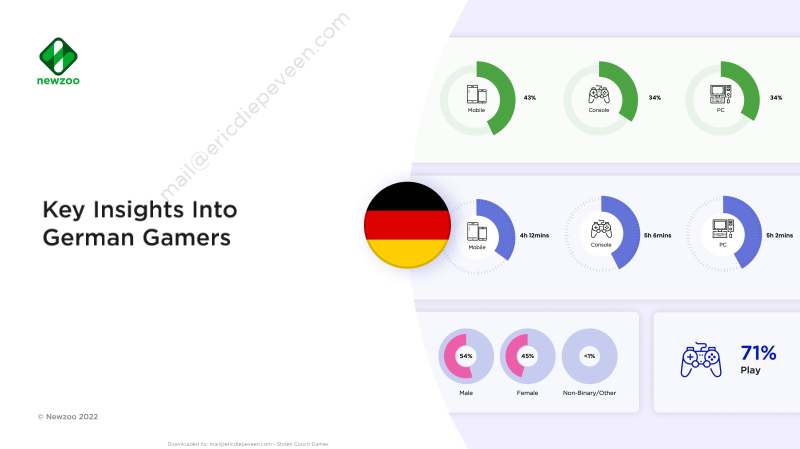
The research is underpinned by a robust methodology, drawing on survey data from over 75,000 consumers worldwide. The findings highlight distinct engagement patterns, such as the prevalence of specific gaming personas—notably Time Fillers and Mainstream Gamers—and the interplay between playing and viewing habits. For instance, data from the German market indicates that while playing remains the dominant activity, a significant portion of the population also engages with gaming video content and esports. Furthermore, the report identifies key drivers for consumer spending, noting that price sensitivity, the desire for exclusive content, and social connectivity are primary motivators for financial investment in games.
Covering a broad geographic scope that includes North America, Europe, Latin America, the Middle East, and the Asia-Pacific region, the report serves as a strategic tool for navigating the complex global gaming landscape. By synthesizing metrics such as monthly active users, daily active users, and lifetime player value, the analysis facilitates a deeper understanding of the motivations driving player behavior. Ultimately, the findings emphasize that a nuanced approach to audience segmentation and platform-specific engagement is essential for companies seeking to reach and retain diverse gaming populations in an increasingly competitive entertainment market.
- The research is based on a global dataset of over 75,000 consumers across 36 international markets, covering North America, Europe, Latin America, the Middle East, and the Asia-Pacific region.
- Consumer spending is primarily driven by three factors: price sensitivity, the desire for exclusive content, and the need for social connectivity.
- Gaming engagement is categorized into distinct personas, with 'Time Fillers' and 'Mainstream Gamers' identified as the most prevalent segments.
- Player behavior analysis utilizes over 100 key performance indicators, including monthly active users (MAU), daily active users (DAU), and lifetime player value (LPV).
- Engagement patterns in markets like Germany demonstrate that gaming video content and esports are significant activities that complement traditional gameplay.
Data for Mobile Gaming 2022-2024
Mobile gaming maintains its position as the primary driver of industry expansion, fueled by widespread smartphone adoption and consistent engagement across both emerging and established markets. Between 2022 and 2024, the sector has demonstrated a clear trend where revenue growth consistently outpaces download volume on both iOS and Android platforms. This financial trajectory is increasingly supported by a strategic shift toward in-game advertising, which is currently outpacing traditional in-app purchases as a primary revenue stream.
Global market dynamics remain anchored by the United States, China, and Japan, which continue to serve as the most significant revenue generators. However, emerging markets are playing an increasingly critical role in the industry’s growth, particularly in regions like Brazil, where smartphone gaming penetration has surpassed 90% across all demographics. In these regions, player behavior is heavily influenced by free-to-play accessibility, narrative depth, and social recommendations. Furthermore, data from the U.S. and U.K. confirms that younger demographics prioritize smartphones over consoles and PCs, solidifying the mobile device as the central hub for modern gaming.
Despite the proliferation of available titles, the global player base exhibits a preference for focused engagement, with many users choosing to dedicate their time to a single game rather than managing multiple titles simultaneously. While market concentration among top-tier publishers remains stable, the rapid expansion of the advertising sector suggests a fundamental change in how developers monetize their audiences. Ultimately, the industry is transitioning toward a model that prioritizes long-term retention and diversified revenue streams over simple volume-based growth, ensuring that mobile gaming remains the most influential segment of the broader interactive entertainment landscape.
- Mobile gaming revenue growth is consistently outpacing download volume across iOS and Android platforms between 2022 and 2024.
- In-game advertising has overtaken traditional in-app purchases as the primary revenue stream for mobile developers.
- The United States, China, and Japan remain the dominant global revenue generators, while Brazil has reached over 90% smartphone gaming penetration across all demographics.
- Younger demographics in the U.S. and U.K. are increasingly prioritizing smartphones over consoles and PCs as their primary gaming platform.
- Player behavior is shifting toward focused engagement, with users increasingly dedicating their time to a single title rather than managing multiple games.
The Hyper-Casual Benchmark Report: Q3 2022
The hyper-casual mobile gaming sector experienced a notable escalation in acquisition costs during the latter half of 2022, characterized by rising median cost-per-install (CPI) rates across both Android and iOS platforms. By the fourth quarter of 2022, median CPI reached all-time highs of $0.20 on Android and $0.42 on iOS. This upward trend in acquisition spending was global, as no major market tracked by ad spend experienced a decrease in median CPI on Android, while iOS markets saw varied fluctuations, including a significant decrease in the United States and notable increases in France and Germany.
Retention metrics reveal a consistent performance advantage for iOS over Android across all tiers of game quality. For the top 2% of hyper-casual titles, iOS achieved a 45% Day 1 retention rate compared to 38% on Android, with Day 7 retention figures similarly favoring iOS at 19% versus 14%. This performance gap persists among the top 25% of games and the median cohort, where iOS maintains a higher percentage of returning players. These findings underscore a widening disparity between high-performing titles and average games, emphasizing the critical importance of engagement optimization in a landscape of increasing user acquisition costs.
The analysis draws upon data from over 100,000 games and one-third of the global mobile player base to establish these benchmarks. By segmenting performance by platform and geographic region, the data highlights the shifting economic landscape for developers and publishers. The findings suggest that while market saturation and rising costs present significant challenges, the ability to maintain player retention remains the primary differentiator between top-tier hyper-casual games and the broader market.
- Retention is the primary differentiator for success, with top-tier hyper-casual games significantly outperforming the median cohort as acquisition costs rise.
- Median cost-per-install (CPI) reached record highs in Q4 2022, hitting $0.20 on Android and $0.42 on iOS.
- iOS consistently outperforms Android in retention, with top-tier titles achieving 45% Day 1 retention on iOS compared to 38% on Android.
- Day 7 retention metrics show a persistent gap between platforms, with top-tier iOS titles retaining 19% of players versus 14% on Android.
- Rising acquisition costs are a global trend, as no major Android market tracked in the report experienced a decrease in median CPI during the period.
State of Mobile Indonesia 2022
Indonesia’s mobile ecosystem expanded rapidly in 2021, with users downloading 7.31 billion apps and spending 532 million hours gaming—a 33 % rise in downloads and a 38 % jump in playtime over two years. Daily mobile usage climbed to 5.4 hours per user, while gaming apps alone accounted for 325 million downloads and generated $1,000 per minute of waking‑hour engagement. The overall market grew 20 % YoY, driven largely by hyper‑casual titles and a surge in app‑store consumer spend.
Gaming remained the dominant category, with hyper‑casual action and puzzle games surpassing 5 B downloads worldwide in 2021. The most lucrative genre, 4×‑march‑battle strategy games, produced $10 B in consumer spend. Finance apps also experienced explosive growth; Indonesia’s finance‑app downloads rose 82 % YoY to 400 M, and neobanks such as Jenius saw a 12 % increase in monthly active users, indicating deeper penetration into underbanked populations.
Mobile video‑streaming and food‑delivery apps surged, driven by exclusive content and rapid delivery models. Netflix achieved over one million local downloads in more than 60 countries, while Indonesia’s food‑delivery sessions grew 480 % YoY to roughly six billion, with a ninefold increase in app usage. Grab Eats and Gojek dominated the market, underscoring the importance of localized programming and ultra‑fast delivery for capturing highly engaged consumers.
Travel, dating, and sports apps rebounded strongly after pandemic restrictions. Travel app downloads reached 1.95 billion in H2 2021, nearly pre‑pandemic levels, with Traveloka leading the market. Global dating spend hit $5 billion, driven by growth in the US, Japan, UK, and China. Sports app engagement rose 30 % worldwide, with Indonesian time‑spend up 90 %, reflecting a broader shift toward lifestyle, social, and health‑related mobile services as consumers return to pre‑pandemic behaviors.
The market was dominated by casual and social‑gaming titles such as Higgs Domino, Free Fire, and Mobile Legends: Bang Bang, which topped downloads, spend, and MAU charts. Leading publishers were primarily Chinese (ByteDance/TikTok, Tencent) and US‑based Meta/Facebook, while local brands like Shopee and Lazada drove spend. Overall, the data highlight a strong preference for free‑to‑play games and social media apps, with significant consumer spending concentrated in a handful of high‑profile titles.
- Indonesia’s mobile market saw 7.31 billion app downloads and 532 million hours of gaming in 2021, with daily usage reaching 5.4 hours per user.
- Gaming remains the dominant category, with 325 million downloads generating $1,000 per minute of engagement, led by titles like Higgs Domino, Free Fire, and Mobile Legends: Bang Bang.
- Finance app adoption surged 82% year-over-year to 400 million downloads, with neobanks like Jenius recording a 12% increase in monthly active users.
- Food-delivery app sessions in Indonesia grew 480% year-over-year to approximately six billion, with Grab Eats and Gojek maintaining market dominance through rapid delivery models.
- Travel app downloads recovered to 1.95 billion in H2 2021, while sports app engagement in Indonesia increased by 90%, signaling a return to pre-pandemic lifestyle behaviors.
Hyper-Casual Games Benchmark Report
The report presents a quarterly benchmark of hyper‑casual mobile games, focusing on cost‑per‑install (CPI), cost‑per‑lead (CPL), and retention metrics across Android and iOS platforms. In Q4 2022, median CPL rose modestly to $0.20 on both platforms, with Android up by $0.05 and iOS up by $0.17 from Q3, reflecting a tightening cost environment for user acquisition. Median CPI reached an all‑time high of $0.42, indicating higher spending per install during the period.
Geographically, the analysis highlights top markets by ad spend. For Android, China, South Korea, and Australia remain leaders; France and the Netherlands appear as secondary markets. In iOS, the United States dominates CPI costs, followed by Japan and South Korea, with France and Germany showing notable increases. Mexico emerges as a new market experiencing CPI decline, while Brazil’s CPI rises to become the highest in its segment.
Retention benchmarks reveal platform‑specific performance. Across all game tiers—top 2 %, top 25 %, and median—the day‑1 retention rates are higher on iOS than Android, with the greatest gap observed in top 2 % games (45 % vs. 38 %). Day‑7 retention follows a similar pattern, underscoring iOS’s advantage in sustaining early player engagement for hyper‑casual titles.
Methodologically, the data derive from a sample of over 100 000 games tracked by GameAnalytics, covering Q4 2022 and comparing against Q3 benchmarks. The report’s scope spans global markets, with a focus on the most active regions for mobile advertising spend.
- Median CPI for hyper-casual games reached an all-time high of $0.42 in Q4 2022, signaling a significant increase in user acquisition costs.
- Median CPL rose to $0.20 on both Android and iOS in Q4 2022, with Android costs increasing by $0.05 and iOS costs by $0.17 compared to Q3.
- iOS consistently outperforms Android in player retention, with top-tier games achieving 45% day-1 retention on iOS compared to 38% on Android.
- The United States remains the most expensive market for iOS user acquisition, while China, South Korea, and Australia lead ad spend on Android.
- Mexico is currently experiencing a decline in CPI, whereas Brazil has seen its CPI rise to the highest level within its specific market segment.
Modern Mobile Consumer 2022: App Monetization Report
The report examines how modern mobile consumers interact with app monetization, revealing that rewarded ads and in‑app purchases (IAP) coexist without cannibalizing revenue. Surveying 30,457 participants—18,894 from gaming apps and 11,563 from non‑gaming apps on the ironSource network, plus a 500‑person control group outside MobileVoice®—the study covers North America and global markets from April to May 2022. Respondents were verified as adults and opted in for virtual rewards, ensuring engagement accuracy.
Key findings show an almost even split between IAP and ad‑supported preferences across both gaming and non‑gaming audiences. Generation X favors occasional or frequent IAP yet prefers ad support overall, while 24% of Gen Z would pay a one‑time fee to remove ads. Approximately one third of users make occasional IAPs, a significant rise from the 2‑3% noted five years earlier. Free apps with IAP dominate downloads (52% of gaming users), and 15‑17% of consumers now spend more on IAPs than five years ago.
Methodologically, the study combined custom MobileVoice® surveys with third‑party polling (Pollfish) to mitigate bias. Data were analyzed using ironSource’s Offerwall and native survey offers, with age verification and global reach.
The report concludes that diversified monetization strategies—balancing ads, IAPs, and optional removal fees—are essential to meet evolving consumer expectations. It recommends audience‑specific research, price optimization, and value bundle offerings to maximize revenue while preserving user experience.
- Rewarded ads and in-app purchases (IAP) do not cannibalize each other, allowing for a hybrid monetization strategy that maximizes revenue without sacrificing user experience.
- The percentage of users making occasional IAPs has grown significantly to approximately one-third of the total user base, up from 2-3% five years ago.
- Free apps with IAP are the dominant model, accounting for 52% of all gaming app downloads.
- Consumer spending on IAPs has increased, with 15-17% of users reporting higher expenditure compared to five years ago.
- While preferences are split between IAP and ad-supported models, 24% of Gen Z users are specifically willing to pay a one-time fee to remove advertisements.
Newzoo IP-Based Mobile Games Report (2022)
Intellectual property has emerged as a primary driver of success in the mobile gaming landscape, particularly as privacy changes like Apple’s IDFA have complicated traditional user acquisition. In 2021, the dominance of established franchises was underscored by the fact that only one non-IP title reached the top ten global downloads. High-spending players, defined as those investing over $25 per month, demonstrate a significantly higher propensity to download games based on familiar franchises compared to low spenders. This trend translates into superior long-term value and revenue potential for developers who leverage recognized brands to bypass rising marketing costs.
The global market exhibits distinct regional dynamics regarding IP performance. While Western properties such as Disney and Marvel achieve massive download volumes worldwide, Eastern IPs—specifically those originating from Japanese manga and Chinese literature—consistently lead the top-grossing charts. This financial success is driven by the integration of deep monetization mechanics, such as gacha systems, and a strong cultural fit within Asian markets. However, the mere presence of a popular brand does not guarantee longevity. Success requires a "fan-first" approach where game mechanics align seamlessly with the source material. Titles like Umamusume: Pretty Derby illustrate how high-quality simulation and immersive character work drive retention, whereas technical shortcomings or a poor fit between the genre and the IP can lead to rapid player churn.
Long-term profitability in the IP-based mobile sector depends on deep collaboration between developers and licensors to create exclusive content that expands the franchise's universe. Experts emphasize that localized cultural optimization and high production values are essential for maintaining engagement. By utilizing comprehensive market data and consumer research, industry stakeholders can better navigate these trends, sizing global opportunities and identifying the specific franchise-mechanic combinations that resonate most effectively with high-value audiences.
- Established intellectual property is now a primary driver of mobile success, evidenced by the fact that only one non-IP title reached the top ten global downloads in 2021.
- High-spending players, defined as those investing over $25 per month, show a significantly higher propensity to download games based on familiar franchises than low spenders.
- While Western IPs like Disney and Marvel drive high global download volumes, Eastern IPs from Japanese manga and Chinese literature dominate top-grossing charts due to deep monetization mechanics like gacha systems.
- Leveraging recognized brands serves as a critical strategy to bypass rising user acquisition costs caused by privacy changes such as Apple’s IDFA.
- Long-term retention requires a 'fan-first' approach where game mechanics, such as the high-quality simulation found in Umamusume: Pretty Derby, align seamlessly with the source material.
Newzoo Trends to Watch 2022: Games, Esports, Live Streaming, Cloud and the Metaverse
The analysis projects that 2022 will be defined by a cautious expansion of emerging monetisation models and a deepening investment in immersive technologies. While non‑fungible tokens and crypto‑based revenue streams continue to provoke player backlash, platform bans and regulatory scrutiny, publishers are expected to experiment with “NFT‑like” features under less contentious branding. Concurrently, legal pressure on Apple and Google is likely to ease app‑store steering rules, creating alternative payment pathways that could reshape distribution economics.
Metaverse and virtual‑reality narratives are driving substantial capital inflows, with major hardware releases from Meta, Sony and Apple building on the strong sales of the Quest 2 in 2021. High‑profile titles such as Horizon Forbidden West illustrate the market’s appetite for immersive experiences. A parallel “brand gold rush” in virtual real‑estate is accelerating, exemplified by multi‑million‑dollar acquisitions in Decentraland’s Fashion District and The Sandbox, where corporations are establishing branded malls and interactive spaces.
Globally, the games industry generated $175.9 billion in 2021, anchored by the Asia‑Pacific region’s $88.2 billion contribution and an 8.7 percent compound annual growth rate. North America remains a significant market, while esports and cloud‑based services continue to expand the ecosystem’s reach and monetisation potential. The convergence of these trends suggests a year of strategic experimentation, heightened investment in immersive platforms, and evolving regulatory landscapes shaping the future of interactive entertainment.
- The global games industry generated $175.9 billion in 2021, with the Asia-Pacific region contributing $88.2 billion and maintaining an 8.7 percent compound annual growth rate.
- Publishers are shifting away from explicit NFT branding due to player backlash and regulatory scrutiny, opting instead to experiment with 'NFT-like' features under alternative labels.
- Legal pressure on Apple and Google is expected to force a relaxation of app-store steering rules, potentially creating new payment pathways that will alter distribution economics.
- Major hardware releases from Meta, Sony, and Apple are building on the momentum of the Quest 2 to drive capital into immersive technologies and virtual reality.
- A 'brand gold rush' is occurring in virtual real estate, with corporations spending millions to acquire space in platforms like Decentraland and The Sandbox for branded malls and interactive experiences.
Modern Mobile Consumer 2022: App Discovery Report
The Modern Mobile Consumer 2022: App Discovery Report examines the evolving journey of mobile users from initial app discovery to daily usage and long-term engagement. The primary thesis suggests that the traditional distinction between gamers and non-gamers is increasingly obsolete, as consumer behaviors and attitudes toward advertising are remarkably consistent across different app categories. Findings indicate that mobile gaming has become a universal hobby, with 60% of non-gaming app users playing mobile games daily, tying with social media for the top usage category.
Data highlights the dominance of in-app advertising as a discovery tool, with 70% of gaming audiences and 78% of a control group reporting they have downloaded apps after seeing mobile advertisements. While most users maintain over 20 apps on their devices, the majority only engage with five to ten apps daily. To break into this limited rotation, the research suggests that video ads, app store promotions, and interactive formats are the most effective. Furthermore, rewarded ads—traditionally associated with gaming—show broad appeal, with 33% of non-gaming audiences paying more attention to ads that offer in-app incentives.
The research methodology involved a large-scale survey of 30,457 respondents conducted in April and May 2022. The sample included 18,894 consumers from gaming apps and 11,563 from non-gaming apps within the ironSource network, supplemented by a 500-person third-party control group to eliminate bias. All participants were verified adults aged 18 or older. The geographic scope is global, focusing on the broader mobile app economy. Conclusions emphasize that successful user acquisition strategies must prioritize interest-based relevance, humor, and rewarded engagement to capture the attention of the modern mobile consumer.
- Mobile gaming has become a universal behavior, with 60% of non-gaming app users playing mobile games daily, matching social media as the top usage category.
- In-app advertising is a primary driver for app discovery, leading to downloads for 70% of gaming audiences and 78% of non-gaming control group users.
- While users typically maintain over 20 apps on their devices, the majority limit their daily engagement to only five to ten apps.
- Rewarded ads have broad appeal beyond gaming, with 33% of non-gaming audiences reporting they pay more attention to advertisements that offer in-app incentives.
- To successfully acquire users in a crowded market, developers should prioritize interest-based relevance, humor, and interactive ad formats.
The State of Mobile Gaming 2022: Market Trends and Top Titles in the U.S., Europe, and Asia
Global mobile gaming revenue experienced its first historical year-over-year decline in the first quarter of 2022, falling 6% to $21.2 billion. This contraction follows a period of unprecedented pandemic-driven growth and is largely attributed to market stabilization and rising inflation, which contributed to a 22% spending drop on Google Play. While established markets such as the United States and Japan saw double-digit revenue decreases, global game adoption remained resilient at approximately 14 billion quarterly downloads, a figure significantly higher than pre-pandemic benchmarks.
Geographic performance diverged sharply between mature and emerging regions. The U.S. market saw consumer spending fall 10% to $5.8 billion, and the broader Asian market declined 7% to $11.2 billion. Conversely, emerging markets in Southeast Asia and the APAC region showed significant growth. India solidified its position as the global leader in volume, accounting for 15% of worldwide installs and a 73% increase in consumer spending. In Europe, Turkey emerged as a primary growth hub, recording a 36% revenue increase and becoming the region's fastest-growing market for both downloads and development.
Genre and monetization trends indicate a shift toward sophisticated engagement mechanics. While RPG and Shooter revenues fell by 13% and 14% respectively, RPG remains the highest-grossing genre globally, and Hypercasual titles continue to dominate downloads with a 32.5% market share. Real-Time Strategy emerged as the fastest-growing sub-genre by revenue. To combat declining spending, developers are increasingly adopting Season Passes, now utilized by half of the world’s top-grossing titles to revitalize legacy games. Furthermore, strong correlations have emerged between specific aesthetics and monetization strategies, particularly the synergy between Anime art styles and Gacha mechanics, as well as the integration of ad-removal subscriptions within casual titles.
- Global mobile gaming revenue declined 6% year-over-year in Q1 2022 to $21.2 billion, ending a period of pandemic-driven growth due to market stabilization and inflation.
- Consumer spending dropped 10% in the U.S. and 7% in Asia, while Google Play saw a 22% decrease in spending despite global downloads remaining resilient at 14 billion.
- Emerging markets are driving growth, led by India’s 73% increase in consumer spending and Turkey’s 36% revenue surge, which established it as Europe’s fastest-growing market.
- While RPG and Shooter genres saw revenue declines of 13% and 14% respectively, Real-Time Strategy emerged as the fastest-growing sub-genre by revenue.
- Hypercasual titles continue to dominate the market with a 32.5% share of total downloads.