Key insights
5 slides
The core trend
Revenue growth consistently outpaces download volume on iOS and Android.
Between 2022 and 2024, mobile gaming revenue growth consistently outpaced download volume on both iOS and Android platforms. This financial trajectory is supported by a strategic shift toward in-game advertising.
Page 2 of the report202034.3
2021-0.8
2022-0.1
2023-3.7
2024-5.9
Key number
In-game advertising has overtaken traditional in-app purchases.
In-game advertising has overtaken traditional in-app purchases as the primary revenue stream for mobile developers. This rapid expansion suggests a fundamental change in how developers monetize their audiences.
Page 28 of the report201827.9
201920.8
202036.3
202141.5
202214
202313.6
202416
202513.5
Where growth anchors
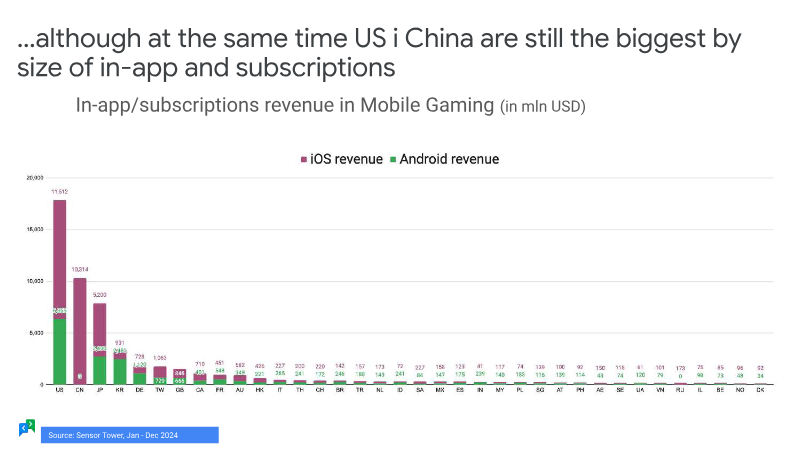
U.S., China, and Japan remain the dominant global revenue generators.
The United States, China, and Japan continue to serve as the most significant revenue generators. However, emerging markets are playing an increasingly critical role in the industry’s growth, particularly in regions like Brazil.
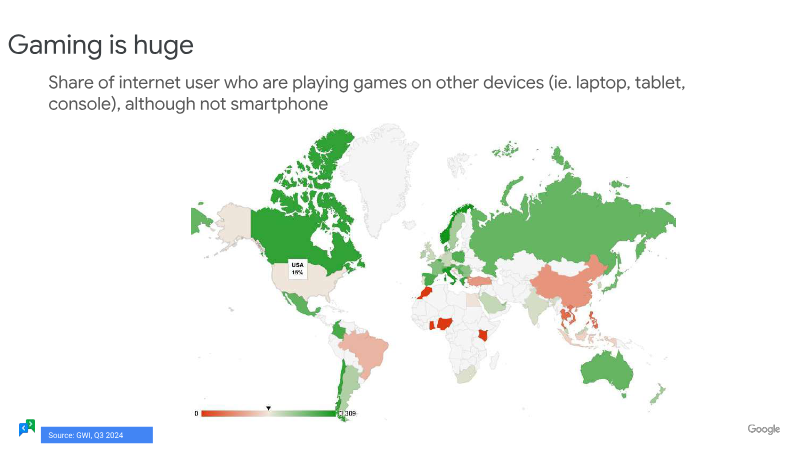
Revenue anchors. The United States, China, and Japan remain the dominant global revenue generators, while Brazil has reached over 90% smartphone gaming penetration across all demographics.
Device preference
Younger U.S. and U.K. demographics prioritize smartphones over consoles and PCs.
Data from the U.S. and U.K. confirms that younger demographics prioritize smartphones over consoles and PCs. This solidifies the mobile device as the central hub for modern gaming.
Smartphone priority. Younger demographics in the U.S. and U.K. are increasingly prioritizing smartphones over consoles and PCs as their primary gaming platform.
Engagement focus
Users increasingly dedicate their time to a single game rather than multiple titles.
Despite the proliferation of available titles, the global player base exhibits a preference for focused engagement. Many users choose to dedicate their time to a single game rather than managing multiple titles simultaneously.
Single-game focus. Player behavior is shifting toward focused engagement, with users increasingly dedicating their time to a single title rather than managing multiple games.
Page 53 of the reportBrazil24
Germany26
Japan24
USA24
1 / 5
Ask AI about this report