Mergers & Acquisitions reports and market data
Documents
TWIG #355 Apple’s $2B Blow, Halo’s PlayStation Leap, and Pokémon Pocket’s Mobile Masterclass
The gaming industry is currently undergoing a period of profound structural and strategic transformation, characterized by shifting exclusivity models, regulatory challenges, and a pivot toward AI-driven development.
- A UK Competition Appeal Tribunal ruling against Apple for excessive commission fees could result in £2 billion in damages, signaling significant regulatory risk for platform holders.
- Microsoft is ending the 25-year console exclusivity of the Halo franchise by bringing it to PlayStation 5, marking a strategic shift toward multiplatform publishing that risks diluting hardware brand identity.
- Pokémon TCG Pocket has seen its annual revenue run rate plummet from $840 million to $300 million, as the game’s reliance on pack-opening mechanics fails to sustain long-term player retention.
Squad Busters, Sandsoft, Boss Fight, the ‘billion dollar blueprint’, Google Play, more
The mobile gaming industry is currently experiencing a period of significant consolidation and studio restructuring, marked by the high-profile closure of several notable titles and development teams.
- The mobile gaming industry is undergoing significant consolidation, evidenced by the closure of Sandsoft, Netflix's shuttering of Boss Fight, and Supercell’s decision to discontinue Squad Busters by mid-2026 due to poor long-term retention.
- Hybrid-casual games are experiencing rapid growth, recording a 114% increase in in-app purchase revenue during the third quarter.
- Google has opened the US Play Store to alternative payment systems, aligning with broader industry trends toward payment liberation for mobile developers.

TWIG #354 Google's New Payment-Link Era and Rovio's End of an Era
The gaming industry is currently undergoing a structural shift characterized by a move toward direct-to-consumer payment models and a consolidation of development resources.
- Regulatory shifts forcing Google to allow third-party payment links are not increasing developer profit margins, as savings are being redirected into rising user acquisition costs.
- Cross-platform commerce is emerging as a critical strategic battleground for firms like Unity and Epic Games, who are leveraging payment solutions to aggregate user data for ad-tech applications.
- The industry is shifting toward a 'fewer, bigger, better' production philosophy, exemplified by Rovio's recent restructuring following the underperformance of key titles.
Why Did EA Really Sell for $55B? The Truth Wall Street Missed (ft. Zynga's Former M&A Chief)
The acquisition of Electronic Arts by Saudi Arabia’s Public Investment Fund for $55 billion represents a strategic shift toward private ownership, designed to insulate the publisher from the volatility and short-term performance pressures of public markets.
- Saudi Arabia’s Public Investment Fund (PIF) acquired Electronic Arts for $55 billion to transition the company into a private entity, insulating it from the short-term performance pressures of public markets.
- The acquisition is a long-term strategic investment rather than a leveraged buyout, prioritizing transmedia expansion of EA’s sports intellectual property and growth in Asian markets over immediate operational restructuring.
- The deal aims to provide the capital stability necessary for long-term innovation and riskier development cycles that are typically stifled by quarterly earnings expectations.
EA Goes Private and Playstation State of Play Review | Roundtable News | 369
The gaming industry is undergoing a fundamental structural transformation characterized by a shift toward private equity ownership and a retreat from experimental development.
- The potential acquisition of EA by a consortium including Saudi Arabia's Public Investment Fund, Silver Lake, and Affinity Partners is valued at approximately $55 billion.
- The gaming industry is experiencing a significant shift in development talent and cost efficiency, with Asian developers increasingly producing high-quality, competitive titles that challenge the dominance of Western studios.
- Major publishers like EA are facing intense scrutiny regarding their lack of recent hit titles and the ongoing impact of widespread industry layoffs on their workforce stability.
Who really bought EA and why this isn’t a typical PE deal
The acquisition of Electronic Arts (EA) for $55 billion represents the largest leveraged buyout in gaming history, involving a consortium led by Saudi Arabia’s Public Investment Fund (PIF), Silver Lake, and Affinity Partners.
- The $55 billion acquisition of Electronic Arts is the largest leveraged buyout in gaming history, funded by a $36 billion equity stake and $19 billion in debt.
- The consortium is led by Saudi Arabia’s Public Investment Fund (PIF), alongside Silver Lake and Affinity Partners, aiming to establish Riyadh as a global gaming hub.
- EA’s annual cash flow of $2.5 to $3 billion is projected to cover debt service, reducing the likelihood of the aggressive 25% to 30% workforce cuts typically seen in private equity buyouts.

Week in Mobile Games E67 - The $55bn EA acquisition unpacked
The acquisition of Electronic Arts by Saudi Arabia’s Public Investment Fund, in partnership with Silver Lake and Affinity Partners, marks a transformative $55 billion shift in the gaming landscape.
- Electronic Arts is set to be acquired by an investor consortium led by Saudi Arabia's Public Investment Fund, Silver Lake, and Affinity Partners in an all-cash deal valued at $55 billion, with closure expected in the 2027 financial year.
- EA's mobile division has seen revenue decline for two consecutive years, with recent performance falling below pandemic-era highs despite the company having launched over 50 mobile titles in the last decade.
- Genshin Impact's mobile revenue has declined annually since its launch, with year five generating approximately $500 million, which is half of the revenue recorded in year four.
TWIG #351 EA Acquisition Analysis That Will Shock You...
Microsoft’s gaming division is currently navigating a period of significant strategic recalibration, marked by rising hardware costs, diminished retail presence, and a fundamental retreat from its aggressive subscription-led growth model.
- A consortium led by Saudi Arabia’s Public Investment Fund, Silver Lake, and Affinity Partners has acquired Electronic Arts in a $55 billion leveraged buyout, the largest transaction in gaming industry history.
- The EA acquisition is structured with $19 billion in debt, but is considered sustainable due to EA’s high profitability and the PIF’s capital reserves, signaling a long-term strategy to establish Riyadh as a global gaming hub.
- Microsoft is pivoting away from its 'growth-at-all-costs' subscription model by increasing Game Pass pricing and restricting day-one releases, reflecting the unsustainability of its previous strategy amid hardware stagnation.
About that EA deal…
The acquisition of Electronic Arts by an investor group led by the Public Investment Fund and Silver Lake represents a significant shift toward geopolitical influence in the gaming sector.
- The acquisition of Electronic Arts by an investor group led by the Public Investment Fund and Silver Lake for $55 billion shifts the company to private ownership to prioritize long-term flexibility over quarterly earnings pressures.
- The EA acquisition strategy may involve decoupling the sports division from other franchises to optimize performance and manage corporate debt, though this risks organizational restructuring and potential layoffs.
- Xbox Game Pass is restructuring its Ultimate tier to $29.99 and integrating Ubisoft Plus to correct historical imbalances where low-intensity users subsidized heavy players.
$55,000,000,000 Buyout , Bowser’s Nintendo Retirement, & Game Showcase Roundup | Games For Breakfast
The gaming industry is currently navigating a period of profound structural and strategic transformation, characterized by aggressive corporate consolidation and the rapid expansion of intellectual property crossovers.
- A consortium led by the Saudi Public Investment Fund and Silver Lake has proposed a $55 billion acquisition to take Electronic Arts private, raising concerns regarding debt-driven management and the potential degradation of creative output.
- Wizards of the Coast is aggressively expanding Magic: The Gathering by integrating high-profile intellectual properties like Marvel and Star Trek, a strategy aimed at growth that risks brand dilution and player fatigue.
- Nintendo of America president Doug Bowser is set to retire, marking a significant leadership transition for the hardware manufacturer.
TWIG #349 The Conspiracy Behind Apple's New Gaming App and a Plea to Supercell
The gaming industry is currently defined by a tension between platform consolidation and the struggle to maintain creative momentum.
- Apple is launching a centralized gaming hub to unify its fragmented ecosystem of App Store titles and Apple Arcade, a strategic move designed to reinforce control over distribution channels amid ongoing antitrust scrutiny.
- Supercell is facing significant pressure to improve performance following a series of underperforming releases since 2018, with analysts advising a return to its historical practice of canceling failing projects to prepare for a potential IPO.
- Nintendo is successfully executing a Disney-style strategy by leveraging its existing intellectual property across movies, theme parks, and hardware, utilizing remakes and ports as a low-cost method to maximize holiday revenue.
Embracer Group Annual General Meeting 2025: Presentation
The Embracer Group 2025 Annual General Meeting presentation outlines a comprehensive corporate restructuring strategy aimed at transitioning the organization into a more resilient, IP-focused entity.
- Embracer Group achieved a net cash position of SEK 5.4 billion by the end of the 2024/25 fiscal year, driven by the divestment of major assets including Easybrain, Saber, and Gearbox, and the spin-off of Asmodee.
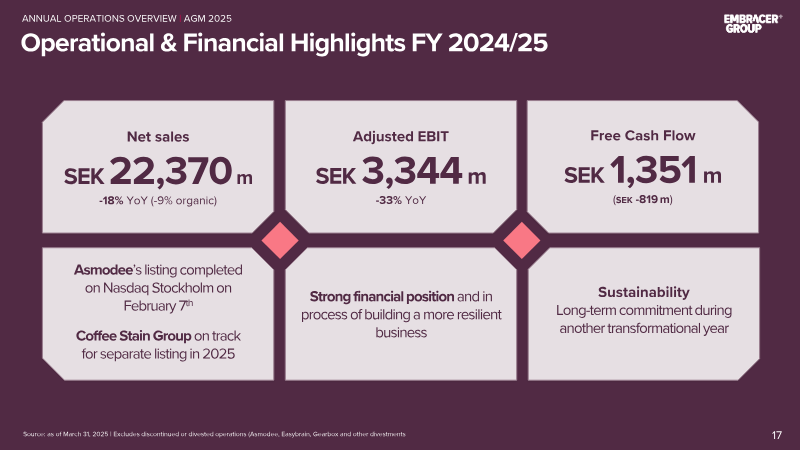
- Financial performance for the 2024/25 fiscal year saw net sales decline 18% year-over-year to SEK 22,370 million, with adjusted EBIT falling 33% to SEK 3,344 million.
- The company significantly improved free cash flow by reducing annual capital expenditure from SEK 8 billion to SEK 3 billion and streamlining its development pipeline to 116 projects.