Market Analysis
Documents

Behind the Screens: The Salary Stats in Gamedev
This research, conducted by 80 Level in January 2024, examines the global compensation landscape and financial well-being of professionals within the video game development industry. Based on a survey of over 1,000 respondents from the 80 Level Research panel and reader base, the study analyzes how geography, years of experience, and specific job roles influence annual income and purchasing power.
The findings reveal a highly stratified industry where nearly 40% of developers earn less than $40,000 annually, while only 11% exceed the $150,000 mark. Geographic location serves as a primary driver of these disparities; for instance, 36% of U.S.-based professionals earn over $150,000, whereas 54% of surveyed developers in India earn under $9,999. In Europe, the majority of professionals in the UK, Germany, and Sweden fall within the $30,000 to $79,999 range. The data also highlights a significant "cost of living" gap, noting that while 16.6% of the workforce can afford all discretionary purchases, 24.4% earn enough for a car but remain unable to afford a residence.
Experience levels further dictate earning potential, with 74% of interns earning under $9,999, while 24% of Directors and Leads exceed $150,000. The analysis of specific roles shows that Creative Directors and Software Developers generally occupy higher salary segments compared to Artists and Game Designers. Notably, the study identifies a segment of "struggling" C-level executives (19%), likely representing founders of small indie studios who face financial instability despite their titles. The research concludes that while the industry offers high-earning potential at senior levels in Western hubs, a substantial portion of the global workforce operates under significant financial constraints.
- The game development industry is highly stratified, with nearly 40% of professionals earning under $40,000 annually and only 11% earning more than $150,000.
- Geography is a primary driver of income disparity, evidenced by 36% of U.S.-based professionals earning over $150,000 compared to 54% of developers in India earning under $9,999.
- Financial instability is prevalent, as 24.4% of the workforce can afford a car but cannot afford a residence, while only 16.6% can afford all discretionary purchases.
- Experience correlates strongly with compensation, as 74% of interns earn under $9,999, whereas 24% of Directors and Leads earn over $150,000.
- Creative Directors and Software Developers generally command higher salaries than Artists and Game Designers.

Games Market Trends to Watch in 2024
The global games market in 2024 is characterized by a period of stabilization and strategic restructuring following the post-pandemic correction. While the industry saw a revenue decline in 2022, recovery began in 2023 and is expected to continue through 2024, driven largely by the expanding install base of current-generation consoles like the PlayStation 5 and Xbox Series X|S. Despite this growth, the year is defined as a lean period for many companies as they navigate high interest rates, reduced investment capital, and a highly competitive landscape where a small number of titles dominate the majority of player engagement.
Key findings indicate a significant shift in business models and platform strategies. While live-service games remain the primary revenue drivers, the market is experiencing oversaturation, leading many developers to return to premium, finite gaming experiences. Growth in multi-game subscription services is expected to slow as they face competition from free-to-play social platforms like Fortnite and Roblox. Additionally, mobile developers are increasingly diversifying by bringing their titles to PC to combat rising user acquisition costs and stricter privacy regulations. Major hardware and distribution shifts are also anticipated, including the launch of a new Nintendo console and the introduction of an Xbox mobile store on Android.
The scope of this analysis covers global market trends across PC, console, and mobile segments, with revenue forecasting extending through 2026. The methodology combines internal market data and analyst perspectives with a survey of gaming executives and industry experts from companies such as Ubisoft, Iron Galaxy Studios, and Savvy Games Group. Emerging technologies like generative AI are identified as tools for increasing production efficiency, though they are not expected to transform game development at scale within the immediate calendar year. Overall, the industry is moving toward risk-reduction strategies, focusing on established intellectual properties and cross-platform accessibility to maintain stability.
- The global games market is in a period of stabilization and recovery throughout 2024, supported by the growing install base of current-generation consoles like the PlayStation 5 and Xbox Series X|S.
- Developers are increasingly pivoting back to premium, finite gaming experiences to counter the oversaturation of the live-service market.
- Mobile developers are expanding to PC platforms to mitigate the impact of rising user acquisition costs and stricter privacy regulations.
- Growth in multi-game subscription services is expected to decelerate as they face direct competition from free-to-play social platforms such as Fortnite and Roblox.
- The industry is preparing for significant infrastructure shifts, including the anticipated launch of a new Nintendo console and the introduction of an Xbox mobile store on Android.

The State of Gaming 2024: An Analysis of the Current Mobile Gaming Market Trends
The global mobile gaming market underwent a significant correction in 2023, characterized by a 10% decline in worldwide downloads and a 2% drop in total revenue. This downturn was primarily fueled by escalating user acquisition costs and a post-pandemic stabilization of consumer habits. While the broader market contracted, a distinct shift toward casualization occurred, evidenced by an 8% increase in Casual game revenue and a 30% surge in the Hybridcasual segment. Conversely, Mid-core titles faced a 9% revenue decline, signaling a transition in player preferences toward more accessible experiences.
Geographic performance diverged sharply as publishers pivoted toward emerging markets to mitigate rising costs in established territories. While the Asian market saw a 6% revenue contraction, the Middle East, Europe, and Latin America experienced revenue growth of 8%, 7%, and 4% respectively, despite falling download numbers. This regional resilience was often driven by high-profile intellectual properties, such as the success of Monopoly GO! in Europe and the expansion of Netflix’s gaming portfolio, which saw a 194% increase in downloads through the integration of major franchises like Grand Theft Auto.
Strategic adaptations in 2023 focused on maximizing player lifetime value through Live Ops events and transmedia collaborations. Mobile gaming now commands 67% of global digital advertising spend, with marketing strategies increasingly segmented by platform; YouTube and TikTok serve as primary hubs for core gamers, while Facebook and Pinterest remain vital for reaching casual female audiences. To combat the challenges of the current landscape, the industry has embraced low-cost user-generated content and external subscription models, leveraging recognizable IP to bridge the gap between gaming and broader entertainment media.
- The global mobile gaming market contracted in 2023, with a 10% decline in downloads and a 2% drop in total revenue due to rising user acquisition costs and post-pandemic habit stabilization.
- Player preferences shifted toward accessibility, resulting in an 8% revenue increase for Casual games and a 30% surge in the Hybridcasual segment, while Mid-core titles saw a 9% revenue decline.
- Publishers are pivoting to emerging markets to offset costs, with the Middle East, Europe, and Latin America seeing revenue growth of 8%, 7%, and 4% respectively.
- High-profile intellectual property is a primary growth driver, evidenced by the success of Monopoly GO! in Europe and a 194% surge in Netflix gaming downloads following the integration of franchises like Grand Theft Auto.
- Mobile gaming now accounts for 67% of global digital advertising spend, with marketing strategies increasingly segmented by platform, such as using YouTube and TikTok for core gamers and Facebook and Pinterest for casual female audiences.

Art Direction in Game Remakes: An Analysis of 7 Case Studies
The pursuit of a successful game remake requires a delicate equilibrium between honoring the original creative spirit and meeting the heightened technical expectations of modern audiences. Analysis of high-profile titles released through 2024, including Metroid Prime Remastered and Resident Evil 4, indicates that critical and fan reception serves as the primary metric for quality, often superseding raw financial performance. Developers find the most success when they rebuild visual assets from scratch, leveraging contemporary lighting and 3D environments to recreate the atmospheric immersion that original technical constraints once limited.
Modernization strategies vary based on the age and mechanical relevance of the source material. While some titles benefit from subtle control refinements, others require a total overhaul of core systems to remain viable. Capcom’s approach to the Resident Evil series exemplifies this by replacing dated tank controls and fixed cameras with fluid 3D movement and strategic lighting. Similarly, Square Enix transitioned the static backgrounds and turn-based combat of Final Fantasy VII into expansive environments and action-oriented hybrid systems. These shifts demonstrate that adhering to the "pillars of experience" is more vital than preserving obsolete functional elements.
Ultimately, the most effective remakes prioritize the recreation of a specific feeling or "spirit" over mere resolution increases. While visual fidelity must be modernized to maintain immersion, gameplay adjustments should be handled selectively to avoid alienating the core fanbase. Industry leaders like Nintendo and specialized external development partners emphasize that leveraging modern hardware to amplify a game's original intent is the most reliable path to critical acclaim. By focusing on atmospheric depth and evolved control schemes, developers can ensure that classic titles resonate with both nostalgic players and new audiences within the current AAA landscape.
- Successful remakes prioritize the recreation of a game's original 'spirit' and atmospheric intent over simple increases in visual resolution.
- Critical and fan reception serves as the primary metric for quality in modern remakes, often outweighing raw financial performance.
- Developers achieve the highest success by rebuilding visual assets from scratch to leverage contemporary lighting and 3D environments, overcoming the technical constraints of original releases.
- Modernization strategies must distinguish between preserving 'pillars of experience' and replacing obsolete functional elements, such as Capcom’s transition from fixed cameras to fluid 3D movement in Resident Evil 4.
- Square Enix’s approach to Final Fantasy VII demonstrates that transitioning from static backgrounds and turn-based combat to expansive, action-oriented systems can effectively modernize legacy titles.

Xsolla Report: State of Play – Winter 2024 Edition
The global gaming industry is currently navigating a period of stabilization following a massive 26% growth surge between 2019 and 2021. While the rapid pandemic-era expansion has moderated, the sector reached $106.8 billion in 2023 and is on a trajectory to hit $205.7 billion by 2026. This growth is underpinned by a global player base expanding to 3.79 billion people, with mobile gaming remaining the dominant force, accounting for nearly half of all consumer spending. Despite a downward revision in year-over-year growth forecasts to 0.6%, mobile spending is expected to reach $111.4 billion in 2024, led by strong performance in the United States and Japan.
The industry is undergoing a significant structural transformation driven by technological shifts and regulatory changes. The transition toward digital-only monetization, cloud-based services, and the metaverse—projected to reach $996 billion by 2030—reflects a broader convergence with the entertainment landscape. Furthermore, the implementation of the Digital Markets Act is opening doors for alternative billing systems and direct-to-consumer web stores. These shifts occur alongside a demographic evolution where women now represent nearly 50% of the player base, though they remain underrepresented in executive and professional roles.
Financial dynamics within the sector show a complex landscape of consolidation and rising costs. While AAA development budgets have tripled over the last five years, the investment market has faced volatility, characterized by a cooling M&A environment and significant layoffs. Despite a drop in deal volume, strategic investment value surged by 577% in mid-2023, reaching $7 billion in a single quarter. To counter high user acquisition costs and stricter privacy regulations, developers are increasingly adopting generative AI for efficiency and pivoting toward community-focused organic reach, early access models, and influencer partnerships to ensure long-term sustainability.
- The global gaming industry is projected to grow from $106.8 billion in 2023 to $205.7 billion by 2026, supported by a total player base of 3.79 billion people.
- Mobile gaming remains the industry's primary revenue driver, accounting for nearly 50% of total consumer spending and reaching a projected $111.4 billion in 2024.
- Strategic investment value saw a massive 577% surge in mid-2023 to reach $7 billion in a single quarter, despite an overall cooling in M&A activity and a volatile investment climate.
- The metaverse is projected to reach a valuation of $996 billion by 2030 as the industry shifts toward digital-only monetization and cloud-based services.
- Regulatory changes like the Digital Markets Act are forcing a structural shift toward alternative billing systems and direct-to-consumer web stores to bypass traditional platform constraints.

The Alumni Effect: A Deep Dive into Studios Founded by Ex-Rioters
The emergence of startups founded by former Riot Games employees represents a significant sub-sector of the venture capital landscape in gaming. Since 2020, investors have funneled nearly $500 million into 27 startups led by these alumni across 38 funding rounds. These founders command a substantial premium in the market, with an average round size of $11 million, which is 53% higher than the $7 million average seen across the broader gaming startup ecosystem.
The investment data reveals a high level of confidence from specialized venture capital firms, with Andreessen Horowitz (a16z Games) and Bitkraft Ventures leading the activity. These firms have participated in deals valued at $339.3 million and $236.3 million respectively. Furthermore, ex-Riot teams demonstrate superior fundraising momentum compared to the general market. A significantly higher percentage of these studios successfully secure follow-on financing within two to three years of their initial rounds, whereas the broader gaming market sees a much sharper decline in subsequent funding success over the same period.
While capital infusion is high, the majority of these ventures are currently in the pre-release phase. Out of 27 identified startups, only six have released products to date. The most well-funded projects include Theorycraft’s Supervoke, Believer’s unannounced AAA title, and Singularity 6’s Palia. The scope of these projects primarily focuses on high-ambition genres such as multiplayer RPGs, extraction MOBAs, and backend infrastructure. This trend underscores a strategic focus on complex, scalable platforms that mirror the live-service expertise associated with the founders' professional origins.
- Startups founded by former Riot Games employees have raised nearly $500 million across 27 companies since 2020.
- Ex-Riot founders command a 53% premium in average round size, securing $11 million per round compared to the $7 million industry average.
- Venture capital firms Andreessen Horowitz and Bitkraft Ventures are the primary backers, participating in deals worth $339.3 million and $236.3 million respectively.
- Alumni-led studios demonstrate superior fundraising momentum, with a higher rate of success in securing follow-on financing within two to three years compared to the broader gaming market.
- Despite significant capital infusion, only six of the 27 identified startups have released products to date.

Game Developer Index: Sweden 2024
The analysis evaluates the health and trajectory of Sweden’s video‑game sector during 2023‑24, mapping its economic performance, creative output, ecosystem structure and emerging challenges. By quantifying sales, employment, investment and cultural impact, it argues that the industry remains a growth engine for the Swedish economy while confronting structural constraints that could limit future expansion.
Domestic net sales rose 6 % to SEK 34.6 billion (≈ EUR 3 billion, USD 3.2 billion) and total global revenue reached SEK 90.4 billion, a 4.5 % increase. The number of registered firms grew by 108 to 1,010, and Swedish‑owned companies expanded overseas to 218 subsidiaries in 54 countries, employing 15,792 staff abroad, of whom 29.5 % are women. Major titles such as Helldivers 2 (12 million copies in three months) and Satisfactory (6 million copies and a console launch) reinforced Sweden’s market presence, while Steam and Twitch data showed Swedish games accounting for over 700 million streamed hours in 2023 and nearly 500 million from January‑October 2024.
The ecosystem is heavily concentrated in Stockholm, home to 439 studios and 5,816 employees, with secondary hubs in Skåne‑Blekinge, Västra Götaland, Västerbotten‑Norrbotten and Östergötland. Educational provision spans bachelor, master and vocational programmes, serving roughly 700 students across multiple institutions. Inclusion initiatives have broadened participation, exemplified by a game‑developer camp for about 100 gender‑diverse teens and a network of scholarships and mentorships. Nevertheless, early‑stage capital has weakened, talent pipelines remain thin—with only 644 new hires in 2023 and rising work‑permit refusals—and public‑health screen‑time guidance remains ambiguous.
Capital flows revived in 2023‑24, highlighted by Embracer’s SEK 4.9 billion sale of Gearbox to Take‑Two and EQT’s SEK 28.7 billion acquisition of
- Sweden’s video-game sector grew to SEK 90.4 billion in total global revenue in 2023-24, a 4.5% increase, while domestic net sales rose 6% to SEK 34.6 billion.
- The industry’s footprint expanded to 1,010 registered firms, with Swedish-owned companies now operating 218 subsidiaries across 54 countries and employing 15,792 staff abroad.
- Major commercial successes like 'Helldivers 2', which sold 12 million copies in three months, and 'Satisfactory', which reached 6 million copies, drove significant market presence and over 700 million streamed hours in 2023.
- Capital activity remains robust, evidenced by major transactions including EQT’s SEK 28.7 billion acquisition and Embracer’s SEK 4.9 billion sale of Gearbox to Take-Two.
- Stockholm remains the primary industry hub with 439 studios and 5,816 employees, though the ecosystem faces structural challenges including a thin talent pipeline, with only 644 new hires in 2023, and rising work-permit refusals.

Interactive Entertainment 2025: Global Market Sizing & Forecast
The interactive entertainment market is projected to reach $250.2 billion in consumer spending by 2025, representing a 4.6% year-over-year growth. This recovery follows a period of transition characterized by a significant cyclical downturn in console hardware, which is expected to decline by 31% in 2024 as the industry prepares for next-generation devices. The analysis covers global consumer spending across software publishing, hardware, emerging technology, and live-streaming segments for the period spanning 2023 through 2025.
Software publishing remains the primary market driver, with mobile gaming leading as the largest category, forecasted to reach $115.7 billion in 2025. While PC gaming shows the strongest growth rate at 8.1% for 2025, console software spending is also expected to rise in anticipation of new hardware cycles. In contrast, the esports and live-streaming sectors face ongoing profitability challenges; esports revenue is projected to decline by 8.3% in 2025, while streaming platforms struggle with high operational costs despite modest growth in user engagement.
Emerging technologies, including virtual reality and blockchain gaming, are identified as latent disruptors fueled by venture capital and platform investments. Virtual reality is expected to grow by 11% in 2025, supported by new hardware like the Apple Vision Pro. Additionally, the market is seeing a strategic shift as major entertainment firms like Sony and Disney evolve into all-round media conglomerates, leveraging established intellectual property across games, film, and virtual storefronts in platforms like Roblox to reach new audiences. Data for these findings is derived from company financials and a proprietary partner network tracking over 200 consumer brands.
- The global interactive entertainment market is projected to reach $250.2 billion in consumer spending by 2025, marking a 4.6% year-over-year growth.
- Mobile gaming remains the industry's largest segment, with forecasted consumer spending of $115.7 billion in 2025.
- Console hardware is experiencing a significant cyclical downturn, with spending expected to decline by 31% in 2024 ahead of next-generation device launches.
- PC gaming is the fastest-growing software segment, projected to achieve an 8.1% growth rate in 2025.
- Esports revenue is facing a downturn, with a projected decline of 8.3% in 2025 due to ongoing profitability challenges.
Annual Universe of Positive Gaming Experiences 2024
Stillfront Group’s 2024 fiscal year marks a pivotal transition into a synergy-driven operational phase, characterized by a major geographic reorganization into Europe, North America, and MENA & APAC business areas. This strategic shift aims to drive efficiency and mitigate a 2% organic revenue decline, which resulted in total net revenues of 6,737 MSEK. The financial year was defined by a significant net loss of 7,378 MSEK, primarily driven by a 6.9 billion SEK goodwill impairment in the North American segment due to lower-than-expected growth. Despite these non-cash charges, the group maintained a resilient financial foundation, generating over 1 billion SEK in free cash flow and improving gross margins to 80% through successful direct-to-consumer initiatives.
The group’s portfolio remains focused on free-to-play franchises, with North America and Europe accounting for 71% of player bookings. To reduce dependency on third-party platforms, which still facilitate 54% of revenue, management is prioritizing its internal payment systems and the "Stillops" platform for cost optimization. A comprehensive cost-savings program is underway, targeting up to 250 MSEK in annual savings by late 2025. Leadership has also stabilized under a new CEO and a board that remains fully compliant with the Swedish Code of Corporate Governance, focusing on organic growth and franchise scaling over dividend distributions.
Sustainability and governance have been deeply integrated into the corporate strategy in preparation for the EU’s Corporate Sustainability Reporting Directive. The group achieved Science Based Targets initiative validation, reducing market-based greenhouse gas emissions by 7% and more than doubling its renewable energy share to 37%. While social metrics show a stable workforce with improved turnover rates and high data security standards, challenges remain in gender diversity at the executive level. Executive remuneration is now tied to long-term sustainability targets, including employee satisfaction and data privacy, ensuring that environmental and social governance remains central to the group’s long-term value creation.
- Stillfront Group reported a net loss of 7,378 MSEK for fiscal year 2024, largely driven by a 6.9 billion SEK goodwill impairment in its North American segment.
- Total net revenues reached 6,737 MSEK, reflecting a 2% organic revenue decline that prompted a major geographic reorganization into Europe, North America, and MENA & APAC.
- Despite the net loss, the company generated over 1 billion SEK in free cash flow and improved gross margins to 80% through direct-to-consumer initiatives.
- Management is executing a cost-savings program targeting 250 MSEK in annual savings by late 2025 while prioritizing internal payment systems to reduce reliance on third-party platforms, which currently account for 54% of revenue.
- The company is shifting focus toward organic growth and franchise scaling, with 71% of player bookings currently concentrated in North America and Europe.

Supercharged: Powering the Future of the UK Video Game and Interactive Entertainment Industry
The new five‑year strategy and action plan sets out a comprehensive roadmap for the UK video‑games and interactive‑entertainment sector, positioning it as the world’s leading hub for new intellectual property and innovation by 2030. Its core thesis is that sustained growth, enhanced global perception, and a resilient, diverse talent pipeline will secure the industry’s long‑term economic and cultural impact. The plan outlines four strategic priorities—transforming public and media perceptions, building a pro‑games policy agenda, cultivating a highly skilled and inclusive workforce, and strengthening businesses through targeted support.
Key initiatives include three flagship campaigns: energising industry to turn innovative stories into globally successful IPs, empowering talent by nurturing creators and entrepreneurs, and elevating games to showcase British‑made titles as forces for good. The 2024‑25 action schedule launches a coordinated PR strategy, high‑impact partnerships with cultural and digital brands, and an evidence‑led lobbying effort aimed at more competitive tax reliefs, increased investment, and the introduction of a Digital Creativity GCSE. A new research and evidence base will underpin policy advocacy, while a sector‑wide skills network and the refreshed #RaiseTheGame programme will drive diversity, equity, and inclusion across the talent pipeline.
The plan also commits to environmental responsibility through participation in the Playing for the Planet Alliance and internal sustainability measures. Supporting stronger businesses will involve a refreshed membership strategy, expansion of the Ukie Worldwide platform for trade and investment, and the continuation of the Video Games Growth Programme. By inviting industry stakeholders to engage through surveys, working groups, mentorship, and board participation, the strategy seeks broad collaboration to deliver its ambitious objectives across the UK’s mobile, console, core and casual game segments throughout the 2024‑2030 horizon.
- The UK video game industry has launched a five-year strategy aiming to establish the nation as the global leader in intellectual property and innovation by 2030.
- The 2024-25 action plan prioritizes lobbying for more competitive tax reliefs, increased investment, and the introduction of a Digital Creativity GCSE.
- Strategic efforts to strengthen the workforce include the expansion of the #RaiseTheGame diversity, equity, and inclusion programme and the creation of a sector-wide skills network.
- Business growth initiatives include the expansion of the Ukie Worldwide trade platform and the continuation of the Video Games Growth Programme.
- The industry is formalizing its commitment to environmental sustainability through participation in the Playing for the Planet Alliance.

Serbian Gaming Industry Report 2023
The 2023 Serbian gaming industry assessment quantifies the sector’s rapid expansion, maps its ecosystem, and evaluates the conditions shaping future growth. Drawing on a 97‑question survey that reached 80 % of the domestic ecosystem and validated financial data for the 21 leading firms, the analysis establishes a clear upward trajectory for Serbia’s game development landscape.
Total industry revenue reached €175 million, a 17 % year‑on‑year increase, while the workforce nearly doubled to roughly 4,300 professionals. The market now hosts 38 active studios producing 81 titles, with mobile‑first games still dominant but ceding share to core and original‑IP projects. Talent inflows from Russia, Ukraine and Belarus, together with 70 % of respondents expressing optimism, underpin this momentum, and a quarter of companies are planning foreign offices despite lingering concerns over tax incentives and regulatory red tape.
The ecosystem comprises more than 140 companies and over 500 regional stakeholders, featuring high‑profile successes such as Foxy Voxel’s “Going Medieval” (850 k+ copies), GameBiz Consulting’s $250 million revenue from 80+ global studios, Onyx Studio’s 57 million monthly players, and Sozap’s NASDAQ listing with 30 million downloads. Collaborative ties with DICE/EA, Microsoft, Google and Epic Games, alongside mentoring programmes, Gamescom exposure, and the Shift2Games and Playing Narratives initiatives, reinforce Serbia’s emergence as a European development hub. At the same time, the rollout of generative‑AI tools raises IP, privacy and deep‑fake risks, prompting EU‑wide regulatory scrutiny.
Overall, the sector is maturing into a diversified, internationally connected hub with strong growth prospects. Realising its potential will require addressing regulatory and fiscal barriers, leveraging AI responsibly, and sustaining education and mentorship programmes that nurture talent and support SMEs in scaling their operations.
- The Serbian gaming industry generated €175 million in revenue in 2023, marking a 17% year-on-year increase.
- The sector's workforce nearly doubled to approximately 4,300 professionals, supported by talent inflows from Russia, Ukraine, and Belarus.
- The ecosystem now includes 38 active studios producing 81 titles, with a strategic shift occurring from mobile-first games toward core and original-IP projects.
- High-profile industry successes include Foxy Voxel’s 'Going Medieval' (850k+ copies), Onyx Studio’s 57 million monthly players, and Sozap’s NASDAQ listing.
- Serbia has established strong collaborative ties with major global players including DICE/EA, Microsoft, Google, and Epic Games.
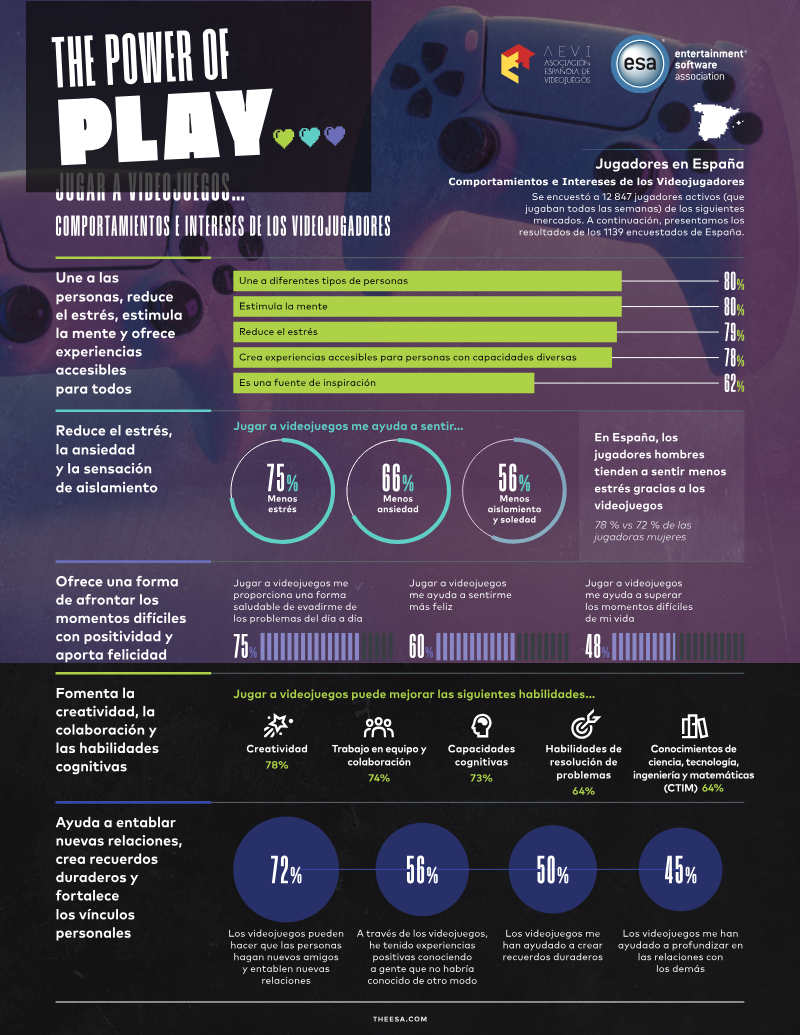
Comportamientos e Intereses de los Videojugadores: Spain
The study investigates how Spanish video‑game players experience play, what motivates them, and which social and cognitive benefits they perceive. It situates Spain within a broader cross‑national analysis that also includes Poland, South Korea and Australia, focusing on active gamers who play at least once a week.
Data were collected through an online questionnaire administered to 12,847 weekly players across the four markets, of which 1,139 respondents were from Spain. The sample spans ages 16 to 65 plus and includes both genders, allowing comparison of habits and attitudes between men and women and across age brackets.
Among Spanish gamers, 80 % cite “meeting different people” and “stimulating the mind” as primary reasons for playing, while 78 % report that games help reduce stress and anxiety. Men are slightly more likely than women to feel less isolated (78 % vs 72 %) and to use gaming as a healthy outlet for daily pressures (75 % of men versus 60 % of women). Solo play remains the most common mode, yet eight out of ten men regularly play with others online, and roughly half of all respondents combine solo and online sessions.
Social interaction is linked to perceived skill gains: 78 % associate multiplayer play with enhanced creativity, 74 % with teamwork, and 64 % with improved cognitive and STEM‑related abilities. Integrated communication tools are used frequently by 29 % of younger male players, while 55 % of all participants view playing with others—whether online or in person—as a positive experience that fosters lasting friendships and shared memories.
Overall, Spanish gamers view video games as a versatile medium that delivers entertainment, mental‑health relief, social connection and transferable competencies, underscoring the sector’s relevance for both consumer satisfaction and broader wellbeing initiatives.
- 80% of Spanish gamers play primarily to meet new people and stimulate their minds, while 78% use gaming as a tool to reduce stress and anxiety.
- Multiplayer gaming is perceived as a driver for skill development, with 78% of players associating it with creativity, 74% with teamwork, and 64% with improved cognitive and STEM-related abilities.
- Social gaming is a core habit, as 55% of all participants view playing with others as a positive experience that fosters lasting friendships and shared memories.
- While solo play remains the most common mode, 80% of male gamers play online with others regularly, and roughly 50% of all respondents combine solo and online sessions.
- Gender differences exist in perceived benefits, with men more likely than women to report feeling less isolated (78% vs 72%) and using gaming as a healthy outlet for daily pressure (75% vs 60%).