Updated Mar 17, 2026 by AEVI
Report · January 1, 2024
Published by AEVI
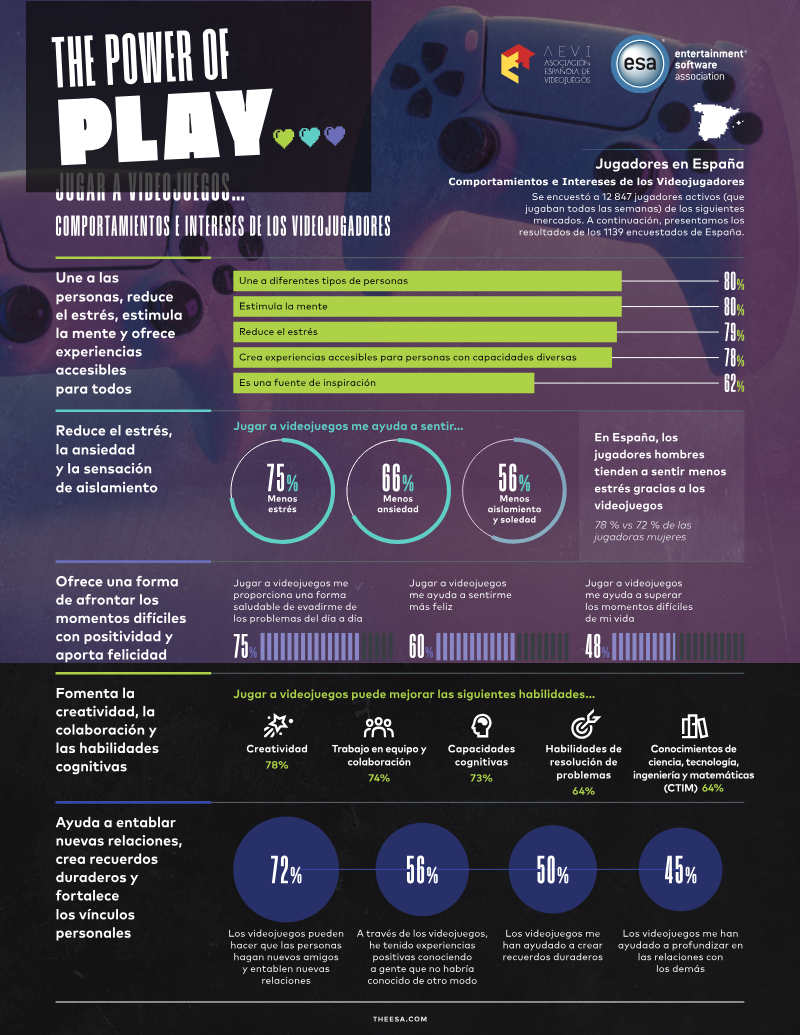
The study investigates how Spanish video‑game players experience play, what motivates them, and which social and cognitive benefits they perceive. It situates Spain within a broader cross‑national analysis that also includes Poland, South Korea and Australia, focusing on active gamers who play at least once a week. Data were collected through an online questionnaire administered to 12,847 weekly players across the four markets, of which 1,139 respondents were from Spain. The sample spans ages 16 to 65 plus and includes both genders, allowing comparison of habits and attitudes between men and women and across age brackets. Among Spanish gamers, 80 % cite “meeting different people” and “stimulating the mind” as primary reasons for playing, while 78 % report that games help reduce stress and anxiety. Men are slightly more likely than women to feel less isolated (78 % vs 72 %) and to use gaming as a healthy outlet for daily pressures (75 % of men versus 60 % of women). Solo play remains the most common mode, yet eight out of ten men regularly play with others online, and roughly half of all respondents combine solo and online sessions. Social interaction is linked to perceived skill gains: 78 % associate multiplayer play with enhanced creativity, 74 % with teamwork, and 64 % with improved cognitive and STEM‑related abilities. Integrated communication tools are used frequently by 29 % of younger male players, while 55 % of all participants view playing with others—whether online or in person—as a positive experience that fosters lasting friendships and shared memories. Overall, Spanish gamers view video games as a versatile medium that delivers entertainment, mental‑health relief, social connection and transferable competencies, underscoring the sector’s relevance for both consumer satisfaction and broader wellbeing initiatives.
Los jugadores hombres tienden a jugar con otros jugadores en línea Poland South Korea Spain PL AY juega a videojuegos para divertirse Jugadores ~~en España~~ JUGAR A VIDEOJUEGOS… Australia ~~Australia~~ ~~Australia~~ Comportamientos e Intereses de los Videojugadores Se encuestó a 12 847 jugadores activos (que COMPORTAMIENTOS E INTERESES DE LOS VIDEOJUGADORES jugaban todas las semanas) de los siguientes mercados. A continuación, presentamos los resultados de los 1139 encuestados de España. Une a las Une a diferentes tipos de personas 80% personas, reduce Estimula la mente 80% el estrés, estimula 79 la mente y ofrece Reduce el estrés 78% experiencias 53% Crea 55% accesibles experiencias accesibles para personas con capacidades diversas 62% para todos Es una fuente de inspiración % Todas las 85% 45% 28% Reduce el estrés, Jugar a videojuegos me ayuda a sentir… En España, los la ansiedad 75 66 56 jugadores hombres y la sensación 18-18 35.44 % % % tienden a sentir menos Mujres 19-24 25-34 55-64 de aislamiento Menos 65* Menos Menos estrés gracias a los estrés ansiedad aislamiento videojuegos y soledad 78 % vs 72 % de las jugadoras mujeres Ofrece una forma Jugar a videojuegos me Jugar a videojuegos Jugar a videojuegos proporciona una forma 28% de afrontar los Hombres saludable de evadirme de me ayuda a sentirme me ayuda a superar momentos difíciles los problemas del día a día más feliz los momentos difíciles de mi vida con positividad y 75 % 60% 48% aporta felicidad
os me Jugar a videojuegos Jugar a videojuegos proporciona una forma 28% de afrontar los Hombres saludable de evadirme de me ayuda a sentirme me ayuda a superar momentos difíciles los problemas del día a día más feliz los momentos difíciles de mi vida con positividad y 75 % 60% 48% aporta felicidad Fomenta la ~~Jugar a videojuegos puede mejorar las siguientes ~~ califican la experiencia de ~~habilidades…~~ creatividad, la jugar con otras personas, ya colaboración y sea en línea o presencialmente, Juego con otras personas en línea Juego con otras personas como positiva las habilidades Creatividad Trabajo en equipo y Capacidades Habilidades de Conocimientos de cognitivas 78% colaboración cognitivas resolución de ciencia, tecnología, 74% 73% problemas ingeniería y matemáticas 64% (CTIM) 64% Los jugadores hombres y jóvenes Ayuda a entablar usan más las funciones de nuevas relaciones, comunicación integradas crea recuerdos A veces 72 % ~~56~~ % ~~50~~ 79% 45 duraderos y de los 60% 73% % 69% 62% % fortalece jugadores 51% 50% 45% los vínculos 35% personales Frecuentemente Los videojuegos pueden A través de los videojuegos, Los videojuegos me Los videojuegos me han hacer que las personas he tenido experiencias han ayudado a crear ayudado a profundizar en hagan nuevos amigos positivas conociendo recuerdos duraderos las relaciones con y entablen nuevas a gente que no habría los demás Siempre relaciones conocido de otro modo
Mujeres Todos los encuestados coinciden juega a videojuegos para de los jugadores de España juega a videojuegos para divertirse entretenerse juega a videojuegos para coincide en que hay un videojuego entretenerse adecuado para cada persona Aunque jugar solo es lo más comun, casi la mitad Todos los encuestados coinciden Aunque jugar solo es lo más común, casi la mitad en que los videojuegos les ayudan de los jugadores de España que juegan todas las a reducir el estrés y relajarse semanas lo hacen en línea con otros jugadores 62% 60% 63% Solo En línea con Presencialmente 58% 55% 62% 59% 63% 55% 60% Solo En línea con Presencialmente 58% 55% 59% 53% 60% 55% 60% 53% otras personas con otras personas 53% 53% Todas las 85% 45% 28% semanas Mujeres de España Total Hombres 16-18 19-24 25-34 35-44 45-54 55-64 65+ Los jugadores hombres tienden a jugar con otros jugadores en línea 8 de cada 10 Mujeres 41% Hombres 49% Mujeres 28% Hombres 28% Hombres califican la experiencia de jugar con otras personas, ya sea en línea o presencialmente, Juego con otras personas en línea Juego con otras personas como positiva Juego con otras personas en línea presencialmente como positiva Juego con otras personas 55% presencialmente Los jugadores hombres y jóvenes 29<sub>%</sub> usan más las funciones de comunicación integradas A veces usan más las funciones de
personas en línea Juego con otras personas como positiva Juego con otras personas en línea presencialmente como positiva Juego con otras personas 55% presencialmente Los jugadores hombres y jóvenes 29<sub>%</sub> usan más las funciones de comunicación integradas A veces usan más las funciones de A veces de los 60% 73% 79% 69% 62% Frecuencia jugadores 51% 73% 79% 69% 50% de uso 20<sub>%</sub> utiliza las 60% 62% 35% 45% Frecuencia Frecuentemente 51% 50% de uso funciones de 35% 45% 6 comunicación Frecuentemente Siempre % integradas en Mujeres Hombres16-18 19-24 25-34 35-44 45-54 55-64 65+ los videojuegos Siempre
**Summary of “The Power of Play: España” (Survey of Spanish Video‑Game Players)** --- ## 1. Scope & Sample - **Population surveyed:** 12 847 active gamers (play ≥ once a week) across several markets. - **Spanish subsample:** 1 139 respondents (men + women) who answered the questionnaire. --- ## 2. Demographic Profile | Age group (years) | % of Spanish respondents* | |-------------------|---------------------------| | 16‑18 | 8 % (men) / 41 % (women) | | 19‑24 | 49 % (men) / 28 % (women) | | 25‑34 | 28 % (men) / 28 % (women) | | 35‑44 | – | | 45‑54 | – | | 55‑64 | – | | 65+ | – | \*The table in the original document mixes gender‑specific percentages; the numbers above reflect the most clearly reported figures. - **Gender split (overall):** Roughly equal, with a slight male majority in the 19‑24 bracket. - **Play mode:** 8 out of 10 male gamers (≈ 80 %) report playing **with other players online**. For women, solo play is still the most common, but a sizable minority also play online or in person. --- ## 3. Primary Motivations for Playing | Motivation | % of respondents (overall) | |------------|----------------------------| | **Fun / Entertainment** | 85 % | | **Stress reduction / relaxation** | 78 % (men) – 75 % (women) | | **Social connection (meeting new people, making friends)** | 62 % (men) – 55 % (women) | | **Escapism / coping with daily problems** | 28 % (men) – 48 % (women) | | **Feeling happier / more positive** | 75 % (men) – 60 % (women) | | **Creating lasting memories** | 45 % (men) – 35 % (women) | *Note:* The percentages are drawn from multiple overlapping questions (e.g., “Jugar a videojuegos me ayuda a sentir…”, “Reduce el estrés, la ansiedad, el aislamiento”). The highest‑scoring items are fun, stress relief, and social interaction. --- ## 4. Perceived Benefits ### 4.1 Psychological & Emotional - **Stress & anxiety:** 78 % of men and 75 % of women say gaming helps them feel **less stressed** and **less anxious**. - **Isolation:** 78 % of men and 72 % of women report a **reduction in feelings of loneliness**.
The study investigates how video‑games are consumed in Spain, focusing on family interaction, the adoption of parental‑control tools, and the impact of streaming personalities on player behaviour. It draws on data collected in 2022 and compares it with earlier figures from 2015 to illustrate recent trends. A striking finding is that nearly eight in ten Spanish parents reported playing video games together with their children in 2022, up from just over a third in 2015, indicating a rapid cultural shift toward shared digital entertainment within households. Despite this increase in joint play, only about thirty‑nine percent of gamers employ any form of parental control—seventeen point five percent do so regularly and twenty‑two percent occasionally—while more than forty percent never use such measures and almost twenty percent claim ignorance of them. This gap suggests limited awareness and uptake of safety mechanisms despite heightened parental involvement. The research also highlights the growing relevance of streamers, noting that many families monitor the content creators their children follow, which further shapes consumption patterns and expectations. Overall, the findings point to a need for broader education on parental‑control options and for policies that address the influence of streaming platforms, as the Spanish gaming market continues to expand across all age groups.
The 2023 Power of Play survey set out to map the motivations, social impacts and perceived wellbeing benefits of video gaming across a broad international sample. By combining responses from 12,847 active gamers who play at least once a week with findings from ten recent peer‑reviewed studies, the analysis argues that games deliver measurable social, emotional and cognitive value that extends far beyond pure entertainment. Respondents from twelve markets—Australia, Brazil, Canada, France, Germany, Italy, Japan, Poland, South Korea, Spain, the United Kingdom and the United States—identified “having fun” as the top driver (69 % overall), followed by “entertainment” and “stress relief”. More than half of participants reported regular online play, while a third also engaged in face‑to‑face sessions. Nearly 45 % said they had met a close friend, partner or spouse through gaming, and 67 % believed games help them forge new relationships. Across the sample, 71 % felt games reduce stress, anxiety and isolation, 64 % described gaming as a healthy escape from daily problems, and 83 % reported increased happiness when playing. Cognitive and creative gains were also prominent: 69 % linked gaming to improved problem‑solving, 65 % to greater adaptability, 60 % to enhanced communication, and 57 % to better linguistic skills. The report cites academic work that documents superior cognitive performance among gamers, reduced depressive symptoms during the COVID‑19 pandemic, and potential protective effects against age‑related memory decline and dementia. Studies of exergames and therapeutic titles further suggest benefits for pain management, motor coordination and social inclusion in clinical populations. Methodologically, the survey employed an online, quota‑controlled panel designed to reflect each country’s demographic composition, with screening to ensure weekly gaming activity. Data were collected by AudienceNet, a market‑research firm accredited by the Market Research Society and compliant with GDPR standards. The integration of large‑scale consumer data with scholarly evidence provides a comprehensive picture of gaming’s evolving role in mental health, social connectivity and skill development worldwide.
The study commissioned by the Spanish Association of Distributors and Publishers of Entertainment Software aims to map the profile, habits and concerns of Spanish video‑game players as of 2011, positioning Spain within the broader European market. Spain ranks as the fourth largest European video‑game market, with sales exceeding €1.245 billion in 2010, while the continent records a 25.4 % adult gaming penetration (79.2 million regular players). In Spain, 24 % of adults play regularly, and the most active segment is aged 7‑34, representing 45.3 % of the population. The typical gamer is 32 years old, with women accounting for 40 % of players over 15 years. Over half are married or cohabiting, and 43 % devote between one and five hours per week to gaming. Lifestyle data show that 70 % of gamers frequently engage in outdoor activities such as walking, café visits or restaurant meals, while 61 % exercise regularly. Health awareness is high: 57 % prioritize nutritious food, and 75 % actively practice environmental stewardship through recycling and energy‑saving habits. Values analysis reveals a predominance of hedonistic (≈25 %) and authentic (≈19 %) orientations, followed by social‑rational and aspirational profiles (each around 15 %). Expectations for the next decade are strong: 90 % foresee gaming becoming a universal pastime, with 55‑88 % anticipating virtual‑reality immersion, multisensory experiences and a shift toward educational, medical and professional applications. The research draws on GfK Emer Ad Hoc surveys conducted across Europe in 2009‑2010, combining sales figures, penetration rates and attitudinal questionnaires to deliver a comprehensive portrait of Spanish gamers.