Market Analysis
Documents

How Consumers Engage with Games Today: Newzoo’s Global Gamer Study 2024
Gaming dominates contemporary culture, with eight in ten global consumers actively playing or engaging in related activities. The study identifies a highly engaged, high‑spending cohort—particularly Gen Alpha and Gen Z players—who devote an average of 5.2 hours per week to gaming, outpacing social media use. These younger generations also participate in content viewing and community interaction, favoring adventure‑type titles that deliver trend‑driven experiences.
Gen Z’s motivations center on expansive open worlds (66–73%) and deep storytelling (65–68%), with optional tasks, high‑speed action, competitive duels (71%) and cooperative goals (68%) also prominent. Their average daily playtime on PC/console is 2.1 hours, and 22 % spend $25 or more monthly, demonstrating a willingness to pay upfront. In contrast, mobile players prefer free‑to‑play models and lower spend levels.
A significant segment of PC/console gamers—about one third—are “new game seekers.” They spend 7–8 hours weekly, often across two or three platforms, and are predominantly Gen Z (42%) and Baby Boomers. These players allocate over $25 monthly on average, favor adventure, fighting, shooter, racing and battle‑royale titles with high graphics fidelity and survival themes. They consume gaming media at a rate exceeding 90 % and show strong loyalty to franchise titles such as Call of Duty, FIFA, and Roblox.
The findings underscore that Gen Alpha and Gen Z represent a sizable, spend‑capable audience for expansive, socially driven experiences. Simultaneously, the new‑game‑seeker cohort highlights opportunities for high‑quality, cross‑genre titles that appeal to both younger and older demographics across PC, console, and mobile platforms.
- Gen Z and Gen Alpha players spend an average of 5.2 hours per week gaming, surpassing their time spent on social media.
- Approximately 22% of Gen Z players spend $25 or more monthly on games, showing a strong preference for upfront payments compared to the free-to-play model favored by mobile gamers.
- One-third of PC/console gamers are 'new game seekers' who spend 7–8 hours weekly across multiple platforms and consistently invest over $25 monthly.
- Gen Z motivations are driven by open-world environments (66–73%), deep storytelling (65–68%), competitive duels (71%), and cooperative goals (68%).
- New game seekers are predominantly Gen Z (42%) and Baby Boomers who show high loyalty to major franchises like Call of Duty, FIFA, and Roblox.

Inside Gaming: It's Personal!
The report examines how video games increasingly serve as a platform for personal identity and self‑expression, noting that nearly two thirds of gamers feel they can be more authentic while playing. It argues that this trend fuels a 30 % rise in time spent gaming among those who view games as a space for true self‑presentation, compared with previous years. The analysis draws on a global survey of 5,000 entertainment and gaming consumers and proprietary first‑party data from Fandom for 2024. Findings highlight that in‑game customization is the most powerful driver of self‑expression, with 76 % of players citing character personalization as a key tool; gamertags and usernames follow at 48 %, while communication features, signatures, emblems, emotions, and gestures each attract between 30‑35 % of respondents. The study also identifies a disconnect: many gamers believe they can be authentic online yet perceive their in‑person gamer persona as distinct from their real‑life personality. Brands are encouraged to bridge this gap by creating opportunities that translate virtual identity into physical expression—such as cosplay collaborations, cosmetic product lines, or skill‑building experiences that mirror in‑game achievements. The report covers a global audience across all major gaming segments, focusing on the 2024 period and emphasizing actionable insights for marketers seeking to align brand experiences with gamers’ desire for authenticity.
- Nearly two-thirds of gamers report feeling more authentic while playing than in their daily lives, a sentiment that has driven a 30% increase in time spent gaming among those who view these platforms as spaces for self-presentation.
- In-game character customization is the primary driver of self-expression for 76% of players, significantly outpacing other features like usernames (48%) and communication tools or emotes (30–35%).
- Fandom’s 2024 data indicates a psychological disconnect where gamers maintain distinct online personas that they perceive as separate from their real-life identities.
- Marketers can capitalize on the desire for authenticity by creating physical-world extensions of virtual identities, such as cosplay collaborations, branded cosmetic lines, or skill-building programs that mirror in-game achievements.
- These insights are based on a 2024 global survey of 5,000 entertainment and gaming consumers, combined with proprietary first-party data from Fandom.

Digital Market Index: Q1 2024
Global consumer spending on mobile applications reached a record $45 billion in the first quarter of 2024, reflecting a 9.5% year‑over‑year increase that was largely driven by the iOS ecosystem, which grew 11.5% versus a 5.3% rise on Google Play. Despite this surge in spend, total app downloads fell 3.5%, marking the third consecutive quarterly decline since Q1 2021; nevertheless, iOS maintained its highest quarterly download volume since 2020. Entertainment and productivity categories led the spend growth, each expanding over 30% YoY, while gaming spending rebounded on iOS but remained flat on Google Play.
Hyper‑casual games continued to dominate the download landscape, with racing and action titles generating the largest volumes. Conversely, casual sub‑genres such as arcade and simulation experienced double‑digit declines. TikTok remained the top spender globally, generating more than $1.2 billion in revenue and outpacing YouTube by a wide margin, while emerging short‑form drama apps—ReelShort, DramaBox, and ShortMax—entered the top ten for both revenue and download growth. In mobile gaming, “Monopoly GO” set a new quarterly spend record of $770 million, surpassing the previous $765 million benchmark and standing alone as a title to exceed $600 million in a single quarter.
Retail‑media advertising in the United States was led by Walmart and Target, which together delivered over 18 billion impressions in Q1 2024. Specialized retailers such as Chewy and Home Depot captured significant niche shares, with personal care emerging as the top category overall—driven by Ulta and Sephora. Walmart dominated food, beverages, and consumer packaged goods, while Target excelled in shopping, household supplies, and baby & toddler segments. Co‑branded partnerships—including Chewy × Purina, Walmart × Unilever, and Target × Apple—generated hundreds of millions of impressions, underscoring the strategic value of retailer‑brand collaborations in expanding digital ad reach.
- Global mobile app spending reached a record $45 billion in Q1 2024, a 9.5% year-over-year increase driven primarily by an 11.5% growth in the iOS ecosystem.
- Total app downloads declined by 3.5%, marking the third consecutive quarterly drop, even as iOS achieved its highest download volume since 2020.
- Monopoly GO set a new mobile gaming record with $770 million in quarterly spend, becoming the only title to surpass $600 million in a single quarter.
- Entertainment and productivity apps led category growth with over 30% year-over-year increases, while TikTok maintained its position as the top-earning app with $1.2 billion in revenue.
- Short-form drama apps including ReelShort, DramaBox, and ShortMax emerged as top performers in both revenue and download growth during Q1 2024.
Perforce 2024 State of Game Technology Report
The report demonstrates that real‑time 3D engines and advanced asset pipelines are now integral to more than half of organizations beyond traditional game development, spanning media, automotive, education and healthcare. The primary drivers are the demand for high‑quality visual tools that can be reused across projects and the need to streamline workflows amid increasingly complex, remote‑enabled teams. Funding constraints, collaboration bottlenecks—particularly large‑file transfer—and limited staffing emerge as the top challenges.
Collaboration pain points persist, with 31 % of studios citing slow large‑file transfer and 38 % reporting remote coordination issues. Unreal Engine dominates usage at 63 %, while Unity follows at 47 %. Perforce Helix Core leads version‑control adoption (51 %) across industries, with GitHub and GitLab trailing. These figures underscore the necessity of robust pipelines that support rapid asset sharing, remote teamwork and efficient version control.
Asset management practices vary by studio size: AAA studios largely build custom tools (≈ 19 %) to handle extensive IP libraries, diverting resources from core development; indie and mid‑size studios rely more on market solutions, with 32 % using Perforce Helix Core and only 17 % developing in‑house tools. Generative AI is widely adopted, with over 65 % of respondents using an AI tool—ChatGPT being the most common (47 %). Indie studios adopt AI more aggressively than AAA studios, and usage patterns differ by industry. Cloud development is also prevalent: 49 % run cloud servers, led by AWS (30 %) and Azure (18 %), while hybrid or on‑premises setups are rare.
Hiring priorities across gaming, media, education, engineering and automotive sectors emphasize specialized experience (91–100 %) and strong portfolios (75–94 %). General cross‑functional skills such as rapid learning and presentation abilities are valued but to a lesser extent (54–82 %). The data indicate that firms prioritize deep technical expertise and demonstrable work, reflecting a continued focus on specialized knowledge across all sectors.
- Real-time 3D engines have expanded beyond gaming, with over 50% of organizations in media, automotive, education, and healthcare now integrating these technologies into their workflows.
- Unreal Engine leads the market with 63% usage, followed by Unity at 47%, while Perforce Helix Core remains the primary version-control solution for 51% of firms.
- Generative AI adoption is widespread, with over 65% of respondents utilizing AI tools, led by ChatGPT at 47%, with indie studios showing higher adoption rates than AAA counterparts.
- Collaboration remains a significant bottleneck, as 31% of studios struggle with slow large-file transfers and 38% report ongoing issues with remote team coordination.
- Cloud infrastructure is the industry standard for development, with 49% of organizations utilizing cloud servers, primarily through AWS (30%) and Azure (18%).
Gaming Industry Report: Q4 2023
The global gaming industry reached a market valuation of $184 billion in 2023, representing a modest year-over-year growth of 0.6%. Despite this stability, the sector experienced a significant contraction in investment activity, with venture funding falling 33% quarter-over-quarter in Q4 to $308 million. This decline reflects a broader normalization of capital flows to pre-pandemic levels, as the industry shifts away from the high-growth, speculative environment of 2021 and 2022.
Key industry trends in late 2023 were defined by regulatory and operational restructuring. A landmark legal verdict against Google established that its app store practices constituted an illegal monopoly, forcing potential shifts in how developers distribute content and process payments. Simultaneously, major players like ByteDance began retreating from gaming divisions, while the industry at large grappled with approximately 10,500 layoffs. These workforce reductions were driven by a heightened focus on operational efficiency, the prioritization of high-retention projects, and the consolidation of assets following major mergers and acquisitions.
Geographically, North America remains the primary hub for venture capital, though the industry maintains a global footprint with significant activity in Asia and Europe. While venture funding and M&A deal volumes have stabilized, public gaming stocks demonstrated resilience, with leading exchange-traded funds outperforming broader market indices by year-end. Looking forward, the industry is projected to maintain a compound annual growth rate of 3.5% through 2029, supported by the continued integration of user-generated content platforms and advancements in developer tools that emphasize productivity and cost-effective scaling.
- The global gaming industry reached a $184 billion valuation in 2023, reflecting a modest year-over-year growth of 0.6%.
- Venture funding for the gaming sector dropped 33% quarter-over-quarter in Q4 2023 to $308 million, signaling a return to pre-pandemic capital levels.
- Approximately 10,500 industry layoffs occurred in 2023 as companies prioritized operational efficiency, asset consolidation, and high-retention projects.
- A landmark legal verdict against Google ruled its app store practices an illegal monopoly, potentially forcing significant changes to content distribution and payment processing.
- The industry is projected to maintain a 3.5% compound annual growth rate through 2029, driven by user-generated content and productivity-focused developer tools.
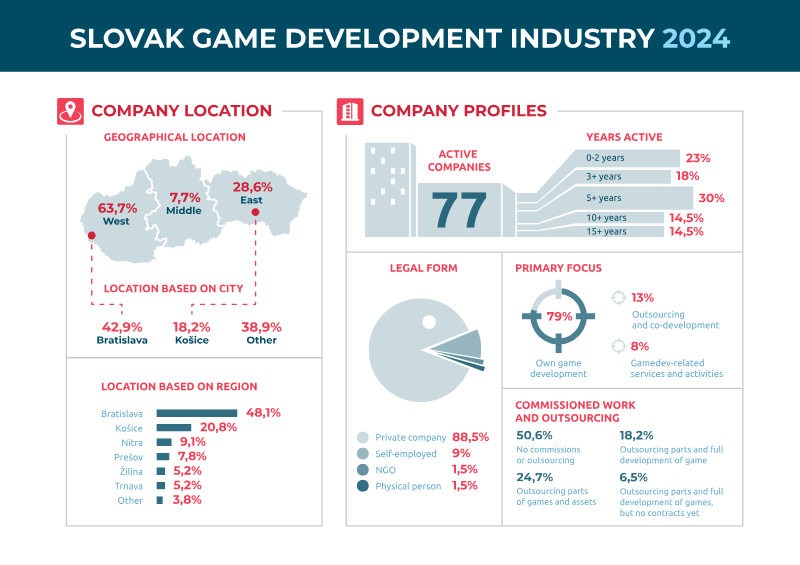
Slovak Game Industry Infographic 2024
The 2024 Slovak Game Industry report provides a comprehensive overview of the nation’s game development sector, detailing its economic performance, workforce composition, and operational landscape as of December 31, 2024. The industry is characterized by a mix of established firms and newer entrants, with a primary focus on own-game development, which accounts for nearly 43% of activities, followed by outsourcing and co-development services. Geographically, the industry is concentrated in Bratislava and Košice, reflecting the urban centralization of technical talent and infrastructure.
Financially, the sector generated a total turnover of approximately 67.8 million euros in 2024, with a high degree of market concentration; the top 10% of companies account for over 83% of this revenue. The workforce consists of 982 employees with a median age of 30 to 35. While the industry remains male-dominated, women represent nearly 20% of the workforce, primarily in visual arts and marketing roles. Foreign talent is a significant component of the ecosystem, comprising 11.6% of the total headcount, with employees largely sourced from Poland, Ukraine, and Czechia. Remote work is highly prevalent, with 91% of companies offering some form of home office or fully remote arrangements.
Development trends show a strong preference for PC platforms, which serve as the primary target for both released and in-development titles. Self-funding remains the dominant financial model for projects, utilized by 80.5% of companies, while public funding and international publishers play secondary roles. Despite the industry's growth, stakeholders identify a need for improved state support, specifically requesting tax incentives, increased R&D funding, and more effective mechanisms for hiring foreign professionals. The report highlights a sector that is technically mature but actively seeking structural improvements to enhance its international competitiveness and sustainability.
- The Slovak game industry generated 67.8 million euros in total turnover in 2024, with high market concentration where the top 10% of companies account for over 83% of total revenue.
- The sector employs 982 professionals with a median age of 30–35, and while male-dominated, women comprise nearly 20% of the workforce, primarily in visual arts and marketing.
- Self-funding is the primary financial model for 80.5% of companies, indicating a reliance on internal capital over public funding or international publishing deals.
- Development activity is heavily focused on PC platforms and concentrated geographically in Bratislava and Košice, with 43% of industry output dedicated to own-game development.
- Remote work is standard practice in the sector, with 91% of companies offering either hybrid or fully remote work arrangements.
Netherlands Games Monitor 2024
AUTHORS SPECIAL THANKS TO Manuel Kerssemakers (Abbey Christel van Grinsven APPLIED Games) Arjan Terpstra Bowie Derwort (Game Tailors) Laurens Rutten (CoolGames Matthijs Dierckx Michaël Bas (&ranj) & Dutch Games Association) Roger ter Heide (Improvive) Tuur Hendrikx (Sonic Picnic) RESEARCH CHAPTER 1 ...
- The Dutch games industry employed 4,291 people by the end of 2023, a decline of 269 persons compared to 2021, with employment decreasing by 3% per year between 2021 and 2023, though revenue increased by an average annual rate of 10.5% to €763 million.
- The percentage of female workers in the Dutch games industry is rising, reaching 23.2% currently, aligning with broader European and North American industry averages.
- Applied games studios are adopting generative AI faster than entertainment studios, using or testing it for localization, dialogue, training content, and audio, with clients open to custom AI-enabled solutions, while entertainment studios are more hesitant due to potential player backlash.
- The Greater Amsterdam urban region remains the primary hub for the Dutch games industry, offering nearly 1,800 jobs by the end of 2023, and notably continued to grow employment between 2021 and 2023 despite an overall industry decline.
- There are 41 game education programs in the Netherlands, similar to 2022, primarily focusing on programming or game art, with a majority of courses having around 40% of students stating they will never use AI for finished assets.

Sensor Tower Global Mobile Gaming Industry Outlook 2024
Global mobile gaming experienced a minor 2% year-on-year decline in in-app purchase revenue in 2023, totaling $76.7 billion. Despite this slight contraction, the market remains 22% larger than pre-pandemic levels in 2019. Projections indicate a recovery to $78 billion in 2024, with a long-term growth trajectory expected to surpass $100 billion by 2028 at an average annual growth rate of 6.8%. These findings are based on Sensor Tower App Performance Insights, covering the App Store and Google Play across major global markets including the United States, China, Japan, and South Korea.
The industry is currently defined by a shift in consumer spending from mid-core and hardcore titles toward casual and hybrid-casual models. Casual game revenue grew 8% to $28.6 billion in 2023, now accounting for 38% of the global market. Hybrid-casual games showed the most aggressive growth, increasing 30% to exceed $2.1 billion. In contrast, traditional high-revenue genres like RPGs and Strategy games both saw 10% revenue declines as the pandemic-era stay-at-home boost faded. Despite these drops, RPGs and Strategy remain the largest individual segments, generating $20 billion and $14.8 billion respectively.
Geographically, the United States remains the largest market at $22.2 billion, followed by the Chinese iOS market at $15.1 billion. While the Japanese and South Korean markets saw declines of 13% and 7% respectively, specific titles defied broader trends. MONOPOLY GO! and Royal Match emerged as major drivers in the casual sector, with the former generating $1.2 billion and the latter surpassing Candy Crush Saga in monthly revenue. In the mid-core space, new entrants like Honkai: Star Rail and Whiteout Survival achieved significant growth, particularly in APAC markets, by utilizing innovative themes and integrated gameplay mechanics.
- Global mobile gaming revenue reached $76.7 billion in 2023, a 2% year-on-year decline, but is projected to recover to $78 billion in 2024 and exceed $100 billion by 2028.
- Consumer spending is shifting toward casual and hybrid-casual models, with casual revenue growing 8% to $28.6 billion and hybrid-casual revenue surging 30% to over $2.1 billion.
- Traditional high-revenue segments, specifically RPGs and Strategy games, experienced a 10% decline in 2023, though they remain the largest categories at $20 billion and $14.8 billion respectively.
- The United States remains the top global market with $22.2 billion in revenue, followed by the Chinese iOS market at $15.1 billion.
- Casual titles like MONOPOLY GO!, which generated $1.2 billion, and Royal Match, which surpassed Candy Crush Saga in monthly revenue, are currently driving market growth.
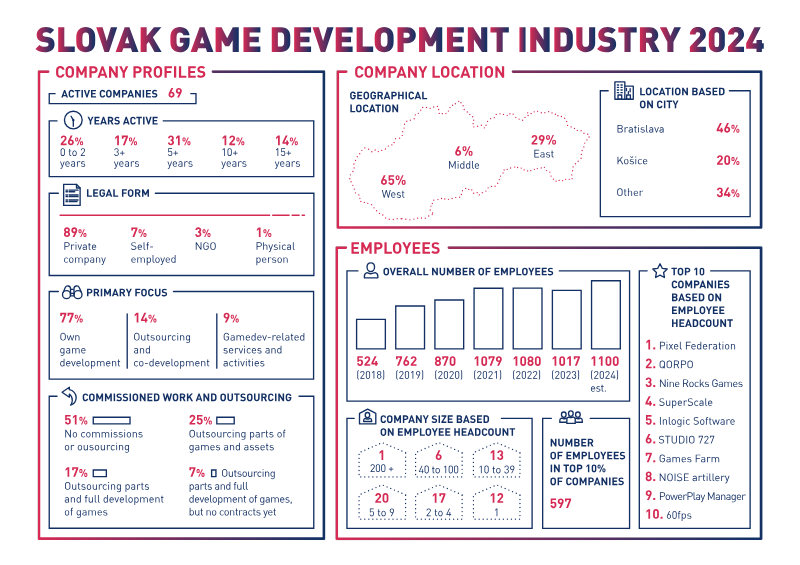
Company Profiles: Slovakia 2024
The Slovak game development industry in 2024 is characterized by a stable ecosystem of 69 active companies, primarily concentrated in the western region of the country, particularly Bratislava. The sector is dominated by private companies, with 77% focusing on original game development rather than outsourcing. While the industry experienced a slight contraction in headcount during 2023, it is projected to rebound to approximately 1,100 employees by the end of 2024. The workforce is relatively young, with a median age of 31, and women represent 21% of the total labor force, primarily occupying roles in graphic arts and marketing.
Financial data indicates a mature but concentrated market. The overall industry turnover for 2023 reached over 70 million EUR, a figure expected to remain stable through 2024. However, wealth is highly centralized, with the top 10% of companies—led by major players like Pixel Federation and Nine Rocks Games—accounting for 83.5% of total revenue. Funding remains largely internal, as 65.2% of projects are self-funded, though public funding supports roughly one-third of the industry.
Technologically, PC remains the primary development platform, utilized by 72.5% of developers, followed by mobile and console platforms. Despite the industry's creative success, developers face significant hurdles in recruitment, particularly for programming and game design roles. To foster future growth, industry stakeholders express a strong desire for increased state support, specifically in the form of R&D funding, tax incentives, and improved educational infrastructure to streamline the employment of both domestic and foreign talent.
- The Slovak game industry is highly concentrated, with the top 10% of companies—including Pixel Federation and Nine Rocks Games—generating 83.5% of the sector's 70 million EUR annual turnover.
- The industry consists of 69 active companies, 77% of which focus on original game development rather than outsourcing services.
- After a slight contraction in 2023, the workforce is projected to reach approximately 1,100 employees by the end of 2024, with a median age of 31 and 21% female representation.
- Financial independence is the industry standard, as 65.2% of projects are self-funded, while public funding supports approximately one-third of the market.
- PC remains the dominant development platform, utilized by 72.5% of Slovak studios, followed by mobile and console platforms.
Global Games Market Report
The global games market is entering a period of stabilization and renewed growth, with 2023 revenues projected to reach $184.0 billion. This recovery follows a post-pandemic correction and is supported by a massive player base of 3.31 billion people worldwide. While the industry faces macroeconomic pressures and shifting privacy regulations, long-term forecasts remain positive, with total revenues expected to climb to $205.4 billion by 2026. This trajectory is fueled by the maturation of the current console generation, the expansion of the middle class in emerging markets, and the increasing influence of transmedia strategies that drive engagement across multiple entertainment formats.
Market dynamics are shifting significantly across different platforms and regions. Mobile gaming remains the largest revenue segment at $89.7 billion, yet it is currently experiencing a 1.4% decline as privacy policies complicate user acquisition and monetization, particularly within the RPG genre. In contrast, the PC and console segments are the primary growth engines for 2023, benefiting from a steady supply of hardware and a robust slate of high-profile releases. Geographically, the Asia-Pacific region maintains its dominance, accounting for 46% of global revenue, even as regulatory hurdles in China slow its immediate growth. Meanwhile, significant capital infusions, such as Saudi Arabia’s $38 billion investment through Savvy Games Group, are reshaping the competitive landscape.
Technological and structural transformations are further defining the industry's future. Generative AI is emerging as a pivotal tool for managing the rising costs of AAA development, though its adoption is tempered by concerns over copyright and workforce impact. Revenue models have transitioned almost entirely to digital formats, with physical sales becoming negligible in the PC market and live-service models dominating console engagement. As the industry evolves, the rise of cloud gaming and handheld "complementary devices" like the Steam Deck are expanding how and where players interact with content, ensuring the market remains resilient despite shifting regulatory and economic conditions.
- The global games market is projected to reach $184.0 billion in 2023, with a forecast to grow to $205.4 billion by 2026 supported by a 3.31 billion-person player base.
- Mobile gaming remains the largest revenue segment at $89.7 billion, though it is currently experiencing a 1.4% decline due to privacy-related challenges in user acquisition and monetization.
- PC and console gaming are the primary industry growth engines for 2023, driven by improved hardware supply and a strong pipeline of high-profile software releases.
- The Asia-Pacific region continues to dominate the global market with 46% of total revenue, despite regulatory headwinds currently impacting growth in China.
- Large-scale capital investments, such as the $38 billion commitment from Saudi Arabia’s Savvy Games Group, are actively reshaping the competitive landscape.

GungHo Online Entertainment Business Report Vol. 42
GungHo Online Entertainment’s business report outlines a strategic transition from a Japan-centric mobile focus toward a diversified global entertainment model. The primary thesis centers on leveraging established intellectual properties, specifically Puzzle & Dragons and the Ragnarok series, to anchor international expansion while developing new console and PC titles for a worldwide audience.
Financial data indicates a significant shift in revenue composition, with the overseas sales ratio rising steadily to reach 64.1% by late 2024. While consolidated net sales saw a decline from 125.3 billion yen in 2023 to 103.6 billion yen in 2024, the group maintained a strong capital-to-asset ratio of 75.9%. Performance in the first half of 2025 shows net sales of 50.5 billion yen and an operating profit of 5.0 billion yen. To enhance shareholder value, the company revised its return policy in February 2025, committing to a consolidated dividend payout ratio of 30% or more and executing substantial share cancellations.
The report highlights the longevity of core titles, noting that Puzzle & Dragons celebrated its 13th anniversary with over 63 million downloads in Japan. To sustain this momentum, the group released Puzzle & Dragons 0 in May 2025 across 150 countries in 11 languages. Simultaneously, the Ragnarok IP, managed by subsidiary Gravity Co., Ltd., has grown from 5 billion yen in annual sales in 2008 to approximately 50 billion yen, driven by mobile expansions in Asia and new initiatives in Latin America.
Future growth is targeted through multi-platform development and the revitalization of existing series. Key projects include the redevelopment of the survival action title Deathverse: Let It Die and the release of the Lunar Remastered Collection. By focusing on original IPs for consoles and PC—areas where the group can demonstrate technical expertise—GungHo aims to establish brand recognition in Western markets where it was previously less known.
- GungHo has successfully pivoted to a global business model, with overseas sales now accounting for 64.1% of total revenue as of late 2024.
- Consolidated net sales declined from 125.3 billion yen in 2023 to 103.6 billion yen in 2024, though the company maintains a strong capital-to-asset ratio of 75.9%.
- The Ragnarok IP, managed by subsidiary Gravity Co., Ltd., has scaled significantly, growing from 5 billion yen in annual sales in 2008 to approximately 50 billion yen today.
- To sustain the 13-year-old Puzzle & Dragons franchise, the company launched Puzzle & Dragons 0 in May 2025 across 150 countries in 11 languages.
- The company is shifting focus toward console and PC development to build Western brand recognition, with key projects including the Lunar Remastered Collection and the redevelopment of Deathverse: Let It Die.
State of Free to Play on Steam in 2024
The analysis evaluates the free‑to‑play (FtP) segment on Steam, highlighting its dominant share of player engagement and the increasing difficulty for new titles to break through. In 2023, FtP games accounted for 51 % of total hours played on the platform, despite premium titles comprising the majority of releases. Engagement is highly concentrated: the top 25 FtP titles generate 88 % of all FtP activity, the top 10 capture roughly 70 %, and the top five hold nearly 60 % of concurrent users (CCU). Counter‑Strike 2 and Dota 2 continue to lead the charts, with eight of the ten highest‑CCU games in 2023 being FtP, while only one premium title (Rust) appears in the list.
The market shows signs of compression as high‑quality premium and paid‑live‑service games erode FtP share. Between 2021 and 2024, premium titles priced $10‑$50 grew from 31 % to 37 % of total playtime, and flagship releases such as Elden Ring and Hogwarts have boosted the over‑$50 segment. Nonetheless, FtP titles remain older on average; the top ten FtP games have a mean age of seven years, and only two new entries (Call of Duty Warzone and Naraka: Bladepoint) have entered the top‑ten
- Free-to-play (FtP) games dominate Steam engagement, accounting for 51% of total hours played in 2023 despite being outnumbered by premium releases.
- Market engagement is highly concentrated, with the top 25 FtP titles capturing 88% of all FtP activity and the top five titles holding nearly 60% of concurrent users.
- The FtP sector is stagnant for new entrants, as the top ten FtP games have a mean age of seven years and only two new titles have broken into that tier since 2021.
- FtP titles maintain a massive presence in the top-tier charts, occupying eight of the ten highest concurrent-user spots in 2023, with Counter-Strike 2 and Dota 2 leading the segment.
- Premium titles are successfully eroding FtP market share, with games priced between $10 and $50 increasing their share of total playtime from 31% to 37% between 2021 and 2024.