Key insights
7 slides
The expansion
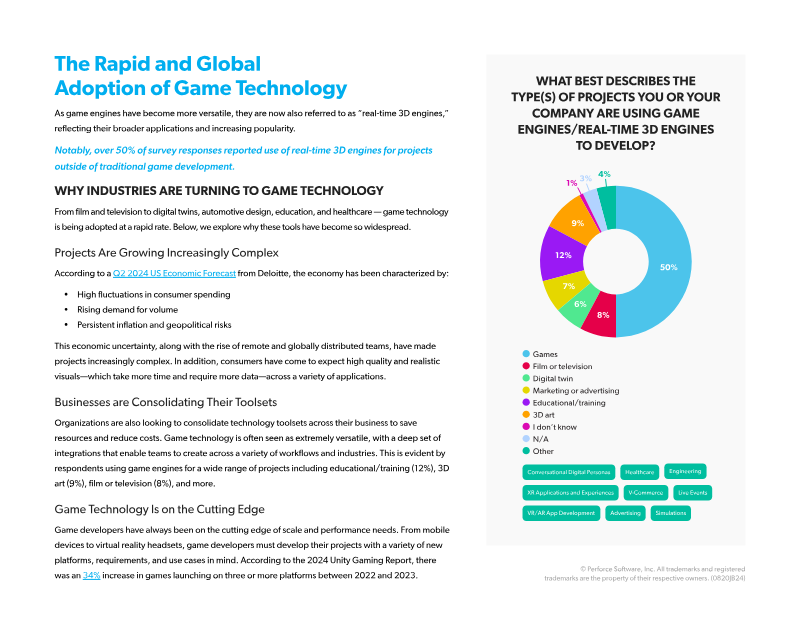
Real-time 3D engines are now integral to more than half of organizations.
Over 50% of organizations in media, automotive, education, and healthcare integrate real-time 3D engines into their workflows. The primary drivers are the demand for high-quality visual tools and the need to streamline workflows.
The bottleneck
Collaboration remains a significant bottleneck for 31% of studios.
31% of studios struggle with slow large-file transfers, and 38% report ongoing issues with remote team coordination. Funding constraints and limited staffing also emerge as top challenges.
Page 10 of the reportMoving large files is slow or difficult38
Reusing assets across teams/projects is difficult29
Providing feedback on assets is difficult26
Time zone issues/remote work29
Other17
Key number
Unreal Engine leads usage at 63%, followed by Unity at 47%.
Unreal Engine dominates usage at 63%, while Unity follows at 47%. Perforce Helix Core leads version-control adoption at 51% across industries, with GitHub and GitLab trailing.
Page 15 of the reportUnreal Engine63
Unity47
Godot9
CRYENGINE1
Amazon Lumberyard2
Frostbite2
Source2
Stride1
AI adoption
Over 65% of respondents use an AI tool, led by ChatGPT at 47%.
Generative AI is widely adopted, with over 65% of respondents using an AI tool. ChatGPT is the most common at 47%, and indie studios adopt AI more aggressively than AAA studios.
Page 23 of the reportChatGPT50
DALL-E12
Adobe Generative Fill6
GitHub Copilot20
JetBrains AI7
Midjourney19
I don't know6
N/A33
Cloud standard
49% of organizations utilize cloud servers, primarily through AWS and Azure.
Cloud infrastructure is the industry standard for development, with 49% of organizations utilizing cloud servers. AWS leads at 30%, followed by Azure at 18%, while hybrid or on-premises setups are rare.
Page 24 of the reportAWS (Amazon Web Services)30
Microsoft Azure18
GCP (Google Cloud Platform)9
Digital Ocean3
Tencent Cloud2
Vultr1
Hybrid model: cloud and on-premises6
I don't know13
Asset management
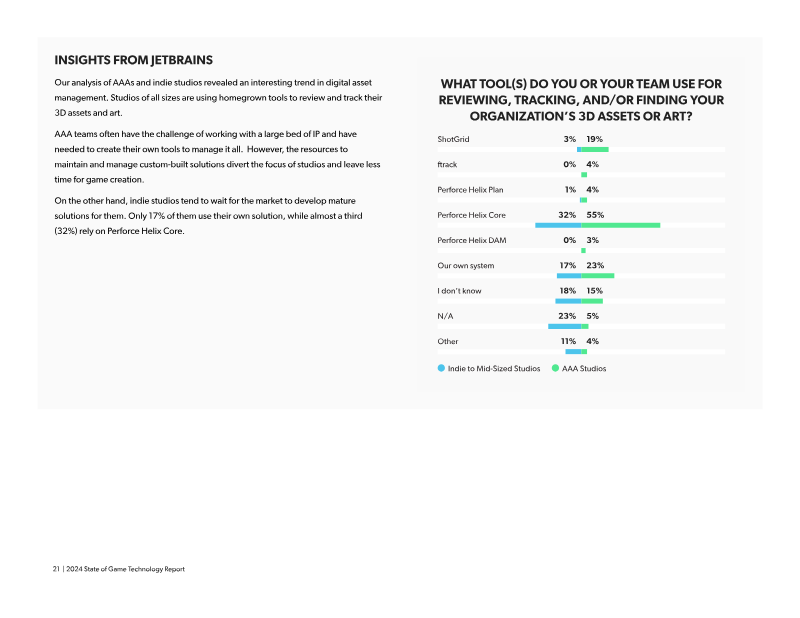
AAA studios build custom tools (19%), while indies rely on market solutions.
Asset management practices vary by studio size: AAA studios largely build custom tools (≈19%) to handle extensive IP libraries. Indie and mid-size studios rely more on market solutions, with 32% using Perforce Helix Core.
Hiring priorities
91–100% of firms require specialized experience in hiring strategies.
General cross-functional skills are valued but to a lesser extent (54–82%).
Expertise focus. 91–100% of firms require specialized experience and 75–94% demand strong portfolios.
Page 29 of the report91–100%
of firms require specialized experience
- demand strong portfolios
- 75–94%
1 / 7
Ask AI about this report