Market Analysis
Documents
The Importance of Wishlists in 2025: Do Wishlists Matter?
Steam wishlists serve as a critical metric for predicting commercial success in the video game industry, functioning as a primary indicator of pre-launch momentum. Data analysis reveals that wishlist distribution is highly top-heavy, with a significant majority of games launching with fewer than 10,000 wishlists, while only a small fraction of titles achieve the 100,000-plus threshold required to reliably forecast a breakout performance. There is a strong 70% correlation between pre-launch wishlist counts and first-month unit sales, particularly for titles that surpass the 100,000-wishlist milestone.
Genre-specific trends highlight that action and adventure titles consistently generate the highest levels of pre-release buzz, often benefiting from the brand equity and marketing budgets of AAA and AA publishers. Conversely, casual and MMO titles frequently rely on post-launch engagement, such as live updates and community building, rather than pre-release wishlist accumulation. Regardless of genre, the timing of a Steam page launch is vital; top-performing games typically establish their presence six to twelve months before release, utilizing a steady stream of trailers and development updates to build and maintain audience interest.
The findings are based on an analysis of games launched on Steam from March 2024 onwards, utilizing proprietary estimation models and industry data. The research emphasizes that while wishlists are not a guarantee of success for every title, they act as a essential barometer for market interest. For developers and publishers, the data underscores that early visibility and sustained marketing efforts are necessary to reach the wishlist tiers that statistically correlate with long-term commercial viability.
- Steam wishlists are a primary indicator of commercial success, showing a 70% correlation between pre-launch counts and first-month unit sales.
- The 100,000-wishlist threshold is the critical benchmark required to reliably forecast a breakout performance for a new title.
- The vast majority of games launch with fewer than 10,000 wishlists, reflecting a highly top-heavy distribution of pre-launch momentum.
- Top-performing titles typically establish their Steam page six to twelve months before release to maintain audience interest through consistent updates.
- Action and adventure games generate the highest pre-release buzz, while casual and MMO titles rely more heavily on post-launch engagement than wishlist accumulation.
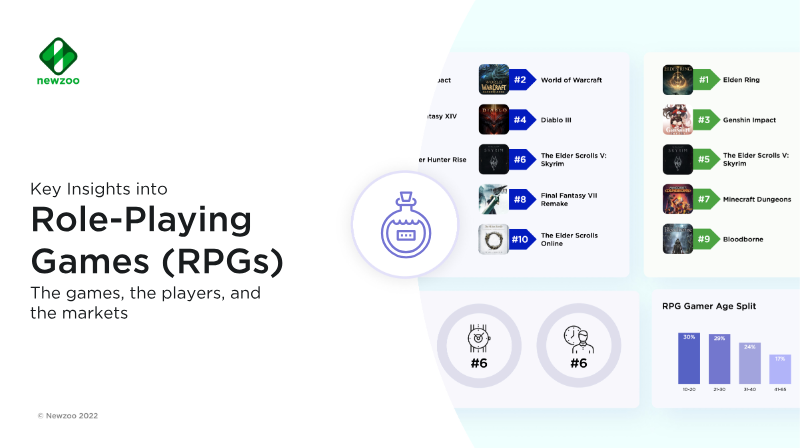
Key Insights into Role-Playing Games (RPGs)
Role-Playing Games (RPGs) represent the highest-revenue genre in the global gaming market as of 2022. The genre is characterized by deep character development, party-based mechanics, and progression systems centered on quests and combat. While RPGs are played across all platforms, they maintain a strong presence on PC and console, where they consistently rank among the top genres for monthly active users.
The demographic profile of the RPG audience is predominantly male, accounting for 58% of players, and skews toward younger age groups, with 59% of the player base falling between the ages of 10 and 30. Engagement patterns reveal that RPG players are highly active, averaging 18.8 sessions per month. The genre also demonstrates significant cross-genre appeal, with high player overlap in the adventure, shooter, and battle royale categories. High magical fantasy remains the most popular thematic element, utilized by 63% of the player base, while skill and talent trees serve as the most prevalent gameplay mechanic.
Monetization within the RPG space is dominated by pay-to-play models, which reach 97% of the player base, followed closely by in-app purchases at 90%. Geographically, the United States and Japan lead in monthly active users on PC and console. The genre also maintains a robust live-streaming presence, generating 205 million hours watched across platforms like Twitch and Facebook Gaming in June 2022. These insights are derived from data covering 37 markets, excluding China and India, and utilize proprietary gamer segmentation to analyze player motivations, viewing habits, and engagement metrics across the broader gaming ecosystem.
- As of 2022, Role-Playing Games (RPGs) rank as the highest-revenue genre in the global gaming market.
- The player base is predominantly male (58%) and young, with 59% of users falling between the ages of 10 and 30.
- Monetization is heavily driven by pay-to-play models used by 97% of the player base, supplemented by in-app purchases at 90%.
- High magical fantasy is the dominant theme, appearing in 63% of RPGs, while skill and talent trees remain the most prevalent gameplay mechanics.
- RPG players exhibit high engagement, averaging 18.8 sessions per month, with significant audience overlap in the adventure, shooter, and battle royale genres.

Annual Report of the German Games Industry 2025
Germany’s video‑game sector generated €5.84 billion in 2024, ranking fifth globally but declining 6 % year‑on‑year. The contraction was most pronounced in game purchases, which fell 17 %, while online gaming and subscription services surged 43 % to €3.26 billion, underscoring a decisive shift toward digital and cloud‑based play. In‑game and in‑app purchases accounted for €4.6 billion, a modest 3 % drop, yet mobile gaming alone grew 63 % since 2019 to €3 billion. Console and PC revenues were €1.9 billion and €1.5 billion, respectively, while hardware sales fell 10 %, with consoles down 26 %. The workforce expanded to 37.5 million players, nearly half women and with an average age of 39.5 years, indicating broader demographic penetration.
Policy analysis reveals that restrictive federal and state funding schemes have limited access for start‑ups, contributing to an 87 % negative perception of Germany’s international competitiveness. The 2025 coalition agreement introduces tax breaks and a €2 750/month “Press Start” grant for new studios, signalling a shift toward a hybrid funding model. A projected €125 million annual increase from 2026, with each tax‑credit euro expected to generate €4.80 in economic spill‑overs, is coupled with calls for university programmes, incubators, and a dedicated “Games University” to supply skilled talent. Without these reforms, Germany risks falling behind global leaders.
The industry’s ecosystem has expanded through high‑profile events such as devcom and gamescom, which attracted record attendance and showcased international diversity. Initiatives like the Press Start: Games Founding Grant, esports talent pipelines, and the Equal Esports Cup demonstrate a coordinated effort to build inclusive professional pathways. The German Games Association, through gamescom and sustainability initiatives such as “Playing for the Planet,” positions Germany as a climate‑friendly, diverse hub. Market data confirm that 60 % of Germans play video games, with mobile gaming dominating at 37.9 %, while over 90 % of households have internet access, underscoring a mature, multi‑platform market poised for continued growth across consoles, PC and mobile channels.
- Germany’s video game sector generated €5.84 billion in 2024, representing a 6% year-on-year decline despite the country maintaining its position as the world's fifth-largest market.
- Consumer spending has decisively shifted toward digital models, with online gaming and subscription services surging 43% to €3.26 billion, while traditional game purchases dropped by 17%.
- Mobile gaming has become a primary market driver, growing 63% since 2019 to reach €3 billion in revenue, while hardware sales contracted by 10% overall, led by a 26% decline in console sales.
- To combat an 87% negative perception of international competitiveness, the 2025 coalition agreement introduces a hybrid funding model featuring tax breaks and a €2,750/month 'Press Start' grant for new studios.
- The government projects a €125 million annual funding increase starting in 2026, with each euro of tax credit expected to generate €4.80 in economic spill-overs.

SensorTower Report: Southeast Asia Mobile Game Market Insights 2025
SensorTower’s Southeast Asia Mobile Game Market Insights 2025 positions the region as a pivotal growth engine for mobile gaming, with 1.93 billion new installs and $625 million in IAP revenue reported for Q1 2025. The analysis draws on App Store and Google Play data, classifying titles by genre and tracking revenue while excluding ad income. Casual genres such as Arcade and Simulation dominate download volumes, whereas Strategy, Shooters, and social‑driven RPGs generate the bulk of monetization. Mobile Legends: Bang Bang and Garena Free Fire remain revenue leaders, while newer IPs like Ragnarok M: Classic and Magic Chess: Go Go rapidly climb both download and revenue charts, illustrating the market’s receptiveness to fresh, socially rich experiences.
Vietnam exemplifies deep localization success: Roblox leads downloads while Garena Free Fire dominates revenue, and local titles such as “Trò Vẽ Vui Tuổi Thơ” fuel organic growth. In the Philippines, hyper‑casual “Block Blast!” captures the largest download share, yet Mobile Legends: Bang Bang sustains top revenue. Across both markets, robust community engagement and localized content underpin strong monetization even as casual download volumes fluctuate.
From 2017 through Q1 2025, Southeast Asian titles have consistently topped global download and revenue charts. Vietnamese and Singaporean publishers now rank among the world’s top download leaders, with titles like Free Fire and Car Race expanding genre breadth. The region’s high mobile penetration, community‑driven marketing, and IP collaborations enable SEA publishers to scale player engagement and revenue on a global stage. Overall, the report underscores Southeast Asia’s emergence as both a production hub and a lucrative monetization frontier for mobile games worldwide.
- Southeast Asia generated 1.93 billion new mobile game installs and $625 million in in-app purchase revenue during Q1 2025.
- Casual genres like Arcade and Simulation drive the highest download volumes, while Strategy, Shooters, and social-driven RPGs account for the majority of monetization.
- Mobile Legends: Bang Bang and Garena Free Fire remain the region's top revenue-generating titles, though newer IPs like Ragnarok M: Classic and Magic Chess: Go Go are rapidly gaining market share.
- Vietnam and Singapore have emerged as global publishing hubs, with local developers consistently ranking among the world's top leaders for both downloads and revenue.
- Market success in the region is heavily dependent on deep localization and community-driven engagement, as evidenced by the dominance of specific titles like Roblox in Vietnam and Block Blast! in the Philippines.

Hybrid Casual Games Playbook
Hybridcasual games blend the instant‑on‑tap simplicity of hyper‑casual titles with deeper progression systems that encourage sustained engagement. The playbook outlines the genre’s rise, noting a 3 % download growth in 2022 to 5 billion downloads—up from 4.9 billion in 2021—while hyper‑casual downloads fell 15 %. Revenue has nearly doubled over two years, with ads contributing about 50 % of total earnings and in‑app purchases accounting for the remainder. Session lengths average 372 seconds, a 160‑second increase over hyper‑casual games, and retention rates at day 30 reach 54 % versus 42 % for hyper‑casual titles, with day 60 retention at 9 % versus 1 %.
The document surveys sub‑genres such as Arcade Idle, Tower Defense, and Interactive Story, citing successful titles like Aquarium Land, City Defense!, and Fight for America. It highlights how hybrid mechanics—drawing towers, RPG‑style upgrades, or automated idle workers—boost lifetime value by 17–35 % in some cases. Methodology relies on aggregate download and revenue data from 2020‑2022, coupled with in‑house analytics tracking session length, retention, and monetization funnels.
Best‑practice guidance centers on marketability, economy tuning, A/B testing, and post‑launch optimization. Case studies of Zombie Defense illustrate how adding narrative layers, social features, and tiered in‑app purchase options can lift LTV to $2+ on day 7. The playbook concludes that sustained success in Hybridcasual hinges on balancing accessibility with meta‑depth, maximizing IAP revenue, and continuously refining content based on player segmentation.
- Hybrid-casual games are outperforming hyper-casual titles, with 5 billion downloads in 2022 (a 3% increase) compared to a 15% decline in hyper-casual downloads.
- Hybrid-casual games achieve significantly higher retention, with day-30 retention at 54% (vs. 42% for hyper-casual) and day-60 retention at 9% (vs. 1%).
- Revenue is split evenly between ads and in-app purchases, with session lengths averaging 372 seconds, which is 160 seconds longer than hyper-casual benchmarks.
- Integrating hybrid mechanics like RPG-style upgrades and automated idle systems can increase player lifetime value by 17–35%.
- Successful titles such as Zombie Defense demonstrate that adding narrative layers and tiered in-app purchase options can drive day-7 lifetime value to over $2.

Global Gaming Report Q2 2025
Public gaming equities surged in the first half of 2025, with the Drake Star Gaming Index climbing 28 % compared to a modest 5 % gain in the S&P 500. Leading performers included Square Enix, Roblox and Konami, underscoring a robust rebound in the sector. M&A activity remained steady at 46 deals, highlighted by Krafton’s $516 million purchase of ADK and Epic Games’ acquisition of AI studio Loci. Private‑market financing reached $3 billion across 110 placements, driven by high‑profile exits such as Dream Games’ $2.5 billion minority stake sale to CVC and Apple’s acquisition of RAC7 for its arcade portfolio. Projections indicate a continued rise in M&A and IPO activity through 2026, with artificial intelligence and technology platforms identified as primary growth catalysts.
Private‑placement capital in Q2 2025 totaled $2.6 billion across 24 deals, with the largest transaction—a $5 billion minority stake sale—valuing its target at nearly $5 billion. Deal distribution spanned mobile ($1.5 billion), PC/console ($0.8 billion), platform/tools ($0.4 billion), esports ($0.3 billion) and blockchain/VR‑AR ($0.2 billion). Key investors included CVC, Blackstone, Tencent and Bessemer Venture Partners. Notable exits such as Dream Games’ $2.5 billion minority sale and Arrowhead’s $80 million investment provided significant liquidity for early‑stage venture capitalists.
Valuation analysis reveals a pronounced divergence between high‑growth Asian titles and mature Western peers. Tencent (EV/EBITDA ≈ 5.7x, revenue growth 10%) and Sea Limited (EV/EBITDA ≈ 4.1x, revenue growth 30%) command premium multiples and robust double‑digit growth, reflecting investor appetite for fast‑growing Asian firms. In contrast, U.S. hardware and platform players such as NVIDIA (EV/EBITDA ≈ 17.9x, revenue growth 43%) and Unity (EV/EBITDA ≈ 6.2x, revenue growth –17%) exhibit lower multiples and mixed performance, indicating more modest valuations amid fluctuating earnings. This geographic and segmental disparity underscores the continued premium placed on rapid growth in emerging markets while mature Western companies face a more cautious valuation environment.
- Public gaming equities significantly outperformed the broader market in H1 2025, with the Drake Star Gaming Index rising 28% compared to a 5% gain in the S&P 500.
- Private-market financing reached $3 billion across 110 placements in H1 2025, bolstered by major exits such as Dream Games’ $2.5 billion minority stake sale to CVC.
- M&A activity remains steady with 46 deals recorded in H1 2025, including Krafton’s $516 million purchase of ADK and Epic Games’ acquisition of AI studio Loci.
- Investor sentiment shows a clear geographic divide, with high-growth Asian firms like Sea Limited (30% revenue growth) commanding premium multiples compared to the mixed performance of mature Western platform players like Unity.
- Q2 2025 private-placement capital totaled $2.6 billion, with mobile gaming leading the sector at $1.5 billion, followed by PC/console at $0.8 billion.

The Industry Quest for Growth
Global games spending reached a record $199.4 bn in 2024, rising 3.5 % year‑over‑year and projected to stabilize near $200 bn in 2025 with modest growth thereafter. The sector remains smaller than the broader video‑related entertainment market but is nine times larger than recorded music, underscoring its expanding economic footprint. Key growth levers include a $7‑8 bn upside from Nintendo’s Switch 2, which is expected to sell 103 million units by 2030, and an additional $1‑2 bn from enhanced in‑game monetisation. Emerging markets—particularly the Middle East, Africa, and Southeast Asia—offer significant upside driven by youthful, mobile‑savvy populations.
The launch delay of GTA VI is anticipated to shave $2.7 bn from 2025 console spend, creating a sales window for other publishers and Nintendo to capture holiday‑season revenue. Untapped consumer cohorts, such as 16‑24 year‑old females and players aged 55+, represent further opportunities for market expansion.
Publishers are responding to slower growth by shifting toward higher‑margin, low‑cost strategies. Remasters and remakes—examples include Resident Evil 4 and the Final Fantasy VII remake—are becoming primary revenue engines. Simultaneously, platform diversification across PC, console, and direct‑to‑consumer web stores, coupled with hybrid monetisation models that blend advertising, in‑app purchases, and subscriptions, are being tested to optimise returns. Expanding intellectual property into music, merchandising, and cloud‑gaming subscriptions further unlocks value from dormant franchises.
- Global games spending reached a record $199.4 billion in 2024, a 3.5% year-over-year increase, with projections stabilizing near $200 billion in 2025.
- The upcoming Nintendo Switch 2 is projected to generate $7–8 billion in upside and reach 103 million units sold by 2030.
- The delay of GTA VI is expected to reduce 2025 console spending by $2.7 billion, creating a strategic window for other publishers to capture holiday market share.
- Publishers are mitigating slower growth by prioritizing high-margin, low-cost strategies such as remasters and remakes, alongside diversifying platforms and hybrid monetization models.
- Emerging markets in the Middle East, Africa, and Southeast Asia, combined with untapped demographic cohorts like 16–24-year-old females and players aged 55+, represent the primary opportunities for future expansion.

PC & Console Gaming Report 2025
Global PC and console revenues are expected to grow modestly through 2027, with consoles driving the majority of expansion at an estimated +13 % CAGR while PC revenue rises only in single digits. 2024 saw a plateau for PCs, dominated by free‑to‑play and in‑game monetisation, whereas console sales are set to rebound from 2025 thanks to strong releases such as GTA VI and the launch of Nintendo Switch 2. Player growth remains incremental, with PC players increasing at +2.3 % annually and console players at +3.5 %, driven largely by established franchises rather than breakthrough innovation.
Playtime data confirm that 2024 experienced a 6 % YoY increase, with Pay‑to‑Play titles (e.g., Call of Duty) and free‑to‑play hits (Fortnite, Roblox) accounting for most of the lift. New releases captured only about 9 % of total playtime, underscoring that long‑running series dominate the market. Console audiences remain heavily slate‑dependent: 67 % of new‑release hours come from annual franchises, while PC players show a higher share of non‑annual titles. In the US and Western Europe, non‑annual franchise games contribute a smaller slice of console revenue (≈8–22 %) compared to annual franchises, which drive the bulk of earnings.
Engagement patterns reveal a sharp decline in title diversity on PC and Xbox, with the average number of titles played per player falling 27 % on Steam in the US and up to 34 % in Russia and Brazil. PlayStation, by contrast, shows modest growth in title engagement. Genre preferences are shifting away from Battle Royale toward Adventure and Role‑Playing, reflecting a broader industry trend toward narrative‑rich, long‑form gameplay. Nostalgia and free‑to‑play models continue to sustain short‑term spikes, but long‑term retention hinges on continuous content updates and robust live‑service strategies. New IPs must prioritize originality, polished gameplay loops, and community‑first discovery to overcome the legacy brand advantage and achieve lasting commercial success.
- Console revenue is projected to grow at a 13% CAGR through 2027, significantly outpacing single-digit growth for PC, with major catalysts including the release of GTA VI and the Nintendo Switch 2.
- Market dominance is heavily concentrated in established franchises, as new releases captured only 9% of total playtime in 2024, with annual franchises accounting for 67% of new-release hours on consoles.
- Title diversity is shrinking, evidenced by a 27% decline in the average number of titles played per user on Steam in the US, with drops as high as 34% in markets like Russia and Brazil.
- Player growth remains incremental, with annual increases of 3.5% for console and 2.3% for PC, driven primarily by legacy brands rather than breakthrough innovation.
- Genre preferences are shifting away from Battle Royale toward Adventure and Role-Playing titles, signaling a market trend toward narrative-rich, long-form gameplay.

Global Games Market Report 2025
The Global Games Market Report 2025 projects a steady expansion of the worldwide player base to 3.6 billion, with payers rising to 1.6 billion and total revenue reaching $188.8 billion, a 3.4 % increase year‑over‑year. Mobile dominates growth and revenue, contributing $103 billion (55 % of the market) and expanding 4.5 % YoY, while PC and console follow at 3.1 % and 2.5 %. The report notes that average spend per payer is expected to decline slightly through 2028 as the market matures, underscoring the importance of retention, innovative monetization and post‑launch content to sustain growth in an increasingly saturated ecosystem.
Geographically, the Asia‑Pacific region leads with a 4.2 % YoY increase, and North America remains strong for console sales (5.4 %). Key growth drivers include the launch of Nintendo Switch 2, continued success of live‑service titles on PC, and a shift toward direct‑to‑consumer monetization in mobile. Discoverability challenges and content fragmentation are identified as notable hurdles across all platforms.
Single‑player AAA titles released in the February–May window outperform those launched August–November by an average of 34 %, largely due to crowded holiday windows and cannibalization. Early Access titles that transition to full release within 4–9 months generate the highest new‑player lift, while staggered cross‑platform releases capture only about 13 % of the total player base. Player attrition drops sharply in weeks 2–5 and stabilizes after week 12, indicating that longer main‑story content (20–40 hours) and simulation elements help retain players over the long term.
The commercial life of single‑player titles is increasingly driven by post‑launch content, strategic discounting and community engagement rather than initial premium spend. DLC revenue shares evolve over a game’s lifecycle, with genres aligning to specific monetization models and subscriptions gaining influence on long‑term engagement. Post‑launch content is identified as the key determinant of discoverability, retention and profitability across a game’s back catalogue.
Methodologically, the report employs a top‑down, data‑driven model that blends proprietary engagement metrics (Game Performance Monitor, Steam data), public economic indicators and partner insights to forecast platform‑specific player, payer and revenue figures through 2028. The approach excludes taxes, hardware and gambling from revenue calculations and provides detailed platform‑by‑platform forecasts (PC, console, mobile, cloud, VR) alongside analytical tools for market segmentation, genre trends and post‑launch monetization strategies.
- The global games market is projected to reach $188.8 billion in 2025, a 3.4% year-over-year increase, with mobile platforms accounting for 55% of total revenue at $103 billion.
- Mobile gaming remains the primary growth engine with a 4.5% year-over-year expansion, while PC and console segments grow at 3.1% and 2.5% respectively.
- Single-player AAA titles launched between February and May outperform those released in the August–November holiday window by an average of 34% due to reduced market cannibalization.
- Player retention is optimized by 20–40 hour main-story content and simulation elements, with attrition rates stabilizing significantly after the 12-week mark.
- Early Access titles achieve the highest new-player lift when transitioning to a full release within a 4–9 month window.

State of the Game Industry
The survey of more than 3,000 global developers in 2025 reveals a gaming industry grappling with persistent instability while making modest progress on diversity. Layoffs have risen, with one‑tenth of respondents reporting job losses in the past year and 58 % worried about future cuts. Women and non‑binary developers now account for 32 % of the workforce, up from 29 % in 2024, and LGBTQ+ representation reached 24 %, yet white males still dominate at 66 %. Revenue pressures and market shifts continue to drive restructuring, underscoring the sector’s vulnerability.
Generative AI has transitioned from a niche experiment to an integral part of many studios, with 36 % of developers using it personally and 52 % reporting company‑wide adoption. However, enthusiasm has cooled: only nine percent of companies plan to expand AI use, and negative perceptions have climbed to 30 % from 21 %. Ethical concerns, intellectual‑property risks, and fears of job displacement now affect more than half of respondents. Internal AI policies have expanded to 64 % of studios, and optional use has become more common, though a small minority mandate AI tools.
Live‑service development remains polarised. While 42 % of studios already produce live titles, only 13 % intend to launch one next year. AAA developers are more inclined (33 %) due to potential financial upside and sustained player engagement, yet worries about market saturation, creative fatigue, predatory monetization, and burnout persist. Media adaptations interest 36 % of AAA studios, whereas internal pitch activity has fallen. Self‑funding remains the dominant financing method (56 %), though success rates vary across funding models.
Work‑hour patterns signal growing strain: the share of developers working over 50 hours a week has risen from 8 % to 13 %, and half of respondents now view excess hours as problematic. Union support remains robust at 69 %, with 58 % advocating industry unionisation, yet only 22 % have discussed it in the past year. These findings illustrate a sector negotiating between rapid technological change, creative ambition, and labour‑market pressures across diverse geographic regions and studio sizes.
- Job instability is widespread, with 10% of developers experiencing layoffs in the past year and 58% expressing concern over future job security.
- Generative AI adoption is high, with 52% of studios using it company-wide, yet negative sentiment has risen to 30% due to ethical, IP, and displacement concerns.
- Work-life balance is deteriorating, as the proportion of developers working over 50 hours per week increased from 8% to 13%, with half of the workforce viewing these hours as problematic.
- Live-service development is cooling, with only 13% of studios planning to launch a new live title next year despite 42% currently maintaining existing ones.
- Workforce diversity is showing modest gains, with women and non-binary developers rising to 32% of the industry and LGBTQ+ representation reaching 24%.

Match-3 Genre Snapshot Report: May 2021
The document presents a comprehensive analysis of the mobile match‑3 puzzle segment for Q1 2021, focusing on revenue performance, genre characteristics, and player motivations. It identifies the top five match‑3 titles—Candy Crush Saga, Homescapes, Project Makeover, Gardenscapes, and Toon Blast—detailing their market share changes, revenue per download (Rev/DL), and year‑over‑year growth. Candy Crush Saga leads with a 16.74% share and a Rev/DL of $11.27, while Project Makeover shows the strongest growth at 10.57% share and a Rev/DL of $45.51, reflecting its premium monetization strategy.
The analysis breaks down genre features, noting that Royal Match and Project Makeover exemplify modern match‑3 design: fast‑paced gameplay, quick animations, and a progression system tied to home or makeover themes. Monetization models emphasize consumable boosters, lives, and continue options, with special events such as guilds, recurring tournaments, and exclusive levels driving engagement. The document also highlights unique mechanics—bonus “no‑fail” levels, mystery boxes, and avatar customization—that differentiate titles within the subgenre.
Player motivation data from a US sample classify drivers into escapism, mastery, social interaction, and management. Match‑3 games score high on mastery (completing milestones) and escapism, while social competition scores lower. The report’s methodology relies on GameRefinery’s SaaS dashboard, aggregating download and revenue metrics across the US market for Q1 2021. Overall, the document underscores that successful match‑3 titles combine rapid core loops with layered progression and event systems to sustain high monetization rates.
- Candy Crush Saga remains the market leader with a 16.74% share and a revenue per download (Rev/DL) of $11.27 as of Q1 2021.
- Project Makeover demonstrates the most aggressive growth in the sector, capturing a 10.57% market share with a high-premium monetization strategy yielding a $45.51 Rev/DL.
- Modern match-3 success is driven by fast-paced core loops, quick animations, and progression systems integrated with home or makeover themes, as seen in titles like Royal Match and Project Makeover.
- Monetization in the genre relies heavily on consumable boosters, lives, continue options, and recurring engagement events like guilds and tournaments.
- Player motivation data indicates that match-3 users are primarily driven by mastery of milestones and escapism, while social competition remains a lower priority.

Japan Game Market Insights 2025
The analysis demonstrates that Japan’s mobile gaming sector has reached a mature equilibrium, with download volumes stabilising after 2020 while in‑app purchase (IAP) revenue continues to grow, largely driven by high‑spending iOS users. Domestic publishers hold a dominant position in downloads—capturing roughly one‑third of the market—and command more than half of total IAP revenue, underscoring Japan’s robust monetisation models and loyal consumer base. Genre preferences have shifted toward strategy titles such as Pokémon TCG Pocket and SD Gundam G Generation ETERNAL, alongside puzzle games that now lead download charts.
Live‑ops and event‑driven monetisation prove highly effective, as illustrated by Last War: Survival’s H1 2025 performance. Aggressive daily offers and themed events produced a 2.7‑fold increase in downloads and significant revenue spikes during campaigns like Double Joy, confirming that adaptive event strategies resonate with Japanese players. Anime‑style IPs maintain a commanding presence, accounting for 42 % of in‑app purchase revenue from January to July 2025. Legacy franchises—Monster Strike, Fate/Grand Order, Umamusume—continue to perform strongly, while new titles such as Shadowverse: Worlds Beyond and Honkai: Star Rail expand the ecosystem, illustrating the enduring commercial relevance of anime IP.
Digital advertising remains tightly coupled with gaming, with mobile action/strategy titles consuming 63 % of ad spend in H1 2025. LINE dominates the channel landscape, delivering approximately 40 billion impressions and over 80 % of mobile ad exposure. Cross‑IP collaborations and event‑driven campaigns sustain long‑term monetisation, reinforcing gaming’s role as a core growth driver for digital advertising in Japan. Overall, Japanese publishers retain global leadership through strong IP‑driven franchises across PC, console, and mobile platforms, with culturally resonant engagement and targeted advertising underpinning sustained revenue growth. Sensor Tower’s comprehensive analytics platform provides the critical insights that enable stakeholders to navigate this mature yet dynamic market.
- Domestic publishers maintain a dominant market position, capturing roughly one-third of total downloads and over 50% of all in-app purchase (IAP) revenue in Japan.
- Anime-style intellectual property remains the primary revenue driver, accounting for 42% of total IAP revenue between January and July 2025.
- Mobile action and strategy titles accounted for 63% of total digital advertising spend during the first half of 2025.
- The LINE platform is the primary advertising channel in Japan, generating approximately 40 billion impressions and accounting for over 80% of mobile ad exposure.
- Live-ops and event-driven strategies are highly effective, evidenced by 'Last War: Survival' achieving a 2.7-fold increase in downloads during H1 2025 through aggressive daily offers and themed campaigns.