Market (Overall)·Updated Apr 13, 2026 by Video Game Insights
Report · January 1, 2025
Published by Video Game Insights, Sensor Tower
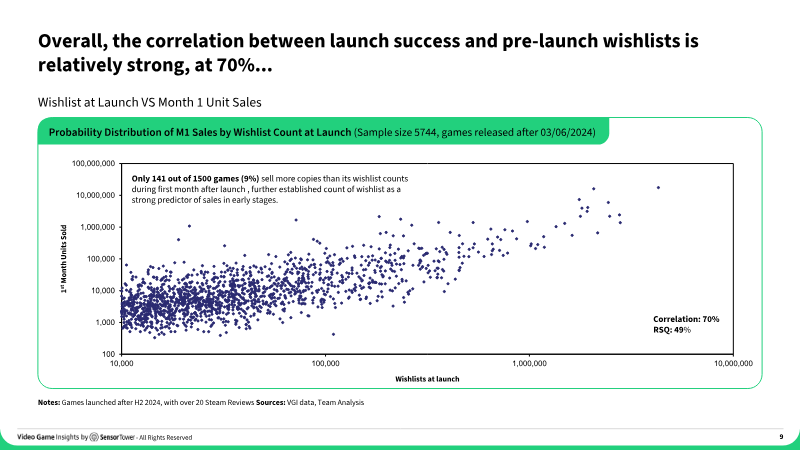
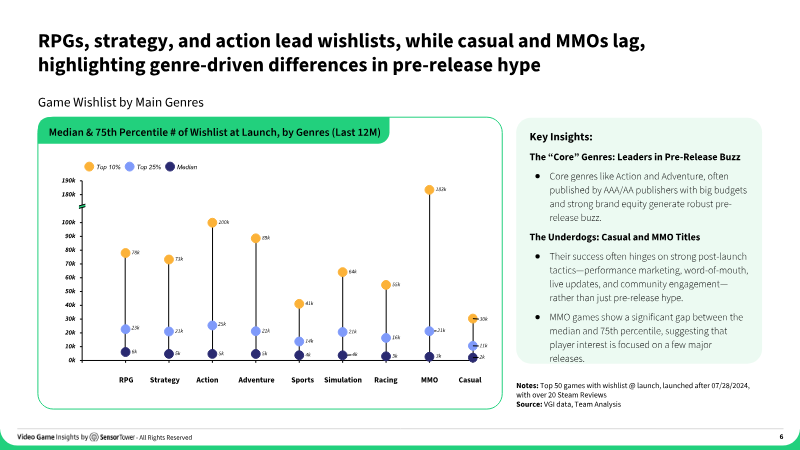
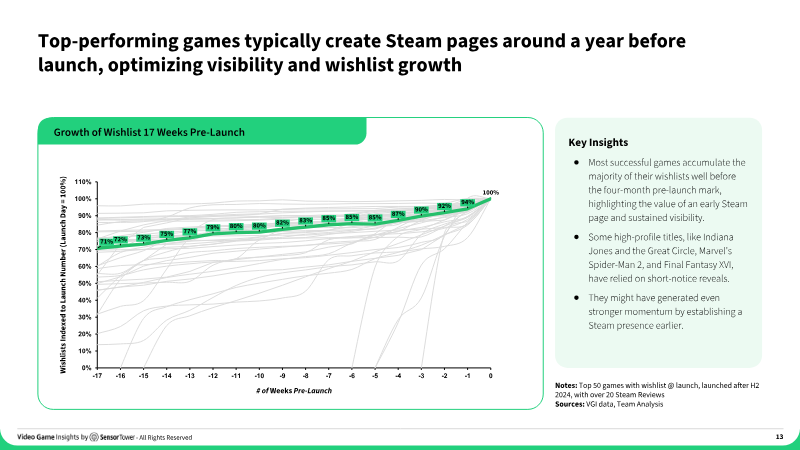
Steam wishlists serve as a critical metric for predicting commercial success in the video game industry, functioning as a primary indicator of pre-launch momentum. Data analysis reveals that wishlist distribution is highly top-heavy, with a significant majority of games launching with fewer than 10,000 wishlists, while only a small fraction of titles achieve the 100,000-plus threshold required to reliably forecast a breakout performance. There is a strong 70% correlation between pre-launch wishlist counts and first-month unit sales, particularly for titles that surpass the 100,000-wishlist milestone. Genre-specific trends highlight that action and adventure titles consistently generate the highest levels of pre-release buzz, often benefiting from the brand equity and marketing budgets of AAA and AA publishers. Conversely, casual and MMO titles frequently rely on post-launch engagement, such as live updates and community building, rather than pre-release wishlist accumulation. Regardless of genre, the timing of a Steam page launch is vital; top-performing games typically establish their presence six to twelve months before release, utilizing a steady stream of trailers and development updates to build and maintain audience interest. The findings are based on an analysis of games launched on Steam from March 2024 onwards, utilizing proprietary estimation models and industry data. The research emphasizes that while wishlists are not a guarantee of success for every title, they act as a essential barometer for market interest. For developers and publishers, the data underscores that early visibility and sustained marketing efforts are necessary to reach the wishlist tiers that statistically correlate with long-term commercial viability.
EUR viaeo dane nsignt. by SensorTower The importance of wishlists in 2025 DEW CLUB Do wishlists matter - what does the data say? STEAM®R NO Video Game Insights.Supporting creativity through data. MO VGinsights.com|Request a Demo!
Table of Contents 01 How many wishlists do games typically get? 4-6 02 Importance of wishlists 7-10 03 How games accumulate wishlists 11- 14 04 Learn more about VGI 15- 20
Using wishlist data as a metric is essential for predicting game success whilst playing a key role in an effective launch strategy Overview of the Report Overview: This report explores Steam wishlists and their importance to games launch performance. Summary: ● Only a small percentage of games surpass 100k wishlists at launch. ● Not all genres are able to garner huge wishlists with action and adventure titles outperforming all other genres. ● Wishlist momentum is a strong indicator of success with games with its snowball effect almost a guarantee of a commercial success, but ONLY for games that achieve at least 100k wishlists pre launch. ● There is a direct correlation with the early launch of a Steam page and wishlist growth. Methodology: The methodology relies on VGI’s estimations and looks at games launched from the March 2024.
Steam wishlist distribution is top-heavy, with a few breakout hits surpassing 1M wishlists while the majority of games launch with under 10K Game Wishlist Overview Distribution of Steam Game Wishlists at Launch (Last 12 M) Wishlist at Launch Leaders (Last 12M) BLACK MYTH Black Myth: Wukong WUKONG 4.3M Wishlists 100K+ 50K-100K 5% 6% Top Batch Breakdown 253 MONSTERHUNTER Monster Hunter Wilds <1K 2.9 M Wishlists 29% 10K-50K23% HADES Hades II EaRLY ACCESS 2.8M Wishlists Manor Lords 22 26 2.8 M Wishlists >1M 500K-1M 100K-500K inZOI 37% 2.6 M Wishlists 1K-10K Notes:Games launched after 03/06/2024, with over 20 Steam Reviews Sources:VGI data, Team Analysis
RPGs, strategy, and action lead wishlists, while casual and MMOs lag, highlighting genre-driven differences in pre-release hype Game Wishlist by Main Genres Median & 75th Percentile # of Wishlist at Launch, by Genres (Last 12M) Key Insights: The “Core” Genres: Leaders in Pre-Release Buzz Top 10% Top 25% Median 190k ● Core genres like Action and Adventure, often 180k 183k published by AAA/AA publishers with big budgets and strong brand equity generate robust pre- 100k 100k release buzz. 90k 89k The Underdogs: Casual and MMO Titles 80k 78k 73k ● Their success often hinges on strong post-launch 70k 64k tactics—performance marketing, word-of-mouth, 60k 55k live updates, and community engagement— 50k 41k rather than just pre-release hype. 40k 30k 23k 25k 30k ● MMO games show a significant gap between the 20k 21k 21k 14k 21k 16k 21k median and 75th percentile, suggesting that 10k 6k 5k 5k 5k 4k 4k 11k player interest is focused on a few major 0k 3k 3k 2k releases. RPG Strategy Action Adventure Sports Simulation Racing MMO Casual Notes:Top 50 games with wishlist @ launch, launched after 07/28/2024, with over 20 Steam Reviews Source:VGI data, Team Analysis
Wishlist momentum acts as a crystal ball for launch success—games with few wishlists rarely break out, while large ones almost guarantee a strong start Wishlist at Launch x Month 1 Sales Distributions Probability Distribution of Month 1 Sales by Wishlist Count at Launch Key Insights (Sample size 5744, games released after 03/06/2024) ● Larger wishlists at launch correlate Games with 1M+ wishlists at strongly with higher first-month sales, 70% launch are very likely to sell emphasizing the need for robust preover 10M units in their lifetime release marketing. 60% ● While small wishlists don’t doom a title, 50% they significantly lower the odds of a 40% breakout, underlining the importance 30% of building an audience early. 20% ● Hitting higher wishlist tiers—especially above 100k—dramatically boosts the 10% likelihood of a blockbuster start, 0% offering a clear goal for studios aiming 1,000 10,000 100,000 1,000,000 10,000,000 100,000,000 for strong initial sales. # ofMonth1Sales 0-10K Wishlists 10K-100K 100K-1M Wishlists 1M+ Wishlists Notes:Top 50 games with wishlist @ launch, launched after H2 2024, with over 20 Steam Reviews Sources:VGI data, Team Analysis
The study aims to map the contemporary PC game distribution ecosystem and evaluate whether Steam functions as a de‑facto monopoly, while outlining alternative channels, associated risks, and growth opportunities for developers and publishers. It positions Steam’s dominance against emerging storefronts, physical media, and gray‑market platforms, offering strategic guidance for navigating a fragmented market beyond 2025. Steam’s market power is evident: 2024 revenue reached $10.8 billion and concurrent active users rose from 25.4 million in 2021 to 40.5 million by September 2025. Eighty‑eight percent of surveyed studios report that Steam delivers over 75 % of their revenue, with 37 % relying on it for more than 90 %. Consequently, 72 % of respondents view Steam as a monopoly and 53 % express concern over this reliance. Nonetheless, diversification is growing—48 % have launched titles on the Epic Games Store, a similar share on the Xbox PC store, while 10 % and 8 % have used GOG and itch.io respectively. Physical releases persist, with 32 % of developers still issuing boxed copies and 72 % of consumers indicating a continued appetite for them. Alternative distribution via e‑stores (e.g., Humble, Fanatical) and marketplaces (e.g., G2A, Kinguin) is gaining traction: 38 % of developers sell through e‑stores and 30 % through marketplaces. Seventy‑five percent anticipate at least a 10 % revenue uplift from these channels, and 80 % expect them to become
The mobile gaming industry is entering a period of strategic recalibration, projected to reach $126.1 billion in revenue by 2025. This growth is underpinned by a transition toward hybrid monetization models and the integration of AI-powered personalization to combat persistent retention challenges. While global install volume grew by 4% in 2024, the market exhibits a distinct geographic divide; North American and European markets face stagnation, whereas Latin America and the Middle East and North Africa regions demonstrate robust expansion. Success in this evolving landscape requires developers to move beyond traditional acquisition, favoring diversified channels such as Connected TV and localized, player-centric engagement strategies. Data from early 2025 indicates that user tracking remains a pivotal operational hurdle, with global App Tracking Transparency opt-in rates hovering at 37.9%. Although arcade games have seen notable improvements in opt-in performance, the United States remains relatively static at 32%, underscoring the necessity for refined messaging strategies to maintain visibility. Concurrently, the industry is grappling with a complex financial environment characterized by rising costs per install and declining average revenue metrics. These headwinds are forcing a shift in marketing tactics, as developers increasingly rely on a broader array of acquisition partners and data-informed creative experimentation to sustain growth. Ultimately, the path to profitability in 2025 lies in prioritizing long-term player value over short-term acquisition metrics. By leveraging AI-driven optimization and fostering community-building initiatives, developers can mitigate the impact of declining revenue per user. The industry is clearly moving toward a more sophisticated, data-reliant ecosystem where the ability to measure performance across fragmented channels—including mobile and Connected TV—is essential for maintaining a competitive advantage in a maturing global market.
The global gaming industry has entered a period of stabilization, with 2024 revenues reaching $187.7 billion and a projected player base of 4 billion by 2027. While mobile gaming remains the dominant sector, accounting for nearly half of all revenue at $92.6 billion, the market is undergoing a structural shift. PC gaming has emerged as a primary growth driver, evidenced by Steam’s record $10.8 billion revenue in 2024 and a historic surge in indie game sales, which surpassed AA and AAA titles for the first time. This evolution is supported by a transition toward hybrid monetization, cross-platform experiences, and a hardware market projected to reach $120 billion by 2028. Influencer marketing has become an indispensable pillar of this ecosystem, with spending expected to hit $32.55 billion by 2025. The landscape is moving away from raw traffic metrics toward "influence quality," where authentic storytelling and niche engagement take precedence over total follower counts. Nano-influencers, particularly on platforms like TikTok and Twitch, are achieving engagement rates exceeding 10%, significantly outperforming larger creators. While Instagram remains the preferred platform for 90% of brand partnerships, the rise of AI-driven optimization and virtual influencers is reshaping how content is produced and consumed across YouTube and emerging platforms like Kick. Successful game launches now rely on sophisticated, multi-platform influencer funnels that utilize early access marathons and Twitch Drops to convert awareness into long-term community advocacy. As social commerce expands globally, particularly following its success in Asian markets, the industry is prioritizing long-term strategic planning over short-term user acquisition. The integration of AI tools, augmented reality, and direct-shopping features indicates a future where gaming and creator content are inextricably linked, requiring brands to adopt agile, data-driven strategies to maintain loyalty in an increasingly fragmented global market.
The game engine landscape is undergoing a significant structural shift, characterized by the decline of proprietary in-house technology in favor of established third-party platforms. While custom engines historically dominated the industry, their market share has eroded substantially over the last decade, falling to approximately 13 percent of new releases by 2024. This transition is driven by the increasing complexity of modern development, which makes the maintenance of internal engines cost-prohibitive and less efficient compared to the immediate, high-fidelity capabilities offered by public alternatives. Unreal Engine has emerged as the primary beneficiary of this trend, particularly within the AAA segment. Following the release of Unreal Engine 5, the platform has successfully reclaimed market share lost during the pandemic, becoming the preferred choice for large-scale, high-budget productions. Conversely, Unity maintains a dominant position in terms of total volume of games released, particularly among indie and smaller developers, though it faces increasing competition from smaller engines like Godot, which has seen notable growth since 2020. Despite Unity’s high release volume, Unreal Engine and custom AAA engines continue to command a larger portion of total units sold, underscoring their prevalence in high-performing commercial titles. The analysis relies on data from over 13,000 games released on Steam, utilizing proprietary estimation algorithms and tagging methodologies to categorize engine usage by game size, genre, and unit sales. The findings indicate that while the choice of engine is often dictated by project scale—with smaller titles favoring Unity and larger, graphics-intensive projects gravitating toward Unreal Engine—the industry is moving toward a standardized ecosystem. As studios weigh the benefits of third-party support, talent accessibility, and advanced graphical features against the loss of proprietary control, the reliance on external engines is expected to continue its upward trajectory through 2030.