Market (PC & Console)·Updated Apr 8, 2026 by Nintendo
Report · January 1, 2025
Published by Nintendo
Global games spending reached a record $199.4 bn in 2024, rising 3.5 % year‑over‑year and projected to stabilize near $200 bn in 2025 with modest growth thereafter. The sector remains smaller than the broader video‑related entertainment market but is nine times larger than recorded music, underscoring its expanding economic footprint. Key growth levers include a $7‑8 bn upside from Nintendo’s Switch 2, which is expected to sell 103 million units by 2030, and an additional $1‑2 bn from enhanced in‑game monetisation. Emerging markets—particularly the Middle East, Africa, and Southeast Asia—offer significant upside driven by youthful, mobile‑savvy populations. The launch delay of GTA VI is anticipated to shave $2.7 bn from 2025 console spend, creating a sales window for other publishers and Nintendo to capture holiday‑season revenue. Untapped consumer cohorts, such as 16‑24 year‑old females and players aged 55+, represent further opportunities for market expansion. Publishers are responding to slower growth by shifting toward higher‑margin, low‑cost strategies. Remasters and remakes—examples include *Resident Evil 4* and the *Final Fantasy VII* remake—are becoming primary revenue engines. Simultaneously, platform diversification across PC, console, and direct‑to‑consumer web stores, coupled with hybrid monetisation models that blend advertising, in‑app purchases, and subscriptions, are being tested to optimise returns. Expanding intellectual property into music, merchandising, and cloud‑gaming subscriptions further unlocks value from dormant franchises.
Market performance & outlook Growth opportunities Spending on games content and services hit a new high of $199.4bn in 2024, growing 3.5% year-on-year and beating the 2021 pandemic-driven market. This record performance glosses over the challenges the industry has suffered during the last two years Nintendo Switch 2 – a $7-8bn content opportunity over the next two years. Nintendo’s new device also offers the prospect of increased in-game monetisation - even a limited increase could reach $1-2bn a year in spending Outlook for games spending over the next two years looks stable and with moderate growth. In 2025 growth is expected to be just 1%, but the market is forecast to reach $200bn for the first time. In 2026 growth is predicted to pick up at 2.2% Regional growth opportunities - $1.3bn in predicted market growth across Middle East & Africa and Southeast Asia over the next two years. These regions will outperform the growth of Western markers and Asia Pacific more generally in 2025 The delay to the launch of Grand Theft Auto VI from 2025 into 2026 will wipe $2.7bn in content and console hardware spend from the 2025 market, but leaves a vacuum for other publishers and Nintendo to move into over the holiday season Underserved audiences even in the most ‘saturated’ markets – Ampere's US data shows a population of 120 million across the important cohorts of 16-24-year-old females and those over 55 years, where gaming has substantial room to grow
behavior Sports rights deals Content production Pay TV Global insight Social Video global for .. Telecoms 4 entertainment Advertising Broadcast TV Games Sports
Verticals Media Games Sports Market sizing and forecasting Three core All of Ampere's teams have modelling and market forecasting expertise, and have An unrivaled team-members who specialise in collecting financial data and KPls, creating verticals supported 2 custom market models, and forecasting sector performance formula that by three core creates a research Quantitative consumer research holistic view of techniques Ampere's Consumer team supports the three verticals, running syndicated and custom the market quantitative studies on behalf of clients or internal stakeholders, processing data and supporting the syndicated quant tracker suite of products which sit within each vertical 360° Automated data solutions Ampere's development team specialises in creating large-scale automated data collection and processing systems, and has particular expertise in creating cleaning, and matching algorithms to make sense of disparate, unconnected, datasets
Contents Games market Growth opportunities: Growth opportunities: performance & New platforms Underserved audiences outlook & sub-regional markets & younger gamers 01 02 03 Content strategies Getting the most from & optimisation games IP & back catalogues 04 05
The games content and services market reached a new Games content and services market, 2018-2026 ($bn) high in 2024 of 199.4bn, beating the previous pandemicdriven record of 196.7bn in 2021. 2024 performance 199.4 201.3 205.7 represented a growth of 3.5% compared to 2023 196.8 188.1 192.8 ($192.8bn). Near-term growth outlook looks mixed, with 182.4 2025 growth of 0.9% and 2026 2.2%, and re ects the shift of the Grand Theft Auto VI launch date to May 2026. The market should break the $200bn level in 2025 150.9 140.5 2024 performance was partially at odds with the broader +3.5% +0.9% +2.2% commentary around the health of the games sector, which has suffered larger numbers of layoffs and studio closures over the last two years. The market was not stagnating or in decline, with 2024 spending out-performing mid-year expectations However, a background of general in ation, hypercompetition, and the slow growth outlook compared to the pre-2019 market, means that the market performance will not alter the de-risking strategic dynamics that are occurring. These include company downsizing, a focus on e ciency, a reduction in content spending and more selective funding of new projects 2018 2019 2020 2021 2022 2023 2024 2025F 2026F Note: $ exchange rate is variable. Market is consumer spending inc. VAT where applied Source: Ampere Games - Markets
The mobile gaming market has yet to recover back to the Games market by device category, 2018-2026 ($bn) height of the pandemic-driven market, but experienced Mobile PC Console VR Cloud steady growth in 2024 at 4.1% year-on-year. Share of market stayed consistent at 58%. Growth is forecast to remain slow over the next couple of years (between 2-3% annually) and will be largely driven by activity outside of 120 Western markets, Japan and South Korea. Other categories - such as instant and browser games - will contribute more 100 The PC gaming market experienced growth of 5.7% in 2024, outperforming console and mobile segments. Whilst 80 smaller than both mobile and console gaming, it is continuing to expand steadily due to it's globalised nature, content availability across business models and price 60 points, and the increase in accessibility through new hardware form factors 40 The console gaming market was at in 2024. The second half of the year delivered better than expected sales and 20 was helped by price increases on subscription services. In 2025, the console gaming market will be hampered by the 0 GTA VI delay. Fresh spending on Switch 2 will be offset to an extent by declines on older devices 2019 2020 2021 2022 2023 2024 2025F 2026F
1. Market trajectory What direction is the PC and console market heading in 2026? 8 What direction is the PC and console market heading in 2026? 2. Attention & value allocation Where do players spend time and money on PC and console? 17 3. Market concentration What happens if you are not a top-20 game? 45 4.
The Game & Network Services segment demonstrates a robust market position characterized by a PlayStation 5 monthly active user base of 118 million and a significant increase in per-console spending, which currently averages $731. This financial performance is underpinned by a strategic shift toward a digital-first ecosystem and recurring revenue models, evidenced by 35% of PlayStation Plus subscribers migrating to premium tiers. Looking toward the FY24–26 period, the primary objective is to secure sustainable profitability by balancing traditional hardware sales with an expanded peripheral lineup and the integration of AI and hybrid cloud technologies to optimize engineering efficiencies. The operational strategy for PlayStation Studios emphasizes a multi-format expansion of intellectual property across console, PC, and live service platforms. Following a period of aggressive studio acquisitions between FY21 and FY23, the focus has transitioned toward disciplined development frameworks and the management of a diversified portfolio. This portfolio includes high-performing tentpole franchises, such as Marvel’s Spider-Man 2 and Helldivers 2, alongside transformational live services and experimental titles. By leveraging broader corporate synergies, the segment aims to maximize the reach of its core IP while utilizing AI-driven tools to streamline production costs and timelines. Future growth remains subject to a complex landscape of macroeconomic and technological risks. Intense market competition and rapid shifts in consumer technology necessitate constant innovation, while financial outcomes are sensitive to foreign exchange volatility, particularly involving the Yen, USD, and Euro. Furthermore, global stability is pressured by geopolitical conflicts and regulatory scrutiny, which may impact supply chains and international operations. Maintaining product quality and cybersecurity remains a critical priority as the segment navigates these external pressures to achieve its long-term financial targets.
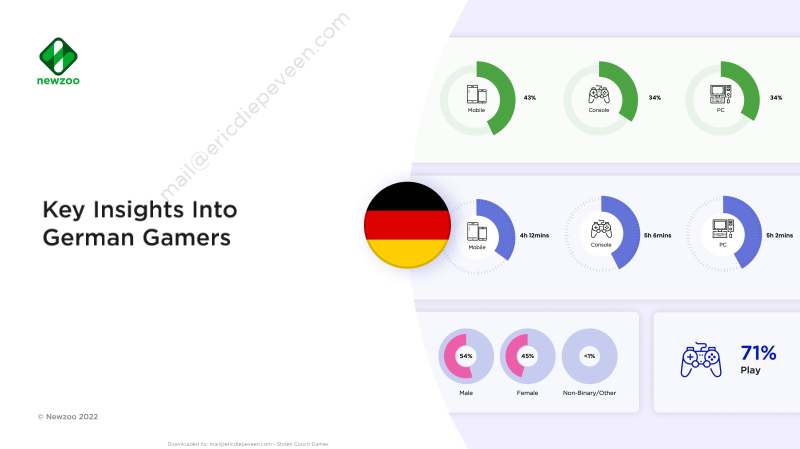
The Consumer Insights: Games and Esports 2022 report provides a comprehensive analysis of global gaming behaviors, motivations, and market engagement. The primary purpose of the research is to equip game developers, publishers, and industry stakeholders with actionable data to benchmark titles, understand player demographics, and identify growth opportunities across 36 diverse international markets. By examining over 100 key performance indicators, the analysis offers a granular view of how players interact with PC, console, and mobile platforms. The research is underpinned by a robust methodology, drawing on survey data from over 75,000 consumers worldwide. The findings highlight distinct engagement patterns, such as the prevalence of specific gaming personas—notably Time Fillers and Mainstream Gamers—and the interplay between playing and viewing habits. For instance, data from the German market indicates that while playing remains the dominant activity, a significant portion of the population also engages with gaming video content and esports. Furthermore, the report identifies key drivers for consumer spending, noting that price sensitivity, the desire for exclusive content, and social connectivity are primary motivators for financial investment in games. Covering a broad geographic scope that includes North America, Europe, Latin America, the Middle East, and the Asia-Pacific region, the report serves as a strategic tool for navigating the complex global gaming landscape. By synthesizing metrics such as monthly active users, daily active users, and lifetime player value, the analysis facilitates a deeper understanding of the motivations driving player behavior. Ultimately, the findings emphasize that a nuanced approach to audience segmentation and platform-specific engagement is essential for companies seeking to reach and retain diverse gaming populations in an increasingly competitive entertainment market.
The 2021 Fact Book presents a comprehensive overview of Bandai Namco Holdings’ strategic direction, emphasizing its transformation into a globally integrated entertainment conglomerate and its commitment to corporate social responsibility. Central to the narrative is the thesis that sustained growth across toys, video games, animation and amusement can be achieved through diversified product portfolios, expansive international operations, and proactive sustainability initiatives. The company’s evolution is traced from a collection of independent toy, arcade‑machine and media firms to a unified group after the 2005‑2007 merger of Bandai and Namco. Key milestones include the launch of flagship lines such as Gundam models (over 500 million units shipped), Tamagotchi (exceeding 20 million units), and Zatchbell Battle (300 million units), as well as the development of major video‑game franchises—TEKKEN, DARK SOULS III and Tales—collectively surpassing 50 million sales. International expansion is evident through subsidiaries and regional headquarters in North America, Europe and Asia, reinforced by repeated listings on the Tokyo Stock Exchange and industry recognitions such as Cannes Best Actor and TSE awards. Environmental and social performance data for fiscal year 2021 highlight a suite of CSR actions, including CO₂ reduction targets, supply‑chain safety measures and work‑life‑balance programmes, all framed within the “NEXT STAGE” mid‑term plan aimed at deepening engagement with a mature fan base and broadening cross‑media offerings. The Fact Book thus underscores Bandai Namco’s dual focus on market leadership and sustainable corporate practices across a worldwide footprint and multiple entertainment segments.