Live Ops reports and market data
Documents
The Mechanics of Explosive Growth
Roblox achieved a transformative inflection point in 2016, transitioning from a decade of steady development to a period of 300% year-over-year growth.
- Roblox achieved a 300% year-over-year growth rate starting in 2016, transitioning from a decade of steady development to rapid scaling.
- The 2014 introduction of the Developer Exchange program incentivized high-quality content, establishing a self-reinforcing cycle where improved creator tools directly drove better player experiences and increased user acquisition.
- Expansion onto the Xbox platform served as a primary catalyst for growth by enabling cross-device play, which triggered powerful network effects and organic word-of-mouth acquisition.

Dead by Daylight: When Creative and Business Minds Are Cooking with GAAS
Dead by Daylight serves as a definitive case study for the successful implementation of Games-as-a-Service models, demonstrating that long-term profitability is best achieved by aligning creative vision with player-centric monetization.
- Monetization in Games-as-a-Service (GaaS) should be additive to the player experience rather than subtractive; by focusing on optional cosmetic items, developers can generate revenue while enhancing player engagement and character customization.
- Behaviour Interactive rejected loot boxes in favor of an 'a la carte' store model to maintain player trust, opting for lower immediate revenue in exchange for long-term brand health and player respect.
- Generosity in GaaS, such as allowing players to unlock 60-70% of store content and all original characters using a grindable 'soft currency,' directly correlates with increased average session duration and player retention.

Engage, Retain, & Delight Players with Live Ops on AWS | PGC Digital #1
Modern game development necessitates a shift toward integrated live operations as a foundational element of design rather than an afterthought.
- Live operations must be integrated as a foundational design element from the start of development rather than treated as an afterthought.
- Real-time data pipelines and streaming technologies are essential for detecting player behavior anomalies and triggering dynamic, personalized in-game encounters.
- Studios should utilize machine learning and automated communication tools to execute segmented player outreach, which is critical for long-term retention.

Analytics from a Live Ops Perspective | PGC Digital #1
Successful Live Ops strategy centers on the integrity of foundational data, prioritizing robust server-side tracking to ensure that decision-makers operate on reliable metrics rather than anomalies.
- Prioritize server-side tracking to ensure data integrity, as decision-making based on unreliable metrics or anomalies undermines Live Ops strategy.
- Shift from excessive A/B testing toward the simulation of game mechanics to provide designers with actionable feedback on balance and content updates.
- Utilize Monte Carlo simulations to identify complex feedback loops and progression imbalances that are frequently missed by manual testing.
Start-And-Discard: A Unified Workflow for Development and Live
The Start-and-Discard workflow represents a strategic shift in online game development, moving away from static, on-premise infrastructure toward a cloud-native, ephemeral environment model.
- Ubisoft Massive implemented the 'Start-and-Discard' workflow, which utilizes infrastructure-as-code (Terraform and Google Cloud) to instantiate identical, production-like environments on demand.
- The methodology eliminates the use of inaccurate 'stubs' or 'shims' by allowing developers to test and debug within full-stack, isolated environments that mirror the final live product.
- By discarding environments immediately after task completion, teams optimize costs by avoiding the maintenance of expensive, permanent staging servers.
Clash of Clans: Bigger, Better, Battle Pass
Clash of Clans achieved a significant resurgence by systematically addressing long-standing progression bottlenecks and economic stagnation that had hindered player retention.
- The introduction of a five-dollar monthly Gold Pass served as the primary catalyst for a 30 percent year-over-year revenue increase and quadrupled the unique payer base.
- The Gold Pass model achieved high sustainability, maintaining a 70 percent monthly retention rate among its subscribers.
- Developers revitalized the game by spending two years refining foundational systems, specifically reducing upgrade costs and times while introducing magic items to eliminate progression bottlenecks.
Scaling to 10 Concurrent Users: Online Infrastructure as an Indie
Building robust online infrastructure for independent games requires a strategic balance between technical capability and resource constraints.
- Prioritize core game mechanics over complex infrastructure, as the time and capital required for sophisticated backends often yield diminishing returns for small studios.
- Avoid microservices architectures, which introduce excessive deployment overhead and multi-hop asynchronous management challenges that can overwhelm indie teams.
- Use WebSockets or gRPC instead of standard HTTP protocols to ensure the bi-directional communication necessary for real-time lobby management and game state synchronization.
Beyond Games as a Service with Live Ops
The transition from viewing video games as discrete, one-time products to the Games as a Service model has fundamentally altered industry priorities, often at the expense of player experience.
- LiveOps should be viewed as an additive, iterative process rather than a sequential development phase, requiring game architecture that supports frequent, small-scale updates rather than just large, pre-planned DLC.
- Designers must identify and support the game's intrinsic motivators—such as social relatedness—rather than focusing solely on optimizing easily measurable KPIs like combat loops or microtransaction funnels.
- LiveOps maturity progresses through three stages: basic iterative updates based on player feedback, optimization through A/B testing and personalization, and finally mastering engagement by extending the game experience beyond the client.
Is Your Game Cross-Platform Ready?
Cross-platform development has emerged as a critical strategy for modern game studios, shifting the industry focus from platform-specific silos toward a player-centric model.
- Cross-platform development requires a unified identity system that links disparate platform accounts (e.g., Xbox Live, Steam, PlayStation) to a single, developer-owned account ID to enable seamless cross-play and social features.
- Developers should implement dedicated or relay servers rather than peer-to-peer networking to avoid NAT restriction issues when connecting PC and console players.
- To maintain a consistent experience, unify commerce by using virtual currencies (like V-Bucks or Minecoins) and managing entitlements through a secure, centralized service that validates purchases across different platform storefronts.
Stress-Free Game Development: Powering Up Your Studio With DevOps
Game development studios frequently struggle with cycles of burnout and inefficient production, often relying on unsustainable heroics to manage chaotic release schedules.
- Transitioning from manual workflows to DevOps principles replaces unsustainable 'heroics' and crunch culture with standardized, automated systems that prioritize sustainable production.
- Optimizing studio output requires identifying specific bottlenecks, as increasing capacity in non-constrained areas provides no net improvement to development speed.
- Automating routine tasks—such as build creation, patch note generation, and QA checklist management—is essential for achieving continuous delivery and reducing human error.
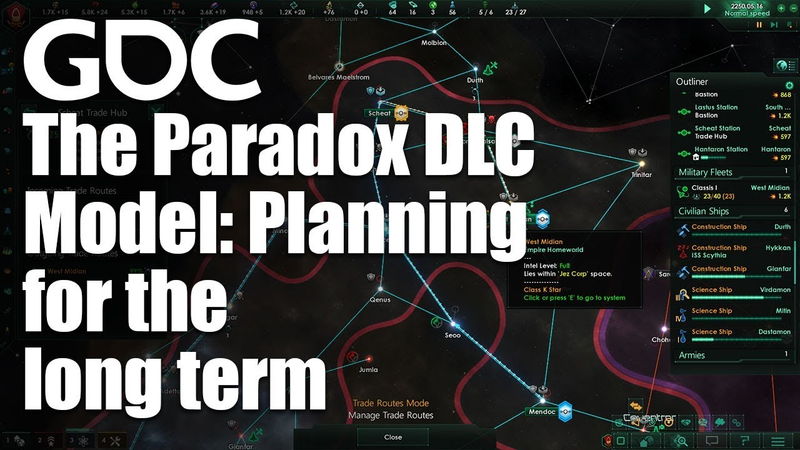
The Paradox DLC Model: Planning for the Long Term
Paradox Interactive achieves long-term commercial success by prioritizing a marathon-oriented business model centered on niche, infinitely replayable strategy titles.
- Paradox Interactive utilizes a modular DLC framework instead of serial expansion cycles to maintain long-term game relevance and generate consistent, multi-year revenue streams.
- The company prioritizes deep, system-driven gameplay and community-driven modding over high-fidelity graphics to ensure high player retention in niche strategy titles.
- Paid content is designed to be atomic, standalone, and additive to enhance the player experience without fragmenting the community or disrupting existing mechanics.
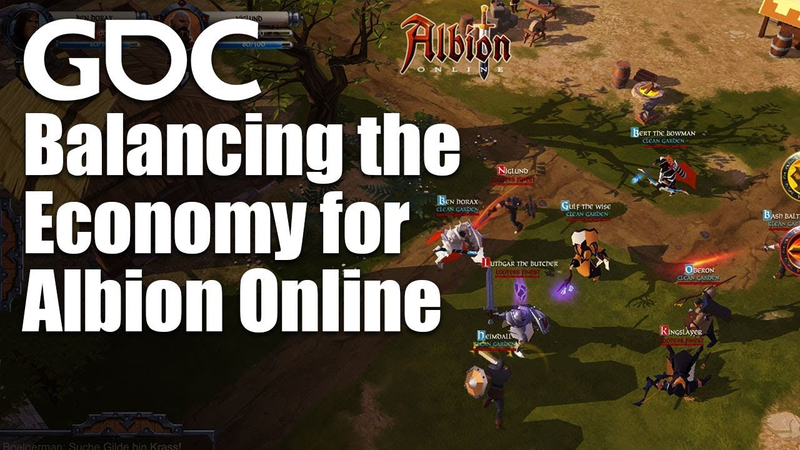
Balancing the Economy for Albion Online
Albion Online operates as a sandbox MMORPG defined by a fully player-driven economy where every piece of equipment is crafted by the community.
- Economy balance in a player-driven MMO is defined as the macro-scale management of all extrinsic reward systems, which function as the primary incentive structure directing player behavior.
- To prevent wealth disparity and provide long-term progression, Albion Online utilizes a tiered equipment system where T4 gear is common and accessible, while T8 gear is rare and serves as a high-end wealth sink.
- The development team establishes price channels for resources by implementing a transmutation system, allowing players to convert silver into higher-tier resources at fixed rates to create a floor and ceiling for market prices.