mixi
Game Co.74 documents
Documents

Report14 pages
Medium-Term Vision: Our Growth Strategy in the We-Time Economy
The We-Time Economy serves as the central strategic framework for future growth, predicated on the belief that artificial intelligence will increase leisure time and heighten the value of shared, trust-based human experiences. By facilitating social interaction through digital platforms and services, the organization aims to capture a significant portion of a global market estimated at US$10–15 trillion. The core thesis posits that shared emotional experiences—ranging from social betting and sports entertainment to family-oriented digital products—create high-retention, high-profitability ecosystems that rely on word-of-mouth growth and community engagement.
Financial targets for the medium term include doubling net sales to 300 billion yen, with a specific focus on scaling the sports and lifestyle segments. To achieve these objectives, the company is implementing a rigorous business portfolio management strategy. This involves classifying business units based on growth potential and profitability relative to a 6.18% weighted average cost of capital. Resources are dynamically allocated to high-growth areas, while underperforming units are subject to restructuring or divestment. Key growth drivers include the global expansion of social betting through PointsBet, the scaling of the FamilyAlbum economic sphere, and the continued monetization of domestic intellectual property like MONSTER STRIKE.
Operational efficiency and shareholder value are prioritized through a commitment to raising the EBITDA margin to 20% and the return on equity (ROE) to 15%. Governance reforms, including the appointment of independent directors to lead compensation committees and the alignment of executive incentives with long-term performance, support these financial goals. The company has also committed to a more robust shareholder return policy, targeting a 40% dividend payout ratio to reflect its transition into a sustained profit growth phase.
- The company aims to double net sales to 300 billion yen by focusing on the 'We-Time Economy,' a strategy targeting a global market estimated at US$10–15 trillion.
- Financial performance targets include achieving a 20% EBITDA margin and a 15% return on equity (ROE).
- Capital allocation is governed by a strict portfolio management strategy that evaluates business units against a 6.18% weighted average cost of capital, leading to the restructuring or divestment of underperforming assets.
- Key growth drivers include the global expansion of social betting via PointsBet, the scaling of the FamilyAlbum ecosystem, and the continued monetization of the MONSTER STRIKE intellectual property.
- The company has established a new shareholder return policy targeting a 40% dividend payout ratio to reflect its transition into a phase of sustained profit growth.
mixi
Financial14 pages
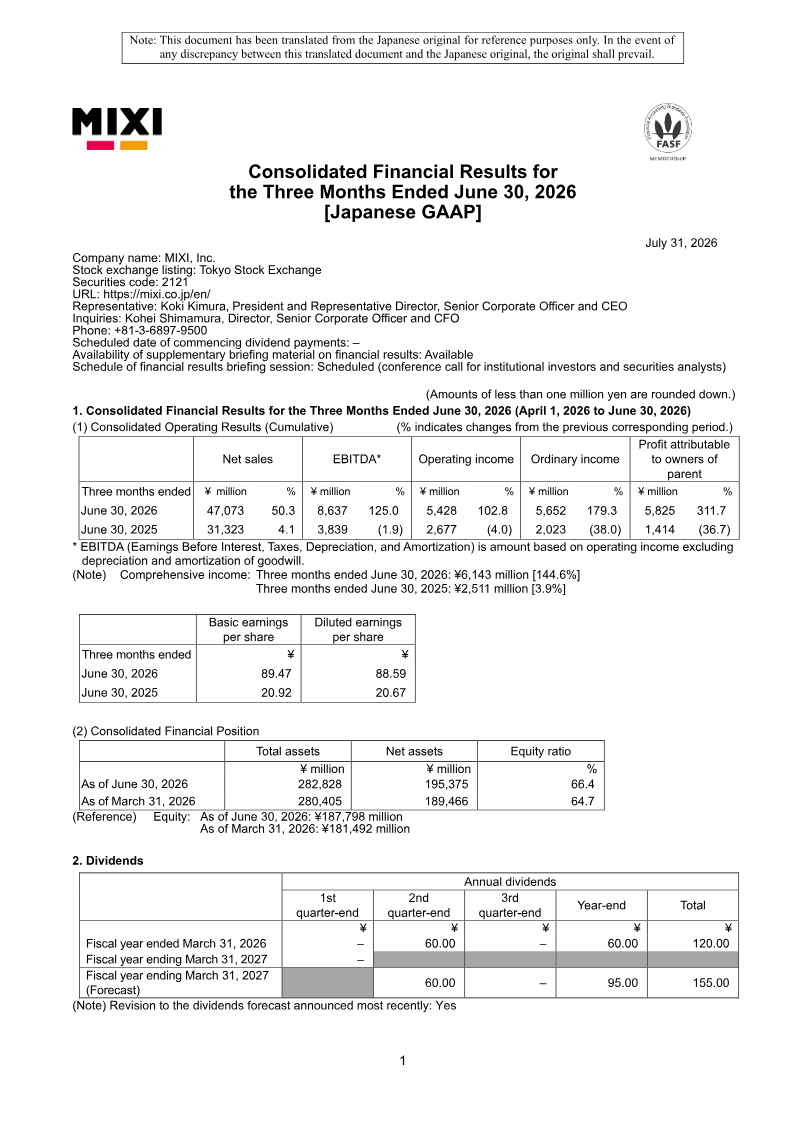
Consolidated Financial Results for the Three Months Ended June 30, 2026
MIXI, Inc.’s consolidated financial results for the three months ended June 30, 2026, demonstrate significant year-over-year growth across all primary business segments. The company reported net sales of ¥47,073 million, a 50.3% increase compared to the same period in 2025. Operating income rose by 102.8% to ¥5,428 million, while profit attributable to owners of the parent surged by 311.7% to ¥5,825 million. This performance reflects a robust expansion in revenue streams and improved operational efficiencies.
The company operates across four segments: Digital Entertainment, Sports, Lifestyle, and Investment. The Digital Entertainment business, anchored by the mobile game Monster Strike, saw net sales grow by 21.5% to ¥19,532 million, driven by increased average revenue per user (ARPU) despite a decline in monthly active users. The Sports business experienced the most substantial growth, with net sales rising 94.5% to ¥21,673 million, bolstered by the consolidation of PointsBet Holdings Limited and strong performance in betting and spectator operations. The Lifestyle and Investment segments also returned to profitability, contributing ¥261 million and ¥860 million in segment profit, respectively.
Financial stability remains strong, with an equity ratio of 66.4% as of June 30, 2026. The company’s cash and cash equivalents stood at ¥109,212 million. During the period, MIXI implemented a change in accounting policy regarding the valuation of investments in partnerships, which resulted in an increase in operational investment securities and valuation differences. Additionally, the company announced a planned divestment of its stake in the equity-method affiliate bitbank, Inc., which is expected to generate a gain of approximately ¥12,231 million in the nine months ending December 31, 2026. The company has revised its full-year forecast for the fiscal year ending March 31, 2027, to reflect these ongoing operational developments.
- MIXI, Inc. reported strong Q1 2026 growth, with net sales rising 50.3% to ¥47,073 million and profit attributable to owners of the parent surging 311.7% to ¥5,825 million.
- The Sports business is now the company's largest revenue driver, growing 94.5% to ¥21,673 million following the consolidation of PointsBet Holdings Limited.
- Digital Entertainment net sales grew 21.5% to ¥19,532 million, as increased ARPU for Monster Strike offset a decline in monthly active users.
- The company expects a gain of approximately ¥12,231 million in the nine months ending December 31, 2026, from the planned divestment of its stake in bitbank, Inc.
- Lifestyle and Investment segments returned to profitability, contributing ¥261 million and ¥860 million in segment profit, respectively.
mixi
Financial22 pages
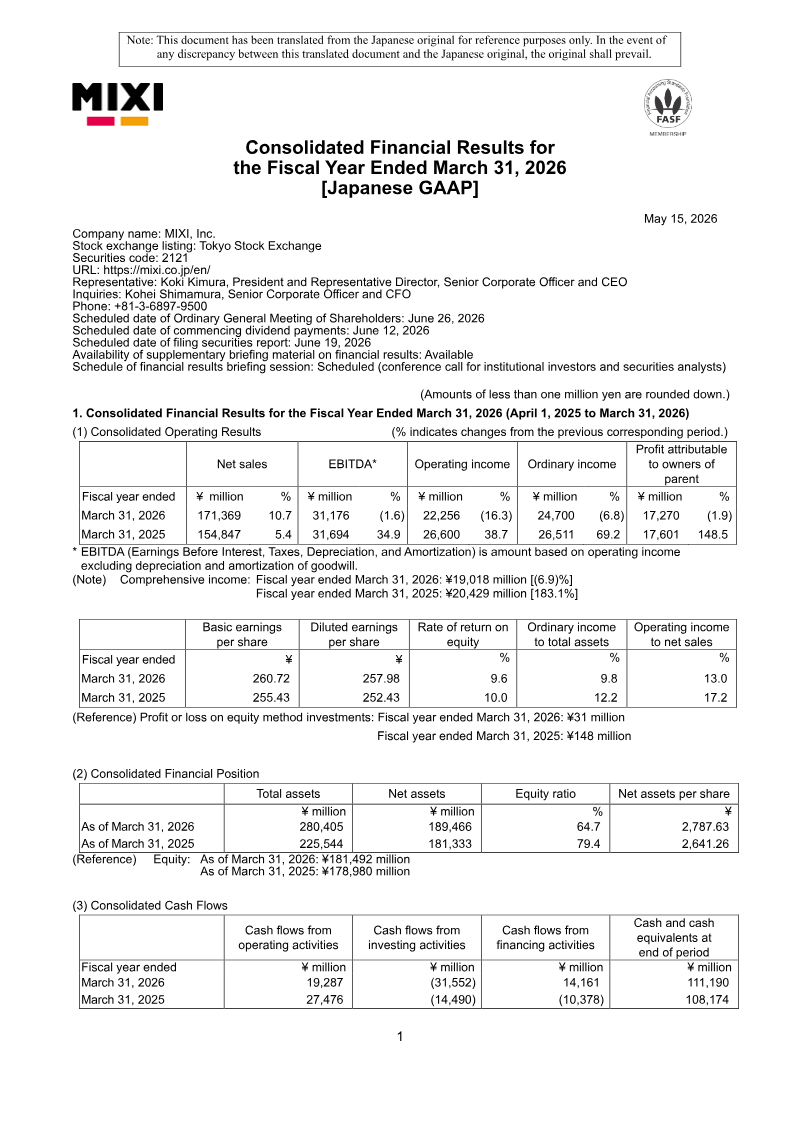
Consolidated Financial Results for the Fiscal Year Ended March 31, 2026
MIXI concluded the fiscal year ending March 31, 2026, with net sales of ¥171,369 million, representing a 10.7% year-over-year increase. Despite this top-line growth, operating income contracted by 16.3% to ¥22,256 million. The financial performance reflects a strategic pivot in revenue composition, as robust expansion within the Sports Business—catalyzed by the acquisition of PointsBet Holdings Limited—successfully mitigated the impact of declining engagement within the flagship Digital Entertainment segment, specifically Monster Strike. Simultaneously, the Lifestyle Business achieved a return to profitability, contributing to a stable financial foundation characterized by ¥189,466 million in net assets.
Capital management during this period prioritized aggressive investment and structural optimization. Cash and cash equivalents reached ¥111,190 million, supported by ¥35,200 million in new long-term borrowings. Investing activities intensified significantly, with outflows totaling ¥31,552 million, of which ¥25,533 million was directed toward subsidiary acquisitions and capital expenditures. To further refine its capital structure, the company resolved to cancel 2.8 million treasury shares in May 2026. These actions underscore a commitment to balancing growth-oriented acquisitions with shareholder value initiatives.
Looking toward the next fiscal year, the company maintains a positive outlook with a consolidated net sales target of ¥185 billion. This projection relies on the continued scaling of the "We-Time Economy" business segments. By leveraging a solid cash position and diversifying revenue streams away from legacy digital entertainment titles, the organization aims to sustain its growth trajectory while navigating the increased costs associated with its recent expansion into the global sports market.
- MIXI reported fiscal year 2026 net sales of ¥171,369 million, a 10.7% year-over-year increase, though operating income fell 16.3% to ¥22,256 million.
- The company is successfully pivoting away from its flagship Digital Entertainment segment, specifically Monster Strike, by leveraging growth in the Sports Business following the acquisition of PointsBet Holdings Limited.
- Capital expenditure and subsidiary acquisitions totaled ¥25,533 million, contributing to a total investment outflow of ¥31,552 million for the fiscal year.
- The company maintains a strong liquidity position with ¥111,190 million in cash and cash equivalents, bolstered by ¥35,200 million in new long-term borrowings.
- The Lifestyle Business segment returned to profitability, helping to stabilize the company's financial foundation, which ended the year with ¥189,466 million in net assets.
+1
mixi
Report6 pages
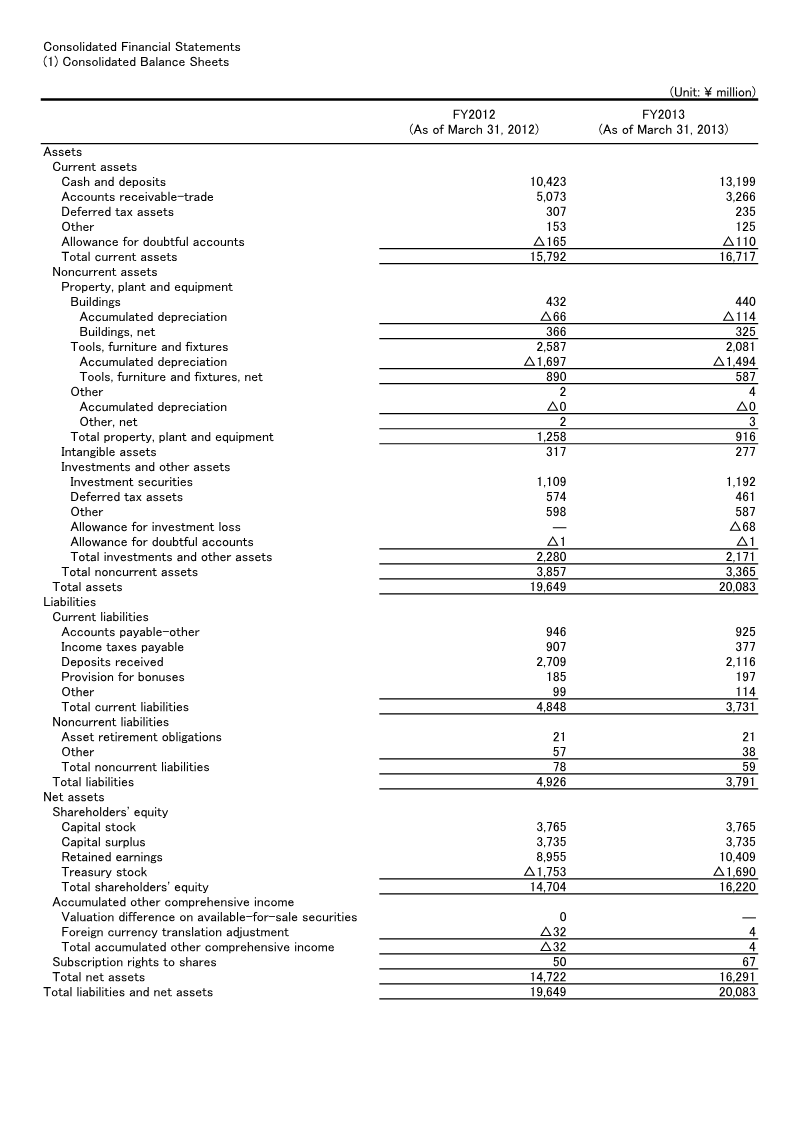
Consolidated Balance Sheets: FY2012-FY2013
The consolidated financial statements cover the fiscal years ending March 31, 2012 and March 31, 2013. Net sales fell from ¥13,334 million to ¥12,632 million, yet operating income rose from ¥2,194 million to ¥2,574 million, reflecting lower cost of sales and improved operating efficiency. Net income more than doubled, increasing from ¥749 million to ¥1,654 million, largely driven by a substantial extraordinary gain of ¥406 million on the sale of subsidiary shares and reduced operating expenses. Comprehensive income grew from ¥732 million to ¥1,691 million; foreign‑currency translation adjustments swung from a negative ¥5 million to a positive ¥36 million, offsetting other comprehensive losses.
Assets increased from ¥19,649 million to ¥20,083 million. Current assets grew modestly, with cash and deposits rising by ¥2,776 million. Non‑current assets declined due to a reduction in property, plant and equipment net balance from ¥1,258 million to ¥916 million, reflecting asset disposals and depreciation. Liabilities fell from ¥4,926 million to ¥3,791 million, driven by lower current liabilities and a reduction in non‑current obligations. Shareholders’ equity expanded from ¥14,722 million to ¥16,291 million; retained earnings grew by ¥1,453 million, while treasury stock decreased in net value from a negative ¥1,753 million to a negative ¥1,690 million.
Cash flow analysis shows operating cash inflows rising from ¥1,043 million to ¥2,836 million. Investing activities remained negative, with a net outflow of ¥2,971 million in 2012 and ¥946 million in 2013, largely due to property, plant and equipment purchases. Financing cash flows were negative in both years, with treasury stock repurchases offset by modest dividend payments. The company’s liquidity improved, as cash and equivalents increased from ¥11,293 million to ¥9,199 million despite the net cash outflow in 2012. Overall, the firm strengthened profitability and equity while managing asset composition and cash flows over the two‑year period.
- Net income more than doubled from ¥749 million in FY2012 to ¥1,654 million in FY2013, bolstered by a ¥406 million extraordinary gain from the sale of subsidiary shares and reduced operating expenses.
- Operating income increased from ¥2,194 million to ¥2,574 million despite a decline in net sales from ¥13,334 million to ¥12,632 million, indicating improved operational efficiency and lower cost of sales.
- Shareholders' equity grew from ¥14,722 million to ¥16,291 million, supported by a ¥1,453 million increase in retained earnings.
- Total liabilities decreased significantly from ¥4,926 million to ¥3,791 million, reflecting reductions in both current and non-current obligations.
- Operating cash inflows saw substantial growth, rising from ¥1,043 million in FY2012 to ¥2,836 million in FY2013.
mixi
Report4 pages
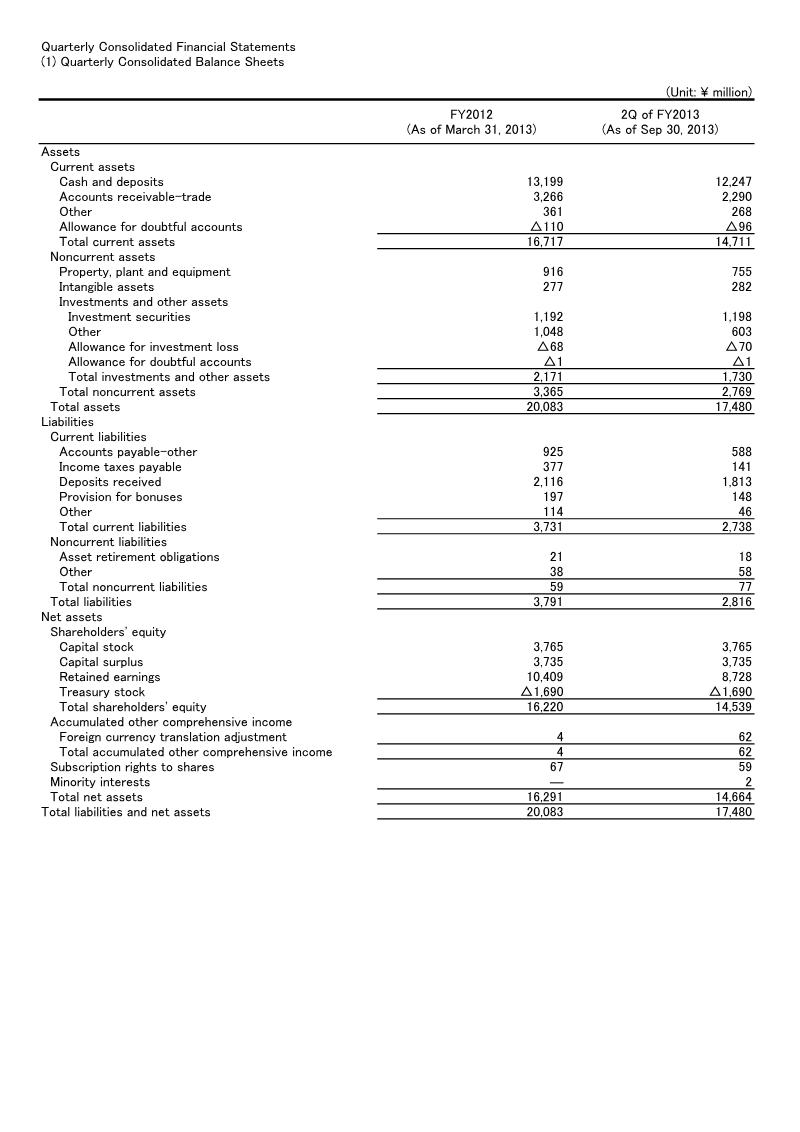
Quarterly Consolidated Balance Sheets: 2Q FY2013
The quarterly consolidated balance sheet and income statements for the second quarter of fiscal year 2013 reveal a contraction in both operating performance and financial position compared with the same period of fiscal year 2012. Total assets fell from ¥20,083 million to ¥17,480 million, largely due to a reduction in current assets and non‑current investments. Current liabilities decreased from ¥3,731 million to ¥2,738 million, but shareholders’ equity declined from ¥16,291 million to ¥14,664 million, driven by a lower retained earnings balance and the continued impact of treasury stock.
Operating income swung from ¥1,612 million in 2Q FY2012 to a loss of ¥398 million in 2Q FY2013, reflecting higher selling, general and administrative expenses relative to sales. Net sales dropped by 41% from ¥6,817 million to ¥3,979 million, while cost of sales fell proportionally. Non‑operating losses increased sharply due to a ¥126 million loss on equity in affiliates and a ¥21 million loss on investments, offset only partially by foreign exchange gains of ¥20 million. Ordinary income turned negative, with a loss of ¥525 million in 2Q FY2013 versus a profit of ¥1,583 million previously.
Comprehensive income mirrored the net loss trend, reporting a ¥1,293 million loss attributable to owners of the parent in 2Q FY2013 versus a ¥1,184 million profit in 2Q FY2012. Cash flow analysis shows operating cash outflows of ¥448 million, a significant rise in investing cash inflows to ¥2,774 million—largely from sales of subsidiary shares—and financing outflows of ¥327 million due to dividend payments. Overall, the company experienced a notable decline in profitability and equity during the second quarter of FY2013.
- Net sales plummeted 41% year-over-year, falling from ¥6,817 million in 2Q FY2012 to ¥3,979 million in 2Q FY2013.
- Operating income shifted from a ¥1,612 million profit in 2Q FY2012 to a ¥398 million loss in 2Q FY2013, driven by high selling, general, and administrative expenses relative to sales.
- The company reported a net loss attributable to owners of the parent of ¥1,293 million for 2Q FY2013, a sharp reversal from the ¥1,184 million profit recorded in the same period of the previous year.
- Total assets contracted from ¥20,083 million to ¥17,480 million, while shareholders’ equity declined to ¥14,664 million due to lower retained earnings and treasury stock impact.
- Ordinary income turned negative, resulting in a loss of ¥525 million compared to a profit of ¥1,583 million in 2Q FY2012, exacerbated by ¥147 million in combined losses from equity in affiliates and investments.
mixi
Report2 pages
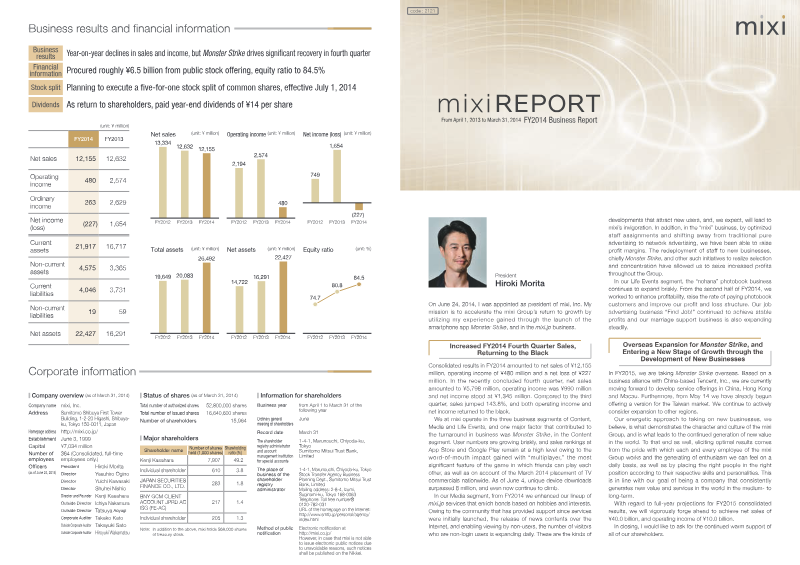
Mixi Report: FY2013 Business Results
The FY2014 business results demonstrate a strategic pivot toward new growth areas after a period of declining sales and income. Net sales fell 3 % from ¥12,632 million in FY2013 to ¥12,155 million in FY2014, while operating income contracted sharply from ¥2,574 million to ¥480 million, resulting in a net loss of ¥227 million. The decline is largely attributed to reduced performance in the traditional “mixi” social networking segment, which has been restructured toward network advertising and staff redeployment to higher‑margin initiatives. In contrast, the Content Group’s flagship mobile game Monster Strike delivered a robust recovery: fourth‑quarter sales rose 143.8 % to ¥5,798 million, operating income reached ¥990 million, and net profit stood at ¥1,345 million. Monster Strike’s success is linked to aggressive marketing, including nationwide TV commercials and a focus on multiplayer features that encourage daily play among friends. The company plans to expand the game overseas, targeting China, Hong Kong, Macau, and Taiwan, with a partnership with Tencent to localize the service.
Other segments—Media and Life Events—continue to grow. The “nohana” photobook business achieved a 16 % increase in paid purchase rates, while the “Find Job!” job‑advertising service maintained a stable user base of 700 k members. Mixi’s equity ratio improved to 84.5 % after a ¥6.5 billion public offering, and a five‑for‑one stock split is scheduled for July 1 2014. Overall, the report highlights a shift from legacy social networking to diversified content and advertising services, with Monster Strike as the primary catalyst for returning profitability.
- Monster Strike drove a major recovery in Q4 FY2014, generating ¥5,798 million in sales—a 143.8% increase—and contributing ¥990 million in operating income.
- Mixi experienced an overall net loss of ¥227 million in FY2014, with net sales declining 3% to ¥12,155 million and operating income dropping to ¥480 million due to the decline of the legacy social networking segment.
- The company is aggressively expanding Monster Strike internationally through a partnership with Tencent to localize the game for markets in China, Hong Kong, Macau, and Taiwan.
- Mixi’s financial position was bolstered by a ¥6.5 billion public offering, improving the equity ratio to 84.5%, with a five-for-one stock split scheduled for July 1, 2014.
- The 'nohana' photobook business saw a 16% increase in paid purchase rates, while the 'Find Job!' service maintained a stable user base of 700,000 members.
+2
mixi
Financial10 pages
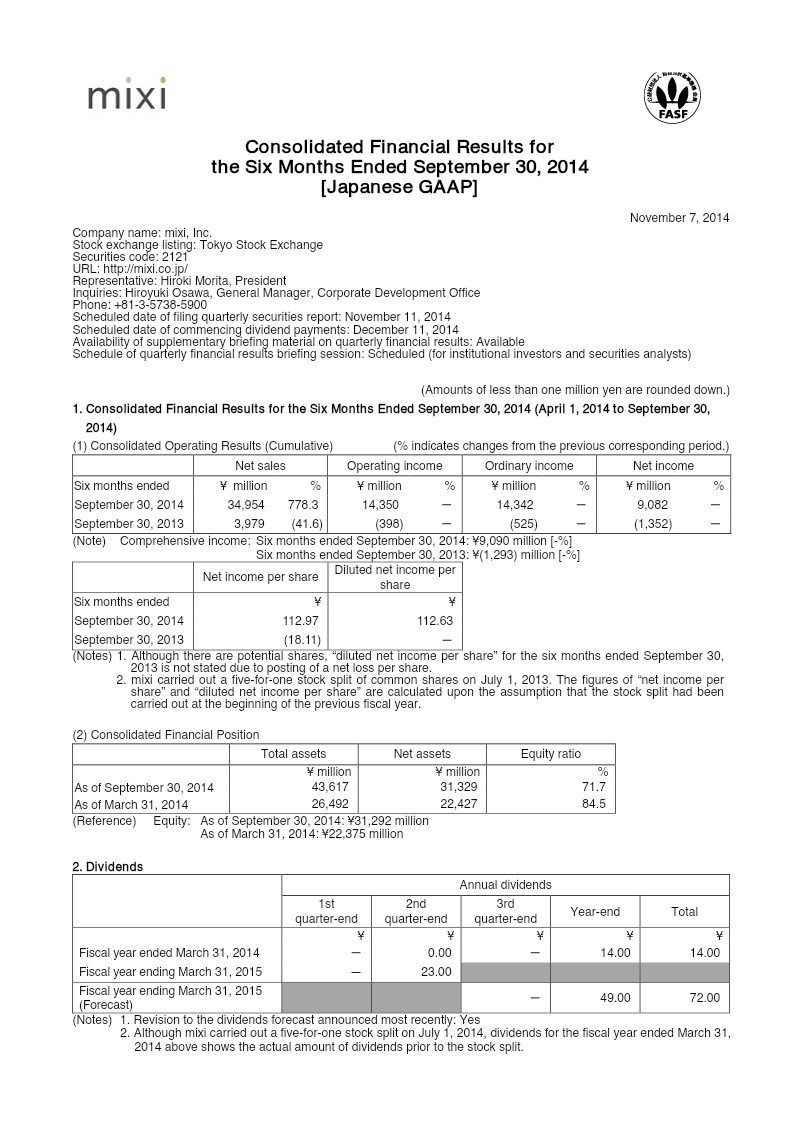
Consolidated Financial Results for the Six Months Ended September 30, 2014: Japan
The consolidated financial results for mixi, Inc. cover the six‑month period from April 1 to September 30, 2014, and provide a forecast for the fiscal year ending March 31, 2015. Net sales surged to ¥34,954 million from ¥3,979 million in the same period a year earlier, reflecting a 778.3 % increase driven by expanded media and content offerings. Operating income rose to ¥14,350 million from a loss of ¥398 million, and ordinary income reached ¥14,342 million. Net income for the six months amounted to ¥9,082 million, a turnaround from a loss of ¥1,352 million in 2013, and translated into earnings per share of ¥112.97 (diluted ¥112.63). Comprehensive income for the period was ¥9,090 million.
Total assets grew to ¥43,617 million from ¥26,492 million, with net assets increasing to ¥31,329 million and an equity ratio of 71.7 %. Cash and cash equivalents rose to ¥28,549 million, supporting a net cash inflow of ¥11,731 million from operating activities. The company’s dividend policy shifted to quarterly payments, with a forecast of ¥49 million for the fiscal year ending March 31, 2015.
Segment analysis shows that the Media & Content Business and Life Events Business now comprise the primary revenue drivers, with significant company‑wide expense adjustments of ¥893 million. No changes in consolidation scope or accounting policies were reported, and the forecasted full‑year net sales of ¥100,000 million represent a 722.6 % increase over the prior year. The results indicate robust growth in user engagement and monetization, positioning mixi for continued expansion within Japan’s social networking and digital media markets.
- Mixi, Inc. reported a 778.3% increase in net sales to ¥34,954 million for the six months ending September 30, 2014, compared to ¥3,979 million in the same period the previous year.
- The company achieved a significant financial turnaround, reporting a net income of ¥9,082 million for the period, compared to a net loss of ¥1,352 million in 2013.
- Operating income reached ¥14,350 million for the six-month period, a substantial improvement over the ¥398 million loss recorded in the prior year.
- Management forecasts full-year net sales of ¥100,000 million for the fiscal year ending March 31, 2015, representing a projected 722.6% increase over the prior year.
- The company maintains a strong balance sheet with total assets of ¥43,617 million and an equity ratio of 71.7%.
+1
mixi
Report2 pages
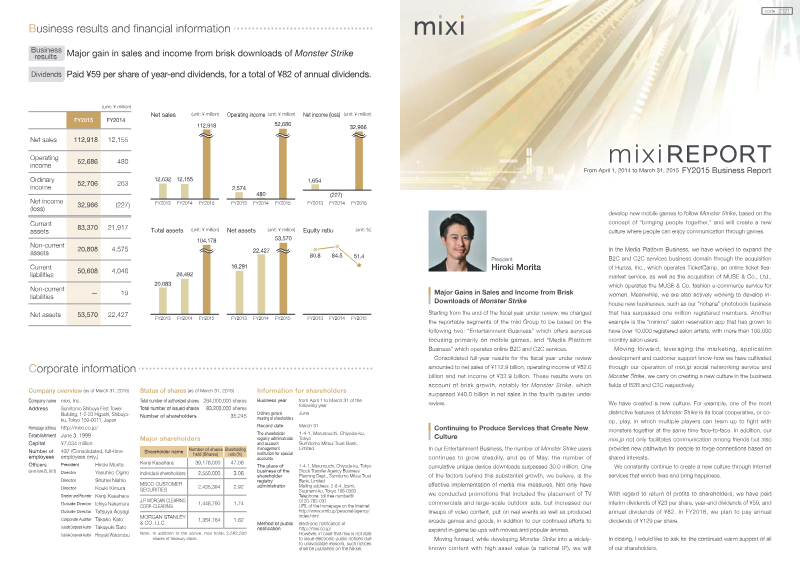
FY2015 Annual Business Report: MIXI
The FY2015 annual report demonstrates that mixi, Inc.’s core revenue engine remains the mobile game Monster Strike, which generated ¥112.9 billion in net sales and ¥52.7 billion of operating income, a 30‑plus percent increase over FY2014. Net profit rose to ¥32.9 billion, reversing the prior year’s loss, and dividends were raised to ¥59 per share (¥82 total). The company attributes the surge to Monster Strike’s rapid download growth—over 30 million cumulative unique device downloads—and its expansion into new markets, including China, South Korea, North America, and Hong Kong/Macau. Strategic media‑mix initiatives such as TV commercials, outdoor advertising, and in‑game tie‑ups with movies and anime have reinforced user acquisition and retention.
Beyond Monster Strike, mixi diversified its portfolio through acquisitions of Hunza, Inc. (TicketCamp) and MUSE & Co., Ltd. (fashion e‑commerce), strengthening its B2C and C2C services segment. The company also launched several new mobile titles in FY2015, including “nohana” photo‑sharing and “Kimidake LIVE,” a live‑streaming platform for artists, targeting family and children audiences. A planned annual release of one new game each year signals a sustained focus on in‑house development.
Financially, total assets stood at ¥104.2 billion with an equity ratio of 51.4 %. The report outlines a forward‑looking strategy that leverages mixi’s social networking foundation, media‑mix expertise, and newly acquired IPs to broaden its entertainment and platform businesses while continuing to deliver shareholder value through dividends.
- Monster Strike served as the primary revenue driver, generating ¥112.9 billion in net sales and ¥52.7 billion in operating income, representing a growth of over 30% compared to FY2014.
- The company returned to profitability with a net profit of ¥32.9 billion, leading to an increased dividend payout of ¥59 per share.
- Monster Strike achieved over 30 million cumulative unique device downloads and expanded its international footprint into China, South Korea, North America, and Hong Kong/Macau.
- Strategic diversification efforts included the acquisitions of Hunza, Inc. (TicketCamp) and MUSE & Co., Ltd. to bolster the company's B2C and C2C service segments.
- The company maintained a strong financial position with total assets of ¥104.2 billion and an equity ratio of 51.4%.
+1
mixi
Financial10 pages
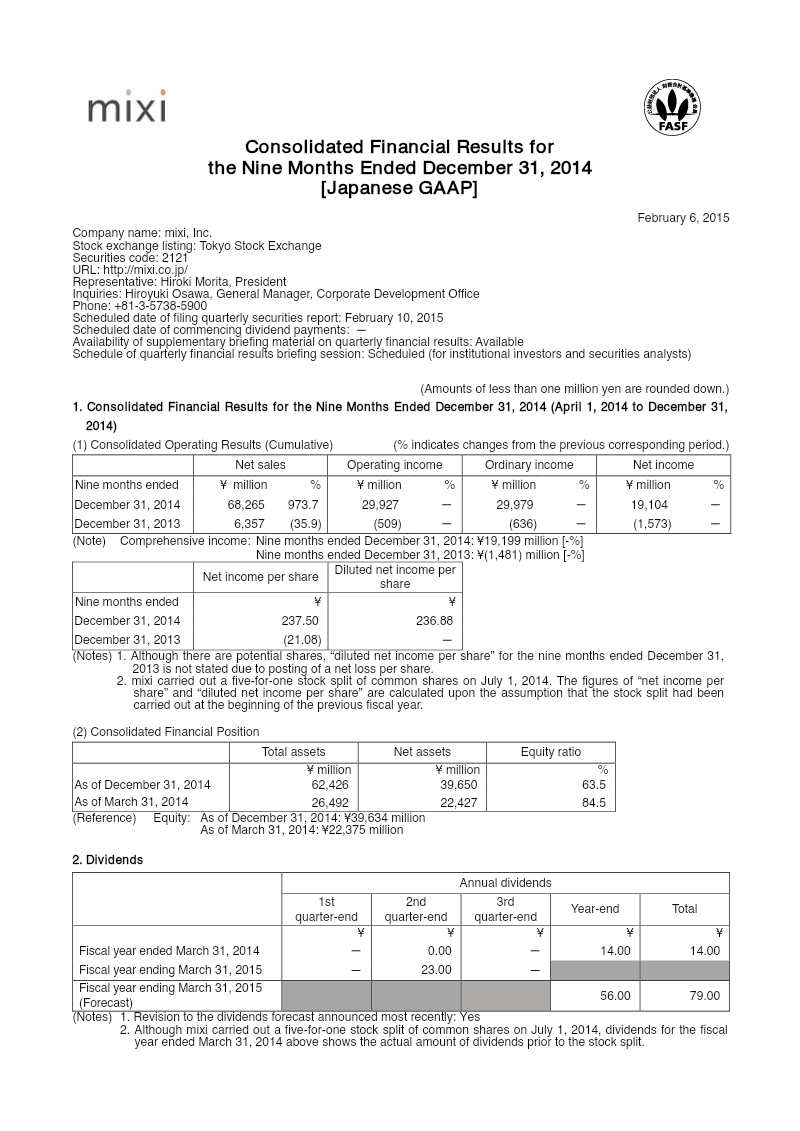
Consolidated Financial Results for the Nine Months Ended December 31, 2014: Japan
The nine‑month financial results for mixi, Inc., covering April 1 to December 31 2014, demonstrate a dramatic turnaround from the prior year. Net sales surged 973.7 % to ¥68,265 million, driven by a sharp increase in external customer sales across the Media & Content and Life Events businesses. Operating income rose to ¥29,927 million from a loss of ¥509 million in the same period last year, resulting in an ordinary income of ¥29,979 million and a net profit of ¥19,104 million. Comprehensive income for the period was ¥19,199 million, compared with a loss of ¥1,481 million the previous year. Net income per share reached ¥237.50 (diluted ¥236.88) versus a loss of ¥21.08 per share in 2013.
Total assets expanded from ¥26,492 million to ¥62,426 million, while equity grew from ¥22,238 million to ¥39,402 million, raising the equity ratio to 63.5 % from 84.5 %. Cash and cash equivalents increased markedly, ending the period at ¥42,065 million. The company’s liquidity improved as current liabilities rose to ¥22,771 million, largely due to higher accounts payable and tax provisions.
The forecast for the fiscal year ending March 31 2015 projects net sales of ¥110,000 million and a net income of ¥32,000 million. No changes in accounting policies or significant subsidiaries were reported for the nine‑month period, and a five‑for‑one stock split on July 1 2014 was accounted for in per‑share calculations. The results reflect mixi’s strategic realignment of reportable segments and expansion into new business areas, underpinning its return to profitability.
- Mixi, Inc. achieved a significant financial turnaround for the nine months ending December 31, 2014, with net sales surging 973.7% to ¥68,265 million compared to the prior year.
- The company shifted from an operating loss of ¥509 million in the previous year to an operating income of ¥29,927 million, resulting in a net profit of ¥19,104 million.
- Net income per share reached ¥237.50 for the period, a stark recovery from the ¥21.08 loss per share recorded in 2013.
- Total assets more than doubled to ¥62,426 million, with cash and cash equivalents rising to ¥42,065 million by the end of December 2014.
- The company projects full-year net sales of ¥110,000 million and a net income of ¥32,000 million for the fiscal year ending March 31, 2015.
+1
mixi
Financial26 pages
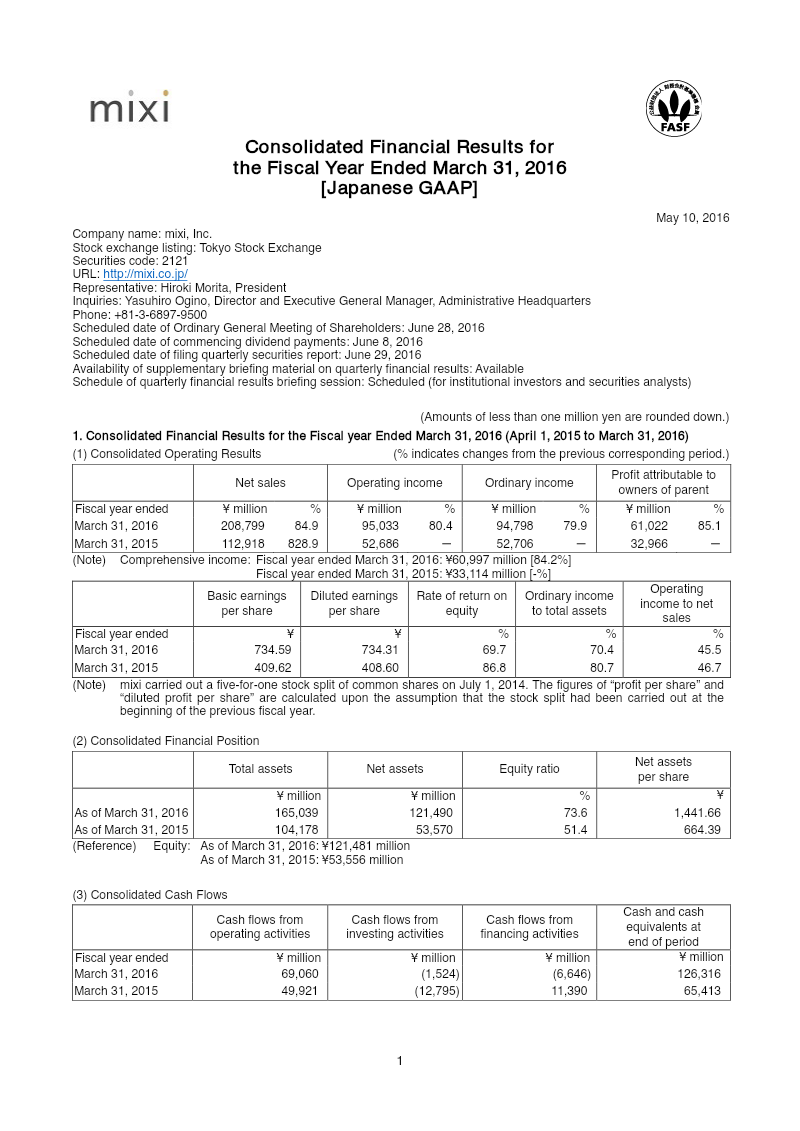
Consolidated Financial Results for the Fiscal Year Ended March 31, 2016: Japan
Consolidated Financial Results for the Fiscal Year Ended March 31, 2016 Stock exchange listing: Tokyo Stock Exchange Representative: Hiroki Morita, President Inquiries: Yasuhiro Ogino, Director and Executive General Manager, Administrative Headquarters Scheduled date of Ordinary General Meeting of Shareholders: June 28, 2016 Scheduled date of commencing dividend payments: June 8, 2016 Scheduled date of filing quarterly securities report: June 29, 2016 Availability of supplementary briefing mater...
- mixi, Inc. reported a significant increase in total net assets, growing from ¥53,570 million in FY2015 to ¥121,490 million in FY2016, driven by substantial growth in retained earnings (from ¥40,744 million to ¥91,112 million) and capital surplus (from ¥7,007 million to ¥20,427 million).
- The company's total liabilities decreased from ¥50,608 million in FY2015 to ¥43,548 million in FY2016, primarily due to the elimination of short-term loans payable (¥13,348 million in FY2015).
- mixi acquired Hunza, Inc. (100% voting rights) on March 31, 2015, to expand into the online ticket flea-market service, aiming to leverage its know-how from "mixi.jp" and "Monster Strike" to accelerate growth in the live entertainment market.
- mixi also acquired MUSE & Co., Ltd. to enter the fashion commerce market, targeting females with a smartphone-centric flash sales service, recognizing the rapid expansion of the Japanese smartphone commerce market.
- The company recorded an impairment loss of ¥199 million in FY2015 related to the Media Platform Business, specifically on goodwill for mixi research, Inc., due to unfulfilled revenue expectations.
+1
mixi
Financial22 pages
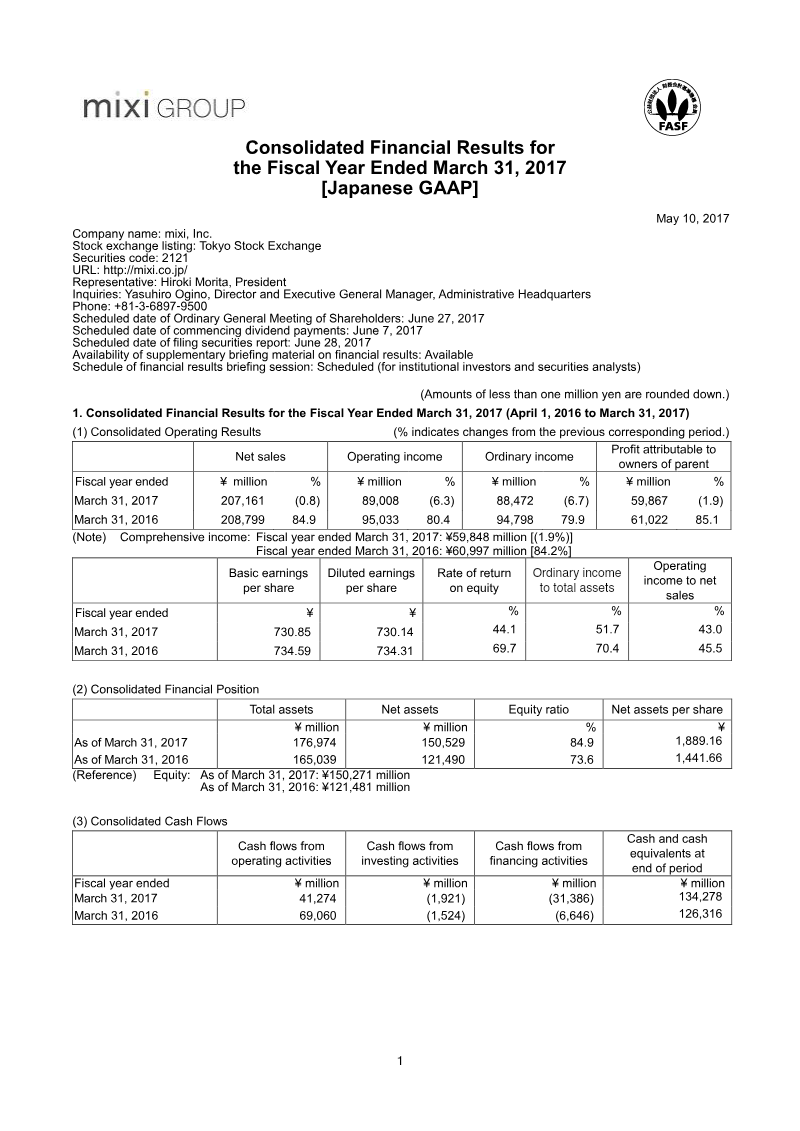
Consolidated Financial Results for the Fiscal Year Ended March 31, 2017: Japan
Consolidated Financial Results for the Fiscal Year Ended March 31, 2017 Stock exchange listing: Tokyo Stock Exchange Representative: Hiroki Morita, President Inquiries: Yasuhiro Ogino, Director and Executive General Manager, Administrative Headquarters Scheduled date of Ordinary General Meeting of Shareholders: June 27, 2017 Scheduled date of commencing dividend payments: June 7, 2017 Scheduled date of filing securities report: June 28, 2017 Availability of supplementary briefing material on fin...
- mixi, Inc. reported consolidated net sales of ¥207,161 million for the fiscal year ended March 31, 2017, a slight decrease of 0.8% from the previous year.
- Operating income for mixi, Inc. decreased by 6.3% to ¥89,008 million, and ordinary income decreased by 6.7% to ¥88,472 million for the fiscal year ended March 31, 2017.
- Profit attributable to owners of parent for mixi, Inc. was ¥59,867 million, a 1.9% decrease compared to the previous fiscal year.
- mixi, Inc. forecasts a decline in performance for the fiscal year ending March 31, 2018, with projected net sales of ¥200,000 million (down 3.5%), operating income of ¥70,000 million (down 21.4%), and profit attributable to owners of parent of ¥48,000 million (down 19.8%).
- The company paid total annual dividends of ¥147.00 per share for both the fiscal years ended March 31, 2016 and March 31, 2017.
mixi
Financial46 pages
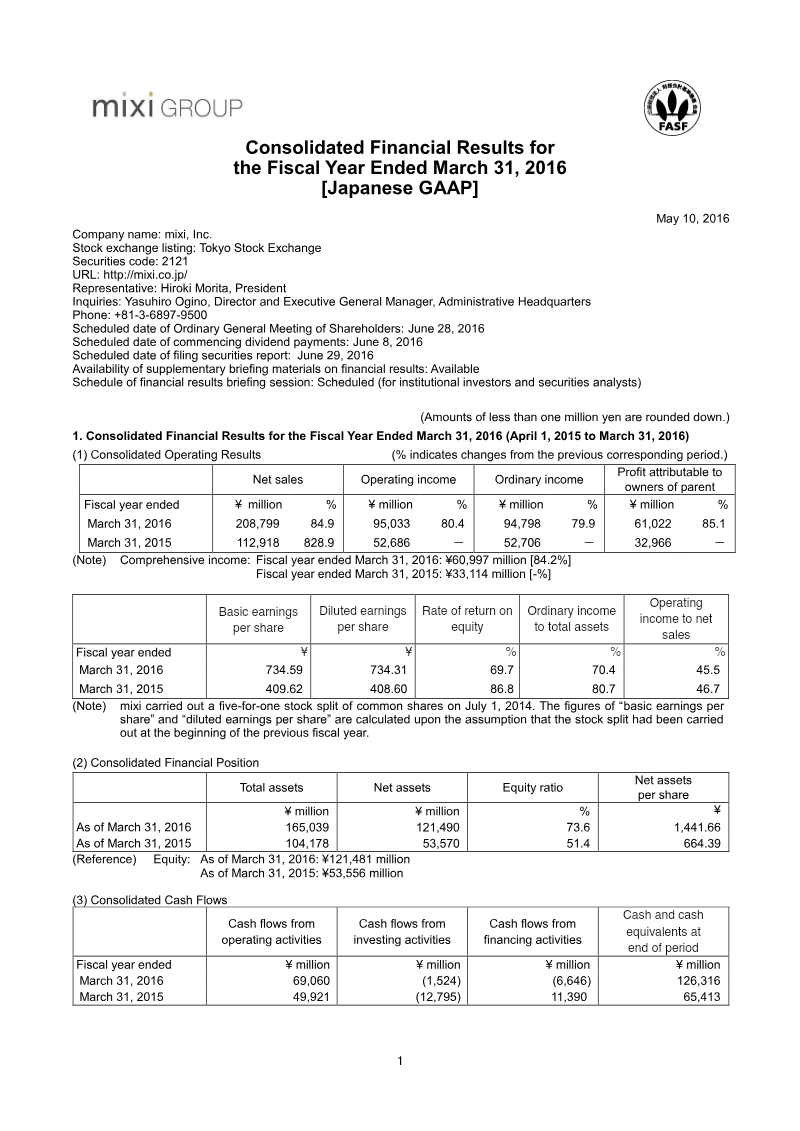
Consolidated Financial Results: Fiscal Year Ended March 31, 2016
Consolidated Financial Results for the Fiscal Year Ended March 31, 2016 Stock exchange listing: Tokyo Stock Exchange Representative: Hiroki Morita, President Inquiries: Yasuhiro Ogino, Director and Executive General Manager, Administrative Headquarters Scheduled date of Ordinary General Meeting of Shareholders: June 28, 2016 Scheduled date of commencing dividend payments: June 8, 2016 Scheduled date of filing securities report: June 29, 2016 Availability of supplementary briefing materials on fi...
- mixi, Inc. experienced significant growth in the fiscal year ended March 31, 2016, with net sales increasing by 84.9% to ¥208,799 million, operating income up 80.4% to ¥95,033 million, and profit attributable to owners of parent rising 85.1% to ¥61,022 million.
- The company's cash and deposits more than doubled, growing from ¥65,413 million in FY2015 to ¥126,316 million in FY2016, indicating strong cash generation.
- Net cash provided by operating activities increased substantially from ¥49,921 million in FY2015 to ¥69,060 million in FY2016.
- Goodwill, primarily from the acquisition of Hunza, Inc., was a significant intangible asset, initially ¥11,934 million and finalized at ¥11,577 million after revisions, and is being amortized over 8 years.
- mixi plans to repurchase up to 3,000,000 shares (3.56% of total outstanding shares) for a maximum of ¥10,000,000,000 between May 11, 2016, and September 30, 2016, via market purchases on the Tokyo Stock Exchange.
+2
mixi