Global reports and market data
Documents
AI-Supported Feedback, Team Dynamics and Coaching in Hospitality Management Simulation
This study examines how AI-supported feedback, team dynamics, and lecturer coaching shape student learning in a hospitality management simulation at a Portuguese higher education institution.
- Team dynamics were the strongest correlate of perceived learning (ρ = .705, p = .007) and of skills development in the hospitality management simulation, while simulator earnings showed only weak relationships with learning outcomes.
- The study's central argument is that the educational value of the simulation lies more in the social and reflective processes surrounding feedback than in the AI feedback itself or in competitive ranking.
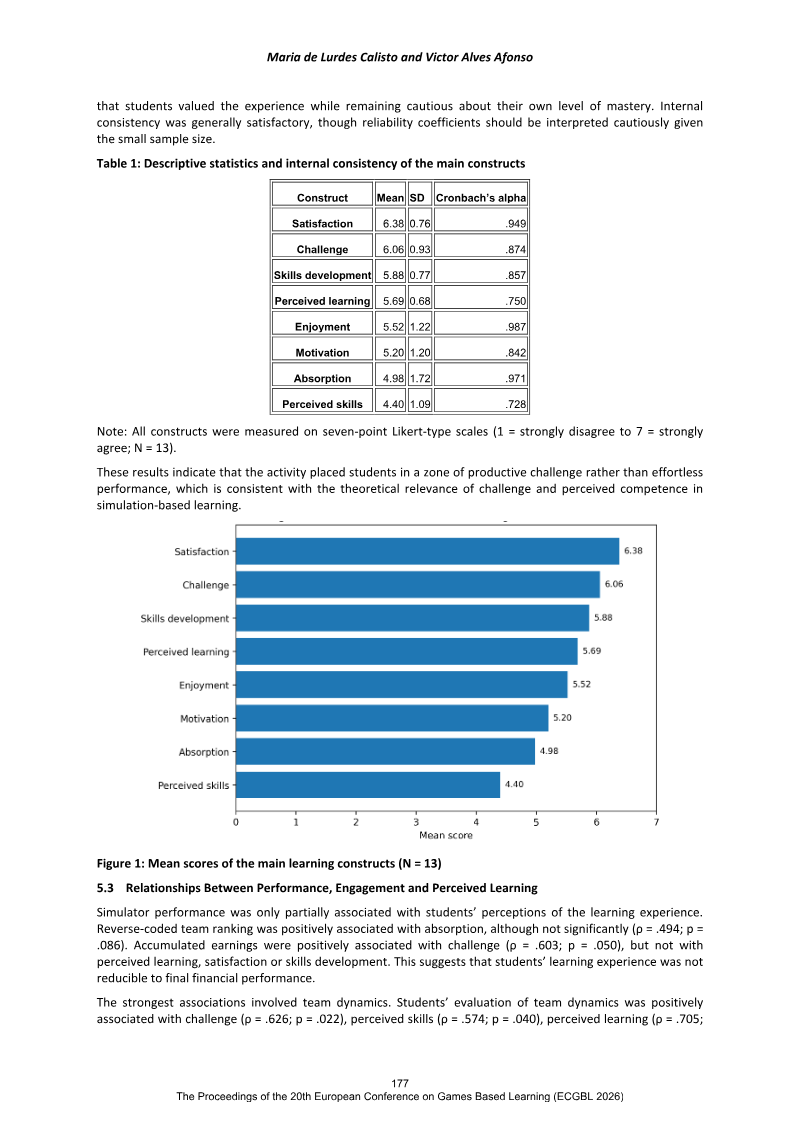
- Respondents reported high satisfaction, challenge, perceived learning, and skills development, based on survey responses from 13 undergraduates (65% of a 20-participant cohort) at a Portuguese higher education institution.
Learning AI Ethics through Game Design as Ethical Inquiry
This study examines whether facilitated participatory tabletop game making can help learners explore the AI responsibility gap, the difficulty of assigning clear responsibility when autonomous or learning systems contribute to outcomes that humans cannot fully predict or control.
- The study examines the AI responsibility gap: the difficulty of assigning clear responsibility when autonomous or learning systems contribute to outcomes humans cannot fully predict or control.
- Fifteen computing-related students at one UK university took part in a qualitative sequence of autonomous-driving cases, collaborative tabletop game design, prototype playtesting, and debriefing.
- Participants moved from broad claims about shared responsibility to specific design questions about which actors could act, when, and from what position, exposing unstated assumptions such as whether a role had the capacity to take an action.
Design Principles for a Digital Game to Address Mathematics Anxiety in the Classroom
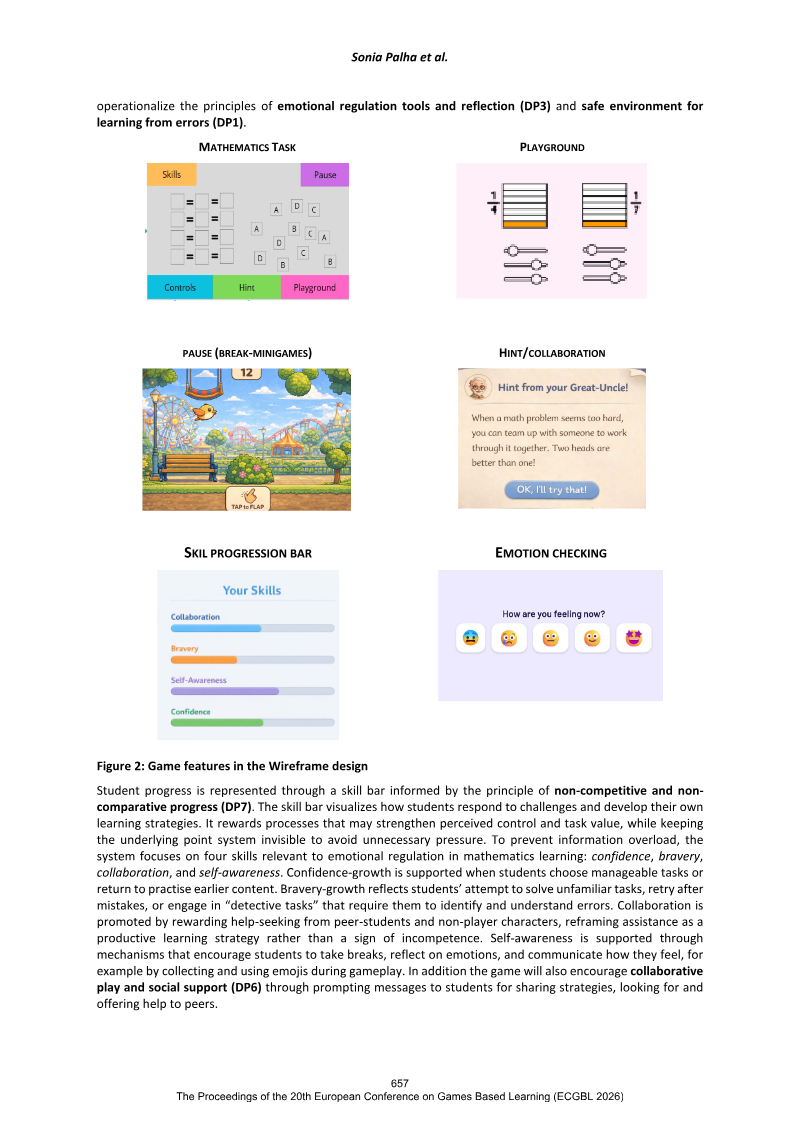
This paper presents the design rationale and early stakeholder evaluation of MathifyMe, a browser-based digital game intended to reduce mathematics anxiety among students aged 7 to 16.
- The paper presents MathifyMe, a browser-based game for students aged 7 to 16 designed to reduce mathematics anxiety, grounded in Control-Value Theory and seven design principles from prior work.
- The authors argue most existing educational games do not explicitly target math anxiety, which limits their impact on the emotional, cognitive, and motivational dimensions of the problem.
- The study examined how design principles were translated into a static wireframe and how stakeholders perceived that translation, not whether the game actually reduces anxiety.
AI-Supported Adjudication in Educational Wargames: Integrating LLMs for Strategic-Level Simulations
This paper examines the use of large language models to support adjudication in educational strategic wargames, arguing that AI can function as a constrained analytical layer rather than an autonomous decision-maker.
- The paper argues AI should act as a constrained analytical layer rather than an autonomous decision-maker in educational wargames, using a case study of 'Arctic Hybrid 2026' at the Bundeswehr Command and Staff College (February 2026) with eighteen participants in six teams.
- AI adjudication, triangulated across three human White Cell reviewers in a five-stage workflow, showed no significant difference from human adjudicators when deployed in its constrained role, and the authors claim grounding in curated source corpora contained hallucination risk to acceptable levels.
- AI non-player characters tended to act as outcome harmonisers, smoothing extreme or irrational behaviour, which shaped simulated outcomes toward moderation.
Off-Course: The Mystery of Teaching Higher Mathematics to Vocational Aeronautic Students
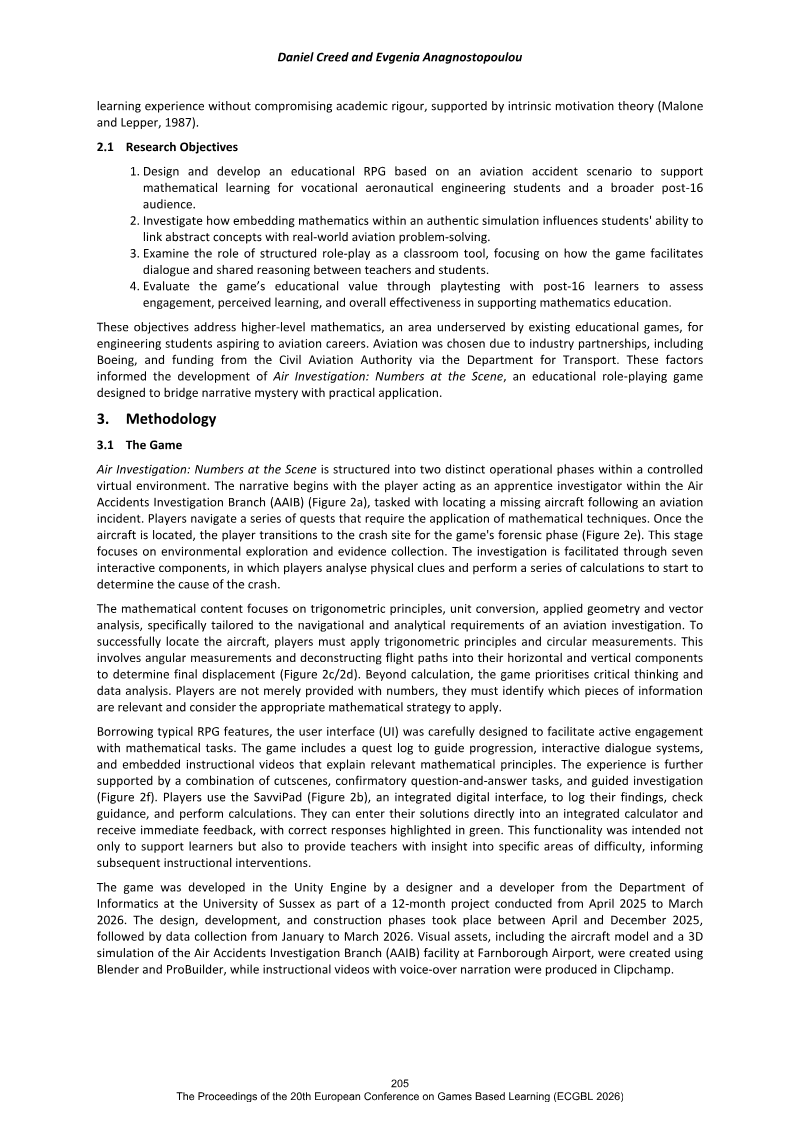
A prototype educational role-playing game, "Air Investigation: Numbers at the Scene," embeds higher-level mathematics, including trigonometry, unit conversion, and vector analysis, within an aviation accident investigation scenario designed for vocational aeronautic students.
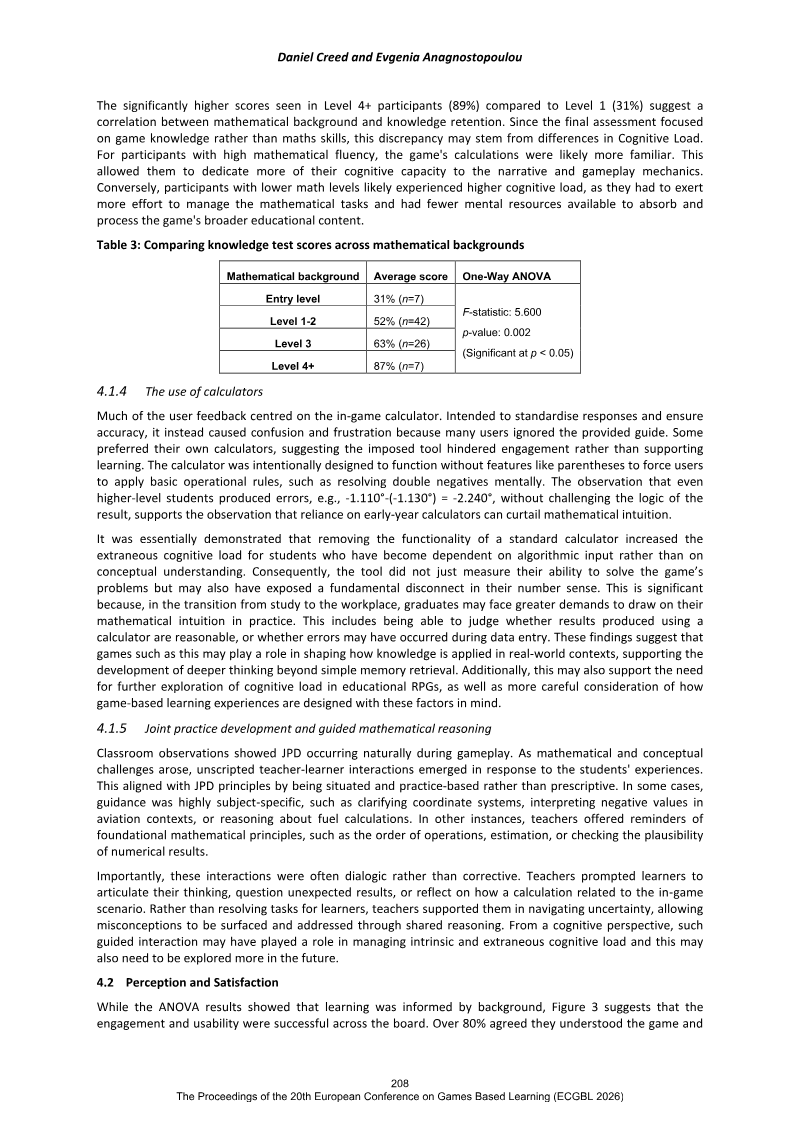
- Prior mathematical proficiency was the strongest predictor of performance: learners with entry-level maths averaged about 31 percent on the knowledge test, versus roughly 87 percent for those at Level 4 and above, a statistically significant difference.
- Narrative engagement alone did not overcome gaps in prior attainment, so the authors argue that pedagogical content must be paired with design work on interface and technical feasibility.
- Engagement was high in a study of 306 post-16 vocational learners: over 80 percent said they understood the game, about 70 percent enjoyed it, and learners rated the aviation accident scenario as authentic.
Imagined Worlds, Real Learning: Worldbuilding as Pedagogical Design
This paper proposes collaborative worldbuilding as a pedagogical design approach within game-based learning (GBL), arguing that the fictional systems surrounding gameplay, such as cultures, institutions, and environments, are underexplored sites of learning.
- The paper proposes "fictional systems pedagogy," a framework in which learners co-construct imagined worlds (cultures, institutions, environments) as settings for inquiry, experimentation, and collective sensemaking within game-based learning.
- It identifies five learning affordances (systems thinking, critical reflection, creative problem-solving, productive fictional distance, and collective sensemaking) and translates them into five design principles, including prioritising system coherence and designing for iteration.
- Fictional systems are distinguished from narrative and simulation by their openness to learner reconfiguration, and worldbuilding can precede, accompany, or stand apart from gameplay.



Designing for Early Civic Agency: A Board Game for Civic Engagement in Kindergarten
This work-in-progress paper presents the design and initial expert review of "Become Mayor" (Γίνε Δήμαρχος), an original educational board game for kindergarten children aged 4 to 6.
- "Become Mayor" is an original board game for kindergarten children aged 4 to 6 designed to build early civic agency by turning local governance, civic engagement, and the UN Sustainable Development Goals into play.
- The game is grounded in Greece's "Civic Actions" curriculum, which embeds civic competencies from early childhood, and in the difficulty of conveying socio-political ideas to preschool learners.
- The design combines constructivist, game-based learning principles with the MDA (Mechanics, Dynamics, Aesthetics) framework, pairing a nine-dimension civic engagement taxonomy with the 17 SDGs.
Investigating the Role-Play Technique in Educational Game Designing Process
This study investigates whether structured role-play can surface the tacit design knowledge that primary school teachers and professional game designers hold when creating educational games.
- The study uses structured role-play, in which teachers and game designers swap roles during co-design workshops, to surface the tacit design knowledge each group holds when creating educational games.
- Three paired co-design workshops conducted over Zoom with six Australian participants found that teachers prioritised curriculum alignment, differentiation for diverse learners, immediate positive feedback, progress tracking, and student autonomy.
- Designers, in turn, contributed expertise in mechanics, narrative, and interface, and in the first role-play they drew out specific teacher requirements such as positive reinforcement and gradual progression, suggesting the two groups hold complementary knowledge.
Inventory of Digital Game-Based Learning Practices for Chemistry Education: A Systematic Review
This work-in-progress systematic review, conducted by researchers at the University of Liège, aims to map digital game-based learning (DGBL) practices in chemistry education from secondary through higher education.
- The review is a work-in-progress systematic review from the University of Liège that maps digital game-based learning (DGBL) in chemistry education from secondary through higher education, deliberately narrowing scope to digital media and excluding board games, escape rooms, and gamified activities.
- A key premise is that prior reviews conflated game-based learning with gamification, so the authors require a pure game-based approach distinct from gamification as an eligibility criterion.
- The PRISMA 2020-guided search covered ERIC, Scopus, EBSCO, and two chemistry education journals, plus snowball searching and grey literature, yielding 2,673 initial records and 2,242 remaining after duplicate removal and automated exclusion.



Learning Through Dissonance: Modeling Cognitive Conflict in Narrative-Driven Educational Games
This paper presents a design-stage prototype that operationalises Festinger's theory of cognitive dissonance as playable mechanics within a mobile interactive narrative for educational games.
- The paper argues that serious games usually treat psychological concepts as atmospheric backdrop, and proposes making cognitive dissonance a computable, playable mechanic instead.
- The prototype tracks three variables: Belief Strength (how firmly a player holds a declared value), Cognitive Strain (which accumulates from belief-action conflicts and compounds over time), and a Persona Dominance Ratio that reshapes the inner voices a player encounters as a coping pattern stabilises.
- Three labelled reduction pathways (behaviour change, belief revision, and justification) are offered as explicit choices, and justification is noted to erode belief strength the most while giving the greatest immediate strain relief.
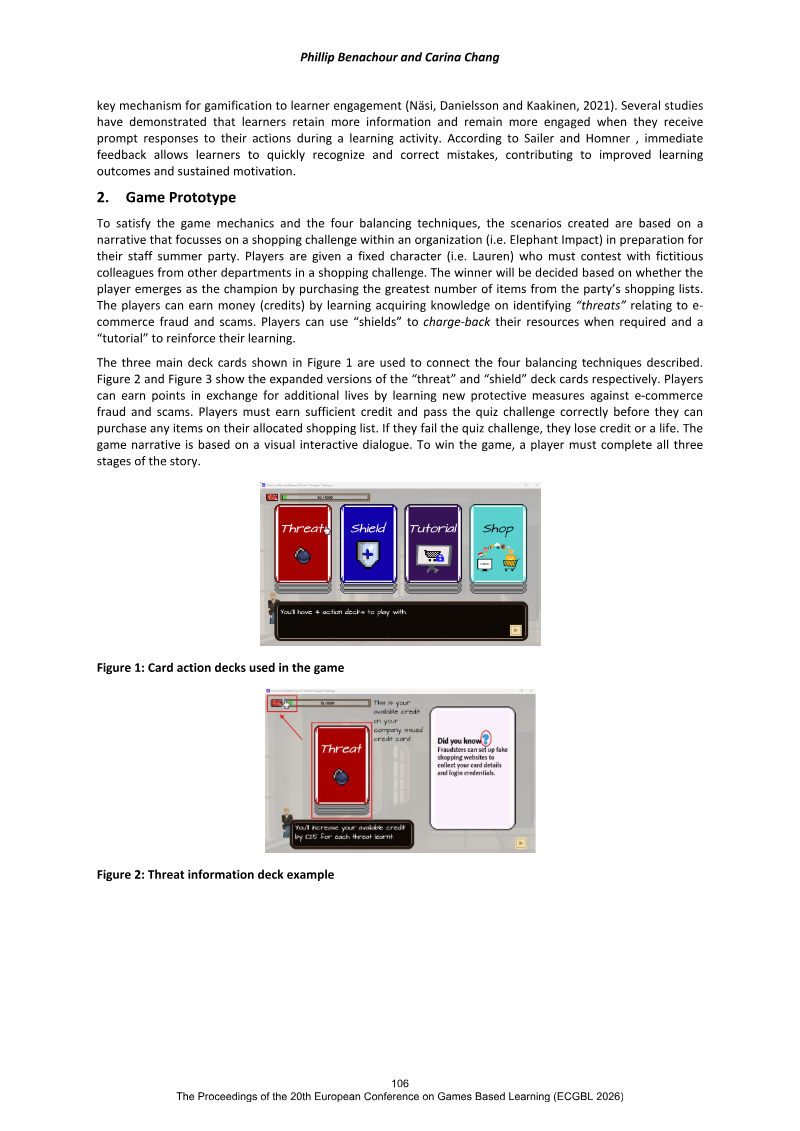
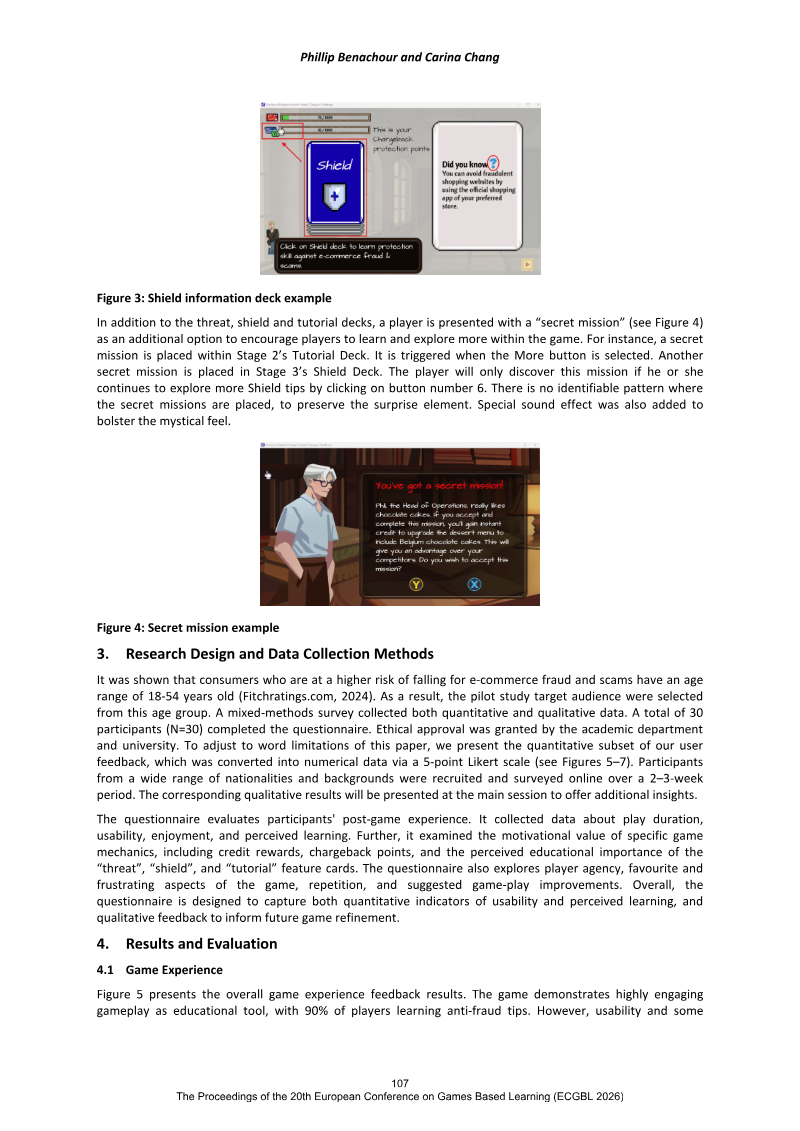
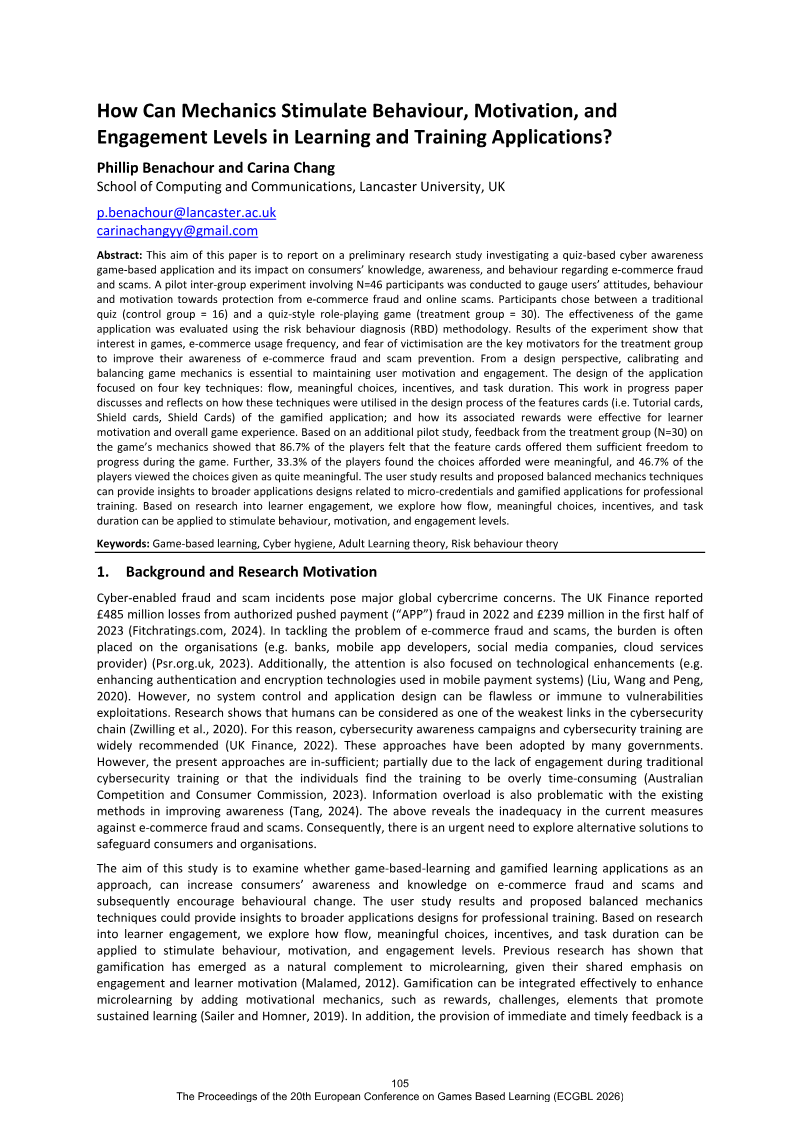
How Can Mechanics Stimulate Behaviour, Motivation, and Engagement Levels in Learning and Training Applications?
This pilot study examines whether a quiz-based, game-based cyber awareness application can improve consumers' knowledge, awareness, and behaviour regarding e-commerce fraud and online scams.
- A pilot study with 46 participants found that a quiz-style role-playing game on e-commerce fraud (30 in the game group, 16 in a traditional quiz control group) was a viable learning tool, with interest in games, frequency of e-commerce use, and fear of victimisation as the main motivators.
- In the treatment group, 90% reported learning anti-fraud tips and 86.7% felt they had sufficient freedom to progress through the game.
- Only 33.3% of players rated the in-game choices as meaningful, with another 46.7% rating them as quite meaningful, and the overall fun rating was moderate at 3.6 out of 5.



Building Digital Educational Escape Rooms: A Modular Toolkit With Low-Code Authoring Approach
This work in progress paper introduces the DEER-Wizard, a low-code authoring tool designed to let non-technical educators create Digital Educational Escape Rooms (DEERs) without programming knowledge.
- The paper introduces DEER-Wizard, a low-code tool that lets non-technical educators build Digital Educational Escape Rooms through a four-step configuration (pre-configuration, resource preparation, riddle configuration, and game structure) without programming knowledge.
- The authors argue DEER adoption is limited because existing authoring tools either lack expressiveness or require technical skill, and DEER-Wizard is designed to resolve this power-usability dilemma.
- The Wizard feeds a DEER-Generator that outputs a playable 2D multiplayer dungeon crawler built on the DEER-Toolkit, supporting cooperative play for two to six players with xAPI-based learning analytics.