Updated Mar 23, 2026 by Koei Tecmo
Report
Published by Koei Tecmo
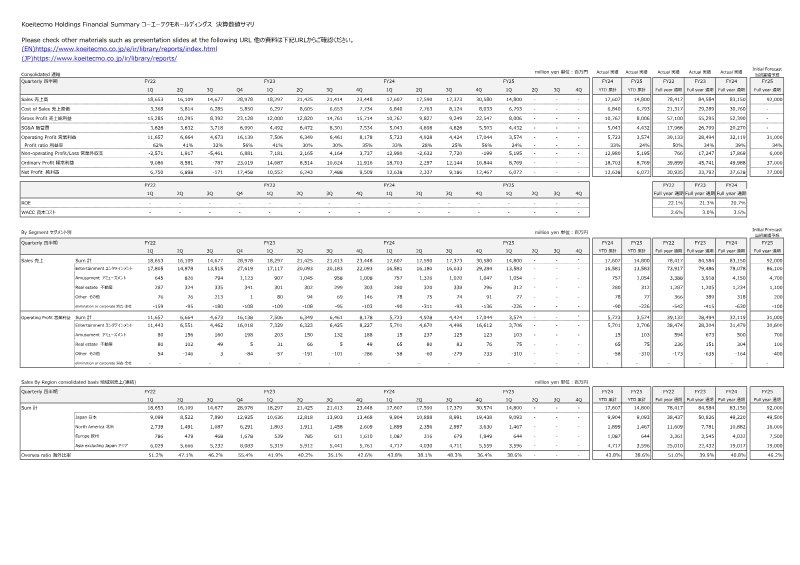
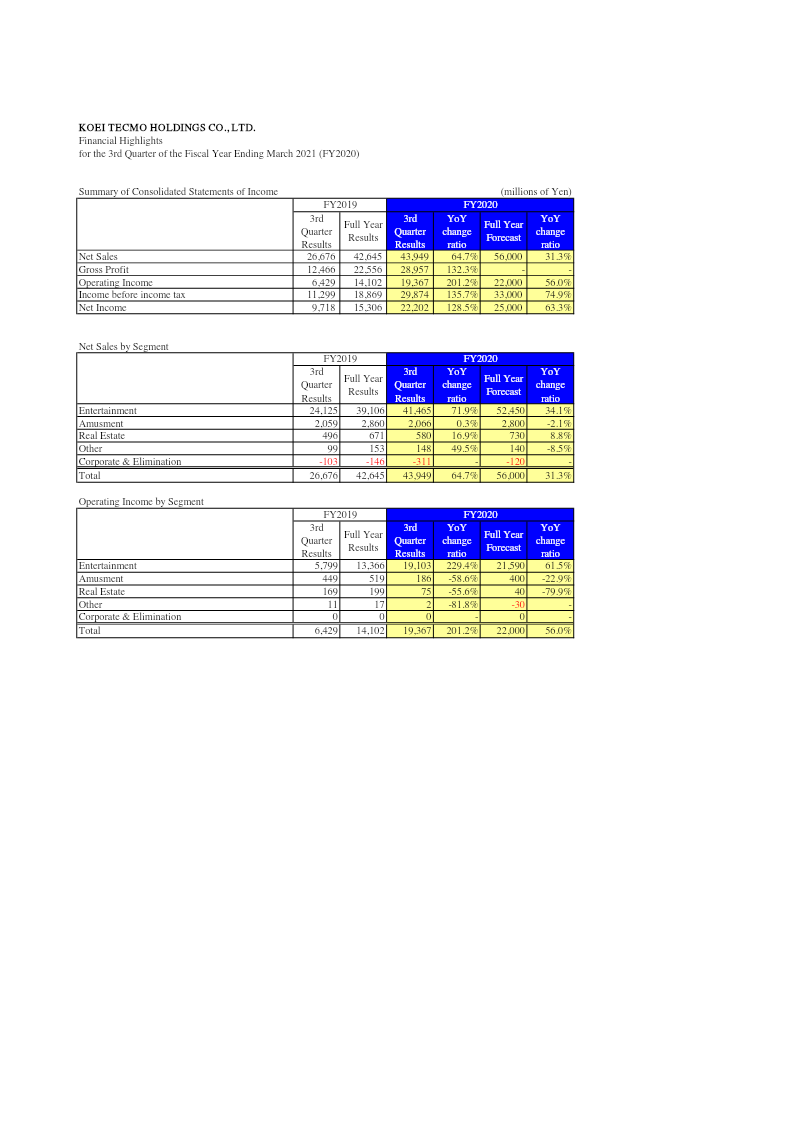
Koei Tecmo Holdings reported a robust third‑quarter performance for fiscal year 2020, with net sales rising 64.7 % to ¥42.6 billion from ¥26.7 billion in the same period of FY2019, and net income increasing 128.5 % to ¥15.3 billion. The entertainment segment drove growth, contributing 71.9 % of sales and delivering a 229.4 % increase in operating income, while amusement and real‑estate segments showed modest gains or declines. Forecasts for the full year projected sales of ¥56 billion and operating income of ¥22 billion, reflecting a 31.3 % and 56.0 % year‑on‑year increase, respectively. On the balance‑sheet side, total assets expanded from ¥147.8 billion to ¥186.5 billion, largely due to a jump in investment securities from ¥71.4 billion to ¥113.9 billion and a rise in property, plant, and equipment to ¥155.8 billion. Current assets grew modestly, while current liabilities increased slightly, driven by higher short‑term loans and accounts payable. Long‑term liabilities surged to ¥5.1 billion, largely from deferred tax obligations. Shareholders’ equity rose to ¥143.9 billion, supported by retained earnings of ¥103.2 billion and a reduction in treasury stock. The figures cover Japan‑based operations for the fiscal year ending March 31, 2020, with quarterly results compared to FY2019 and full‑year forecasts. Data derive from consolidated financial statements prepared under Japanese GAAP, reflecting a comprehensive view of the company’s operating performance and liquidity position.
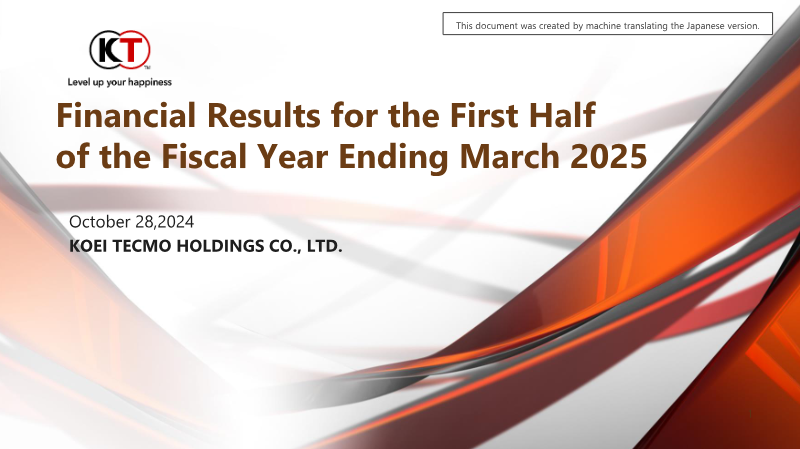
KOEI TECMO HOLDINGS CO., LTD. Financial Highlights for the 3rd Quarter of the Fiscal Year Ending March 2021 (FY2020) Summary of Consolidated Statements of Income (millions of Yen) FY2019 FY2020 3rd Full Year 3rd YoY Full Year YoY Quarter Results Quarter change Forecast change Results Results ratio ratio Net Sales 26,676 42,645 43,949 64.7% 56,000 31.3% Gross Profit 12,466 22,556 28,957 132.3% ‑ ‑ Operating Income 6,429 14,102 19,367 201.2% 22,000 56.0% Income before income tax 11,299 18,869 29,874 135.7% 33,000 74.9% Net Income 9,718 15,306 22,202 128.5% 25,000 63.3% Net Sales by Segment FY2019 FY2020 3rd Full Year 3rd YoY Full Year YoY Quarter Results Quarter change Forecast change Results Results ratio ratio Entertainment 24,125 39,106 41,465 71.9% 52,450 34.1% Amusment 2,059 2,860 2,066 0.3% 2,800 ‑2.1% Real Estate 496 671 580 16.9% 730 8.8% Other 99 153 148 49.5% 140 ‑8.5% Corporate & Elimination ‑103 ‑146 ‑311 ‑ ‑120 ‑ Total 26,676 42,645 43,949 64.7% 56,000 31.3% Operating Income by Segment FY2019 FY2020 3rd Full Year 3rd YoY Full Year YoY Quarter Results Quarter change Forecast change Results Results ratio ratio Entertainment 5,799 13,366 19,103 229.4% 21,590 61.5% Amusment 449 519 186 ‑58.6% 400 ‑22.9% Real Estate 169 199 75 ‑55.6% 40 ‑79.9% Other 11 17 2 ‑81.8% ‑30 ‑ Corporate & Elimination 0 0 0 ‑ 0 ‑ Total 6,429 14,102 19,367 201.2% 22,000 56.0% 計 営業費用
Consolidated Balance Sheets (millions of Yen) Prior Fiscal Year Current Fiscal Year (as of March 31, 2020) (as of December 31, 2020) Assets Current Assets Cash and time deposits 12,890 9,216 Notes and accounts receivable 11,955 15,068 Marketable securities 337 4,130 Merchandise and Finished goods 97 87 Work in process 4 73 Raw materials 50 80 Other current assets 4,636 2,083 Allowance for bad debts △9 △5 Total current assets 29,963 30,734 Fixed assets Property and equipment Buildings and structures, net 24,545 23,939 Land 14,615 14,615 Construction in progress 9 86 Other, net 1,572 1,411 Total Property and equipment 40,743 40,052 Intangible assets Other 191 253 Total Intangible assets 191 253 Investments and other assets Investment securities 71,350 113,875 Deferred tax assets 4,346 421 Net defined benefit assets - 104 Other 1,196 1,045 Total investments and other assets 76,894 115,446 Total fixed assets 117,829 155,752 Total assets 147,793 186,486 (millions of Yen) Prior Fiscal Year Current Fiscal Year (as of March 31, 2020) (as of December 31, 2020) Liabilities Current liabilities Notes and accounts payable‑trade 1,642 746 Short‑term loans payable 13,000 8,000 Accounts payable‑ other 1,594 7,674 Income taxes payable 3,367 4,393 Accrued bonuses to employees 1,190 756 Accrued bonuses to directors 226 226 Allowance for sales returns 0 0 Allowance for sales discount 144 112 Allowance for customer‑discount points 7 3 Deferred tax liabilities 193 4,339 Other current liabilities
other 1,594 7,674 Income taxes payable 3,367 4,393 Accrued bonuses to employees 1,190 756 Accrued bonuses to directors 226 226 Allowance for sales returns 0 0 Allowance for sales discount 144 112 Allowance for customer‑discount points 7 3 Deferred tax liabilities 193 4,339 Other current liabilities 2,916 3,942 Total current liabilities 24,090 25,854 Long‑term liabilities Net defined benefit liability 199 - Deferred tax liabilities 193 4,339 Provision for loss on litigation 181 - Other long‑term liabilities 781 713 Total long‑term liabilities 1,356 5,053 Total liabilities 25,446 30,907 Net assets Shareholders' equity Common stock 15,000 15,000 Capital surplus 26,881 27,402 Retained earnings 88,758 103,171 Treasury stock △2,036 △1,666 Total shareholders' equity 128,602 143,907 Accumulated other comprehensive income Unrealized gains or losses on securities △3,058 14,580 Unrealized losses on revaluation of the land △3,115 △3,115 Foreign currency translation adjustments 130 403 Remeasurements of defined benefit plans △586 △552 Total accumulated other comprehensive income △6,629 11,316 Share subscription rights 373 354 Total net assets 122,346 155,579 Total liabilities and net assets 147,793 186,486
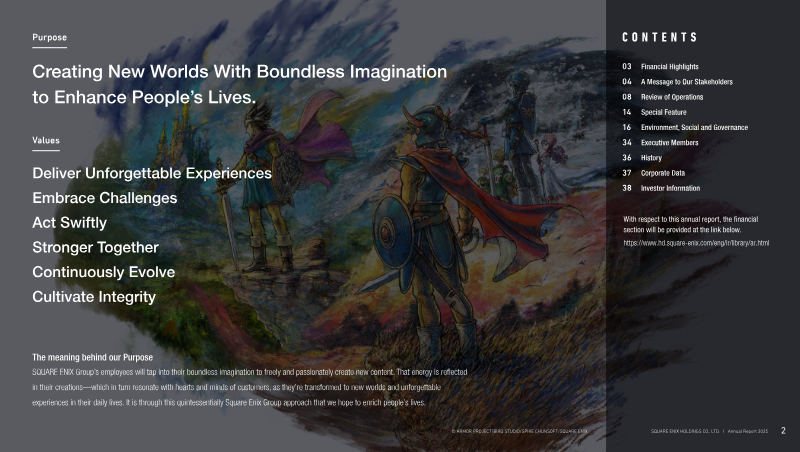
The Square Enix Group operates under a central mission to leverage boundless imagination to create new content that resonates with global audiences and enriches daily lives. This strategic framework emphasizes the delivery of unforgettable experiences through a commitment to innovation, swift action, and collaborative evolution. By focusing on the transformation of creative energy into immersive worlds, the organization aims to maintain its position as a premier provider of entertainment while upholding core values of integrity and continuous improvement. Operational reviews and financial highlights indicate a multifaceted approach to the entertainment industry, spanning digital entertainment, amusement, and publication segments. The organizational structure is designed to support long-term stakeholder value by integrating environmental, social, and governance (ESG) principles into the core business model. This commitment to sustainability and corporate responsibility is presented as a fundamental component of the group’s identity, ensuring that creative pursuits are balanced with ethical operations and transparent governance. The scope of these activities is global, reflecting a history of expansion and a diverse portfolio of intellectual properties. Executive leadership focuses on navigating the evolving landscape of the gaming and media sectors by embracing challenges and fostering a culture of excellence. Through a combination of historical expertise and a forward-looking strategy, the group seeks to sustain its competitive edge and drive growth across all primary business units, ensuring that its creative output remains a significant force in the international market.
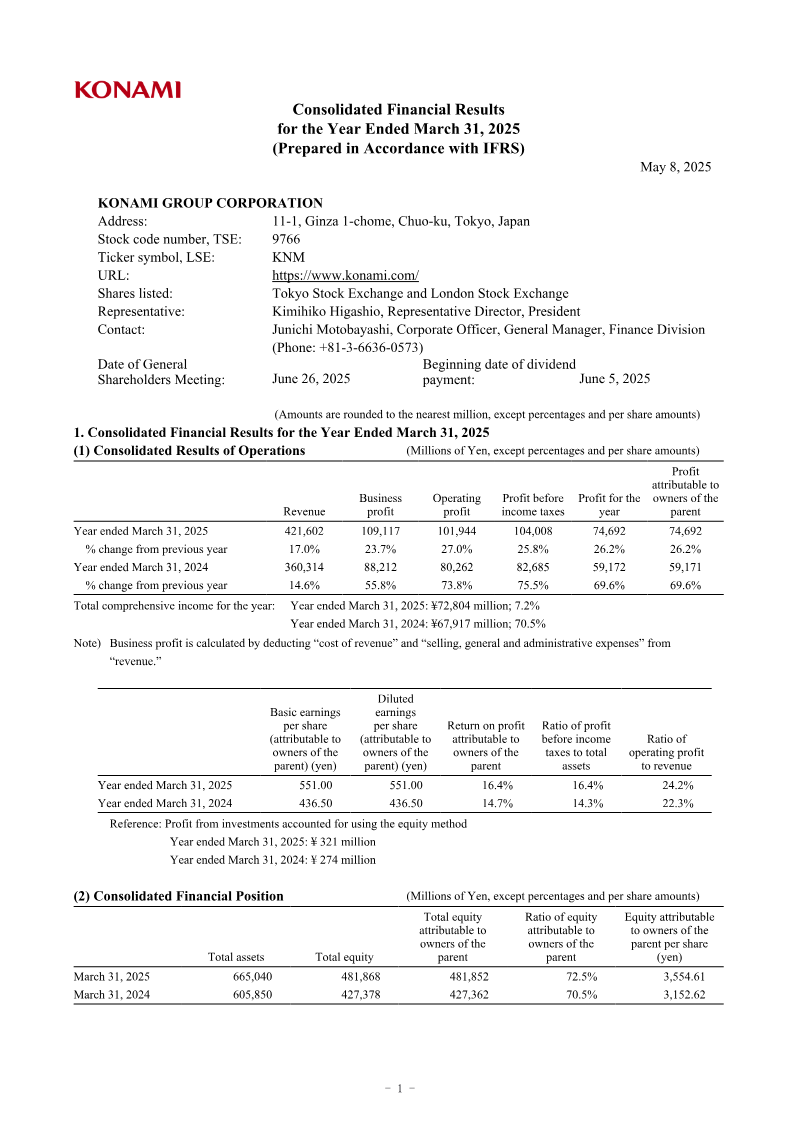
Konami Group Corporation achieved record-breaking financial performance for the fiscal year ending March 31, 2025, characterized by a 17.0% year-on-year revenue increase to ¥421,602 million. This growth trajectory, which marks the second consecutive year of record highs across all profit categories, was primarily propelled by the Digital Entertainment segment. A 22.5% surge in revenue within this division, fueled by the robust performance of key console and mobile titles, solidified its position as the company’s primary financial engine. Operating profit reached ¥101,944 million, reflecting the efficacy of the current business strategy and operational scaling. Diversified growth was evident across other core divisions, with the Gaming & Systems segment recording a 7.4% revenue increase and the Amusement segment growing by 4.6%. Although the Sports segment faced a minor contraction in business profit, the company maintained a resilient financial foundation, concluding the period with ¥294,216 million in cash and cash equivalents. This stability has enabled a shareholder-friendly capital allocation policy, resulting in an increased annual dividend of ¥165.50 per share. Looking toward the fiscal year ending March 31, 2026, the organization maintains a positive outlook, projecting continued expansion. Strategic initiatives for the coming year include the launch of new game titles, the enhancement of casino management system features, and the further scaling of the Pilates Mirror and outsourced sports facility operations. With a dividend increase to ¥166.00 per share already projected, the company remains focused on leveraging its diversified portfolio to sustain long-term profitability and market leadership.
Thunderful Group’s interim report for the first quarter of 2024 details a period of significant financial decline and aggressive corporate restructuring. Net revenue fell 27.7 percent to 391.7 MSEK, while the group recorded an operating loss (EBIT) of 184.4 MSEK, a sharp reversal from the 19.2 MSEK profit reported in the same period the previous year. This downturn was driven by a 35.5 percent revenue drop in the Games segment and a 25.7 percent decrease in Distribution, largely due to weaker market demand for Nintendo Switch products and the underperformance of the internal title SteamWorld Build. To address these challenges, the group initiated a restructuring program aimed at annual cost savings of 90–110 MSEK. This process involved a 72.4 MSEK write-down of capitalized development costs following the cancellation or divestment of twelve game projects. Strategic shifts include the divestment of the German publishing subsidiary Headup GmbH and the sale of Nordic Game Supply’s assets to reduce net debt. Despite these pressures, the group successfully extended its Nintendo distribution agreement for the Nordics and Baltics through March 2026 and reported 13.9 percent growth in its Amo Toys division. The report covers the group’s global operations with a focus on European and Nordic markets for the period of January to March 2024. Financial data indicates a strained liquidity position, with cash and credit facilities dropping to 130.9 MSEK from 329.3 MSEK year-over-year. Management secured a bank waiver conditional on asset divestments and maintains that current funds are sufficient for continued operations. The overarching strategy moving forward emphasizes a simplified games portfolio, more rigorous project validation, and a balanced risk profile across internal and external development.
Bandai Namco’s 2022 integrated report presents a unified growth strategy anchored in the “Fun for All into the Future” purpose, emphasizing an “IP‑axis” model that leverages more than 300 intellectual properties each year across entertainment, toys & hobby, and amusement businesses. The strategy seeks to fuse digital and physical experiences, expand metaverse ecosystems, and deepen global fan engagement, with a particular focus on flagship IPs such as Gundam, Dragon Ball, and Pac‑Man. Financial performance in fiscal 2022 demonstrated the resilience of this model: consolidated net sales reached ¥889.2 billion, operating profit ¥100 billion (a 14.1 % margin), and return on equity 16.9 %, surpassing pre‑COVID levels. Over the past six years, net sales grew from ¥620 billion in FY 2017 to ¥889 billion, assets rose to ¥584 billion, and basic earnings per share more than doubled. The mid‑term plan for FY 2022‑2025 targets ¥1.1 trillion in sales, ¥125 billion in operating profit, a ROE of at least 12 %, and an overseas‑sales share climbing from 29.7 % to 35 % by FY 2025, eventually reaching 50 %. Risk management acknowledges pandemic‑related disruptions, supply‑chain pressures, IP infringement, and cyber threats, while identifying digitalisation, online‑event platforms, and metaverse expansion as key growth levers. Sustainability is embedded as a core pillar, with CO₂ emissions falling 10.6 % to 52,016 t in FY 2022 and a 35 % reduction target by 2030, supported