Game Studies reports and market data
Documents
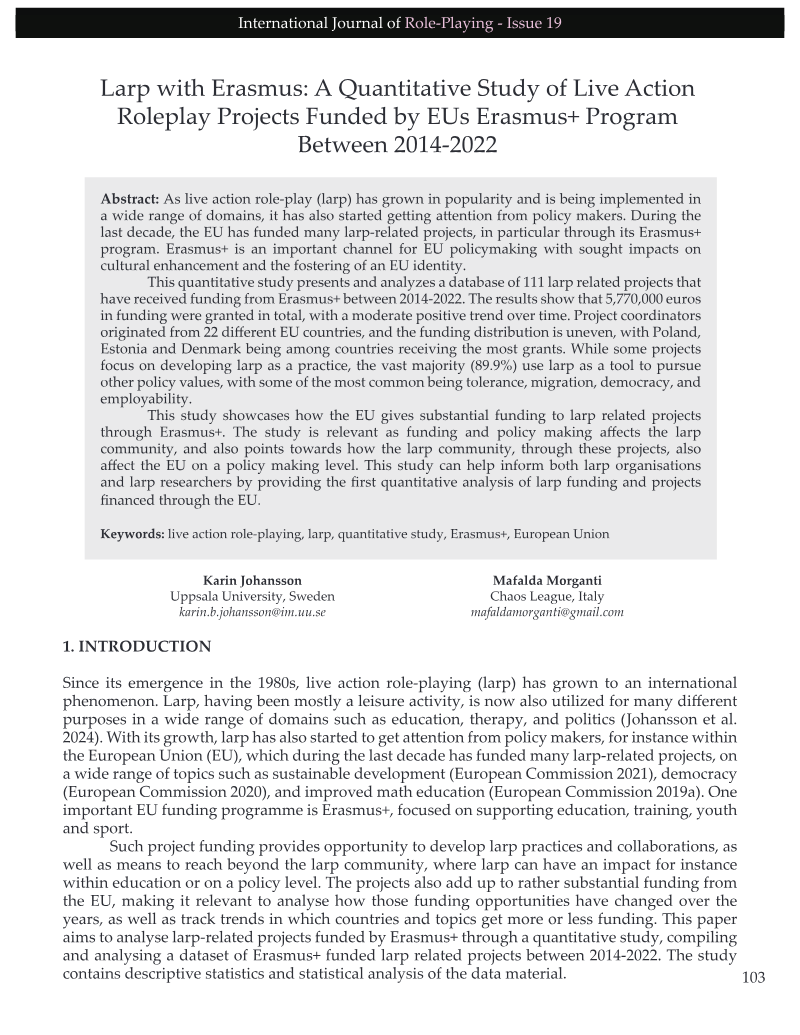
Larp with Erasmus: A Quantitative Study of Live Action Roleplay Projects 2014-2022
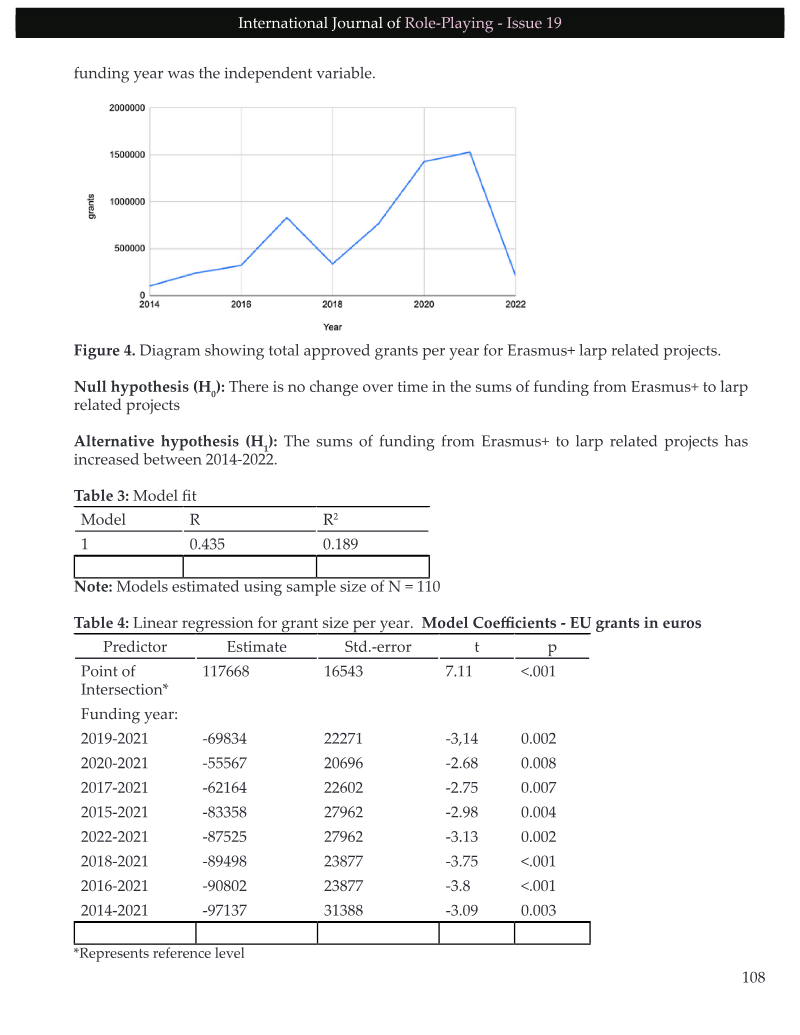
Live action roleplay has emerged as a significant pedagogical and civic tool within the European Union, supported by approximately 5.77 million euros in funding through the Erasmus+ program between 2014 and 2022.
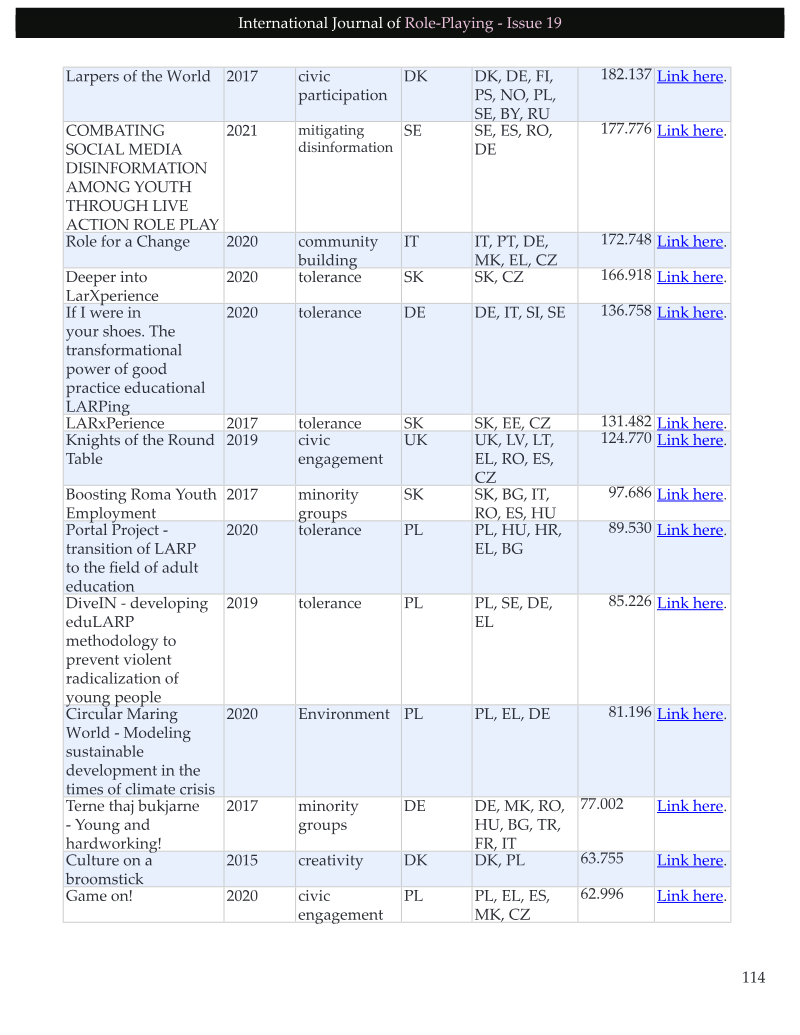
- Between 2014 and 2022, the Erasmus+ program provided approximately 5.77 million euros in funding to support 111 transnational live action roleplay (larp) projects.
- Nearly 90 percent of funded projects prioritize social policy objectives, such as promoting democracy, tolerance, social inclusion, and employability skills, rather than artistic development.
- Project implementation is geographically concentrated, with Poland, Estonia, and Denmark serving as the primary hubs for development across the 22 participating countries.
Let's Do It Together!: Why Participatory Design and Co-Creation Are Promising Approaches for Designing an Edu-Larp
Participatory design and co-creation offer significant advantages for the development of educational live-action role-playing games (edu-larps).
- Participatory design in edu-larps shifts development from top-down models to collaborative processes, directly increasing student agency and critical engagement with curriculum topics.
- Case studies from 2018, specifically 'Amazona Megista' and 'Das Andere Österreich', demonstrate that involving students in world-building and character creation significantly deepens learning outcomes.
- In the 'Das Andere Österreich' project, high school students co-designed a fascist regime and character backstories, which served as a practical application of their studies on democracy and political systems.



Bleed as Intrapersonal Conflict: Understanding Bleed Management and Resilience
The phenomenon of bleed—the spillover of emotions, physical states, and cognitive constructs between players and their characters—is best understood as a form of intrapersonal conflict that disrupts a player’s psychological homeostasis.
- Bleed functions as a form of intrapersonal conflict that disrupts a player’s psychological homeostasis, forcing the psyche to either reject the experience or integrate it to transform the self.
- Players manage bleed through negative feedback loops, which reject character experiences to restore a pre-existing self-concept, or positive feedback loops, which incorporate those experiences to evolve the identity.
- Integration practices such as creative expression, intellectual analysis, and community-based processing are essential tools for players to navigate identity shifts and achieve a new state of homeostasis.
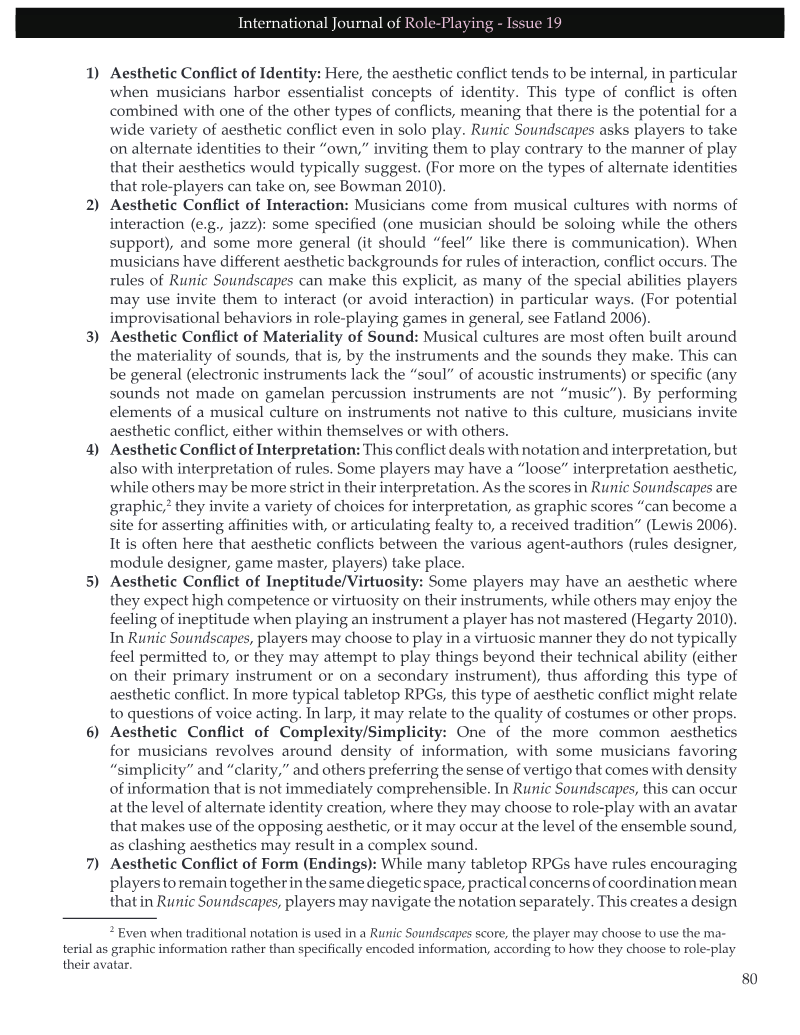
Aesthetic Conflict in the Musical Role-Playing Game: Runic Soundscapes
Aesthetic conflict serves as a vital tool for game design, offering a mechanism to prevent the formation of rigid, exclusionary idiocultures.
- Intentional aesthetic conflict in game design prevents the formation of exclusionary idiocultures and fosters more resilient, adaptable collaborative environments.
- The musical RPG Runic Soundscapes identified seven distinct categories of aesthetic conflict: identity, interaction, materiality of sound, interpretation, ineptitude versus virtuosity, complexity versus simplicity, and form.
- By decoupling aesthetic values from semantic narrative content, Runic Soundscapes allows for the isolation and study of pure aesthetic interaction between human and non-human agents.
Press Start for Heritage: Representing University Sports Rivalries in EA Sports College Football 25
EA Sports College Football 25 functions as a digital vessel for university sports heritage, transforming institutional traditions into a conflict-driven gaming experience.
- EA Sports College Football 25 functions as a digital platform that transforms institutional university history into a conflict-driven, immersive gaming experience.
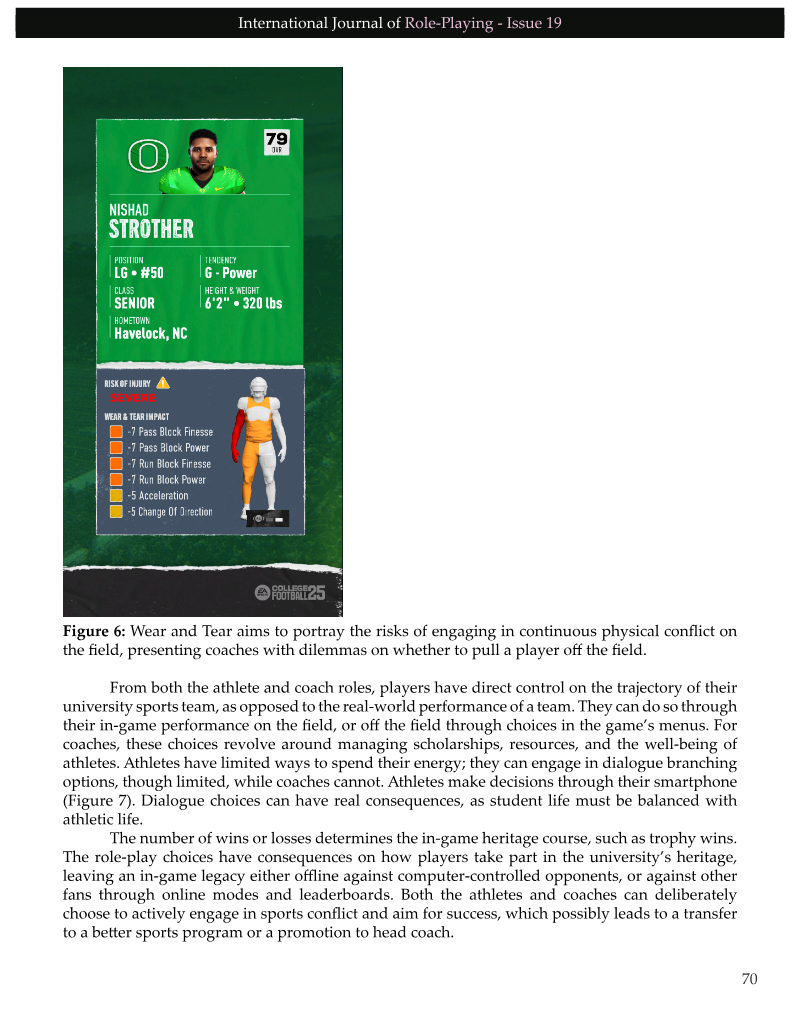
- The game utilizes specific mechanics like 'Stadium Pulse' and 'Wear and Tear' to foster tribalistic loyalty and deepen emotional connections between players and collegiate entities.
- By curating a sanitized and idealized version of university life, the game prioritizes marketability and institutional branding over the complex realities of student-athlete experiences.



Transformative Play for Building Resilience to Misinformation
Transformative play serves as a pedagogical framework for building resilience against misinformation by shifting the focus from traditional, skills-based media literacy to experiential, affective learning.
- Transformative play builds misinformation resilience by shifting from traditional skills-based training to experiential, affective learning in low-stakes environments.
- The Euphorigen Investigation escape room uses a deliberate plot twist where players inadvertently share a deepfake to force a visceral realization of their own susceptibility to manipulation.
- Structured debriefing sessions are the critical phase of the intervention, enabling collective sensemaking and the internalization of lessons regarding information credibility.
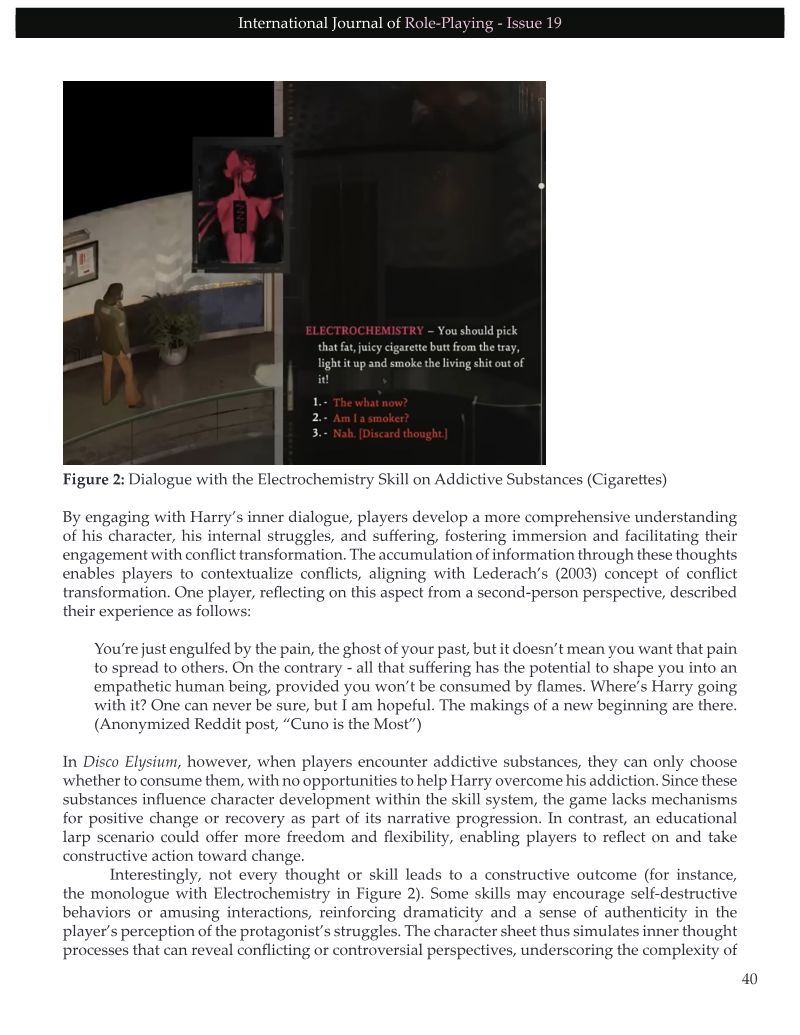
From Digital to Analog: Disco Elysium’s Conflict Transformation Mechanisms for Educational Larps
The integration of digital narrative mechanics into educational live-action role-playing (larp) offers a robust framework for fostering conflict transformation, empathy, and critical self-reflection.
- Educational live-action role-playing (larp) can effectively foster conflict transformation and empathy by adapting internal monologue and skill-based character systems from digital games like Disco Elysium.
- Translating digital narrative mechanics into analog larp environments increases participant agency by shifting the focus from predefined digital outcomes to real-time, active conflict resolution.
- Character development models, such as the trajectory of the character Cuno, can be adapted into educational scenarios to facilitate personal growth and critical self-reflection.
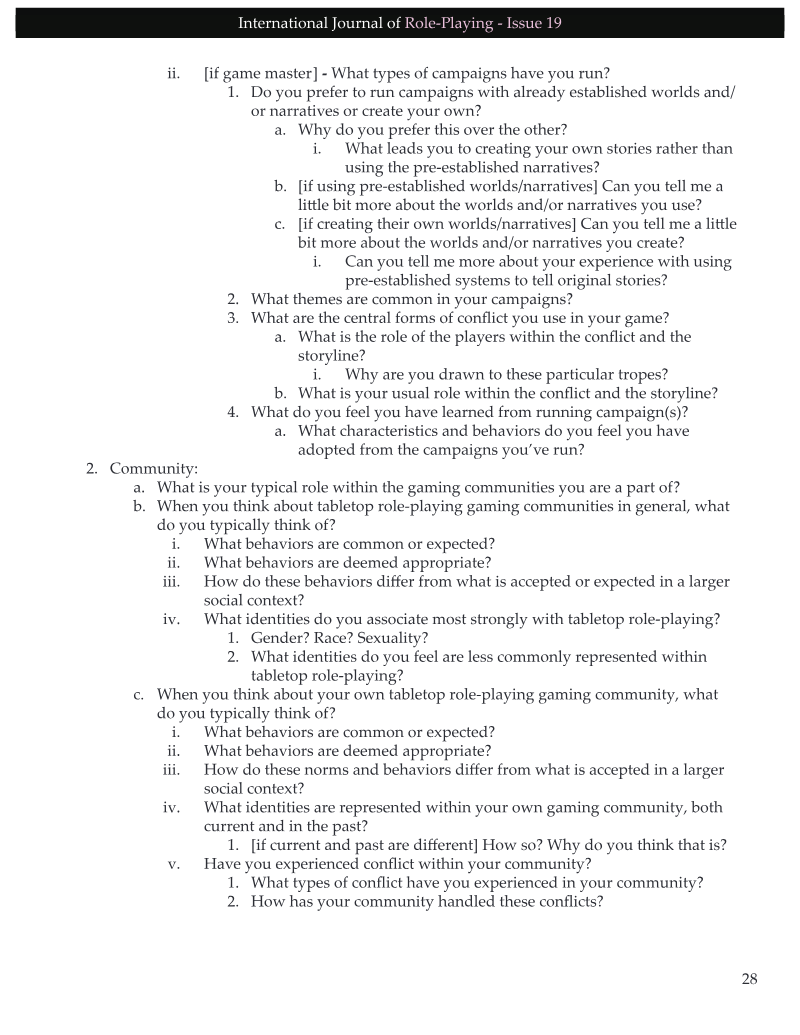
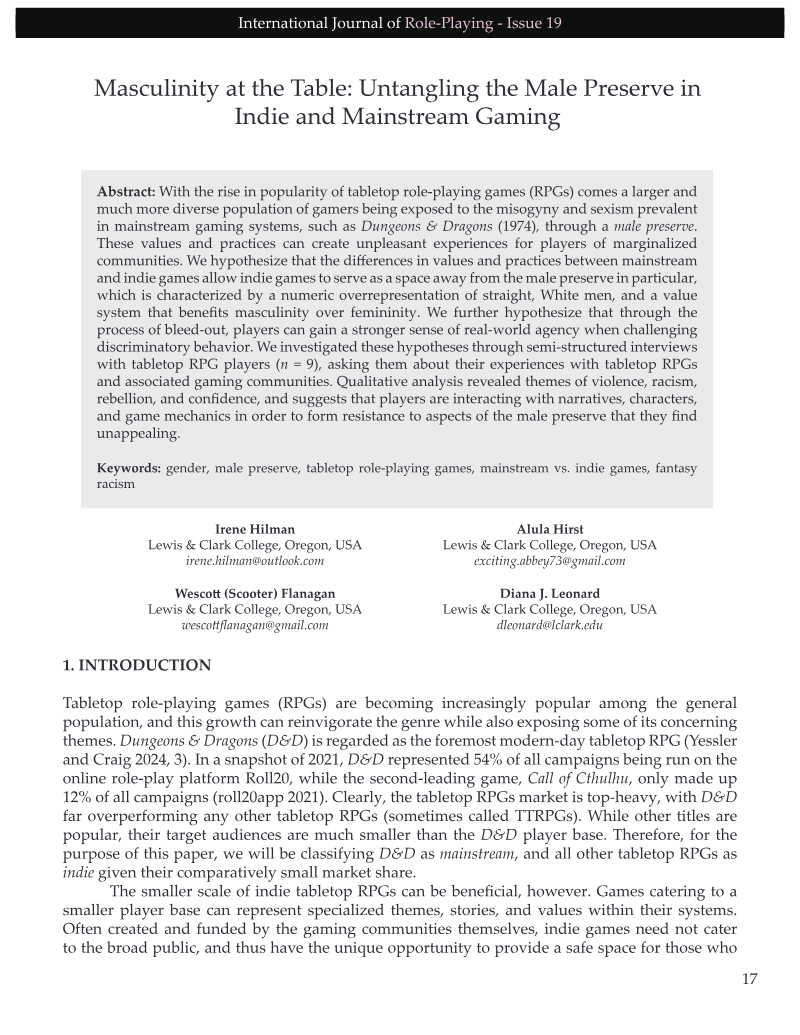
Masculinity at the Table: Untangling the Male Preserve in Indie and Mainstream Gaming
Tabletop role-playing games function as a contested cultural space where mainstream titles often reinforce traditional masculine norms, violence, and exclusionary power structures.
- Mainstream tabletop role-playing games, exemplified by Dungeons & Dragons, often reinforce traditional masculine norms, violence, and exclusionary power structures that marginalize specific player demographics.
- Players are actively migrating from mainstream systems to indie tabletop games that prioritize narrative freedom, inclusivity, and formal safety mechanics.
- Indie tabletop systems facilitate 'emancipatory bleed,' a process where participants use role-playing to address real-world challenges and build personal confidence.
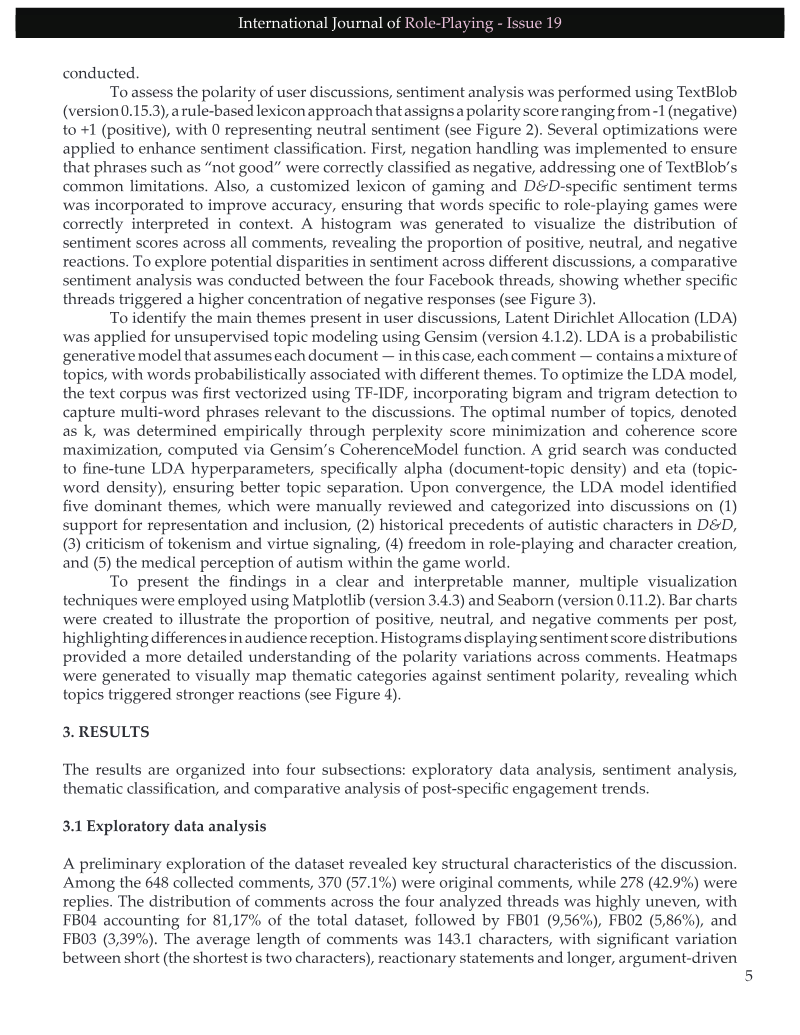
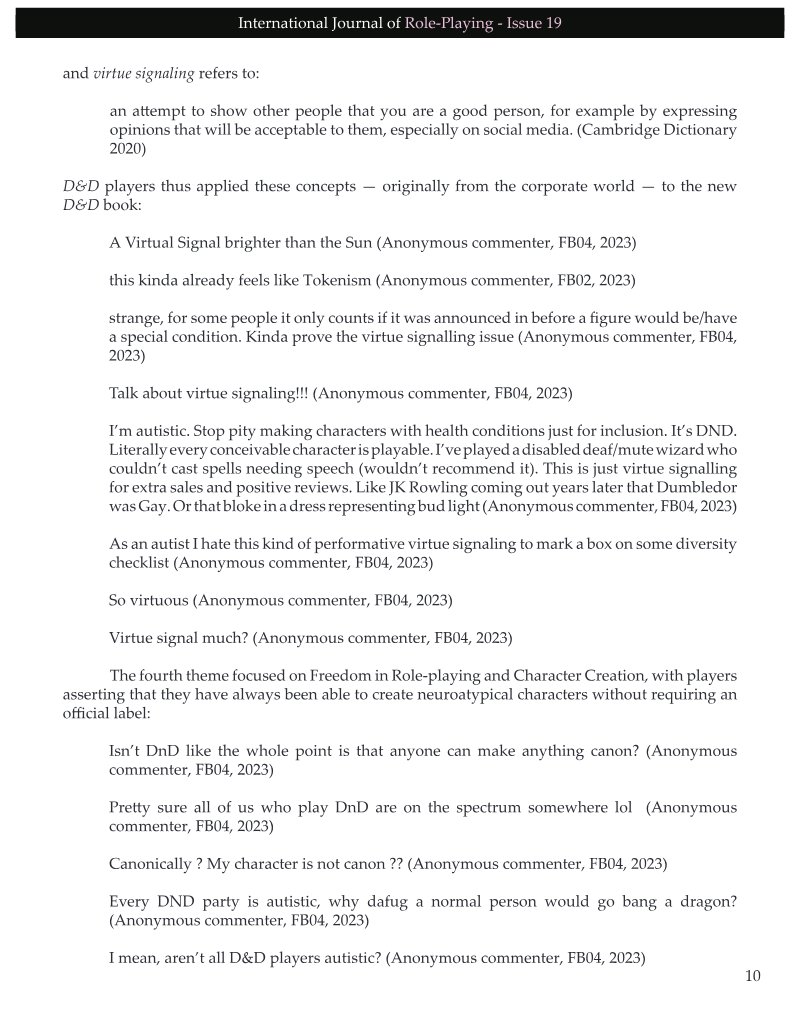
Asteria and Neurodiversity in Role-Playing Games: Inclusion or Tokenism
The introduction of the character Asteria into the Dungeons & Dragons ecosystem serves as a critical case study for evaluating the efficacy of neurodiversity representation within fantasy role-playing games.
- The introduction of the character Asteria into Dungeons & Dragons has polarized the player base, with 44.4% positive sentiment and 28.1% negative feedback.
- Critical discourse surrounding Asteria’s neurodivergent representation generates 18% higher social media engagement than supportive commentary, indicating that inclusive design often acts as a catalyst for cultural friction.
- The industry faces a fundamental conflict between the demand for explicit neurodivergent representation and the preservation of creative autonomy in tabletop gaming.
Arcades on Wheels: The Materiality and Logistics of Itinerant Gaming in Socialist Czechoslovakia
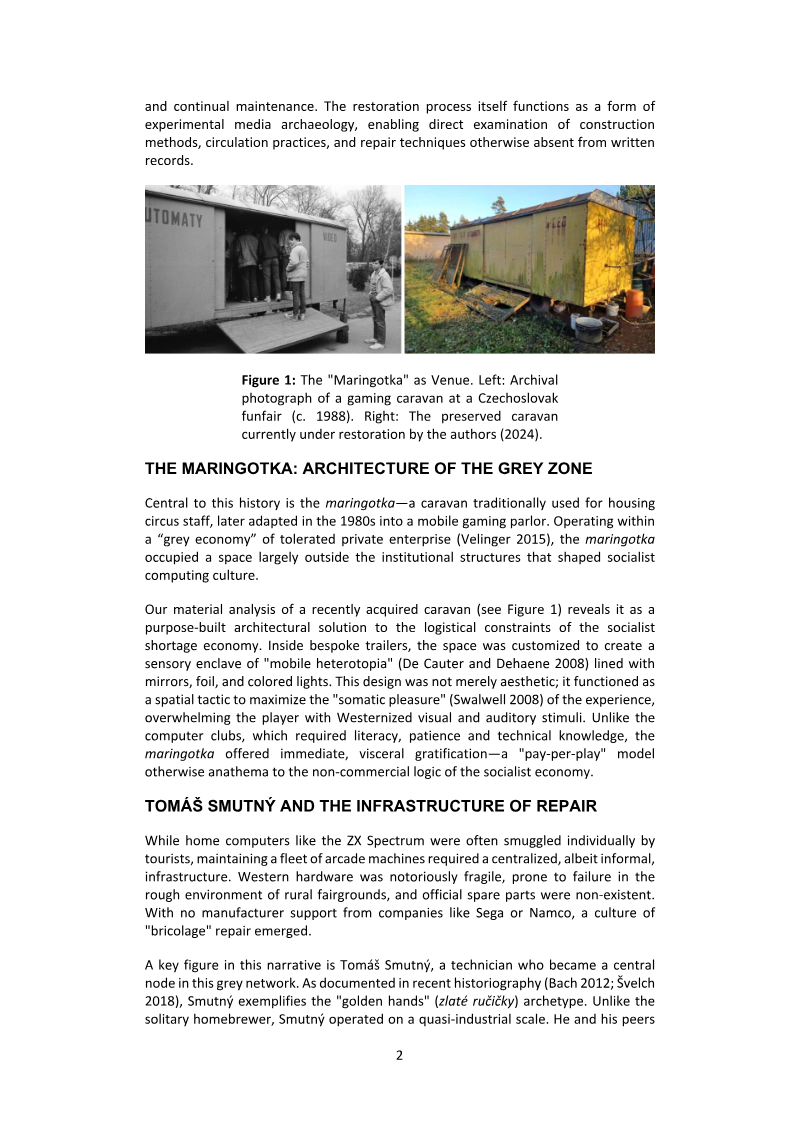
This paper examines the traveling arcade of socialist Czechoslovakia as a mobile infrastructure operated by showfolk within the country's grey economy of tolerated private enterprise.
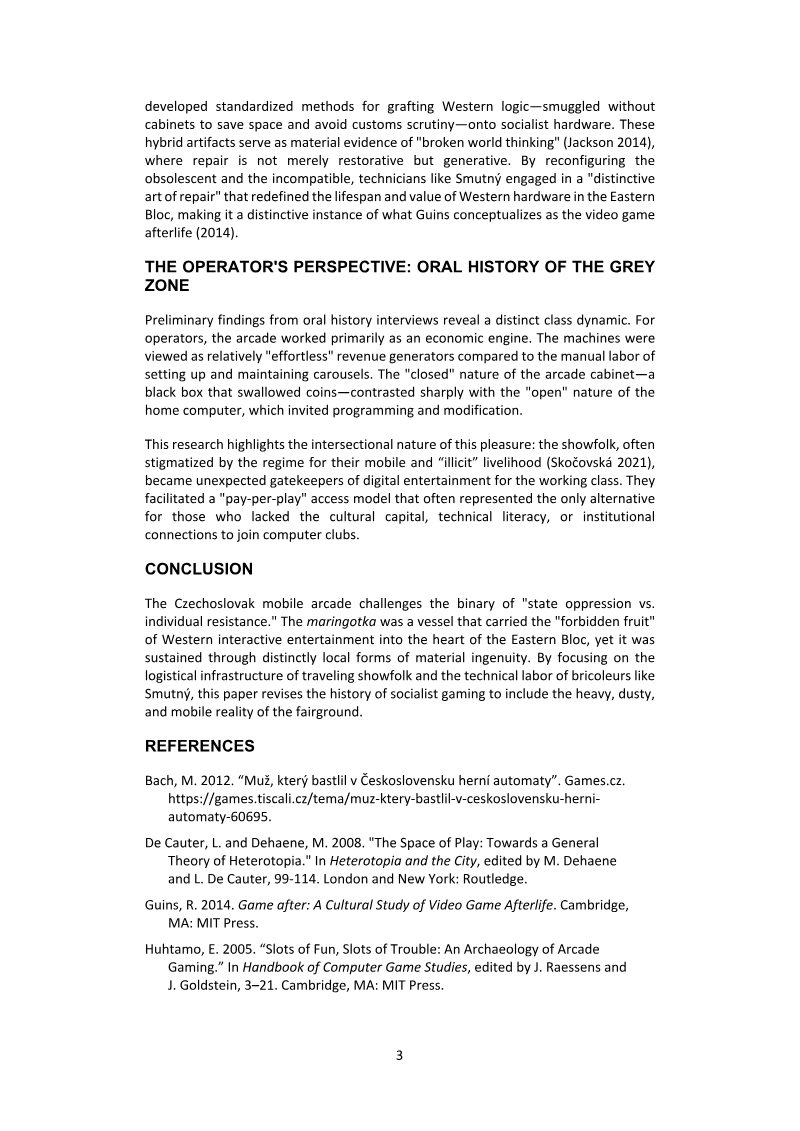
- The paper argues that the traveling arcade of socialist Czechoslovakia, centered on the 1980s maringotka funfair caravan, has been largely overlooked in histories that focus on homebrew programmers and state-sponsored computer clubs.
- Its evidence combines archival research (period photographs and press coverage), oral history interviews with former arcade operators, and material analysis of a preserved caravan the authors are restoring.
- The maringotka was a deliberately designed sensory space lined with mirrors, foil, and colored lights, offering immediate pay-per-play entertainment at odds with the non-commercial logic of the socialist economy.
The Name of Janosik Will Never Perish: Górals Tradition in Game Culture
This paper examines a corpus of independent video games that feature Janosik, the folk hero of the Polish-Slovak borderlands, and considers how these works draw on Góral (Highlander) cultural tradition in the northern Carpathians.
- The paper is a qualitative, game-language analysis of independent video games featuring Janosik, the Polish-Slovak folk hero, and Góral (Highlander) tradition in the northern Carpathians, rather than a quantitative study.
- The authors argue that game portrayals of Janosik and Góral culture are shaped by nearly two centuries of appropriation by surrounding nation-states, including Polish, Slovak, Austro-Hungarian, and Third Reich discourses.
- The corpus includes Mirage (1994), Retrovibe (2020, with a 2024 sequel), Juro Janosik (2021, Slovak), and Hellish Quart (2021), which uses a Janosik analogue named Yendrek, alongside tabletop RPGs Corny Groń and Beyond Corny Groń.
Missing in Action: Professional Wargaming in Game Studies
This paper argues that professional wargaming, the institutionalized use of games by militaries and defence organizations, is a major yet underexamined object of game studies inquiry.
- Professional wargaming, the institutionalized use of games by militaries and defence organizations, is identified as a major yet underexamined object of game studies, which has focused far more on entertainment games and the military-entertainment complex.
- The paper argues that professional wargames do more than represent conflict: they encode assumptions about rationality, technology, identity, and geopolitical order that shape how future conflicts are imagined, prepared for, and managed.
- The paper is an argumentative, agenda-setting intervention rather than an empirical study and presents no new data on any specific military institution.