Game Publishing
Documents
Integrated Report 2018
I N T E G R AT E D R E P O R T 2 0 1 8 develops entertainment-related toys, network content, home video games, amusement machines, amusement facilities, and visual and music content. Under the Mid-term Plan, which was launched in April 2018, the Group aims to achieve “CHANGE” to progress to the next stage, with a Mid-term Vision of CHANGE for the NEXT: Empower, Gain Momentum, and Accelerate Evolution. “Dreams, Fun and Inspiration”are the Engine of Happiness.
- BANDAI NAMCO Group aims for ¥750 billion in net sales and ¥75 billion in operating profit by March 31, 2021, with an operating profit margin and ROE of 10% or more.
- The Group's business is segmented into Toys and Hobby, Network Entertainment, and Visual and Music Production, with Network Entertainment encompassing network content, home video games, arcade machines, and amusement facilities.
- In FY2018.3, amusement facilities generated ¥64.2 billion in sales from 1,870 facilities (293 directly managed, 1,563 revenue-sharing), while amusement machines generated ¥28.2 billion.
- BANDAI NAMCO Group was ranked among the top global app market publishers in 2017 based on revenue for iOS and Google Play, with Tencent being the top publisher.
- The Group emphasizes work-life balance through systems like extended childcare leave, flextime, shorter working hours, and support for family caregiving, exceeding legal requirements.
Integrated Report 2020
I N T E G R AT E D R E P O R T 2 0 2 0 The BANDAI NAMCO Group develops entertainment-related products and services in a wide range of fields, including toys, network content, home video games, amusement machines, amusement facilities, and visual and music content. “Dreams, Fun and Inspiration” are the Engine of Happiness.
- BANDAI NAMCO Group's Mid-Term Plan (April 2018-March 2021) aims to maximize IP value, expand globally, and develop high-growth regions/businesses, with a consolidated net sales forecast of ¥650,000 million and segment profit of ¥50,000 million for the fiscal year ending March 31, 2021.
- The company is strategically expanding in North America and China, focusing on Japanese IP, enhancing e-commerce, and bolstering sales to mature fans, including a joint venture with Shueisha Inc. established in 2019.
- BANDAI NAMCO's Toys and Hobby unit is celebrating the 40th anniversary of Gundam plastic models with strategic product launches, large-scale promotions, and media collaborations, while also expanding production facilities in Japan to meet overseas demand.
- In 2020, BANDAI CO., LTD. partnered with TOEI COMPANY, LTD. to open KAMEN RIDER STORE TOKYO, the world's first official Kamen Rider flagship store, targeting a wide range of customers from children to adults.
- The company views human resources as its most important asset, implementing performance-linked remuneration, systems for idea proposals across departments, and a group-wide recognition system (BANDAI NAMCO Awards) to foster innovation and employee engagement.
Bandai Namco Group Fact Book 2020
01 Consolidated Business Performance / 03 Sales by IPs / Toys and Hobby Unit 05 Network Entertainment Unit 06 Real Entertainment Unit / Visual and Music Production Unit / IP Creation Unit 08 Plastic Model Market / Figure Market / Capsule Toy Market / Card Product Market 09 Candy Toy Market / Children’s Lifestyle (Sundries) Market / Babies’ / Children’s Clothing Market Top Publishers in the Global App Market BANDAI NAMCO Group 10 Home Video Game Market 10 Amusement Machine Market /...
- Bandai Namco Group's Toys and Hobby Unit has achieved significant cumulative shipment volumes for key product lines as of March 2020: Gundam plastic models (696.73 million units), Ultraman soft figures (98.77 million units), Super Sentai series robots (30.45 million units), and Digital Monsters (14.15 million units).
- The Network Entertainment Unit's sales for network content decreased from ¥211.1 billion in FY2019.3 to ¥200.9 billion in FY2020.3, while home video game sales also slightly declined from ¥102.1 billion to ¥99.0 billion in the same period.
- As of March 2020, Bandai Namco Rights Marketing Inc. reported a cumulative total of 492,924,783 fee-based viewings for on-demand animation delivery since October 2002, with 4,508 productions (71,739 episodes) available.
- Bandai Namco Group was formed in September 2005 through the management integration of BANDAI and NAMCO, establishing NAMCO BANDAI Holdings Inc.
- The Japanese figure market reached ¥30.5 billion in FY2019, while the digital card market, where Bandai holds a significant share (60.8% in FY2019), was ¥24.7 billion in FY2019.
Bandai Namco Group Fact Book 2021
1 BANDAI NAMCO Group Outline 01 Consolidated Business Performance / 03 Sales by IPs / Facts & Figures Entertainment Unit (Digital Business) / Entertainment Unit (Toys and Hobby Business) 06 IP Production Unit (Visual and Music Business / Creation Business) / IP Production Unit (Visual and Music Business) / IP Production Unit (Creation Business) / Amusement Unit Entertainment Unit (Digital Business) 07 Game App Market / Top Publishers in the Global App Market / Home Video Game Market ...
- Bandai Namco Group's top-performing IP by sales (worldwide) in FY2021.3 was DRAGON BALL series at ¥127.4 billion, followed by Mobile Suit Gundam series at ¥95.0 billion and ONE PIECE at ¥38.0 billion.
- Network content sales (digital business) grew from ¥200.9 billion in FY2020.3 to ¥207.7 billion in FY2021.3, while home video game sales increased from ¥99.0 billion to ¥118.1 billion in the same period.
- Amusement unit sales declined significantly from FY2020.3 to FY2021.3, with amusement machines dropping from ¥27.1 billion to ¥16.7 billion and amusement facilities from ¥64.7 billion to ¥47.1 billion.
- Bandai Namco Group was ranked 6th globally among app market publishers in 2020, behind Nintendo, Playrix Ireland, Koei Tecmo, Activision Blizzard, and Zynga.
- The company has a strong history of product longevity, with cumulative shipments including 2.65 billion candy toys (since 1995), 101.87 million Ultraman soft figures (since 1983), and 30.89 million Super Sentai series robots (since 1979).
Bandai Namco Group Fact Book 2022
www.bandainamco.co.jp TABLE OF CONTENTS 1 Bandai Namco Group Outline 01 Consolidated Business Performance / Entertainment Unit (Digital Business) 04 Entertainment Unit (Toys and Hobby Business) 06 IP Production Unit (Visual and Music Business / Entertainment Unit (Digital Business) Entertainment Unit (Toys and Hobby Business) 09 Plastic Model Market / Figure Market / Capsule Toy Market / Card Product Market Children’s Lifestyle (Sundries) M...
- Bandai Namco Group's top-performing IPs by sales in FY2022.3 were DRAGON BALL series (¥127.6 billion), Mobile Suit Gundam series (¥101.7 billion), and ONE PIECE (¥44.1 billion).
- The Digital Business segment saw a decrease in network content sales from ¥207.7 billion in FY2021.3 to ¥185.5 billion in FY2022.3, but home video game sales increased significantly from ¥118.1 billion to ¥174.4 billion in the same period.
- As of March 2022, Bandai Namco Entertainment Inc. had 34 game app titles each on Google Play and the App Store, and 5 social media titles in Japan.
- The Toys and Hobby Business unit has achieved substantial cumulative shipment volumes for key products, including 2,699.59 million candy toys (since 1995) and 104.93 million Ultraman soft figures (since 1983).
- The Amusement Unit's sales increased from ¥63.8 billion in FY2021.3 to ¥82.3 billion in FY2022.3, with amusement facilities contributing the majority of sales (¥61.5 billion in FY2022.3).
Bandai Namco Group Fact Book 2023
www.bandainamco.co.jp TABLE OF CONTENTS 01 Consolidated Business Performance / 03 Sales by IPs / Entertainment Unit (Digital Business) 04 Entertainment Unit (Toys and Hobby Business) 06 IP Production Unit / Amusement Unit Entertainment Unit (Digital Business) 07 Game App Market / Home Video Game Market Entertainment Unit (Toys and Hobby Business) 09 Plastic Model Market / Figure Market / Capsule Toy Market / 10 Candy Toy Market / Children’s Lifestyle (Sundries) Mar...
- Bandai Namco Group's history includes the independent founding of Bandaiya in 1950 (later BANDAI) and Nakamura Manufacturing Ltd. in 1955 (later NAMCO), with significant milestones like PAC-MAN's introduction in 1980 and Tamagotchi's launch in 1996.
- The Gundam series is a major IP for Bandai Namco, with cumulative plastic model shipments reaching 761.11 million units by March 2023, including 577.05 million Real series and 1.27 million SD series units.
- Bandai Namco's Toys and Hobby Business saw significant sales from the Gundam series (¥60.5 billion in FY2023.3, up from ¥44.2 billion in FY2022.3) and KAMEN RIDER series (¥23.0 billion in FY2023.3, up from ¥22.8 billion in FY2022.3).
- The company's home video game titles have achieved substantial cumulative shipments, including the TEKKEN series (55.00 million units by March 2023) and the Super Robot Wars series (20.24 million units by March 2023).
- Bandai Namco is actively engaged in ESG initiatives, including sustainability activities utilizing IP to reduce environmental burdens (e.g., clothing donations for upcycling, plastic recycling PR with the Ministry of the Environment) and regional contribution activities like the Gundam Educational Program.
PEGI: European Game Information
The text serves as an educational and promotional overview of the Pan‑European Game Information (PEGI) rating system, using a comic‑style narrative to capture the attention of younger gamers while delivering core information about age‑based content classification. Its central thesis is that PEGI provides the most comprehensive mechanism for informing consumers about video‑game suitability, thereby ensuring safe and informed purchasing decisions across Europe.
Key points emphasize that PEGI operates in more than thirty countries and employs a traffic‑light colour scheme to convey age recommendations: green icons for games suitable for all audiences (ages 3 and 7), amber for intermediate levels, and red for titles restricted to adults (18+). The system also includes content descriptors that clarify specific elements that may affect suitability, reinforcing transparency for parents and players. The narrative illustrates the progression through various “worlds” representing age brackets—3, 7, 12, 16, and 18—highlighting that each tier is tailored to increasingly experienced gamers.
The scope is continental, covering the European video‑game market and all major platforms, with references to the official website and downloadable applications for iPhone, Android, and Windows 7 Phone. No empirical methodology is presented; the piece relies on descriptive exposition and visual storytelling rather than survey data. Overall, the material positions PEGI as a reliable, universally adopted standard that guarantees 100 % informed choice for consumers.
- The PEGI rating system is the standardized age-classification mechanism for video games across more than 30 European countries.
- Age suitability is communicated through a traffic-light color scheme: green for ages 3 and 7, amber for intermediate levels, and red for 18+ restricted titles.
- The system utilizes specific content descriptors alongside age ratings to provide transparency regarding the elements that influence a game's suitability.
- PEGI ratings cover all major gaming platforms and are designed to facilitate informed purchasing decisions for both parents and players.
- The classification framework is structured into five distinct age brackets: 3, 7, 12, 16, and 18.
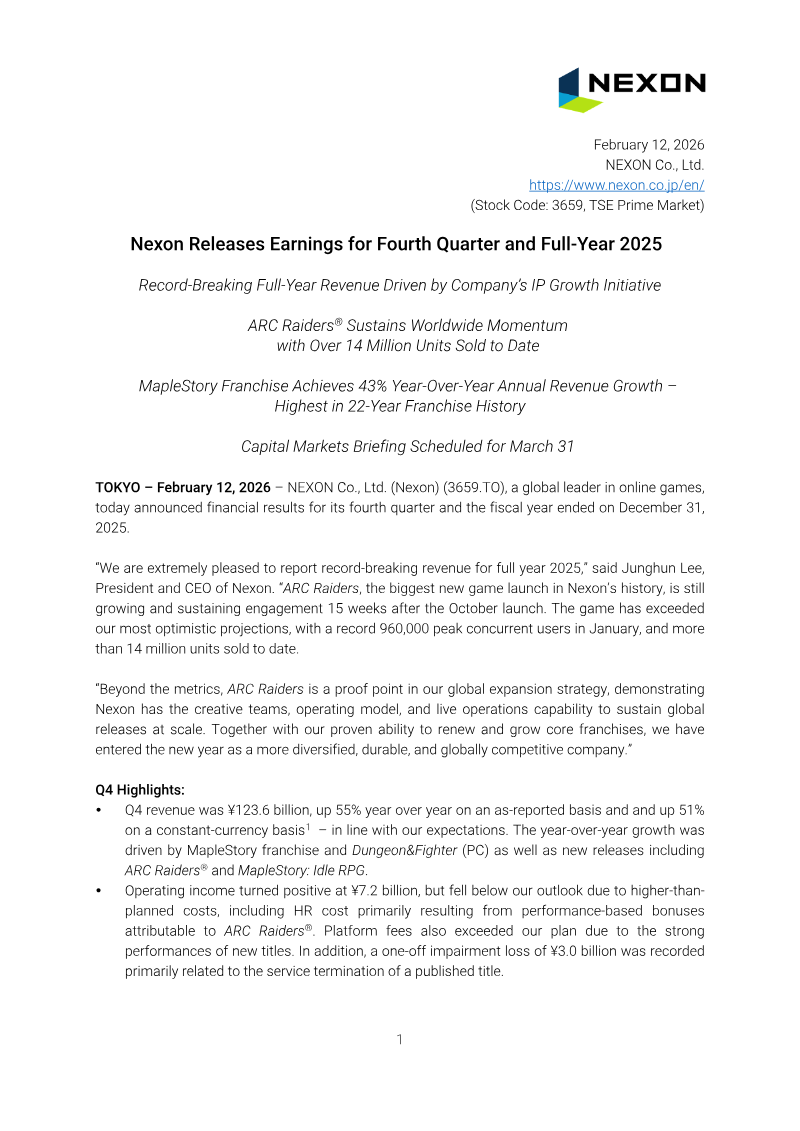
Nexon Releases Earnings for Fourth Quarter and Full-Year 2025
Nexon reported record-breaking financial results for the fiscal year ended December 31, 2025, driven by a strategic IP growth initiative that balanced the expansion of legacy franchises with successful new global launches. Full-year revenue reached ¥475.1 billion, a 6% increase year-over-year, while operating income remained stable at ¥124.0 billion. The fourth quarter saw a significant revenue surge of 55% to ¥123.6 billion, although net income declined 66% to ¥10.9 billion, primarily due to fluctuations in foreign exchange gains compared to the previous year and higher-than-anticipated costs related to performance bonuses and platform fees.
The growth was spearheaded by the launch of ARC Raiders, which sold over 14 million units within 15 weeks and achieved a peak of 960,000 concurrent users. Simultaneously, the 22-year-old MapleStory franchise delivered its highest annual revenue in history, growing 43% year-over-year. This performance offset a 21% decline in the Dungeon&Fighter franchise, despite a strong recovery in its PC segment in China and Korea. The period was also marked by a significant player trust initiative regarding MapleStory: Idle RPG; a coding error led Nexon to offer full refunds, resulting in a ¥9 billion reduction in Q4 revenue.
Geographically, the results reflect Nexon’s successful diversification beyond its traditional Asian strongholds into Western markets via console and PC platforms. Looking ahead to the first quarter of 2026, the company expects revenue growth between 32% and 44%, supported by sustained momentum from new titles and major updates to core IPs. Nexon remains committed to aggressive shareholder returns, doubling its dividend and completing a ¥100 billion share buyback program during the fiscal year.
- Nexon achieved record full-year 2025 revenue of ¥475.1 billion, a 6% year-over-year increase, with operating income holding steady at ¥124.0 billion.
- The new title ARC Raiders was a major growth driver, selling over 14 million units within 15 weeks and reaching a peak of 960,000 concurrent users.
- The 22-year-old MapleStory franchise reached record annual revenue with 43% year-over-year growth, helping to offset a 21% decline in the Dungeon&Fighter franchise.
- Q4 net income dropped 66% to ¥10.9 billion due to foreign exchange fluctuations, increased platform fees, and performance bonuses.
- A player trust initiative following a coding error in MapleStory: Idle RPG resulted in a ¥9 billion revenue reduction in Q4 due to full customer refunds.
Vietnam's Mobile Dev Opportunity
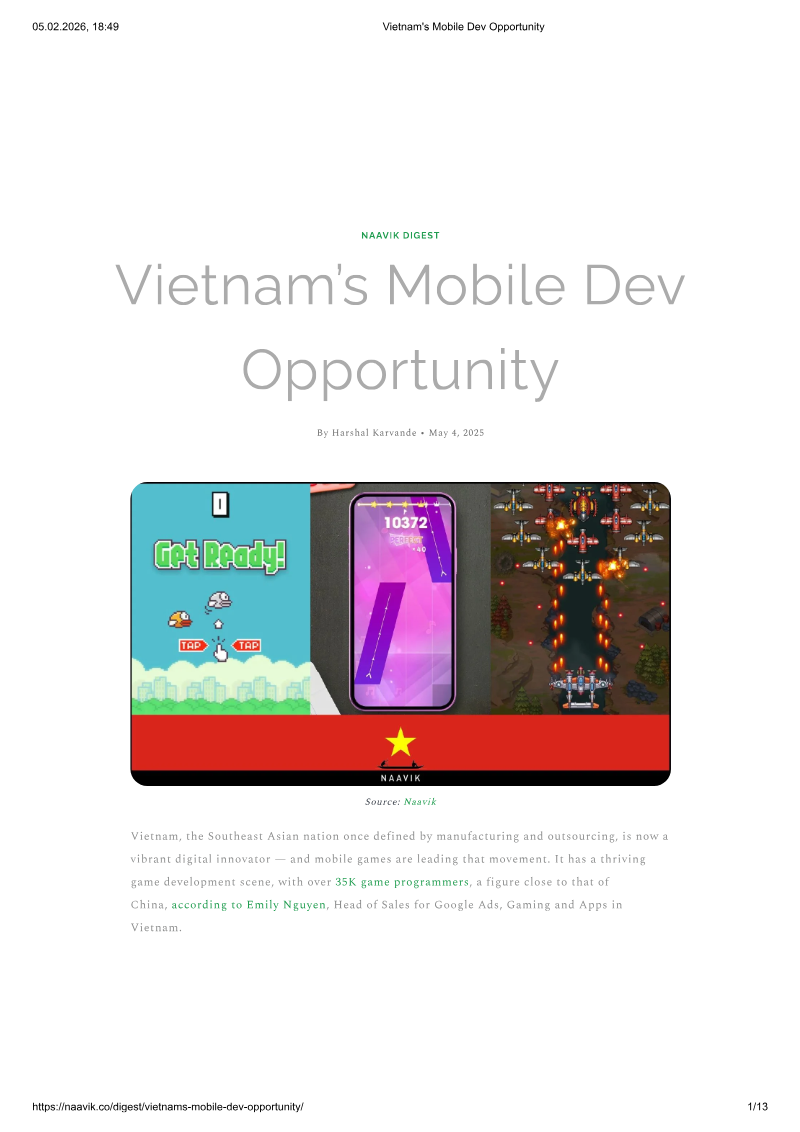
Vietnam’s mobile game sector has evolved from a consumer‑centric market into a burgeoning production hub, driven by a skilled talent pool forged through outsourcing, stringent regulatory frameworks that forced local publishing entities to emerge, and the explosive rise of mobile gaming. The country now hosts over 35 000 game programmers—comparable to China’s workforce—and more than 300 active mobile publishers headquartered in Vietnam. In 2024, five Vietnamese studios ranked among the world’s top 25 publishers by downloads, contributing nearly 2.4 billion downloads and $133 million in revenue—a 67 % increase in downloads and an 82 % rise in earnings since 2020. Key titles such as Car Race, Wood Nuts & Bolts Puzzle, and Hair Salon: Beauty Salon Game illustrate the domestic IP pipeline, while globally recognized titles like Sky Garden: Farming Paradise, Magic Tiles 3, and Axie Infinity showcase the country’s capacity for high‑impact releases.
The transformation accelerated after 2013 when Vietnamese solo developer Nguyen Ha Dong’s Flappy Bird achieved worldwide chart dominance, proving that local talent could produce globally successful mobile games with limited resources. This success spurred a wave of small studios and startups, many of which transitioned from outsourcing or publishing roles to independent IP creation. Vietnam’s high smartphone penetration (84 %) and a youthful, digitally native demographic further underpin market growth.
Regulatory challenges remain: stricter limits on gaming time for minors, mandatory Ministry of Information and Communications approvals, and content censorship can constrain creative expression and international appeal. Future success will hinge on navigating the shift from hypercasual to more complex casual and social mobile games while adapting to evolving regulatory constraints. Despite these hurdles, Vietnam’s established talent base, rapid growth trajectory, and increasing foreign investment position it as a rising contender for global mobile game leadership over the next decade.
- Vietnam has emerged as a major global mobile development hub with over 35,000 game programmers and more than 300 active local publishers.
- In 2024, five Vietnamese studios ranked among the world’s top 25 publishers, generating 2.4 billion downloads and $133 million in revenue.
- Since 2020, the sector has experienced significant growth, marked by a 67% increase in downloads and an 82% rise in earnings.
- The industry’s transition from outsourcing to independent IP creation was catalyzed by the 2013 global success of Flappy Bird, which proved that local talent could achieve international chart dominance.
- Domestic market strength is supported by a digitally native population and an 84% smartphone penetration rate.
Q3 for the Fiscal Year Ending March 2026 Results Presentation
Sega Sammy’s performance through the third quarter of the fiscal year ending March 2026 is characterized by a significant divergence between robust domestic gaming machine operations and substantial financial setbacks in the global consumer and mobile segments. While the Pachislot and Pachinko division exceeded expectations—driven by high-volume unit sales of titles like Smart Pachislot Tokyo Revengers—the broader group faces a projected net loss of 13.0 billion yen for the fiscal year. This downturn is primarily the result of 46.3 billion yen in extraordinary impairment losses related to the acquisitions of Rovio and Stakelogic, the latter of which was impacted by regulatory shifts in the Netherlands.
The Entertainment Contents Business struggled with underperforming new full game launches and a deteriorating user acquisition environment for mobile titles, most notably Sonic Rumble. Consequently, management has pivoted from aggressive expansion to a period of consolidation, suspending large-scale M&A activities in favor of a 20.0 billion yen share buyback program. To restore profitability within the mobile sector, the strategy now emphasizes a "regrowth phase" for Rovio, leveraging AI-driven marketing efficiencies and a transmedia approach that includes major theatrical releases for the Angry Birds and Sonic franchises scheduled through 2027.
Despite current headwinds, the medium-term outlook relies on a robust multi-platform pipeline and the expansion of the Gaming Business, which includes record-high performance at Paradise SegaSammy fueled by Japanese VIP demand. Upcoming releases for the Nintendo Switch 2 and the continued rollout of high-profile intellectual properties like Yakuza and Persona are intended to stabilize the consumer area. Geographically, the company remains focused on global markets while maintaining strict compliance with international gaming regulations in jurisdictions such as Nevada, which govern both corporate operations and shareholder requirements.
- Sega Sammy projects a 13.0 billion yen net loss for the fiscal year ending March 2026, driven by 46.3 billion yen in impairment losses from the acquisitions of Rovio and Stakelogic.
- The Pachislot and Pachinko division is the company's primary financial driver, significantly exceeding expectations through high-volume sales of titles like Smart Pachislot Tokyo Revengers.
- Management has shifted from aggressive M&A to a consolidation strategy, marked by the suspension of large-scale acquisitions and the initiation of a 20.0 billion yen share buyback program.
- The Entertainment Contents Business is underperforming due to weak new full game launches and poor user acquisition for mobile titles, specifically Sonic Rumble.
- The company is pivoting to a 'regrowth phase' for Rovio, utilizing AI-driven marketing and transmedia support from Angry Birds and Sonic theatrical releases scheduled through 2027.
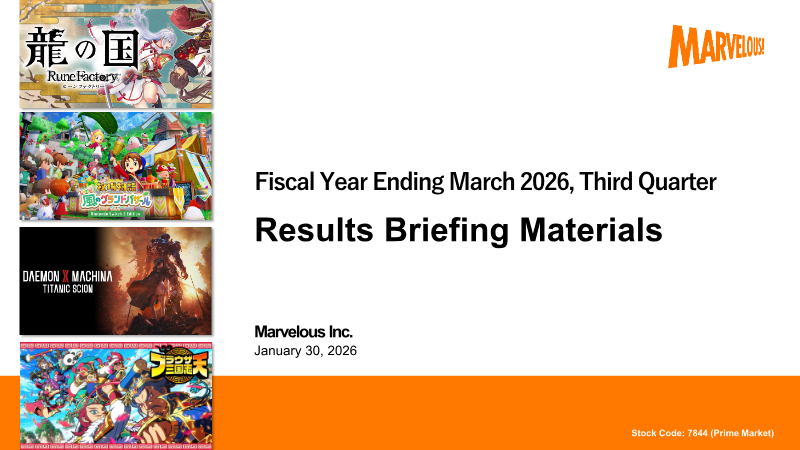
Results Briefing Materials: Fiscal Year Ending March 2026, Third Quarter
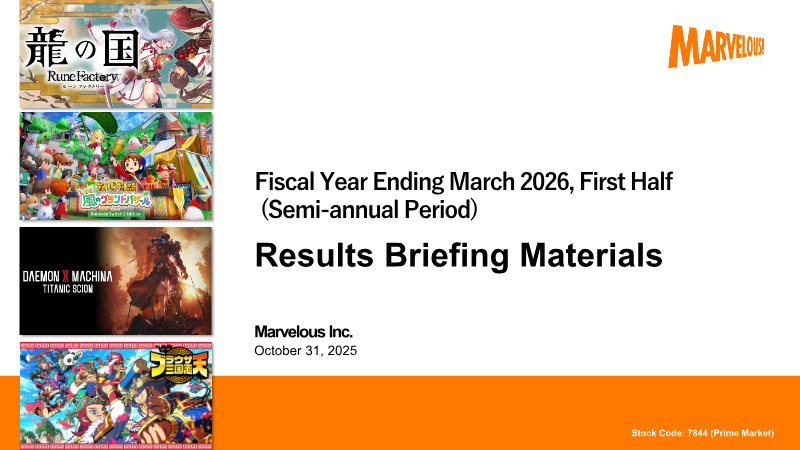
Marvelous Inc. reports a significant increase in financial performance for the first nine months of the fiscal year ending March 2026. Net sales reached 29,121 million yen, a 40.5% year-on-year increase, while ordinary profit grew 28.6% to 2,129 million yen. This growth was primarily driven by the Digital Contents and Amusement segments, alongside foreign exchange gains that bolstered the bottom line.
The Digital Contents business saw revenue jump 69.2% following the successful launches of core titles including Rune Factory: Guardians of Azuma, STORY OF SEASONS: Grand Bazaar, and DAEMON X MACHINA TITANIC SCION. While high development costs for these new titles initially pressured margins, strong sales contributed to earnings ahead of schedule, significantly reducing cumulative operating losses in the segment. In the online space, the company launched Browser Sangokushi Ten, though it noted a slow initial start.
The Amusement business remained a consistent profit driver, with revenue increasing 25.1% due to the continued popularity of Pokémon kids’ amusement machines, such as Pokémon FRIENDA and the overseas expansion of Pokémon MEZASTAR. Conversely, the Audio & Visual business experienced a revenue decline of 11.3% following the liquidation of unprofitable businesses, though segment profit rose sharply by 306.1% due to high-performing stage productions and secondary usage revenue from anime titles.
Geographically, the company is focused on the Japanese, North American, European, and Asian markets across Nintendo Switch, PlayStation 5, and PC platforms. Despite exceeding year-to-date targets for certain profit metrics, the full-year forecast remains unchanged at 35,000 million yen in net sales and 2,000 million yen in operating profit, citing potential future uncertainties in the macroeconomic and industry environment.
- Marvelous Inc. reported a 40.5% year-on-year increase in net sales to 29,121 million yen and a 28.6% rise in ordinary profit to 2,129 million yen for the first nine months of the fiscal year ending March 2026.
- The Digital Contents segment saw a 69.2% revenue surge driven by the releases of 'Rune Factory: Guardians of Azuma', 'STORY OF SEASONS: Grand Bazaar', and 'DAEMON X MACHINA TITANIC SCION', which helped offset initial high development costs.
- The Amusement business grew revenue by 25.1%, fueled by the sustained popularity of 'Pokémon FRIENDA' and the international expansion of 'Pokémon MEZASTAR'.
- The Audio & Visual business saw an 11.3% revenue decline due to business liquidations, but segment profit jumped 306.1% thanks to successful stage productions and anime secondary usage revenue.
- Despite exceeding year-to-date profit targets, the company maintained its full-year forecast of 35,000 million yen in net sales and 2,000 million yen in operating profit, citing macroeconomic and industry uncertainties.
Beyond the App Store: A Guide to Direct Linkouts and Out-of-App Monetization
The mobile gaming industry is undergoing a structural shift as regulatory changes and legal precedents in the United States, Europe, Asia, and Latin America dismantle long-standing app store monopolies. This transition allows publishers to bypass traditional platform commissions of 15% to 30% by steering users toward direct, out-of-app payment channels. The primary thesis is that recovered margins should not be viewed merely as profit, but as a strategic reinvestment budget to enhance player value, improve live operations, and drive long-term audience growth.
Successful implementation requires a disciplined approach to user segmentation, value proposition, and interface design. Rather than inviting all players to use external payment methods, publishers should target high-propensity users—such as frequent spenders or those at higher game levels—to minimize friction for casual players. Because out-of-app flows inherently introduce more steps than native in-app purchases, publishers must provide a tangible incentive, such as bonus currency, exclusive items, or lower effective pricing, to ensure the external path remains attractive.
Operationalizing this strategy requires robust infrastructure to manage global payment routing, tax compliance, fraud protection, and reconciliation. Attempting to build these capabilities in-house often results in excessive overhead that negates the margin benefits. Data from large-scale deployments indicates that well-executed linkout programs can drive significant incremental growth, with some publishers seeing a 17% increase in webstore revenue and a 78% rise in first-time purchase rates. Ultimately, the transition to out-of-app monetization represents a move toward a more sustainable, publisher-controlled economic model that prioritizes lifetime value over single-transaction margins.
- Global regulatory shifts are dismantling app store monopolies, enabling publishers to bypass 15% to 30% platform commissions by utilizing direct, out-of-app payment channels.
- Well-executed webstore programs have demonstrated a 17% increase in total revenue and a 78% rise in first-time purchase rates for mobile game publishers.
- Publishers should treat recovered margins as strategic reinvestment capital for live operations and audience growth rather than immediate profit.
- To maintain conversion rates, publishers must offer tangible incentives such as bonus currency, exclusive items, or lower pricing to offset the increased friction of external payment flows.
- Targeting high-propensity users, such as frequent spenders or high-level players, is more effective than broad-based rollouts that risk alienating casual users.