Game Engines reports and market data
Documents
Improving an Iterative Physics Solver Using a Direct Method
Physics engines often struggle with stability when managing complex mechanical linkages and high-mass-ratio interactions, as standard iterative methods like Projective Gauss-Seidel frequently fail to converge under these conditions.
- A hybrid physics solver improves stability in complex mechanical linkages and high-mass-ratio interactions by integrating a direct sparse LDL matrix decomposition with traditional iterative methods like Projective Gauss-Seidel.
- The solver utilizes body shattering to decompose dense constraint matrices into smaller sub-matrices, reducing computational complexity from cubic to linear for medium-sized mechanical systems.
- To maintain matrix sparsity and minimize fill-in during decomposition, the system maps constraint matrices to graphs and employs a minimum edge creation heuristic for optimal pivot ordering.

Game VR/AR: Make Your Game Run on Quest (and Look Pretty Too)
Achieving high-quality virtual reality experiences on the Oculus Quest requires a rigorous commitment to performance optimization, as maintaining a consistent frame rate of 60 to 72 frames per second is essential to prevent user discomfort.
- Maintain a consistent frame rate of 60 to 72 frames per second to ensure user comfort and prevent motion sickness on the Oculus Quest.
- Limit draw calls to fewer than 120 per frame to stay within the hardware's strict mobile performance budget.
- Prioritize efficient rendering pipelines by utilizing forward rendering, single-pass stereo, and fixed foveated rendering.

Art Direct for 100 MPH: Balancing Visuals with Performance for Forza Motorsport
Achieving photorealistic visuals in high-speed racing titles requires a rigorous balance between graphical fidelity and strict performance constraints.
- To maintain a consistent 60 frames per second at high speeds, developers use eye-tracking data to concentrate high-fidelity assets within a central screen diamond while reducing complexity in peripheral zones.
- Artists employ a 'big-to-small' methodology that focuses 80 percent of effort on high-impact visual moments while intentionally designing areas of visual rest to mimic musical composition.
- The development process for a single track spans approximately one year and relies on a hybrid workforce model combining internal staff with a large network of outsourced artists.
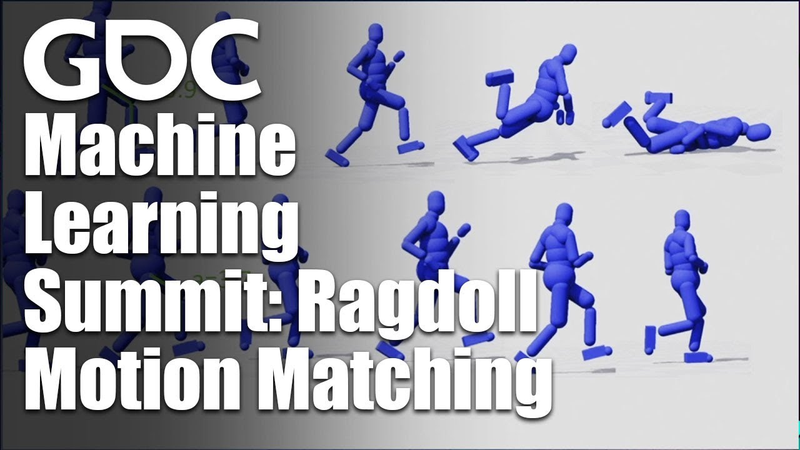
Machine Learning Summit: Ragdoll Motion Matching
Modern character animation is undergoing a significant evolution through the integration of physical ragdoll simulation with data-driven motion matching.
- Modern character animation is shifting from rigid playback to physical ragdoll simulation combined with data-driven motion matching for real-time environmental responsiveness.
- The system utilizes reinforcement learning, specifically actor-critic methods and policy gradient techniques, to map continuous state inputs to physical actions.
- Neural network policies treat actions as Gaussian distributions, iteratively optimizing the mean and standard deviation to improve movement stability and minimize falls.

4K Checkerboard in Battlefield 1 and Mass Effect Andromeda
Achieving 4K-like visual fidelity on hardware with limited bandwidth requires sophisticated rendering techniques that balance performance budgets with image quality.
- The Frostbite engine utilizes packed checkerboard rendering to achieve 4K-like visual fidelity by shading a subset of pixels and reconstructing high-resolution frames from lower-resolution buffers.
- Implementing checkerboard rendering in Battlefield 1 reduced GPU frame costs by approximately 5.08 milliseconds, enabling stable 60Hz performance.
- To maintain visual integrity, the pipeline employs geometry-aware resolves, velocity-based reprojection, and object/primitive ID buffers to prevent color bleeding and z-fighting.

Making 50 Games in 1 Day!
This challenge explores the creative potential and limitations of rapid game development by attempting to build 50 distinct games within an eight-hour timeframe using the Unity engine.
- Rapid prototyping under extreme time constraints—such as building 50 games in eight hours—forces developers to abandon perfectionism and prioritize core gameplay loops.
- Allocating approximately ten minutes per project necessitates the use of a pre-prepared library of reusable scripts for movement, collision detection, and spawning to minimize technical overhead.
- High-volume experimentation acts as a catalyst for innovation, often leading to spontaneous and unconventional design choices that would be overlooked in traditional, slower development cycles.
How Deterministic Game Engines will Disrupt Multiplayer Game Development
Deterministic game engines utilizing predict-rollback netcode represent a significant shift in multiplayer game development by abstracting network complexity away from the developer.
- Deterministic engines shift multiplayer architecture by treating all connected clients as local inputs to a shared simulation, eliminating the need for manual netcode and authoritative server state management.
- To maintain synchronization across different hardware, developers must enforce strict determinism by using fixed-point math libraries and data-oriented architectures while avoiding garbage collection.
- The engine must achieve high performance, with simulation calculations typically requiring completion in under one millisecond to support the constant rollbacks necessary for handling network latency.

Mix and Jam: Becoming a Youtube Influencer with Andre Cardoso | GduX.me
The global game development landscape is increasingly defined by self-directed education and the democratization of technical knowledge.
- Publicly documenting the development process and sharing open-source code builds a loyal, invested community that serves as a more effective marketing strategy than traditional promotional tactics.
- Game jams act as essential infrastructure for professional growth by providing low-stakes environments to refine technical problem-solving and collaborative communication skills.
- Early and frequent playtesting is a mandatory practice to reconcile initial design intentions with objective player interaction, ensuring mechanics resonate in a crowded marketplace.

3 Huge Changes Coming to Unity (With Head of Tech Arvind Neelakantan)
Unity is undergoing a significant technological evolution centered on three core pillars: the Data-Oriented Technology Stack (DOTS), the Scriptable Rendering Pipeline (SRP), and a new multiplayer netcode solution.
- Unity is transitioning from object-oriented programming to the Data-Oriented Technology Stack (DOTS) to enable multi-threaded code execution that optimizes performance and battery efficiency on modern multi-core hardware.
- The new netcode architecture shifts from peer-to-peer to a dedicated server topology, allowing for the synchronization of hundreds of players and objects while improving latency and anti-cheat capabilities.
- The Scriptable Rendering Pipeline (SRP) now features a production-ready High Definition Render Pipeline (HDRP) for high-end ray tracing, alongside the Universal Render Pipeline (URP) for cross-platform visual parity.

A Practical Approach to Developing Forward-Facing Rigs, Tools and Pipelines
Monolithic tool development frequently leads to bloated, unmaintainable codebases that hinder long-term project scalability.
- Transitioning from monolithic tool development to a factory-based plugin architecture prevents bloated, unmaintainable codebases and enhances long-term project scalability.
- Using abstract base classes to define requirements and a factory to manage modular components isolates features, preventing updates from causing unintended side effects across the pipeline.
- A directory-based structure combined with Python’s keyword arguments allows for the seamless integration of 'bolt-on' functionality, such as specialized export logic or animation tools.
Performance and Memory Postmortem for Middle-earth: Shadow of War
Middle-earth: Shadow of War required extensive technical optimization to support a complex open-world environment featuring up to 200 unique AI actors.
- To manage 200 unique AI entities in Middle-earth: Shadow of War, the team moved away from individual system threading in favor of a 'monolithic' approach, where entire systems like effects were scheduled to run on a single core to minimize context switching and cache misses.
- The engine team replaced expensive kernel semaphores with lightweight multiple-reader/single-writer primitives, such as Microsoft’s Slim Reader/Writer (SRW) lock, to reduce CPU overhead during high-contention scenarios.
- To optimize GPU constant buffer uploads, the team implemented named constant buffers and heuristic-based data packing, which prioritized frequently used constants and zero-valued data to minimize memory footprint and avoid cache line flushing issues.
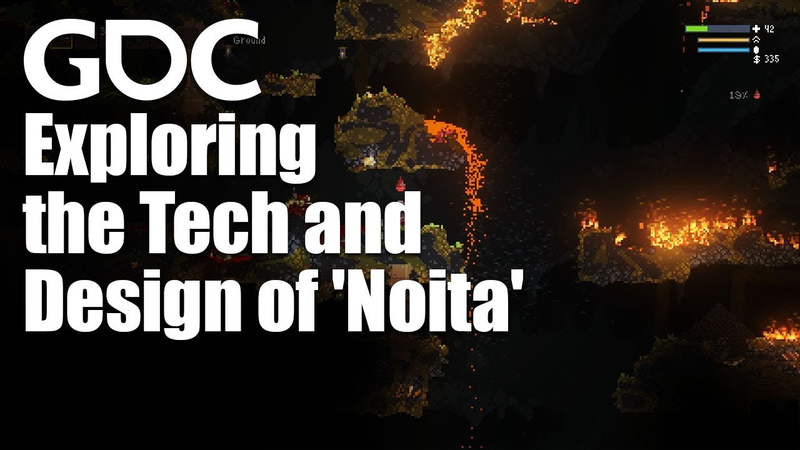
Exploring the Tech and Design of Noita
Noita functions as a technical showcase for pixel-based physics, utilizing a custom engine that integrates granular falling sand simulations with Box2D rigid body dynamics.
- Noita achieves high-fidelity pixel physics by integrating granular falling sand simulations with Box2D rigid body dynamics within a custom engine.
- The engine maintains performance in a continuous world through a chunk-based multithreading system that uses a checkerboard pattern to prevent thread conflicts.
- Memory management is handled by a dynamic streaming system that loads and unloads world chunks to ensure stability during complex simulations.