Game Development reports and market data
Documents

Our Oscars - Why Games Deserve Better than the Spike Video Game Awards - Extra Credits
The gaming industry lacks a prestigious, culturally significant awards ceremony comparable to the Academy Awards, which hinders the medium’s artistic growth and public legitimacy.
- The gaming industry lacks a prestigious, culturally significant awards ceremony, which prevents the medium from gaining the same public legitimacy and artistic recognition as film.
- Current mainstream awards, such as the Spike Video Game Awards, prioritize marketing, trailers, and celebrity appearances over the actual craft and merit of game development.
- Industry-led events like the Game Developers’ Choice Awards and the Interactive Achievement Awards successfully focus on peer-reviewed technical excellence but lack the mainstream visibility required to influence consumer trends.
Graphics vs. Aesthetics - Why High Resolution Graphics Aren't Enough - Extra Credits
The distinction between graphics and aesthetics is a fundamental component of game design that is frequently misunderstood by both industry professionals and consumers.
- Aesthetics define a game's unified visual identity and emotional context, whereas graphics are merely the technical rendering capabilities like polygon counts and lighting.
- Prioritizing technical fidelity over a cohesive aesthetic often leads to bland, forgettable experiences and visual dissonance where imagery fails to support gameplay.
- Strong, deliberate aesthetic choices allow games to remain visually engaging over time, regardless of their technical limitations or aging hardware.

Metrics - The Danger of Data-Driven Game Design - Extra Credits
The integration of telemetry and metrics into game development has transformed the industry by allowing developers to move beyond conjecture and analyze actual player behavior on a massive scale.
- Metrics are a powerful diagnostic tool for optimizing existing gameplay systems, identifying player engagement patterns, and extending product life cycles through post-launch patching.
- Over-reliance on data-driven design risks stifling innovation because metrics are inherently backward-looking and can only measure responses to existing experiences.
- Exclusive dependence on empirical data often leads to the dismissal of radical or novel concepts, resulting in a formulaic manufacturing process rather than artistic invention.

Gamification - How the Principles of Play Apply to Real Life - Extra Credits
Gamification represents the application of video game design principles—such as leveling systems, achievements, quests, and progress tracking—to real-world activities in education, the workplace, and personal habit-building.
- Gamification applies video game design principles—such as leveling systems, achievements, and progress tracking—to real-world environments to combat stagnation in education and the workplace.
- The methodology leverages psychological engagement techniques, including Skinner box mechanics, which utilize immediate feedback and rewards to increase productivity and task compliance.
- Practical applications of gamification include using progress bars to incentivize workplace efficiency, achievement systems to improve educational consistency, and thematic design to enhance focus.
Tutorials 101 - How to Design a Good Game Tutorial - Extra Credits
Effective game design requires integrating tutorials into the core development process rather than treating them as an afterthought.
- Integrate tutorials into the core development process from the start rather than treating them as an afterthought to ensure they remain seamless and invisible to the player.
- Avoid front-loading information, which overwhelms players and hinders retention; instead, introduce mechanics in context-aware, digestible chunks only when they become relevant to gameplay.
- Prioritize interactive learning over text-heavy explanations, as text disrupts flow and is frequently ignored by the players who need it most.

True Female Characters - How to Write Deep and Interesting Characters - Extra Credits
The industry currently struggles to move beyond superficial stereotypes when crafting female characters, often relying on narrow cultural tropes rather than the complexity of human experience.
- Compelling female characters are best developed by exploring the internal conflict between a character's innate traits and the specific, malleable societal pressures of their fictional world.
- Developers should treat gender roles as variable constructs rather than static archetypes, allowing characters to authentically accept, navigate, or reject the norms of their environment.
- Character depth is achieved by focusing on how an individual uniquely reacts to their world, rather than relying on superficial tropes or traditional gender expectations.
Ludus Florentis - Embracing Change in the Games Industry - Extra Credits
The video game industry is currently undergoing a significant transformation, moving toward a pivotal era defined by increased artistic maturity, technological accessibility, and market diversification.
- The games industry is shifting from a reliance on high-budget, graphics-heavy blockbusters toward a more diverse ecosystem of genres, platforms, and player demographics.
- Technological democratization and the rise of digital distribution platforms have lowered barriers to entry, making smaller, experimental projects economically viable.
- As graphical fidelity reaches a point of diminishing returns, development budgets are increasingly being reallocated toward research, design, and narrative depth.

Playing Like a Designer - II: How to Analyze Game Design - Extra Credits
Effective game design analysis requires moving beyond subjective labels like good or bad to understand the mechanics and intent behind a title.
- Professional game analysis requires shifting from a consumer mindset to a structural evaluation of mechanics, moving beyond subjective labels like 'good' or 'bad'.
- Designers should prioritize breadth of experience by sampling a wide variety of genres, as most games reveal their core systems within the first hour of play.
- Identify 'first-order optimal strategies' (food strategies), which provide high power for low skill; these can break single-player depth but are essential for maintaining novice engagement in competitive games.
Playing Like a Designer - I: Examine Your Experiences - Extra Credits
Effective game design requires a transition from passive consumption to active, analytical observation.
- Designers must cultivate a dual-layered mindset that allows them to experience a game while simultaneously deconstructing its mechanics, emotional triggers, and UI conventions.
- Analytical skills should be practiced outside of gaming by observing visceral, non-interactive experiences like roller coasters or concerts to identify the specific environmental factors that trigger emotional shifts.
- Observing how other people react to the same stimuli provides critical data on how different players engage with and process game mechanics.

Amnesia and Story Structure - Character Development in Fallout: New Vegas - Extra Credits
The use of amnesia as a narrative device in video games often serves as a shortcut to bypass the traditional three-act story structure.
- Amnesia is often used as a narrative shortcut to bypass the first act of a traditional three-act story structure, frequently resulting in protagonists that lack depth.
- Fallout: New Vegas relies on the amnesia trope to skip character history, creating a disconnect where the player inhabits a role with a pre-existing life that is never meaningfully explored.
- In contrast to New Vegas, Fallout 3 effectively utilizes a three-act structure by allowing players to experience the character’s formative years.

Piracy - How Can the Game Industry Stop Illegal Downloads? - Extra Credits
The video game industry faces a persistent conflict regarding digital piracy, a complex issue where neither developers nor consumers hold the moral high ground.
- Restrictive Digital Rights Management (DRM) is a failed strategy that penalizes legitimate customers with inferior software while failing to effectively deter piracy.
- Creating a product experience that is objectively worse than a pirated version inadvertently incentivizes users to seek illegal downloads.
- Piracy should be addressed by improving service accessibility and rewarding loyal customers rather than relying on punitive measures.
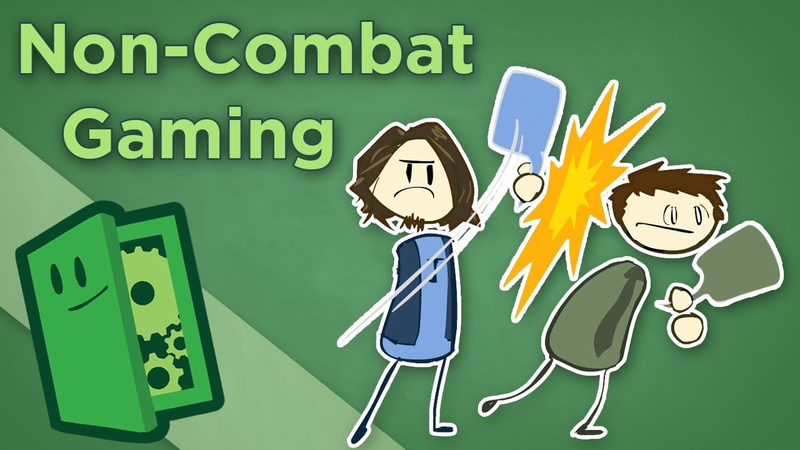
Non-Combat Gaming - How to Make Social Mechanics Fun - Extra Credits
The gaming industry is heavily dominated by combat-centric mechanics, which rely on conflict and danger to drive engagement and provide clear, adrenaline-fueled goals.
- Non-combat social mechanics can achieve the same level of engagement as combat systems if developers apply equivalent mechanical depth, rigor, and strategic complexity.
- Combat is currently favored in game design because it provides a straightforward, reliable framework for implementing stakes, progression, and clear goals.
- Games like Echo Bazaar demonstrate that social activities, such as hosting dinners or engaging in debates, can be gamified through skill checks, stat-based progression, and strategic decision-making.