Europe
Documents

Manifiesto de Video Games Europe 2024-2029
The European video‑game sector seeks recognition as a distinct blend of technology and creative culture and urges policymakers to embed this identity in the EU’s 2024‑2029 strategic framework. By positioning games as a driver of digital innovation, cultural expression, and economic growth, the manifesto argues that tailored legislation, financing, and data‑collection mechanisms are essential to sustain the industry’s momentum and competitiveness.
Between 2019 and 2024 the sector expanded by 16 %, reaching €24 billion in revenue and employing roughly 110 000 highly‑skilled workers across the Union. More than half of Europeans (53 %) now play games, with women accounting for 46.7 % of the audience and the average gamer aged 32. Research indicates that girls who game are three times more likely to pursue STEM studies, underscoring the medium’s educational impact. The self‑regulatory PEGI system, which has labelled over 40 000 titles in 40 countries, has cut non‑compliant sales by up to 50 %, demonstrating effective consumer protection without heavy legislative burden.
Current EU financing tools—tax credits and grants—are deemed insufficient to match the incentives offered by hubs such as Canada, the United Kingdom and France. The manifesto calls for a dedicated funding framework that channels public resources toward innovative, creative projects, alongside flexible talent‑attraction visas and Horizon‑funded labour‑market mapping to close digital‑skills gaps. It also highlights the strain of 850 new obligations introduced between 2017 and 2022, amounting to more than 5 000 pages of regulation, which increase compliance costs for developers and publishers.
To solidify the sector’s contribution, a unified intellectual‑property regime and a revision of NACE classification codes are proposed, enabling accurate economic measurement. Mandatory PEGI‑based age controls, parental‑lock tools and proactive chat moderation address the 53 % of Europeans prioritising child‑friendly environments. Finally, the industry’s low‑carbon digital products and initiatives such as “Playing for the Planet” and “Green Game Jam” are presented as foundations for a climate‑responsible future, aligning gaming with
- The European video game sector generated €24 billion in revenue between 2019 and 2024, representing a 16% growth rate and supporting 110,000 highly-skilled jobs.
- The industry faces a significant regulatory burden, having been subjected to 850 new obligations and over 5,000 pages of legislation between 2017 and 2022.
- Current EU financing tools are insufficient to compete with global hubs like Canada and the UK, prompting calls for a dedicated funding framework and improved tax incentives.
- The PEGI self-regulatory system has successfully labeled over 40,000 titles across 40 countries, reducing non-compliant sales by up to 50%.
- Video games have reached 53% of the European population, with a demographic split of 46.7% women and an average player age of 32.
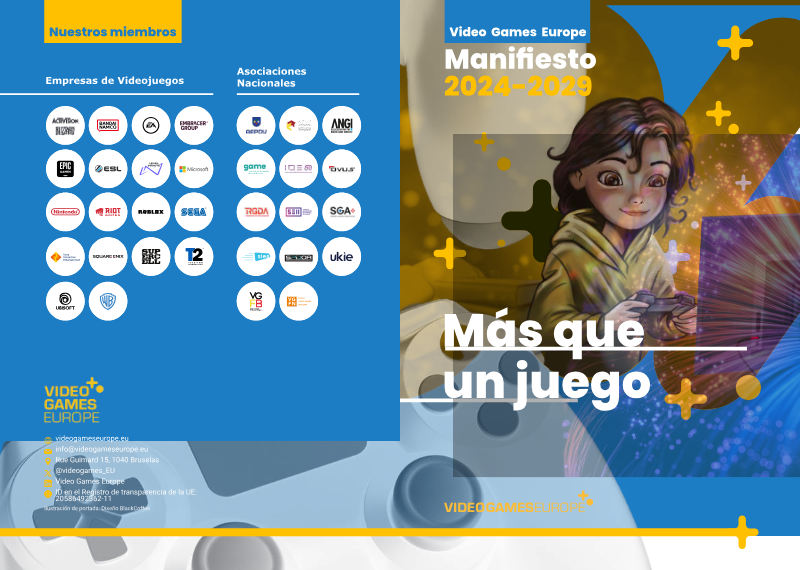
Video Games Europe Manifesto 2024-2029
Europe’s video‑game sector has expanded by 16 % between 2019 and 2024, now delivering €24 billion in revenue and employing roughly 110 000 highly‑skilled workers. More than half of the continent’s gamers are under 20 years old, and nearly half of parents rely on the PEGI age‑rating system to ensure safe play. The industry’s dual nature—combining advanced technology with creative content—underpins a call for EU‑level measures that preserve an open, tax‑free single market, extend the Creative Europe programme, apply the General Exemption Regulation to games, and reinforce intellectual‑property protection while investing in digital‑skill education, particularly STEM pathways for girls.
The PEGI framework, supported by co‑regulation, has already classified around 40 000 titles across 40 European countries, halving non‑compliance penalties and cutting energy‑consumption violations by roughly 20 %. Nevertheless, the sector faces a regulatory load of 850 new EU obligations (over 5 000 pages of rules) introduced between 2017 and 2022. A shift toward transparent self‑regulation is advocated, emphasizing clearer in‑game purchase disclosures, stronger parental‑control tools, and EU‑wide educational programmes to close digital‑skills gaps and attract diverse talent.
Safety‑by‑design requirements now obligate all publishers to integrate PEGI‑based age classification, parental‑control portals, chat moderation, purchase limits and time‑spending caps, reflecting the predominance of minors among players. The climate‑and‑inclusion agenda shows progress: women represent 23.7 % of the video‑game workforce, surpassing the 17 % share in the broader ICT sector, and industry members are adopting gender‑equality guidelines and green initiatives such as the Green Game Jam. Coordinated self‑regulation, targeted public funding, and unified online‑safety strategies are presented as essential to sustain economic contribution, foster innovation, and position Europe as the leading hub for socially responsible game development.
- The European video game sector grew by 16% between 2019 and 2024, reaching €24 billion in annual revenue and employing approximately 110,000 highly-skilled workers.
- Between 2017 and 2022, the industry faced a significant regulatory burden consisting of 850 new EU obligations spanning over 5,000 pages of rules.
- The PEGI age-rating system has successfully classified 40,000 titles across 40 countries, contributing to a 50% reduction in non-compliance penalties and a 20% decrease in energy-consumption violations.
- Women currently account for 23.7% of the European video game workforce, outperforming the 17% representation found in the broader ICT sector.
- Industry stakeholders are advocating for EU-level policies that include the application of the General Exemption Regulation to games, the preservation of a tax-free single market, and the expansion of the Creative Europe programme.

The Austrian Game Industry 2024
The Austrian game sector is portrayed as a youthful, fast‑growing cluster of predominantly small and micro enterprises whose economic relevance has expanded dramatically over the past six years. A 2023‑2024 survey commissioned by the Austrian Professional Association of Management Consultancy, Accounting and IT and executed by the Institute of Industrial Research gathered responses from roughly 150 active developers, with detailed data supplied by 78 firms on production output and by 23 firms on serious‑game activities. The study combines firm‑level questionnaires with macro‑economic modelling to assess direct, indirect and induced effects on the national economy.
Revenue generated by domestic developers reached €92.8 million in 2023, a nominal increase of more than 285 % compared with 2017, and still represents a 180 % rise after price‑level adjustment. Employment rose from 474 jobs in 2017 to 1 080 in 2024, a 128 % increase, and the sector’s multiplier effect creates roughly 2 260 jobs across Austria. Projections that assume a slowdown to one‑third of recent growth still forecast revenues of €149 million and a workforce of over 1 500 by 2029. In the preceding three years, the surveyed firms produced 405 games, while serious‑game developers now number 20‑30 companies employing 130‑150 staff, chiefly to raise awareness of social issues such as climate change.
The workforce is highly qualified: almost 80 % hold tertiary degrees, with the 25‑34 age group dominating. Educational provision is concentrated in three regional hubs—Salzburg, Upper Austria and Carinthia—where 25 university programmes supply the bulk of IT talent. Financing remains largely internal, with self‑funding cited by 92 % of firms; public subsidies rank second but are considered insufficient, reflected in the finding that 77 % of developers rate Austria’s location policy as poor or very poor. Nonetheless, only 5 % contemplate relocation, and the majority anticipate continued employment growth over the next three years.
- The Austrian game industry generated €92.8 million in revenue in 2023, marking a 285% nominal increase since 2017.
- Direct employment in the sector grew 128% over seven years, rising from 474 jobs in 2017 to 1,080 in 2024, with a total economic multiplier effect supporting 2,260 jobs.
- Projections for 2029 estimate industry revenue will reach €149 million and the workforce will exceed 1,500 employees, even assuming a significant slowdown in growth.
- The industry is characterized by small and micro enterprises that rely heavily on internal financing, with 92% of firms self-funding their operations.
- Despite 77% of developers rating Austria’s location policy as poor or very poor, only 5% of firms are considering relocation.
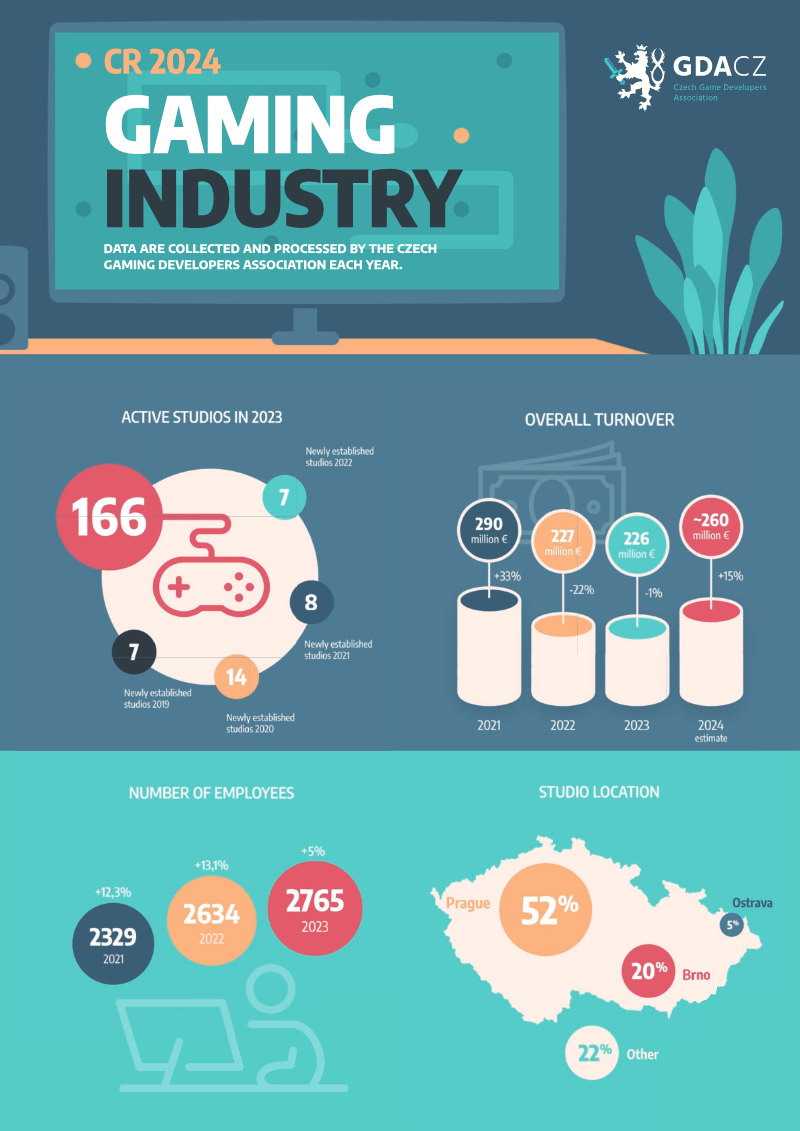
Czech Gaming Industry Report 2024
The Czech Gaming Developers Association compiled an annual industry overview to map the sector’s economic performance, workforce composition and structural trends for 2023 and early 2024. By aggregating self‑reported financial and employment data from member studios, the analysis aims to illustrate growth trajectories, geographic concentration and the evolving profile of talent within the Czech game development ecosystem.
Overall turnover reached €226 million in 2023, marking a 33 % increase over the previous year, while the number of active studios rose modestly, with newly established entities numbering 166 in 2023 compared with 260 in 2022. Employment expanded to roughly 4,165 staff, a 12.3 % rise, with the majority concentrated in Prague (52 %), followed by Ostrava (13 %) and Brno (20 %). The sector released 29 new titles in 2023, supplemented by 10 early‑access projects and 10 DLCs, for a total of 39 releases.
Ownership structures remain dominated by private limited companies, accounting for the bulk of legal entities, while joint‑stock and foreign‑branch configurations each represent about 5 % of the market. Job creation accelerated, with over 430 new positions announced across the year, a 20‑23 % increase relative to prior periods. The workforce is increasingly international: 34 % of employees are foreign nationals, predominantly from EU member states, while 66 % are Czech. Educational backgrounds are diverse, with roughly half holding higher‑education degrees and a similar share possessing vocational or technical qualifications. The report’s methodology relies on annual surveys administered by the association, covering all registered Czech game development firms and providing a comprehensive snapshot of the industry’s health and direction.
- The Czech gaming industry reached a total turnover of €226 million in 2023, representing a 33% year-over-year growth.
- Total employment in the sector grew by 12.3% to 4,165 staff, with over 430 new positions created throughout 2023.
- The industry released 39 total projects in 2023, consisting of 29 new titles, 10 early-access projects, and 10 DLCs.
- The workforce is increasingly international, with foreign nationals—primarily from EU member states—comprising 34% of all employees.
- Geographic concentration remains high, with 52% of the workforce based in Prague, followed by 20% in Brno and 13% in Ostrava.

Essential Facts About Video Games in Italy 2024
1. Italian Video Games Market...............................10 2. Italian Players ..................................................16 3. Italian Video Games Industry ............................23 4. Responsible Gameplay ......................................32 5. IIDEA ...............................................................38 • Total turnover of the sector.
- There are 14 million video gamers in Italy, an 8% increase from 2023, representing 1 in 3 Italians aged 6-64.
- The growth in Italian video gamers is primarily driven by women, with a 14% increase compared to a 3% increase among men in 2023.
- Mobile devices are the most popular gaming platform, used by 74% of gamers, followed by consoles (44%) and PC (34%).
- Purchases of new video games generated €562 million in 2023 (a 3% decrease from 2023), while in-game purchases and subscription services generated €354 million (a 24% increase from 2023).
- Digital downloads for consoles and PCs saw a 15% increase in sales, reaching €362 million, while physical packaged video games decreased by 24% to €201 million.
Big Games Industry Employment Survey 2024: Salaries, Compensation Trends and State of the Games Sector in Europe
The European games industry in 2024 is characterized by significant volatility and structural transformation, with 15% of the workforce experiencing layoffs and 10% exiting the sector entirely. This instability disproportionately affects junior professionals, nearly a third of whom have left the industry over the past year. While 44% of those who switched jobs secured career gains, a notable 24% accepted lower pay or seniority to remain employed. Job satisfaction and employee loyalty follow a U-shaped trajectory, typically bottoming out between three and five years of experience before rebounding as professionals prioritize stability and mature corporate processes.
Technological integration and workplace culture are central to current industry shifts. AI adoption has surged by 17% year-over-year, with 54% of professionals now utilizing these tools. Despite this modernization, the sector struggles with persistent systemic issues, including a gender pay gap driven by a lack of female representation in leadership and technical roles. Discrimination remains prevalent, as 32% of respondents reported personal experiences with gender-based bias and 26% cited ageism. Furthermore, a significant gap in professional development exists; 55% of workers received no formal training in the past year, forcing 65% of those seeking advancement to self-fund their education.
Operational pressures continue to impact well-being, with 28% of the workforce reporting stagnant career development and 7% working overtime almost daily. High dissatisfaction is closely linked to professional burnout, poor management, and a lack of work-life balance. However, certain segments show resilience; the outsourcing sector saw a significant rise in employee net promoter scores, and hybrid work models remain a primary driver of retention. While free-to-play studios generally offer higher compensation than premium developers, long-term stability perks and profit-sharing remain the most effective tools for maintaining a committed workforce in an increasingly precarious market.
- The European games industry faces significant instability, with 15% of the workforce experiencing layoffs and 10% leaving the sector entirely, disproportionately impacting junior professionals.
- AI adoption has surged by 17% year-over-year, with 54% of industry professionals now integrating these tools into their daily workflows.
- Systemic workplace issues persist, as 32% of respondents reported gender-based bias and 26% cited ageism, contributing to a gender pay gap rooted in a lack of female leadership and technical representation.
- Professional development is stagnating, with 55% of workers receiving no formal training in the past year, forcing 65% of those seeking career advancement to self-fund their education.
- While 44% of job switchers achieved career gains, 24% were forced to accept lower pay or reduced seniority to maintain employment in the current market.
The Economic Impacts of Video Game Technology Spillover: UK and Nordic Economies
The analysis quantifies how video‑game technology generates measurable economic benefits beyond the entertainment sector, arguing that spill‑over effects constitute a significant engine of growth for advanced‑technology economies. By applying the IMPLAN input‑output model to 2021 data, the study estimates that spill‑overs contributed roughly £1.3 billion of total output and £760 million of GDP to the United Kingdom, delivering £380 million of labour income and £250 million of government revenue while sustaining about 9,900 non‑gaming jobs. These positions are concentrated in information‑technology, business services and energy extraction, with average salaries 25 % above the national mean. In the Nordic region, comparable effects amounted to £190 million of output and £40 million of GDP, underscoring the broader relevance across Western Europe.
The research situates these figures within the wider UK games ecosystem, which comprises approximately 2,600 firms and 71,400 jobs across direct, indirect and induced employment. Spill‑over activity accounts for roughly 13 % of the industry’s gross value added and 19 % of its employment, highlighting the sector’s pivotal role in supporting ancillary markets. Sectoral case studies illustrate how real‑time engines (Unreal, Unity), VR/AR headsets and haptic devices are reshaping healthcare, oil and gas, architecture, horticulture, furniture design and automotive safety, delivering faster, lower‑cost visualisation, enhanced training and new revenue streams.
The findings extend to the United States, where about one‑fifth of software‑job growth in 2016 and $0.5 billion of software output are linked to game‑technology diffusion. Collectively, the evidence demonstrates that video‑game innovations act as a cross‑industry catalyst, generating substantial fiscal, employment and productivity gains across multiple high‑value sectors during the 2021‑2022 period.
- In 2021, video game technology spill-overs contributed £1.3 billion in total output and £760 million to UK GDP, while sustaining 9,900 non-gaming jobs.
- Spill-over activity from the UK games industry accounts for 13% of the sector's gross value added and 19% of its total employment.
- Non-gaming roles supported by game technology—primarily in IT, business services, and energy—command average salaries 25% higher than the UK national mean.
- Real-time engines like Unreal and Unity, alongside VR/AR and haptic hardware, are driving productivity and cost reductions in sectors including healthcare, architecture, automotive safety, and energy extraction.
- The economic impact of game technology is significant across Western Europe, with the Nordic region recording £190 million in output and £40 million in GDP from these spill-overs.
Financial Results 1H23
This financial analysis details the performance of PCF Group (People Can Fly) for the first half of 2023, a period characterized by strategic expansion and significant capital raising despite a year-over-year decline in profitability. The group reported revenues of 68.7 million PLN for 1H23, down from 90.6 million PLN in 1H22. This decrease, alongside a drop in adjusted EBITDA from 29.7 million PLN to 4.0 million PLN and a net loss of 13.1 million PLN, is attributed to a high comparative base in 2022 following the termination of the Take-Two Interactive contract and the release of Green Hell VR. Current results were also impacted by increased operational scale, with the workforce growing 16% to 674 employees.
The group’s portfolio remains robust, featuring eight projects across various stages of development. Key highlights include two work-for-hire projects for Microsoft (Maverick and Gemini) and three self-published titles (Dagger, Bifrost, and Victoria) slated for 2025-2026. Project Maverick is expected to contribute significantly to financial results starting in the third quarter of 2023. Additionally, the group is expanding into the VR market with Bulletstorm VR, scheduled for release in December 2023.
A pivotal development in 1H23 was the successful completion of a secondary public offering (SPO), raising 235.3 million PLN to fund the group’s updated strategy. This process brought Krafton Inc. on as a strategic investor with a 10% stake following a 144.5 million PLN investment. The agreement grants Krafton specific rights, including right of first refusal for publishing certain upcoming titles. Geographically, the group maintains a strong international presence with studios across Europe and North America, positioning itself for long-term growth through a mix of work-for-hire and self-publishing models.
- PCF Group raised 235.3 million PLN through a secondary public offering, including a 144.5 million PLN investment from Krafton Inc., which acquired a 10% stake and right of first refusal for select future titles.
- Financial performance declined in 1H23, with revenue falling to 68.7 million PLN from 90.6 million PLN in 1H22 and a net loss of 13.1 million PLN reported.
- Adjusted EBITDA dropped significantly to 4.0 million PLN from 29.7 million PLN in 1H22, driven by a high comparative base from the previous year and increased operational costs.
- The company is scaling its workforce by 16% to 674 employees to support a portfolio of eight active projects, including two work-for-hire titles for Microsoft and three self-published games expected in 2025-2026.
- Project Maverick is projected to begin contributing to financial results in the third quarter of 2023.

Videojuegos en el Aula: Guía para un Aprendizaje Adecuado
The guide argues that video games, when deliberately selected and scaffolded, can become powerful learning tools across primary, secondary and vocational settings. By positioning games along a continuum from free play to structured, teacher‑guided activities, educators can align specific game mechanics—joy, meaning, immersion, challenge and agency—with curricular objectives, thereby fostering both cognitive and affective outcomes.
Empirical evidence shows that the $180 billion global games market, with more than three billion active players (over half of Europeans aged 6‑64 and 70 % of those 6‑24), can support cooperative, discovery‑based and project‑based learning. Systematic reviews and studies such as Parker & Thomsen 2019 link core game characteristics to measurable gains in attention, memory, problem‑solving, literacy and even clinical assessment for ADHD. Narrative‑driven titles (e.g., Florence, Mutazione) are already classified as literary texts in Scotland and Poland, while language‑learning apps and exergames extend benefits to vocabulary, pronunciation and physical health. Multiplayer and emotionally charged games are shown to develop empathy, self‑regulation and ethical reasoning, with data from a Flemish suicide‑prevention project confirming social‑emotional growth.
Practical integration strategies emphasize alignment with national curricula, use of in‑game metrics for assessment, and gamification elements such as digital badges and leaderboards. Open‑world and historically themed games (Minecraft, Assassin’s Creed Discovery Tour, Age of Empires) serve as contextual nodes for interdisciplinary projects, while creation platforms—from Scratch Jr to RPG Maker—enable progressive skill development in coding, storytelling and design. The guide also highlights industry disparities (71 % male developers, low representation of women and Black creators) and urges inclusive curricula to broaden participation.
Health considerations note the WHO’s classification of gaming disorder in ICD‑11, but research indicates problematic use remains a minority, often driven by micro‑transaction models. Recommendations include reliance on PEGI age ratings and parental
- Video games are effective pedagogical tools that improve cognitive functions like memory and problem-solving, with studies such as Parker & Thomsen (2019) linking game mechanics to measurable gains in literacy and clinical ADHD assessment.
- The global games market now encompasses over three billion active players, including 70% of Europeans aged 6–24, providing a massive, accessible platform for cooperative and project-based learning.
- Educational integration is most successful when educators use a continuum from free play to structured activities, utilizing titles like Minecraft and Assassin’s Creed Discovery Tour to support interdisciplinary curricula.
- Games are increasingly recognized as legitimate academic texts and social-emotional tools, with narrative titles like Florence and Mutazione used as literature in Scotland and Poland, and multiplayer games shown to foster empathy and ethical reasoning.
- Creation platforms such as Scratch Jr and RPG Maker allow students to develop technical skills in coding and design, while gamification elements like digital badges provide new methods for tracking student progress.

スペイン、カナリア諸島の州政府機関から「ビデオゲーム業界視察ミッション」のご案内
The invitation seeks to generate business opportunities for Japanese video‑game, animation and related audiovisual firms by showcasing the Canary Islands as a strategic production hub. It positions the archipelago as an emerging, tax‑friendly environment, highlighting preferential rates for game development, film and animation, as well as a reduced corporate tax rate, alongside high‑quality infrastructure, skilled talent pools, and strong public support. The core thesis is that direct exposure to local studios, financing mechanisms and regulatory incentives will encourage Japanese companies to establish subsidiaries, pursue co‑production agreements, or outsource projects to Canary Island partners.
The mission is scheduled for 9 – 15 October, with participants traveling from Japan to Tenerife on 9 October and returning after the final day on 15 October. The itinerary includes briefings on the regional industry and tax regime, visits to multiple development studios such as Drakhar, Foxter, The Game Kitchen, Promineo and No Brake Games, a tour of a super‑computer facility, and attendance at the Canarias Game Show on Gran Canaria, featuring B2B matchmaking, conference sessions and networking dinners. All travel costs—including economy‑class round‑trip airfare, hotel accommodation, meals and intra‑island transport—are covered by the organizers, with additional support offered for group participation.
Target participants are Japanese firms contemplating legal entity formation in the Canary Islands, joint‑development projects, or outsourcing production to local studios. The program is coordinated by the Spanish Embassy’s Economic and Commercial Section in Tokyo and the Canary Islands government agency Proexca, which also serves on the regional game office. While the embassy assists with logistics, detailed tax‑incentive information is to be obtained from the Canary Islands authorities and specialist advisors. The initiative aims to deepen Japan‑Spain investment ties within the audiovisual sector by converting the exploratory visit into concrete commercial collaborations.
- The Canary Islands government is hosting a business mission for Japanese video game and animation firms from October 9–15 to promote the region as a strategic production hub.
- The mission covers all travel expenses, including economy-class airfare, accommodation, meals, and local transport, for qualified Japanese companies interested in expansion or outsourcing.
- The Canary Islands offer a competitive business environment featuring reduced corporate tax rates and specific financial incentives for game development, animation, and film production.
- The itinerary includes site visits to local studios such as Drakhar, Foxter, The Game Kitchen, Promineo, and No Brake Games, alongside a tour of a regional super-computer facility.
- Participants will attend the Canarias Game Show on Gran Canaria, which provides dedicated B2B matchmaking, industry conferences, and networking opportunities.
2023 European Video Games Industry Insight Report
By European Games Developer Federation (EGDF) Supported by Video Games Europe European Video Games Industry Data 5 Number of game developer studios 7 Number of people working in the video games industry 8 Percentage of women working in the industry 9 Main European game dev hubs by the number of employees ...
- In 2023, the EU was home to 5,900 game developer studios.
- Public funding plays a crucial role in financing new game studios and supporting research and development across Europe.
- Each European country exhibits unique platform preferences for game development.
- The Czech Republic's video game industry saw its number of studios grow from 110 in 2019 to 1748 in 2022, with turnover reaching 226 million euros in 2022.
- Norway's video game industry had 24 studios in 2022, employing 824 people, and generated 55 million euros in turnover in 2022.
Aktualizacja Strategii Nowe Otwarcie 2023
The strategy overview presents PCF Group S.A. as a leading Polish producer of AAA‑level shooter games built on Unreal Engine, emphasizing its extensive experience, proprietary technology, and international development network. It positions the company as a high‑profile creator of original and co‑produced titles that have repeatedly appeared on the cover of the prestigious “Game Informer” magazine, citing notable releases such as Gears of War series, Bulletstorm, and collaborations with Epic Games on Fortnite.
Financial highlights indicate that cumulative revenue reached 608 million złoty between 2018 and 2022, representing a 4.9‑fold increase and a 2.4‑fold rise in EBITDA to 185 million złoty. The firm projects a similar revenue multiplier for 2023‑2027, driven primarily by a self‑publishing model and the launch of four core AAA projects and three supplementary titles, including two VR offerings slated for 2025‑2026. Shareholder structure after the IPO shows a diversified ownership with significant ESOP participation, and the capital plan anticipates issuing up to 5.85 million new shares.
Operationally, the group employs more than 600 specialists across two continents, organized into matrix‑based centers of excellence that support simultaneous development of multiple projects. The PCF Framework, an Unreal Engine add‑on, accelerates production pipelines and standardizes agile practices across seven development studios located in Warsaw, Newcastle, Montreal, Katowice, Rzeszów, New York, and Kraków. Recent acquisitions have expanded the portfolio with new IPs such as Gemini, Dagger, Bifrost, and Victoria, now in pre‑production.
Strategic goals focus on scaling the self‑publishing business, introducing “games‑as‑a‑service” monetization with micro‑transactions and seasonal passes, and strengthening the company’s position as an independent AAA publisher. The plan anticipates a workforce of over 1 200 employees by 2027, supported by incentive programs for shareholders and a robust cash flow structure designed to fund continued growth without external dilution.
- PCF Group targets a revenue multiplier for 2023–2027 comparable to the 4.9-fold growth seen between 2018 and 2022, when cumulative revenue reached 608 million złoty.
- The company is shifting to a self-publishing model to support the launch of four core AAA projects and three supplementary titles, including two VR games scheduled for 2025–2026.
- Strategic monetization will pivot toward a 'games-as-a-service' model, incorporating micro-transactions and seasonal passes to scale independent AAA publishing.
- The firm plans to double its workforce to over 1,200 employees by 2027, supported by a matrix-based operational structure across seven international studios.
- Development efficiency is driven by the proprietary 'PCF Framework' add-on for Unreal Engine, which standardizes production pipelines across studios in locations including Warsaw, Montreal, and New York.