Casual reports and market data
Documents

💰 Block Out by Grand Games: $300K/Day on iOS Alone & It's About to Overtake Magic Sort
Grand Games has established a dominant position in the mobile puzzle market with the release of Block Out, a deterministic sort puzzler that currently generates $300,000 in daily revenue on iOS.
- Grand Games' title 'Block Out' is generating $300,000 in daily revenue on iOS, positioning it to surpass the studio's previous flagship game, 'Magic Sort'.
- The studio's growth strategy centers on refining proven puzzle mechanics rather than radical innovation, prioritizing accessibility and polish to lower the barrier to entry compared to competitors like 'Color Block Jam'.
- The game’s user acquisition pipeline is driven by high-volume creative testing, featuring over 1,000 unique creatives and 260 playable ads.

TWIG #385: $100M for Indies, Lilith Goes Casino, Google Play Changes, and Toon Blast Breaks Bad
The mobile gaming landscape is undergoing a fundamental transformation driven by shifting discovery mechanics, evolving monetization strategies, and a recalibration of investment models.
- Griffin Gaming Partners has launched a $100 million project-based fund using revenue-share agreements to provide an alternative to equity-focused venture capital for indie studios.
- Embracer Group plans to split into two separate entities by 2027, decoupling its prestige intellectual property from its mobile assets to reverse the effects of unsustainable acquisition strategies.
- Google Play’s shift toward AI-powered conversational search requires developers to move from keyword-based optimization to natural language strategies, likely favoring ad networks with higher bid capacity over individual developers.

🎮 Playable Trends April 2026: Puzzle Format, Long Sessions, Recognizable Mechanics
The mobile advertising landscape is currently defined by a strategic shift toward long-form playable ads that prioritize intuitive, highly recognizable puzzle mechanics.
- Mobile advertising is shifting toward long-form playable ads that utilize intuitive, highly recognizable puzzle mechanics to drive higher conversion rates.
- Developers are prioritizing the 'mum test' to ensure gameplay is immediately understandable to broad, non-specialist audiences, proving that ad length does not hinder engagement if the content is interactive.
- Studios are moving away from creating new concepts in favor of iterative testing and asset variation, using modular templates to scale ad output efficiently.

🚨📢 BREAKING NEWS: Royal Kingdom Adds Ads, Playtika Exits Social Casino, Mistplay Buys Mychips
The mobile gaming industry is currently undergoing a significant shift in monetization and user acquisition strategies, characterized by a move toward casual gaming, the consolidation of rewarded ad platforms, and the abandonment of "no-ads" policies by major studios.
- Dream Games has abandoned its 'no-ads' policy for Royal Kingdom, integrating interstitial and rewarded ads as of February 2026 to drive daily downloads from 100,000–300,000 up to 600,000.
- The addition of ads to Royal Kingdom generates an estimated $170,000–$190,000 in daily revenue without cannibalizing in-app purchases, with markets like Brazil showing simultaneous growth in both revenue streams.
- Playtika has pivoted away from social casino games, which are now in managed decline, to focus on casual titles that currently represent 76% of its business.

Sega-Rovio woes, Playtika goes casual, Unity's turnaround, pitching investors, data nuggets, more
The mobile games industry is currently defined by a shift toward pragmatism, consolidation, and a strategic pivot away from traditional free-to-play models.
- Sega is pivoting away from free-to-play mobile initiatives following a $200 million write-down related to the underperformance of its Rovio acquisition.
- Unity’s financial turnaround is anchored by its Vector adtech product, which achieved an 80% year-over-year revenue increase.
- Playtika has officially shifted its corporate strategy to prioritize casual gaming titles, such as Disney Solitaire, while treating its legacy social casino business as a non-growth asset.

🌺Cozy Florist Deep Dive: 4,000 AI-Generated creatives in 30 Days
Cozy Florist represents a sophisticated Western-market adaptation of the established Chinese title My Garden Tale, blending traditional farming simulation mechanics with merge-based gameplay and gacha-style rarity systems.
- Cozy Florist, a Western-market adaptation of My Garden Tale, produced 4,000 unique AI-generated creatives in 30 days to support its user acquisition strategy.
- Despite high-volume creative output and features like guild systems and gacha mechanics, the title currently generates only $30,000 in daily revenue.
- Chinese development teams maintain a competitive advantage by using automated pipelines and open-source tools to iterate creatives rapidly based on real-time cost-per-install data.
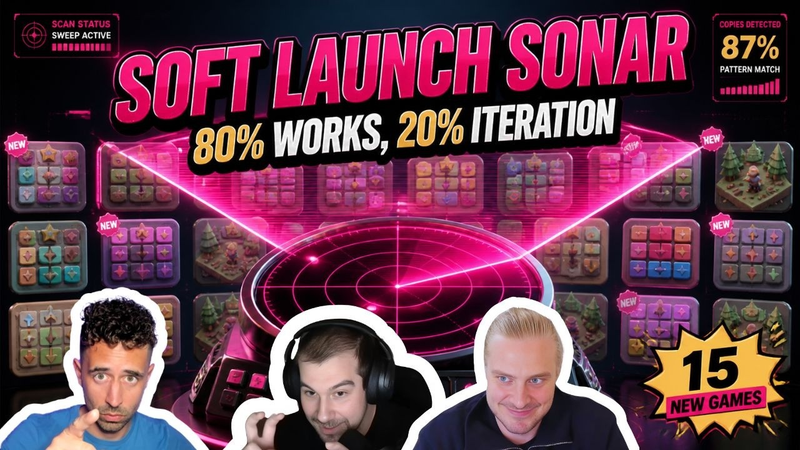
Soft Launch Sonar: 15 New Games, 14 Are Iterations, 1 Is Probably Doomed?!
The mobile gaming industry is currently defined by a pervasive copy-and-iterate strategy, where studios prioritize the refinement of proven mechanics over original innovation.
- The mobile gaming industry is currently dominated by a copy-and-iterate strategy, with 14 out of 15 new games identified as iterations of proven mechanics rather than original innovations.
- Development is heavily concentrated in the Turkish market, where studios such as Rollic, Spike, and Grand Games scale operations by replicating the mechanics of industry leaders.
- Developers are increasingly utilizing niche regional markets, such as Zimbabwe, for soft-launch testing to gather performance data while avoiding market saturation and legal scrutiny from major incumbents.
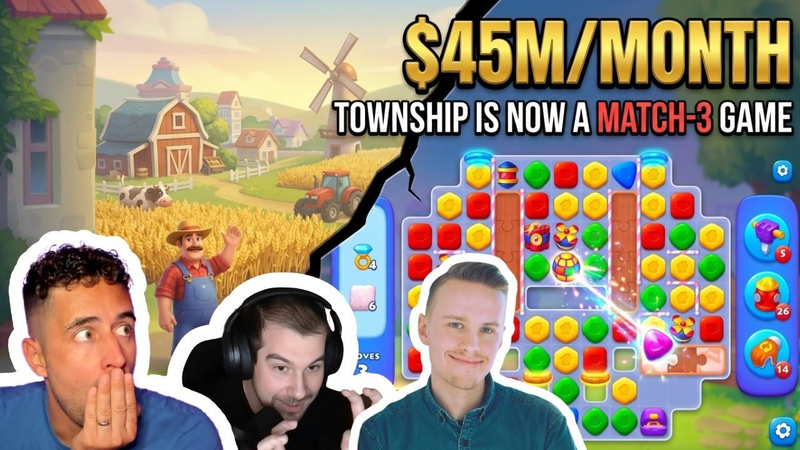
💰🚜 How Playrix turned a 17-Year-Old Tycoon into a $45M/Month UA & Match-3 engine
The longevity and financial success of the mobile title Township demonstrate the effectiveness of evolving legacy tycoon games into sophisticated, multi-core revenue engines.
- Playrix generates $45 million in monthly revenue from Township by evolving the 17-year-old title from a traditional farming simulator into a complex, match-three-driven monetization engine.
- The studio successfully repurposed legacy gameplay loops as onboarding funnels for high-LTV (lifetime value) monetization models, prioritizing energy-driven exploration and merge mechanics over lower-monetizing mini-games.
- To maintain long-term profitability, the studio overhauled the game's economy to tighten currency inflation, ensuring player progression remains strictly tied to the match-three core.
Designing Third Spaces | Design Club
Third spaces—social environments distinct from home and work—are undergoing a fundamental transition from physical locations like pubs and coffee shops to immersive digital realms.
- Effective digital 'third spaces' require a core activity to facilitate socialization, preventing the aimlessness often found in general VR or metaverse environments.
- Social interaction in multiplayer games is significantly enhanced by proximity voice chat, emotes, and movement mechanics, which provide essential layers of presence.
- Successful social hubs like Animal Crossing or Flock Around utilize progression systems, such as cosmetic rewards, to keep players engaged while they socialize.
Is Destiny doomed? King on AI, layoffs and more, plus March's top games, data, soft launches, more
The mobile games industry continues to navigate a complex landscape defined by shifting monetization strategies, the integration of artificial intelligence, and intense market competition.
- Microfun’s Gossip Harbor reached $100 million in monthly in-app purchase revenue for the first time in March, marking a significant increase from $82.5 million in February and positioning it to potentially overtake Candy Crush Saga as the top-grossing puzzle game.
- King VP Eva Ryott defended the company's use of AI as a supporting tool for level management rather than a direct replacement for staff, while noting that workforce adjustments following 200 layoffs were necessary to maintain competitive relevance.
- Candy Crush Saga has adopted a 2x2 matching mechanic, a feature King implemented within the last year to align with evolving market standards and compete against rivals like Royal Match and Gossip Harbor.

🚨Tactile & Loomit: How Top Games Make Money From Ads
Modern mobile game monetization requires a sophisticated balance between maximizing ad revenue and protecting the integrity of in-app purchase ecosystems.
- Developers should shift from static monetization models to hyper-segmented strategies that use geography, platform, and spending history to ensure ad revenue is incremental rather than cannibalizing in-app purchases.
- To protect long-term retention, studios must curate ad quality by requesting conservative creative formats, monitoring ad duration, and actively swapping formats to prevent aggressive ads from degrading the user experience.
- Studios should prioritize a 'buy-over-build' strategy for ad infrastructure, leveraging specialized external tools to manage complex auction dynamics rather than maintaining internal systems.

Subway Surfers City: Sybo built the Best Ad Placements in Mobile Gaming, then forgot to run UA
Subway Surfers City represents a significant attempt to evolve the classic runner genre through a highly polished, shard-based gacha economy and sophisticated monetization architecture.
- Subway Surfers City has reached 10 million downloads but is struggling to retain players, with daily active users currently declining to approximately 730,000.
- The game generates $100,000 in daily ad revenue, yet it relies too heavily on rewarded ads rather than in-app purchases, threatening long-term profitability.
- Sybo has failed to implement aggressive user acquisition tactics, such as robust AppLovin integration, AdROAS strategies, or effective cross-promotion within the original Subway Surfers ecosystem.