AI reports and market data
Documents

Guy Gadney & Harry Holmwood On Baking Omelettes And AI Into Your Game Worlds
The integration of artificial intelligence into game development represents a fundamental shift in creative methodology, moving from using AI as an ancillary optimization tool to baking it into the core of world-building and character design.
- Developers should treat AI implementation as either an 'ancillary tool' for optimization or a fundamental 'baked-in' component of game design, with the latter approach offering the greatest potential to revolutionize storytelling and character depth.
- AI is most effective in game narrative when used for real-time improvisation and dynamic character interaction rather than generating the core story, which remains a craft requiring human creative oversight.
- To navigate the 2024 legal and ethical landscape, studios must maintain transparency by recording prompts, documenting data sources, and understanding the specific intellectual property laws of the regions where their titles are released.

Webshops, IP In AI, And Avoiding Apple’s Commission Fees: The Full PGC London Wrap-Up
The global gaming industry is currently navigating a period of economic volatility and workforce contraction with a focus on strategic resilience and technological adaptation.
- Studios are increasingly adopting direct-to-consumer web shops to bypass traditional platform commission fees and reclaim ownership of valuable customer data.
- The gaming industry is prioritizing the protection of proprietary data sets and prompts to ensure intellectual property security while using AI to optimize user acquisition and game development.
- The Middle East has emerged as the primary growth frontier for the global gaming industry, driven by significant capital investment and a youthful demographic.

Winning the Game: Leveraging Contextual Bandits for Creative Optimization - Joseph Iris, Persona.ly.
Contextual bandits represent a sophisticated evolution in machine learning for creative optimization within the mobile gaming industry.
- Contextual bandits, a subset of reinforcement learning, outperform traditional A/B testing by dynamically allocating traffic to creative variations to minimize exploration costs while maximizing performance goals.
- Contextual bandit algorithms improve upon standard Thompson sampling by incorporating additional data layers—such as user behavior, app context, and creative metadata—to tailor ad delivery to specific audience segments.
- Machine learning models can automatically identify creative preferences for different user cohorts, as demonstrated by an Alien Invasion campaign where idle and RPG players were served distinct, game-relevant creative mechanics without manual intervention.
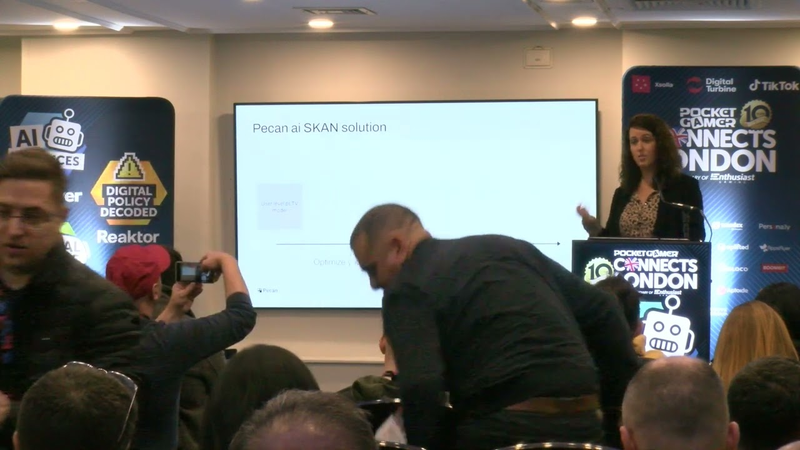
How to Leverage Predictive Analytics to Enhance iOS Marketing Performance - Keren Gritzman, Pecan.ai
Predictive analytics serves as a critical tool for mobile game developers seeking to regain marketing visibility and optimize user acquisition in the post-Apple App Tracking Transparency (ATT) landscape.
- Apple’s SKAdNetwork (SKAN) limits attribution to aggregated, delayed data within the first 24 hours, forcing marketers to rely on incomplete short-term metrics like Day 1 or Day 7 ROAS.
- Machine learning models can analyze early engagement and revenue patterns to forecast long-term metrics such as Day 30, 90, or 180 Lifetime Value (LTV).
- Integrating predictive signals into a customized SKAN conversion schema allows marketers to distribute predicted revenue across campaigns, enabling budget decisions based on long-term value rather than immediate snapshots.

Evolution of Mobile UA: AI Lessons From Gamelight - Valentina Bailly & Julia Scurtul.
The evolution of mobile user acquisition (UA) is increasingly defined by the integration of sophisticated artificial intelligence, which shifts the industry away from manual, demographic-based targeting toward automated, data-driven personalization.
- AI-driven targeting significantly outperforms manual methods by identifying non-obvious audience segments, resulting in performance gains such as a 400% increase in day-seven ARPU for top-grossing RPG titles.
- Gamelight optimizes user acquisition by analyzing real-time behavioral data and limiting recommendations to four games per user, which maximizes ROAS and ARPU by focusing on high-intent, loyal players.
- Unlike traditional demographic-based targeting, AI models continuously self-optimize using historical and real-time data, which minimizes the campaign learning phase and allows for immediate performance adjustments.
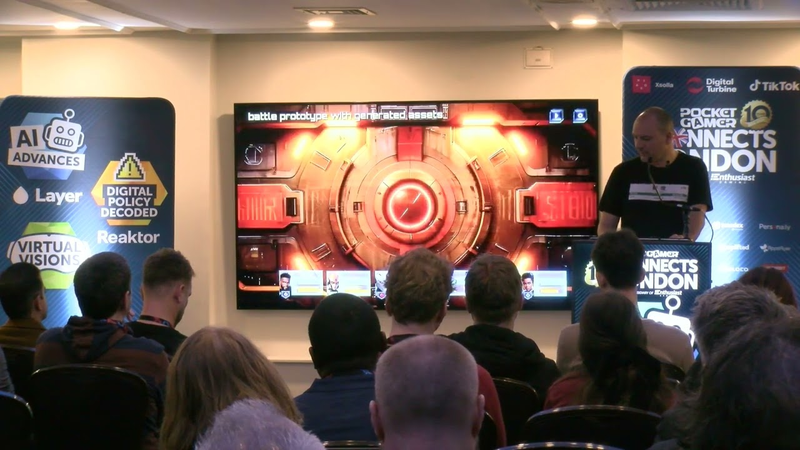
Gen AI First Leap to Generating Game Content, Stop Producing It! - Davy Chadwick, PopScreen Games.
The primary objective of this presentation is to demonstrate how generative artificial intelligence can transition from a brainstorming tool to a core production engine for mobile game development.
- Generative AI can function as a core production engine rather than just a brainstorming tool, enabling studios to automate the creation of complex assets like battlegrounds, character sheets, and narrative elements.
- Integrating generative workflows significantly reduces production costs, exemplified by promotional teaser creation costs dropping to approximately 2,000 euros through internal automation.
- Maintaining stylistic consistency across thousands of game units requires senior artists to fine-tune custom models, such as LoRAs, to ensure high-quality output.

Fireside Chat: Supercharge Your Game art Production - Volkan Gurel, & Andriy Matviychuk.
This discussion explores the integration of generative AI into professional game art pipelines, focusing on a partnership between Layer AI and Tripledot Studios.
- Tripledot Studios reduced the production time for specific game assets from two weeks to a matter of minutes by integrating Layer AI into their pipeline.
- By training custom AI models on proprietary assets, Tripledot Studios was able to eliminate most of its external outsourcing while maintaining a 60-person internal art team.
- Fine-tuning private, model-agnostic workspaces requires only 20 to 25 assets per model to ensure output remains stylistically consistent with a studio's existing brand identity.

AI Driven Game Monetization in a Post ATT World - Don Reilley, Scuti
The gaming industry faces significant challenges in the post-ATT (App Tracking Transparency) and IDFA (Identifier for Advertisers) landscape, characterized by rising user acquisition costs, declining lifetime values, and player frustration with intrusive advertising.
- The gaming industry is pivoting to 'g-commerce' to offset rising user acquisition costs and declining lifetime values caused by post-ATT and IDFA privacy restrictions.
- The g-commerce model integrates an e-commerce marketplace into game lobbies, providing developers with three revenue streams: retail sales commissions, ad revenue, and in-game currency conversion fees.
- Data indicates that 91% of players are willing to purchase physical goods if they are rewarded for doing so, and 30% of daily active users currently convert these rewards into in-game currency.

Fireside Chat: Rovio's AI Transformation for Improving Player Experience - Rovio & Keywords Studio.
Rovio Entertainment’s recent transformation of its player support infrastructure highlights the strategic shift from traditional email-based systems to AI-driven, in-app automation.
- Rovio increased its player support deflection rate from 20% to 63% by migrating from an email-based system to the Helpshift in-app conversational support platform.
- The migration involved consolidating support operations across 23 games and five different studios to standardize workflows and reduce reliance on manual human intervention for repetitive 'dumb' queries.
- Rovio integrated its centralized data platform with the support tool, allowing agents to view player profiles instantly and enabling AI-driven automations based on specific player spend tiers and history.

AI video is Already App-ening - João Vieira da Costa, Replai.io
The integration of generative AI into video creative production is transforming mobile game marketing by shifting workflows from subjective, gut-based decision-making to data-driven, scalable factory processes.
- Generative AI and computer vision enable mobile game studios to automate the production of thousands of video variations per month, shifting creative workflows from subjective decision-making to data-driven processes.
- The 'data-to-video' pipeline uses computer vision to automatically tag in-game elements like characters and calls to action, creating a metadata-based source of truth that links specific visual components to performance metrics.
- Studios can now internalize creative production previously outsourced to agencies by using AI to execute complex tasks such as automated resizes, text translation, lip-syncing, and cultural adaptation.

Gamesforum Live Special w/ Adam & Gus: Rewarded play, AI in game development. Are UA managers lazy?
The rewarded gaming model has emerged as a dominant strategy for driving profitability, utilizing real-money incentives to encourage user engagement through ad interactions and data-sharing tasks.
- The rewarded gaming model achieves profitability within a three-day window by using real-money incentives to drive high-value user cohorts and rapid capital recycling.
- Modern game development is increasingly subservient to acquisition metrics, where marketing requirements dictate core design choices to function as high-performance affiliate platforms.
- A significant skill gap exists among user acquisition managers who rely too heavily on automated platform algorithms rather than integrating creative strategy with game mechanics.
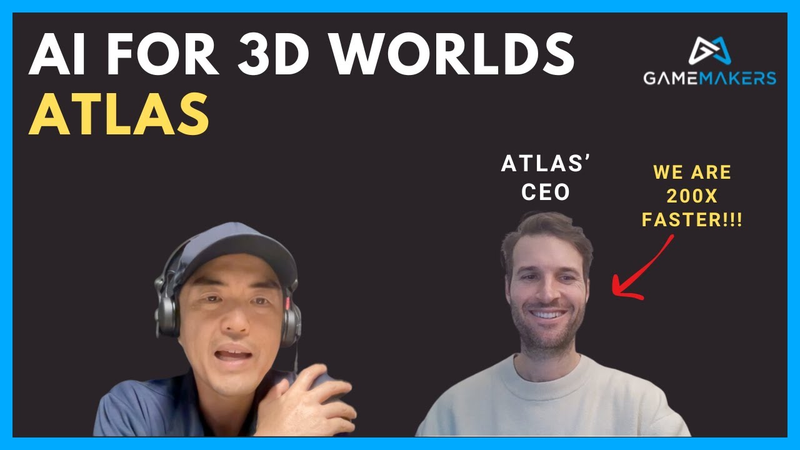
Gaming x AI: How Atlas makes models for 3D worlds 200X faster! (ft. CEO Ben James)
The integration of generative AI into 3D asset production marks a significant shift in game development, enabling the creation of complex, game-ready environments up to 200 times faster than traditional manual modeling.
- Generative AI tools can accelerate 3D asset production by up to 200 times compared to traditional manual modeling methods.
- The technology converts 2D inputs, such as sketches and photographs, into structured 3D geometry that integrates directly into Unity and Unreal Engine pipelines.
- AI-driven workflows are designed to be non-destructive, providing artists with editable, clean assets that allow for rapid iteration rather than replacing human designers.